


Hari Parbat
| Hari Parbat | |
|---|---|
| Koh-i-Maran | |
 View of Hari Parbat | |
| Highest point | |
| Coordinates | 34°6′19″N 74°48′58″E / 34.10528°N 74.81611°E |
| Geography | |
  Hari Parbat Location of Hari Parbat on Srinagar, India  Hari Parbat Hari Parbat (India) | |
| Location | Srinagar, J&K, India |
| Parent range | Zabarwan |
Hari Parbat (Kashmiri pronunciation: [haːri parbatʰ]), also called Koh-i-Maran[1][2][3] ( Kashmiri pronunciation: [koːhi maːraːn]), is a hill overlooking Srinagar, the largest city and the capital of Jammu and Kashmir, India. It is the site of the Hari Parbat fort, built by the Durrani Empire, and of a Hindu temple, mosques, and gurdwara.
Hari Parbat Fort[edit]
The first fortifications on the site were constructed by the Mughal emperor Akbar in 1590 who built an outer wall for the fort as part of his plans for a new capital at the site of modern-day Srinagar city in Kashmir. The project, however, was never completed. The present fort was built in 1808 under the reign of the Governor of Kashmir Province of the Durrani Empire, Atta Mohammed Khan.
The fort can be reached via two sides of the city, (a) via Rainawari through Kathi Darwaza Gate and (b) via Hawal through the Sangin Darwaza Gate. The fort was closed for almost 2 decades and thrown open to the public in 2007.
The Indian government on 15 August 2021 (the 75th independence day) hoisted a 100 feet tall Indian flag on the top of the fort.[4]
Shrines[edit]
Hindu temple[edit]
Hari Parbat is considered sacred by some Kashmiri Pandits.[5] According to Hindu Mythology, the area of Hari Parbat was inhabited by a daemon (asura) named Jalodbhava. People went on to pray to goddess Parvati for help. She took the form of a bird and dropped a pebble on the asura's head. The pebble grew larger and larger until it crushed the daemon. Hari Parbat is revered as that pebble, and Parvati is worshipped under the name Sharika, its temple occupying the middle part of the western slope of the hill. She is depicted as having 18 arms and sitting in Shri Chakra.[6][7][8]
Muslim shrines[edit]
The southern side of Hari Parbat features Makhdoom Sahib, the shrine of Hamza Makhdoom, a 16th-century Kashmiri Sufi saint locally.[9][10]
Built below the fort is a mosque dedicated to Shah Badakhshi, a 17th-century Qadiri Sufi saint. The mosque was built by Mughal princess Jahanara Begum.[11]
Gurdwaras[edit]

Gurdwara Chatti Patshahi at Kathi Darwaza, Rainwari, is believed to be the place where Guru Har Gobind, the sixth Sikh guru, stayed for few days while travelling through Kashmir.[12][13]
Gurdwara Guru Nanak Dev is a place where Guru Nanak sat and had discourse with people in early sixteenth century. It was earmarked with a pedestal by Mohammad Ata Khan, a general of Akbar who built the Durrani Fort. A small Gurdwara was later built at the place by Guru Har Gobind.[14]
Gallery[edit]
-
 Hari Parbat from Dal Lake, Srinagar.
 -
 Hari Parbat as seen from downtown Srinagar, Kashmir.
 -
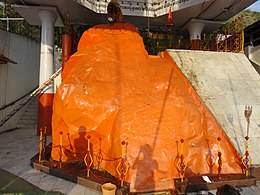 Sharika Temple
 -
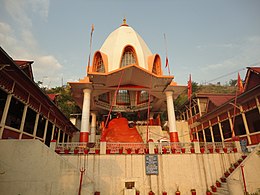 Sharika Temple
 -
 Wooden windows of Hari Parbat Temple
 -
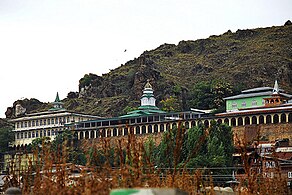 Shrine of Hamza Makhdoom, Srinagar.
 -
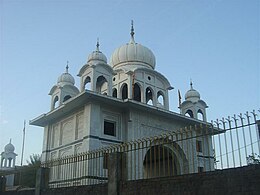 Gurdwara Chatti Patshahi, Rainawari
 -
 Hari Parvat
 -
 Kathi Darwaza


See also[edit]
- Badamwari Park, situated at the foothills of Hari Parbat
References[edit]
- ^ Asher, Catherine .B (1992). Architecture of Mughal India. Vol. 4. Cambridge University Press. p. 124. ISBN 9780521267281.
In Kashmir's capital city, Srinagar, Akbar had constructed a massive fort on a high hill known as the Koh-i Maran or Hari Parbat overlooking Dal lake.
- ^ Kashir Encyclopedia (in Kashmiri). Vol. 1. Jammu and Kashmir Academy of Arts Culture and Languages. 1986. p. 403.
- ^ Fernandez, E.E (1889). The Indian Forester. Vol. 15. Roorkee: Thomas Civil Engineering Press. p. 366.
The beautiful expanse of water is situated at the foot of the hill called the Hari Parbat or Koh-i-maran.
- ^ "India at 75: 100-feet tall national flag hoisted at Hari Parbat Fort in Srinagar - Hari Parbat".
- ^ Origin Archived 22 February 2012 at the Wayback Machine
- ^ Nilamata Purana. 17 February 2014.
- ^ "Kashmiri Pandit Network (KPN): Home". www.ikashmir.net. Retrieved 23 September 2021.
- ^ Excelsior, Daily (14 June 2014). "Hariparbat-The abode of Goddess Sharika". Jammu Kashmir Latest News | Tourism | Breaking News J&K. Retrieved 23 September 2021.
- ^ Hamza Makhdum
- ^ "Makhdoom Sahib Shrine". Archived from the original on 15 June 2009. Retrieved 28 March 2022.
- ^ Asher, Catherine B. (24 September 1992). Architecture of Mughal India. Cambridge University Press. p. 215. doi:10.1017/chol9780521267281. ISBN 978-0-521-26728-1.
- ^ "Gurudwara Patshahi Chevin, Village Rainawari". AllAboutSikhs.com. Archived from the original on 4 July 2017. Retrieved 15 December 2015.
- ^ "SRĪNAGAR (34º-5'N,74º-50'E)". eos.learnpunjabi.org. Retrieved 16 March 2020.
- ^ "Gurdwara Guru Nanak Dev Ji, Hari Parbat, Sri Nagar". www.sikhphilosophy.net. Sikh Philosophy Network. Retrieved 14 September 2019.
External links[edit]
