


Holiness (style)
 | This article has multiple issues. Please help improve it or discuss these issues on the talk page. (Learn how and when to remove these template messages)
|


| Papal styles of Holiness (style) | |
|---|---|
 | |
| Reference style | His Holiness |
| Spoken style | Your Holiness |
| Religious style | Holy Father |
The title His Holiness (and the associated form of address Your Holiness) is an official title or style referring to leaders in a number of religious traditions. It is used to refer to the Pope in Roman Catholicism; this use can be traced back several hundred years.[1] It is also an official title for Oriental Orthodox patriarchs . It is used to refer to religious leaders in Islam, Buddhism, and Bon. Buddhist leaders referred to this way include the Dalai Lama, the Menri Trizin, and Da'i al-Mutlaq of the Dawoodi Bohras, among others.
Buddhism and Bon[edit]
The English-language honorific "His Holiness" and the female version "Her Holiness" have commonly and very recently been used for religious leaders from other traditions, including Buddhism [2][3] leaders such as the Dalai Lama,[4] the Gyalwa Karmapa,[5] the Je Khenpo in Bhutan[6] and Shinso Ito of the Shinnyo-en branch of Shingon Buddhism.[7] In the Bön tradition it is used for the Menri Trizin.[8][9]
-
 Dalai Lama, Tenzin Gyatso (b. 1935)
 -
 11° Panchen Lama, Gedhun Choekyi Nyima (b. 1989)
 -
 17° Karmapa, Trinley Thaye Dorje (b. 1983)
 -
 17° Karmapa, Ogyen Trinley Dorje (b. 1985)
 -
 12° Gyalwang Drukpa, Jigme Pema Wangchen (b. 1963)


Christianity[edit]
Catholic Church[edit]

His Holiness (Latin: Sanctitas) is the official style used to address the Roman Catholic Pope.
The full papal title, rarely used, is:
- His Holiness (Francis), Bishop of Rome, Vicar of Jesus Christ, Successor of the Prince of the Apostles, Supreme Pontiff of the Universal Church, Primate of Italy, Archbishop and Metropolitan of the Roman Province, Sovereign of the Vatican City State, Servant of the servants of God.
The best-known title, that of "Pope", does not appear in the official list of titles, but is commonly used in the titles of documents and appears, in abbreviated form, in their signatures as "PP", standing for Papa (Pope).[10][11][12][13][14] The 2020 Annuario Pontificio lists all of his formal titles, except Bishop of Rome, as "historical titles".[15]
It is customary when referring to popes to translate the regnal name into local languages. Thus he is Papa Franciscus in Latin (the official language of the Holy See), Papa Francesco in Italian (the language of the Vatican), Papa Francisco in his native Spanish, and Pope Francis in English.[16]
In February 2013, the Holy See announced that former Pope Benedict XVI would retain the style "His Holiness" after resigning and becoming pope emeritus.
The term is sometimes abbreviated as "HH" or "H.H." when confusion with "His/Her Highness" is unlikely.
Oriental and Eastern Orthodox churches[edit]
His Holiness (Latin: Sanctitas) is the official style also used to address the Oriental Orthodox Catholicoi/patriarchs. In the Eastern Orthodox Church, the ecumenical patriarch of Constantinople has the title of His All Holiness (abbreviation HAH). It is also used for certain other Eastern patriarchs, notably those who head a church or rite which recognizes neither Rome's nor Constantinople's primacy.
-
 Papa Tawadros II of Alexandria of the Coptic Orthodox Church (b. 1952)
 -
 Patriarch Kirill of Moscow
(b. 1946) -

-

-

-
 Mar Dinkha IV, Patriarch of the Church of the East (b. 1935)
 -
 Ignatius Aphrem II, of the Syriac Orthodox Church (b.1965)
 -

-
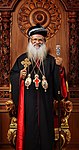 Baselios Marthoma Mathews III, of the Malankara Orthodox Syrian Church (b. 1949)


Islam[edit]
In Islam, it is used in Ahmadiyya for the 5th Caliph Mirza Masroor Ahmad.[17] It is used in the Dawoodi Bohra sect of Ismaili Shia for the office of Da'i al-Mutlaq, Syedna. Syedna Mufaddal Saifuddin is recognized by most Dawoodi Bohras as the 53rd Da'i al-Mutlaq.[18][19] \
-

-
 Syedna Mufaddal Saifuddin, 53rd Da'i al-Mutlaq


See also[edit]
References[edit]
- ^ "Why is the pope called 'Your Holiness'? - Arlington Catholic Herald".
- ^ His Holiness Living Buddha Lian Sheng, Grand Master Sheng-Yen Lu
- ^ "Royal Albert Hall ticket office: His Holiness the Dalai Lama, 19 June 2012". Archived from the original on July 15, 2012.
- ^ "His Holiness the 14th Dalai Lama". July 3, 2023.
- ^ "Rumtek Dharma Chakra Centre - the Karmapa".
- ^ "Message from His Holiness the Je Khenpo on the launch of "Our Gyenkhu" campaign | Ministry of Health".
- ^ Asian Tribune: example of reference to "Her Holiness Shinso Ito, the Head Priest of Shinnyo en Temple in Tachikawa, Tokyo", 3 July 2012
- ^ "Biography of His Holiness the 33rd Abbot of Menri Lungtok Tenpei Nyima Rinpoche – Yungdrung Bon Monastic Centre Society".
- ^ "His Holiness the 34th Menri Trizin | Ligmincha". 27 February 2019.
- ^ Shahan, Thomas Joseph (1907). . In Herbermann, Charles (ed.). Catholic Encyclopedia. Vol. 1. New York: Robert Appleton Company.
- ^ "Pope". Encyclopædia Britannica. 2013. Retrieved 14 April 2013.
- ^ Cappelli, Adriano. "Lexicon Abbreviaturarum". p. 283. Archived from the original on 25 July 2013. Retrieved 18 February 2013.
- ^ "Contractions and Abbreviations". Ndl.go.jp. 4 August 2005. Archived from the original on 10 December 2011. Retrieved 21 November 2011.
- ^ "What Does PP Stand For?". Acronyms.thefreedictionary.com. Retrieved 21 November 2011.
- ^ "Other than 'bishop of Rome,' yearbook lists papal titles as 'historic'". Crux. 3 April 2020. Retrieved 5 April 2020.
- ^ Parker, Alan (15 March 2013). "A Few Things You Might Not Know About Pope Francis". Toronto Sun. Archived from the original on 11 April 2014. Retrieved 11 April 2014.
{{cite news}}: CS1 maint: unfit URL (link) - ^ "Life Sketch and Services of His Holiness Hazrat Mirza Masroor Ahmad Khalifatul Masih V". Archived from the original on 12 July 2021. Retrieved 12 March 2011.
- ^ Kappal, Bhanuj (2019-07-28). "The battle for the leadership of the Dawoodi Bohras". Retrieved 2019-11-21.
- ^ Schleifer, S Abdallah, ed. (2019). The Muslim 500: The World's 500 Most Influential Muslims (PDF). Jordan: The Royal Islamic Strategic Studies Centre. ISBN 9789957635459. Archived from the original (PDF) on 12 June 2020. Retrieved 12 June 2020.
| Catholic Church | Style |
|---|---|
| Pope | His Holiness |
| Cardinal | His Eminence |
| Bishop | His Excellency |