


Horses of Saint Mark


The Horses of Saint Mark (Italian: Cavalli di San Marco), also known as the Triumphal Quadriga or Horses of the Hippodrome of Constantinople, is a set of bronze statues of four horses, originally part of a monument depicting a quadriga (a four-horse carriage used for chariot racing). The horses were placed on the facade, on the loggia above the porch, of St Mark's Basilica in Venice, northern Italy, after the sack and looting of Constantinople in 1204. They remained there until looted by Napoleon in 1797 but were returned in 1815. The sculptures have been removed from the facade and placed in the interior of St Mark's for conservation purposes, with replicas in their position on the loggia.
Origins[edit]
The sculptures date from classical antiquity. Many scholars believe they were sculpted in the 2nd or 3rd century AD, noting similarities to the Equestrian Statue of Marcus Aurelius in Rome (c. 175 AD).[1] But some say the evident technical expertise and naturalistic rendering of the animals suggest they were made in Classical Greece of the 5th and 4th centuries BC.[2]
In light of their short backs and long legs, it has been argued that they were originally situated above the eye line,[3] probably created to top a triumphal arch or some other grand building. Perhaps commissioned by the Emperor Septimus Severus, they may originally have been made for the Eastern capital of Constantinople, where they were long displayed.[3]
Analysis suggests that the sculptures are at least 96.67% copper,[4] and therefore should be viewed not as made from bronze but of an impure copper. The relatively low tin content increased the casting temperature to 1200–1300 °C.[5] The copper was chosen to give a more satisfactory mercury gilding.
History[edit]

The horses, along with the quadriga with which they were depicted, were long displayed at the Hippodrome of Constantinople; they may be the "four gilt horses that stand above the Hippodrome" that "came from the island of Chios under Theodosius II" mentioned in the 8th- or early 9th-century Parastaseis syntomoi chronikai.[6] As part of the sack of the capital of the Byzantine Empire in the Fourth Crusade, they were looted by Venetian forces in 1204. That same year, the collars on the four horses were added to obscure where the animals' heads had been severed to allow them to be transported from Constantinople to Venice.[7] Shortly after the Fourth Crusade, Doge Enrico Dandolo sent the horses to Venice, where they were installed on the terrace of the façade of St Mark's Basilica in 1254. Petrarch admired them there.[8]
In 1797, Napoleon had the horses forcibly removed from the basilica and carried off to Paris, where they were used in the design of the Arc de Triomphe du Carrousel together with a quadriga.
In 1815, following the final defeat of Napoleon, the horses were returned to Venice by Captain Dumaresq. He had fought at the Battle of Waterloo and was with the Coalition forces in Paris where he was selected, by the Emperor of Austria, to take the horses down from the Arc de Triomphe du Carrousel and return them to St Mark's in Venice. For the skillful manner in which he performed this work, the Emperor gave him a gold snuff box with his initials in diamonds on the lid.[9]

The horses remained in place over St Mark's until the early 1980s, when damage from air pollution led them to be removed and put on display inside the basilica. They were replaced on the loggia with replicas.
Image gallery[edit]
-
 Side view, replicas
 -
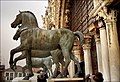 Side view, replicas
 -
 Painting by George Owen Wynne Apperley (1905)
 -
 Colorized photograph by Carlo Naya
 -
 Black and white photo
 -
 Facade of St Mark's Basilica, replicas
 -
 View from below, replicas


_-_I_cavalli_di_san_Marco_a_Venezia.jpg)


References[edit]
- ^ Henig, Martin (ed), A Handbook of Roman Art, p. 95, Phaidon, 1983, ISBN 0714822140
- ^ Rosenblatt, Tom (2016). "The Arrangement of the Tetrarchs and Quadriga". Bowdoin Journal of Art: 1–21.
- ^ a b Freeman, Charles (2004). The Horses of St Mark's: A Story of Triumph in Byzantium, Paris and Venice. Overlook Press. ISBN 978-1590202678.
- ^ Anon 1979 The Horses of San Marco Thames and Hudson an English translation of a 1977 Venetian city government publication, p. 191
- ^ Anon 1979, p. 199
- ^ Parastaseis syntomoi chronikai, ch. 84.Th
- ^ Houpt, Simon (2006). Museum of the Missing: A history of Art Theft. Sterling Publishing Co,. Inc. p. 32. ISBN 1402728298. Retrieved 18 September 2014.
- ^ Petrarch, Rerum senilium, V., noted by Roberto Weiss, The Renaissance Discovery of Classical Antiquity (Oxford: Blackwell) 1973:35.
- ^ A History of The Boissier-Scobell Families" by Henry Boissier, 1933 page 7.
External links[edit]

- Byzantium 1200 Hippodrome Boxes shows the location of the horses until 1204.
45°26′4.17″N 12°20′21.73″E / 45.4344917°N 12.3393694°E
| International | |
|---|---|
| National | |
| Other | |
