A quadriga is a car or chariot drawn by four horses abreast and favoured for chariot racing in classical antiquity and the Roman Empire. The word derives from the Latinquadrigae, a contraction of quadriiugae, from quadri-: four, and iugum: yoke. In Latin the word quadrigae is almost always used in the plural[1] and usually refers to the team of four horses rather than the chariot they pull.[2] In Greek, a four-horse chariot was known as τέθριππονtéthrippon.[3]
The four-horse abreast arrangement in a quadriga is distinct from the more common four-in-hand array of two horses in the front plus two horses behind those.
Quadrigas were emblems of triumph; Victory or Fame often are depicted as the triumphant woman driving it. In classical mythology, the quadriga is the chariot of the gods; the god of the SunHelios (often identified with Apollo, the god of light) was depicted driving his quadriga across the heavens, delivering daylight and dispersing the night.[5]
Modern sculptural quadrigas are based on the four bronze Horses of Saint Mark or the "Triumphal Quadriga", a set of equine Roman or Greek sculptures, the only representation of a quadriga to survive from the classical world, and the pattern for all that follow.[6][need quotation to verify]
Their age is disputed. Originally erected in the Hippodrome of Constantinople, possibly on a triumphal arch, they are now in St Mark's Basilica in Venice. Venetian Crusaders looted these sculptures in the Fourth Crusade (which dates them to at least 1204) and placed them on the terrace of St Mark's Basilica. In 1797, Napoleon carried the quadriga off to Paris but they were returned after Napoleon's fall. Due to the effects of atmospheric pollution, the original quadriga was retired to a museum and replaced with a replica in the 1980s.
Though quadrigae were usually drawn by horses, occasionally, other animals or mythological creatures were employed in spectacles and in art. Elephants were sometimes used to draw quadrigae in the Roman imperial period, and more frequently elephant quadrigae were depicted on coins and other official images. In art and sculpture, quadrigae ridden in by the gods were appropriate to their characters; Neptune's quadriga was drawn, for example, by hippocampi (mythological sea-horses).
c. 1815 – The Carrousel quadriga is situated atop the Arc de Triomphe du Carrousel in Paris, France. The arch itself was built to commemorate the victories of Napoleon, but the quadriga was sculpted by Baron François Joseph Bosio to commemorate the Restoration of the Bourbons. The restoration is represented by an allegorical goddess driving a quadriga, with gilded Victories accompanying it on each side.
1868 – The quadriga on the ducal palace in Braunschweig was destroyed in 1944 during the Second World War. It was reconstructed in 2008 and is considered the largest one in Europe.
1888 – Quadriga de l'Aurora as part of the Font de la cascada that is in Parc de la Ciutadella, Barcelona. Erected by Josep Fontserè (with possible contributions by the young Antoni Gaudí).
1912 – The Wellington Arch Quadriga is situated atop the Wellington Arch in London, England. It was designed by Adrian Jones. The sculpture shows a small boy (actually the son of Lord Michelham, the man who funded the sculpture) leading the quadriga, with Peace descending upon it from heaven.
1919–1923 – The former Banco di Bilbao headquarters at no. 16 Calle de Alcalá in Madrid, now part of Banco Bilbao Vizcaya Argentaria, features two quadrigas on a commercial building. The building was designed by Ricardo Bastida, with the sculptor of the chariot Higinio Basterras, and other sculptures by Quentin de la Torre. The charioteers are helmeted men standing on the handrails of the chariots. Height to plinth: about 87 feet (27 meters).
2002 – The Warsaw's Grand Theatre features a quadriga reflecting the original Antonio Corazzi's 1833 plans for the building, but not commissioned and executed until 2002.
^
Annual Report of the American Scenic and Historic Preservation Society to the Legislature of the State of New York, Volume 18, by American Scenic and Historic Preservation Society, 1913, page 344





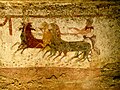
 Frieze on the 2nd-century BC Libyco-Punic Mausoleum of Dougga
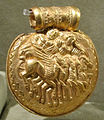 Jupiter and Minerva riding a quadriga drawn by pegasi on a 4th-century BC gold Etruscan bulla (Museo Gregoriano Etrusco)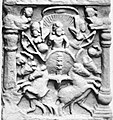

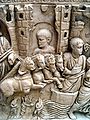 Detail from a plaster cast of the late 4th-century so-called Sarcophagus of Stilicho (Museum of Roman Civilization)
 11th-century rook from Southern Italy in the form of Charlemagne in a quadriga, from the Charlemagne chessmen (Cabinet des Médailles)


 The triumph of Neptune and Venus in a quadriga drawn by hippocampi in a mosaic from Utica in Africa (Bardo National Museum)
 Medallion of the co-augusti Diocletian and Maximian (r. 285–305) riding in a quadriga drawn by elephants and crowned by Victory
 Cybele and Attis riding on a quadriga drawn by lions on the 4th-century Parabiago plate (Archaeological Museum of Milan)
 Buddy Bear Quadriga in Berlin, Kurfürstendamm 21
052.jpg)


_Buddy_B%C3%A4r_10_Jahre_Neues_Kranzler_Eck.jpg)



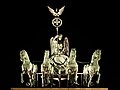 Brandenburg Gate Quadriga at night
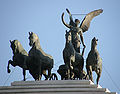 The Quadriga dell'Unità at Vittoriano, Rome
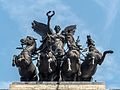 Quadriga, Wellington Arch, London
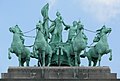 Brabant Raising the National Flag or Quadriga of Brabant, Parc du Cinquantenaire, Brussels
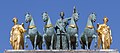 Quadriga, Arc de Triomphe du Carrousel, Paris
 Quadriga, Grand Theatre, Warsaw
 A quadriga sculpted by Peter Clodt von Jürgensburg at Bolshoi Theater
 Quadriga by Daniel Chester French, World's Columbian Exposition, 1893
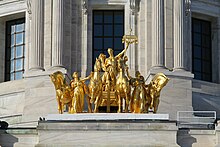
 Daniel Chester French and Edward Clark Potter, Minnesota State Capitol, 1905
 The Seiugae of the Arch of Peace in Milan
 Quadriga in the Parc de la Ciutadella in Barcelona
 Wayne County Building, Detroit, Michigan, by J. Massey Rhind


