


Ideal norm
In commutative algebra, the norm of an ideal is a generalization of a norm of an element in the field extension. It is particularly important in number theory since it measures the size of an ideal of a complicated number ring in terms of an ideal in a less complicated ring. When the less complicated number ring is taken to be the ring of integers, Z, then the norm of a nonzero ideal I of a number ring R is simply the size of the finite quotient ring R/I.
Relative norm[edit]
Let A be a Dedekind domain with field of fractions K and integral closure of B in a finite separable extension L of K. (this implies that B is also a Dedekind domain.) Let and be the ideal groups of A and B, respectively (i.e., the sets of nonzero fractional ideals.) Following the technique developed by Jean-Pierre Serre, the norm map



is the unique group homomorphism that satisfies
![{\displaystyle N_{B/A}({\mathfrak {q}})={\mathfrak {p}}^{[B/{\mathfrak {q}}:A/{\mathfrak {p}}]}}](https://wikimedia.org/api/rest_v1/media/math/render/svg/d3393cf49606044e636ccd0024f72a1cf4cc2f18)
for all nonzero prime ideals of B, where is the prime ideal of A lying below .


Alternatively, for any one can equivalently define to be the fractional ideal of A generated by the set of field norms of elements of B.[1]



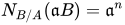
For , one has , where .

![{\displaystyle n=[L:K]}](https://wikimedia.org/api/rest_v1/media/math/render/svg/96b81d44ad43163032e8c59bf674878b85d0e19b)
The ideal norm of a principal ideal is thus compatible with the field norm of an element:

Let be a Galois extension of number fields with rings of integers .


Then the preceding applies with , and for any we have



which is an element of .

The notation is sometimes shortened to , an abuse of notation that is compatible with also writing for the field norm, as noted above.


In the case , it is reasonable to use positive rational numbers as the range for since has trivial ideal class group and unit group , thus each nonzero fractional ideal of is generated by a uniquely determined positive rational number.
Under this convention the relative norm from down to coincides with the absolute norm defined below.


Absolute norm[edit]
Let be a number field with ring of integers , and a nonzero (integral) ideal of .


The absolute norm of is
![{\displaystyle N({\mathfrak {a}}):=\left[{\mathcal {O}}_{L}:{\mathfrak {a}}\right]=\left|{\mathcal {O}}_{L}/{\mathfrak {a}}\right|.\,}](https://wikimedia.org/api/rest_v1/media/math/render/svg/aa96449b00cca034de1b256dfbeefd2212abe6a1)
By convention, the norm of the zero ideal is taken to be zero.
If is a principal ideal, then

- .[3]

The norm is completely multiplicative: if and are ideals of , then

- .[3]

Thus the absolute norm extends uniquely to a group homomorphism

defined for all nonzero fractional ideals of .
The norm of an ideal can be used to give an upper bound on the field norm of the smallest nonzero element it contains:
there always exists a nonzero for which


where
- is the discriminant of and
- is the number of pairs of (non-real) complex embeddings of L into (the number of complex places of L).[4]


See also[edit]
References[edit]
- ^ Janusz, Gerald J. (1996), Algebraic number fields, Graduate Studies in Mathematics, vol. 7 (second ed.), Providence, Rhode Island: American Mathematical Society, Proposition I.8.2, ISBN 0-8218-0429-4, MR 1362545
- ^ Serre, Jean-Pierre (1979), Local Fields, Graduate Texts in Mathematics, vol. 67, translated by Greenberg, Marvin Jay, New York: Springer-Verlag, 1.5, Proposition 14, ISBN 0-387-90424-7, MR 0554237
- ^ a b Marcus, Daniel A. (1977), Number fields, Universitext, New York: Springer-Verlag, Theorem 22c, ISBN 0-387-90279-1, MR 0457396
- ^ Neukirch, Jürgen (1999), Algebraic number theory, Grundlehren der mathematischen Wissenschaften, vol. 322, Berlin: Springer-Verlag, Lemma 6.2, doi:10.1007/978-3-662-03983-0, ISBN 3-540-65399-6, MR 1697859