


Separable extension
In field theory, a branch of algebra, an algebraic field extension is called a separable extension if for every , the minimal polynomial of over F is a separable polynomial (i.e., its formal derivative is not the zero polynomial, or equivalently it has no repeated roots in any extension field).[1] There is also a more general definition that applies when E is not necessarily algebraic over F. An extension that is not separable is said to be inseparable.


Every algebraic extension of a field of characteristic zero is separable, and every algebraic extension of a finite field is separable.[2] It follows that most extensions that are considered in mathematics are separable. Nevertheless, the concept of separability is important, as the existence of inseparable extensions is the main obstacle for extending many theorems proved in characteristic zero to non-zero characteristic. For example, the fundamental theorem of Galois theory is a theorem about normal extensions, which remains true in non-zero characteristic only if the extensions are also assumed to be separable.[3]
The opposite concept, a purely inseparable extension, also occurs naturally, as every algebraic extension may be decomposed uniquely as a purely inseparable extension of a separable extension. An algebraic extension of fields of non-zero characteristic p is a purely inseparable extension if and only if for every , the minimal polynomial of over F is not a separable polynomial, or, equivalently, for every element x of E, there is a positive integer k such that .[4]


The simplest nontrivial example of a (purely) inseparable extension is , fields of rational functions in the indeterminate x with coefficients in the finite field . The element has minimal polynomial , having and a p-fold multiple root, as . This is a simple algebraic extension of degree p, as , but it is not a normal extension since the Galois group is trivial.



![{\displaystyle f(X)=X^{p}-x^{p}\in F[X]}](https://wikimedia.org/api/rest_v1/media/math/render/svg/aa90729f83deabe4f595ffffe336899de9bdd119)

![{\displaystyle f(X)=(X-x)^{p}\in E[X]}](https://wikimedia.org/api/rest_v1/media/math/render/svg/1e19287afa379f76b1725ea2d60ed72a08b3aad7)
![{\displaystyle E=F[x]}](https://wikimedia.org/api/rest_v1/media/math/render/svg/c3e2ffe95fea7b2f3be3d049bd921e4702513976)

Informal discussion
[edit]An arbitrary polynomial f with coefficients in some field F is said to have distinct roots or to be square-free if it has deg f roots in some extension field . For instance, the polynomial g(X) = X 2 − 1 has precisely deg g = 2 roots in the complex plane; namely 1 and −1, and hence does have distinct roots. On the other hand, the polynomial h(X) = (X − 2)2, which is the square of a non-constant polynomial does not have distinct roots, as its degree is two, and 2 is its only root.

Every polynomial may be factored in linear factors over an algebraic closure of the field of its coefficients. Therefore, the polynomial does not have distinct roots if and only if it is divisible by the square of a polynomial of positive degree. This is the case if and only if the greatest common divisor of the polynomial and its derivative is not a constant. Thus for testing if a polynomial is square-free, it is not necessary to consider explicitly any field extension nor to compute the roots.
In this context, the case of irreducible polynomials requires some care. A priori, it may seem that being divisible by a square is impossible for an irreducible polynomial, which has no non-constant divisor except itself. However, irreducibility depends on the ambient field, and a polynomial may be irreducible over F and reducible over some extension of F. Similarly, divisibility by a square depends on the ambient field. If an irreducible polynomial f over F is divisible by a square over some field extension, then (by the discussion above) the greatest common divisor of f and its derivative f′ is not constant. Note that the coefficients of f′ belong to the same field as those of f, and the greatest common divisor of two polynomials is independent of the ambient field, so the greatest common divisor of f and f′ has coefficients in F. Since f is irreducible in F, this greatest common divisor is necessarily f itself. Because the degree of f′ is strictly less than the degree of f, it follows that the derivative of f is zero, which implies that the characteristic of the field is a prime number p, and f may be written
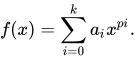
A polynomial such as this one, whose formal derivative is zero, is said to be inseparable. Polynomials that are not inseparable are said to be separable. A separable extension is an extension that may be generated by separable elements, that is elements whose minimal polynomials are separable.
Separable and inseparable polynomials
[edit]An irreducible polynomial f in F[X] is separable if and only if it has distinct roots in any extension of F (that is if it may be factored in distinct linear factors over an algebraic closure of F).[5] Let f in F[X] be an irreducible polynomial and f ' its formal derivative. Then the following are equivalent conditions for the irreducible polynomial f to be separable:
- If E is an extension of F in which f is a product of linear factors then no square of these factors divides f in E[X] (that is f is square-free over E).[6]
- There exists an extension E of F such that f has deg(f) pairwise distinct roots in E.[6]
- The constant 1 is a polynomial greatest common divisor of f and f '.[7]
- The formal derivative f ' of f is not the zero polynomial.[8]
- Either the characteristic of F is zero, or the characteristic is p, and f is not of the form

Since the formal derivative of a positive degree polynomial can be zero only if the field has prime characteristic, for an irreducible polynomial to not be separable, its coefficients must lie in a field of prime characteristic. More generally, an irreducible (non-zero) polynomial f in F[X] is not separable, if and only if the characteristic of F is a (non-zero) prime number p, and f(X)=g(Xp) for some irreducible polynomial g in F[X].[9] By repeated application of this property, it follows that in fact, for a non-negative integer n and some separable irreducible polynomial g in F[X] (where F is assumed to have prime characteristic p).[10]
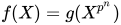
If the Frobenius endomorphism of F is not surjective, there is an element that is not a pth power of an element of F. In this case, the polynomial is irreducible and inseparable. Conversely, if there exists an inseparable irreducible (non-zero) polynomial in F[X], then the Frobenius endomorphism of F cannot be an automorphism, since, otherwise, we would have for some , and the polynomial f would factor as [11]






If K is a finite field of prime characteristic p, and if X is an indeterminate, then the field of rational functions over K, K(X), is necessarily imperfect, and the polynomial f(Y)=Yp−X is inseparable (its formal derivative in Y is 0).[1] More generally, if F is any field of (non-zero) prime characteristic for which the Frobenius endomorphism is not an automorphism, F possesses an inseparable algebraic extension.[12]
A field F is perfect if and only if all irreducible polynomials are separable. It follows that F is perfect if and only if either F has characteristic zero, or F has (non-zero) prime characteristic p and the Frobenius endomorphism of F is an automorphism. This includes every finite field.
Separable elements and separable extensions
[edit]Let be a field extension. An element is separable over F if it is algebraic over F, and its minimal polynomial is separable (the minimal polynomial of an element is necessarily irreducible).
If are separable over F, then , and are separable over F.


Thus the set of all elements in E separable over F forms a subfield of E, called the separable closure of F in E.[13]
The separable closure of F in an algebraic closure of F is simply called the separable closure of F. Like the algebraic closure, it is unique up to an isomorphism, and in general, this isomorphism is not unique.
A field extension is separable, if E is the separable closure of F in E. This is the case if and only if E is generated over F by separable elements.
If are field extensions, then E is separable over F if and only if E is separable over L and L is separable over F.[14]

If is a finite extension (that is E is a F-vector space of finite dimension), then the following are equivalent.
- E is separable over F.
- where are separable elements of E.
- where a is a separable element of E.
- If K is an algebraic closure of F, then there are exactly field homomorphisms of E into K that fix F.
- For any normal extension K of F that contains E, then there are exactly field homomorphisms of E into K that fix F.



![{\displaystyle [E:F]}](https://wikimedia.org/api/rest_v1/media/math/render/svg/9490bd8939b0fb2663f3f26dac59badef0184170)
The equivalence of 3. and 1. is known as the primitive element theorem or Artin's theorem on primitive elements. Properties 4. and 5. are the basis of Galois theory, and, in particular, of the fundamental theorem of Galois theory.
Separable extensions within algebraic extensions
[edit]Let be an algebraic extension of fields of characteristic p. The separable closure of F in E is For every element there exists a positive integer k such that and thus E is a purely inseparable extension of S. It follows that S is the unique intermediate field that is separable over F and over which E is purely inseparable.[15]



If is a finite extension, its degree [E : F] is the product of the degrees [S : F] and [E : S]. The former, often denoted [E : F]sep, is referred to as the separable part of [E : F], or as the separable degree of E/F; the latter is referred to as the inseparable part of the degree or the inseparable degree.[16] The inseparable degree is 1 in characteristic zero and a power of p in characteristic p > 0.[17]
On the other hand, an arbitrary algebraic extension may not possess an intermediate extension K that is purely inseparable over F and over which E is separable. However, such an intermediate extension may exist if, for example, is a finite degree normal extension (in this case, K is the fixed field of the Galois group of E over F). Suppose that such an intermediate extension does exist, and [E : F] is finite, then [S : F] = [E : K], where S is the separable closure of F in E.[18] The known proofs of this equality use the fact that if is a purely inseparable extension, and if f is a separable irreducible polynomial in F[X], then f remains irreducible in K[X][19]). This equality implies that, if [E : F] is finite, and U is an intermediate field between F and E, then [E : F]sep = [E : U]sep⋅[U : F]sep.[20]

The separable closure Fsep of a field F is the separable closure of F in an algebraic closure of F. It is the maximal Galois extension of F. By definition, F is perfect if and only if its separable and algebraic closures coincide.
Separability of transcendental extensions
[edit]Separability problems may arise when dealing with transcendental extensions. This is typically the case for algebraic geometry over a field of prime characteristic, where the function field of an algebraic variety has a transcendence degree over the ground field that is equal to the dimension of the variety.
For defining the separability of a transcendental extension, it is natural to use the fact that every field extension is an algebraic extension of a purely transcendental extension. This leads to the following definition.
A separating transcendence basis of an extension is a transcendence basis T of E such that E is a separable algebraic extension of F(T). A finitely generated field extension is separable if and only it has a separating transcendence basis; an extension that is not finitely generated is called separable if every finitely generated subextension has a separating transcendence basis.[21]
Let be a field extension of characteristic exponent p (that is p = 1 in characteristic zero and, otherwise, p is the characteristic). The following properties are equivalent:
- E is a separable extension of F,
- and F are linearly disjoint over
- is reduced,
- is reduced for every field extension L of E,


where denotes the tensor product of fields, is the field of the pth powers of the elements of F (for any field F), and is the field obtained by adjoining to F the pth root of all its elements (see Separable algebra for details).


Differential criteria
[edit]Separability can be studied with the aid of derivations. Let E be a finitely generated field extension of a field F. Denoting the E-vector space of the F-linear derivations of E, one has


and the equality holds if and only if E is separable over F (here "tr.deg" denotes the transcendence degree).
In particular, if is an algebraic extension, then if and only if is separable.[22]

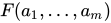
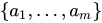
Let be a basis of and . Then is separable algebraic over if and only if the matrix is invertible. In particular, when , this matrix is invertible if and only if is a separating transcendence basis.





Notes
[edit]- ^ a b Isaacs, p. 281
- ^ Isaacs, Theorem 18.11, p. 281
- ^ Isaacs, Theorem 18.13, p. 282
- ^ Isaacs, p. 298
- ^ Isaacs, p. 280
- ^ a b Isaacs, Lemma 18.7, p. 280
- ^ Isaacs, Theorem 19.4, p. 295
- ^ Isaacs, Corollary 19.5, p. 296
- ^ Isaacs, Corollary 19.6, p. 296
- ^ Isaacs, Corollary 19.9, p. 298
- ^ Isaacs, Theorem 19.7, p. 297
- ^ Isaacs, p. 299
- ^ Isaacs, Lemma 19.15, p. 300
- ^ Isaacs, Corollary 18.12, p. 281 and Corollary 19.17, p. 301
- ^ Isaacs, Theorem 19.14, p. 300
- ^ Isaacs, p. 302
- ^ Lang 2002, Corollary V.6.2
- ^ Isaacs, Theorem 19.19, p. 302
- ^ Isaacs, Lemma 19.20, p. 302
- ^ Isaacs, Corollary 19.21, p. 303
- ^ Fried & Jarden (2008) p.38
- ^ Fried & Jarden (2008) p.49
References
[edit]- Borel, A. Linear algebraic groups, 2nd ed.
- P.M. Cohn (2003). Basic algebra
- Fried, Michael D.; Jarden, Moshe (2008). Field arithmetic. Ergebnisse der Mathematik und ihrer Grenzgebiete. 3. Folge. Vol. 11 (3rd ed.). Springer-Verlag. ISBN 978-3-540-77269-9. Zbl 1145.12001.
- I. Martin Isaacs (1993). Algebra, a graduate course (1st ed.). Brooks/Cole Publishing Company. ISBN 0-534-19002-2.
- Kaplansky, Irving (1972). Fields and rings. Chicago lectures in mathematics (Second ed.). University of Chicago Press. pp. 55–59. ISBN 0-226-42451-0. Zbl 1001.16500.
- Lang, Serge (2002), Algebra, Graduate Texts in Mathematics, vol. 211 (Revised third ed.), New York: Springer-Verlag, ISBN 978-0-387-95385-4, MR 1878556
- M. Nagata (1985). Commutative field theory: new edition, Shokabo. (Japanese) [1]
- Silverman, Joseph (1993). The Arithmetic of Elliptic Curves. Springer. ISBN 0-387-96203-4.