


Interaction picture
| Part of a series of articles about |
| Quantum mechanics |
|---|
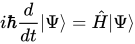
In quantum mechanics, the interaction picture (also known as the interaction representation or Dirac picture after Paul Dirac, who introduced it)[1][2] is an intermediate representation between the Schrödinger picture and the Heisenberg picture. Whereas in the other two pictures either the state vector or the operators carry time dependence, in the interaction picture both carry part of the time dependence of observables.[3] The interaction picture is useful in dealing with changes to the wave functions and observables due to interactions. Most field-theoretical calculations[4] use the interaction representation because they construct the solution to the many-body Schrödinger equation as the solution to the free-particle problem plus some unknown interaction parts.
Equations that include operators acting at different times, which hold in the interaction picture, don't necessarily hold in the Schrödinger or the Heisenberg picture. This is because time-dependent unitary transformations relate operators in one picture to the analogous operators in the others.
The interaction picture is a special case of unitary transformation applied to the Hamiltonian and state vectors.
Definition
[edit]Operators and state vectors in the interaction picture are related by a change of basis (unitary transformation) to those same operators and state vectors in the Schrödinger picture.
To switch into the interaction picture, we divide the Schrödinger picture Hamiltonian into two parts:

Any possible choice of parts will yield a valid interaction picture; but in order for the interaction picture to be useful in simplifying the analysis of a problem, the parts will typically be chosen so that H0,S is well understood and exactly solvable, while H1,S contains some harder-to-analyze perturbation to this system.
If the Hamiltonian has explicit time-dependence (for example, if the quantum system interacts with an applied external electric field that varies in time), it will usually be advantageous to include the explicitly time-dependent terms with H1,S, leaving H0,S time-independent:

We proceed assuming that this is the case. If there is a context in which it makes sense to have H0,S be time-dependent, then one can proceed by replacing by the corresponding time-evolution operator in the definitions below.

State vectors
[edit]Let be the time-dependent state vector in the Schrödinger picture. A state vector in the interaction picture, , is defined with an additional time-dependent unitary transformation.[5]



Operators
[edit]An operator in the interaction picture is defined as

Note that AS(t) will typically not depend on t and can be rewritten as just AS. It only depends on t if the operator has "explicit time dependence", for example, due to its dependence on an applied external time-varying electric field. Another instance of explicit time dependence may occur when AS(t) is a density matrix (see below).
Hamiltonian operator
[edit]For the operator itself, the interaction picture and Schrödinger picture coincide:


This is easily seen through the fact that operators commute with differentiable functions of themselves. This particular operator then can be called without ambiguity.
For the perturbation Hamiltonian , however,


where the interaction-picture perturbation Hamiltonian becomes a time-dependent Hamiltonian, unless [H1,S, H0,S] = 0.
It is possible to obtain the interaction picture for a time-dependent Hamiltonian H0,S(t) as well, but the exponentials need to be replaced by the unitary propagator for the evolution generated by H0,S(t), or more explicitly with a time-ordered exponential integral.
Density matrix
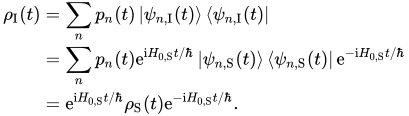
[edit]The density matrix can be shown to transform to the interaction picture in the same way as any other operator. In particular, let ρI and ρS be the density matrices in the interaction picture and the Schrödinger picture respectively. If there is probability pn to be in the physical state |ψn⟩, then
Time-evolution
[edit]Time-evolution of states
[edit]Transforming the Schrödinger equation into the interaction picture gives

which states that in the interaction picture, a quantum state is evolved by the interaction part of the Hamiltonian as expressed in the interaction picture.[6] A proof is given in Fetter and Walecka.[7]
Time-evolution of operators
[edit]If the operator AS is time-independent (i.e., does not have "explicit time dependence"; see above), then the corresponding time evolution for AI(t) is given by
![{\displaystyle \mathrm {i} \hbar {\frac {\mathrm {d} }{\mathrm {d} t}}A_{\text{I}}(t)=[A_{\text{I}}(t),H_{0,{\text{S}}}].}](https://wikimedia.org/api/rest_v1/media/math/render/svg/16855fbb0074eb48752032691ec84675bf5a5dd0)
In the interaction picture the operators evolve in time like the operators in the Heisenberg picture with the Hamiltonian H' = H0.
Time-evolution of the density matrix
[edit]The evolution of the density matrix in the interaction picture is
![{\displaystyle \mathrm {i} \hbar {\frac {\mathrm {d} }{\mathrm {d} t}}\rho _{\text{I}}(t)=[H_{1,{\text{I}}}(t),\rho _{\text{I}}(t)],}](https://wikimedia.org/api/rest_v1/media/math/render/svg/fa5ec127bfe1d67bf6801adc15ba84cf60efcee3)
in consistency with the Schrödinger equation in the interaction picture.
Expectation values
[edit]For a general operator , the expectation value in the interaction picture is given by


Using the density-matrix expression for expectation value, we will get

Schwinger–Tomonaga equation
[edit]The term interaction representation was invented by Schwinger.[8][9] In this new mixed representation the state vector is no longer constant in general, but it is constant if there is no coupling between fields. The change of representation leads directly to the Tomonaga–Schwinger equation:[10][9]
![{\displaystyle ihc{\frac {\partial \Psi [\sigma ]}{\partial \sigma (x)}}={\hat {H}}(x)\Psi (\sigma )}](https://wikimedia.org/api/rest_v1/media/math/render/svg/49199dc4a274002f608bd123df791d32d8db5335)
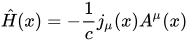
Where the Hamiltonian in this case is the QED interaction Hamiltonian, but it can also be a generic interaction, and is a spacelike surface that is passing through the point . The derivative formally represents a variation over that surface given fixed. It is difficult to give a precise mathematical formal interpretation of this equation.[11]


This approach is called the 'differential' and 'field' approach by Schwinger, as opposed to the 'integral' and 'particle' approach of the Feynman diagrams.[12][13]
The core idea is that if the interaction has a small coupling constant (i.e. in the case of electromagnetism of the order of the fine structure constant) successive perturbative terms will be powers of the coupling constant and therefore smaller.[14]
Use
[edit]The purpose of the interaction picture is to shunt all the time dependence due to H0 onto the operators, thus allowing them to evolve freely, and leaving only H1,I to control the time-evolution of the state vectors.
The interaction picture is convenient when considering the effect of a small interaction term, H1,S, being added to the Hamiltonian of a solved system, H0,S. By utilizing the interaction picture, one can use time-dependent perturbation theory to find the effect of H1,I,[15]: 355ff e.g., in the derivation of Fermi's golden rule,[15]: 359–363 or the Dyson series[15]: 355–357 in quantum field theory: in 1947, Shin'ichirō Tomonaga and Julian Schwinger appreciated that covariant perturbation theory could be formulated elegantly in the interaction picture, since field operators can evolve in time as free fields, even in the presence of interactions, now treated perturbatively in such a Dyson series.
Summary comparison of evolution in all pictures
[edit]For a time-independent Hamiltonian HS, where H0,S is the free Hamiltonian,
| Evolution of: | Picture () | ||
| Schrödinger (S) | Heisenberg (H) | Interaction (I) | |
| Ket state | constant | ||
| Observable | constant | ||
| Density matrix | constant | ||






References
[edit]- ^ Duck, Ian; Sudarshan, E.C.G. (1998). "Chapter 6: Dirac's Invention of Quantum Field Theory". Pauli and the Spin-Statistics Theorem. World Scientific Publishing. pp. 149–167. ISBN 978-9810231149.
- ^ https://courses.physics.illinois.edu/phys580/fa2013/interaction.pdf [bare URL PDF]
- ^ Albert Messiah (1966). Quantum Mechanics, North Holland, John Wiley & Sons. ISBN 0486409244; J. J. Sakurai (1994). Modern Quantum Mechanics (Addison-Wesley) ISBN 9780201539295.
- ^ J. W. Negele, H. Orland (1988), Quantum Many-particle Systems, ISBN 0738200522.
- ^ "The Interaction Picture, lecture notes from New York University". Archived from the original on 2013-09-04.
- ^ Quantum Field Theory for the Gifted Amateur, Chapter 18 - for those who saw this being called the Schwinger-Tomonaga equation, this is not the Schwinger-Tomonaga equation. That is a generalization of the Schrödinger equation to arbitrary space-like foliations of spacetime.
- ^ Fetter, Alexander L.; Walecka, John Dirk (1971). Quantum Theory of Many-particle Systems. McGraw-Hill. p. 55. ISBN 978-0-07-020653-3.
- ^ Schwinger, J. (1958), Selected papers on Quantum Electrodynamics, Dover, p. 151, ISBN 0-486-60444-6
- ^ a b Schwinger, J. (1948), "Quantum electrodynamics. I. A covariant formulation.", Physical Review, 74 (10): 1439–1461, Bibcode:1948PhRv...74.1439S, doi:10.1103/PhysRev.74.1439
- ^ Schwinger, J. (1958), Selected papers on Quantum Electrodynamics, Dover, p. 151,163,170,276, ISBN 0-486-60444-6
- ^ Wakita, Hitoshi (1976), "Integration of the Tomonaga-Schwinger Equation", Communications in Mathematical Physics, 50 (1): 61–68, Bibcode:1976CMaPh..50...61W, doi:10.1007/BF01608555, S2CID 122590381
- ^ Schwinger Nobel prize lecture (PDF), p. 140,
Schwinger informally calls differential as local approach, and calls integral as a type of global approach. The term global here is used with respect to the integration domain
- ^ Schwinger, J. (1958), Selected papers on Quantum Electrodynamics, Dover, p. preface xiii, ISBN 0-486-60444-6,
"Schwinger informally calls local approach referring to fields also in the context of local actions. Particle are emergent properties from an integral approach applied to the field, or averaged approach. He is at the same time making an analogy to the classical distinction between particles and fields, and to show how this is realized for quantum fields
- ^ Schwinger, J. (1958), Selected papers on Quantum Electrodynamics, Dover, p. 152, ISBN 0-486-60444-6
- ^ a b c Sakurai, J. J.; Napolitano, Jim (2010), Modern Quantum Mechanics (2nd ed.), Addison-Wesley, ISBN 978-0805382914
Further reading
[edit]- L.D. Landau; E.M. Lifshitz (1977). Quantum Mechanics: Non-Relativistic Theory. Vol. 3 (3rd ed.). Pergamon Press. ISBN 978-0-08-020940-1.
- Townsend, John S. (2000). A Modern Approach to Quantum Mechanics (2nd ed.). Sausalito, California: University Science Books. ISBN 1-891389-13-0.
