


Jacobi field
In Riemannian geometry, a Jacobi field is a vector field along a geodesic in a Riemannian manifold describing the difference between the geodesic and an "infinitesimally close" geodesic. In other words, the Jacobi fields along a geodesic form the tangent space to the geodesic in the space of all geodesics. They are named after Carl Jacobi.

Definitions and properties[edit]
Jacobi fields can be obtained in the following way: Take a smooth one parameter family of geodesics with , then


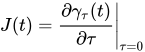
is a Jacobi field, and describes the behavior of the geodesics in an infinitesimal neighborhood of a given geodesic .
A vector field J along a geodesic is said to be a Jacobi field if it satisfies the Jacobi equation:

where D denotes the covariant derivative with respect to the Levi-Civita connection, R the Riemann curvature tensor, the tangent vector field, and t is the parameter of the geodesic. On a complete Riemannian manifold, for any Jacobi field there is a family of geodesics describing the field (as in the preceding paragraph).

The Jacobi equation is a linear, second order ordinary differential equation; in particular, values of and at one point of uniquely determine the Jacobi field. Furthermore, the set of Jacobi fields along a given geodesic forms a real vector space of dimension twice the dimension of the manifold.


As trivial examples of Jacobi fields one can consider and . These correspond respectively to the following families of reparametrisations: and .




Any Jacobi field can be represented in a unique way as a sum , where is a linear combination of trivial Jacobi fields and is orthogonal to , for all . The field then corresponds to the same variation of geodesics as , only with changed parameterizations.




Motivating example[edit]
On a unit sphere, the geodesics through the North pole are great circles. Consider two such geodesics and with natural parameter, , separated by an angle . The geodesic distance

![{\displaystyle t\in [0,\pi ]}](https://wikimedia.org/api/rest_v1/media/math/render/svg/9379db0b64ddff71762d02723a565f19e65443cb)

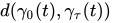
is

Computing this requires knowing the geodesics. The most interesting information is just that
- , for any .

Instead, we can consider the derivative with respect to at :


Notice that we still detect the intersection of the geodesics at . Notice further that to calculate this derivative we do not actually need to know

- ,
rather, all we need do is solve the equation
- ,

for some given initial data.
Jacobi fields give a natural generalization of this phenomenon to arbitrary Riemannian manifolds.
Solving the Jacobi equation[edit]
Let and complete this to get an orthonormal basis at . Parallel transport it to get a basis all along . This gives an orthonormal basis with . The Jacobi field can be written in co-ordinates in terms of this basis as and thus






and the Jacobi equation can be rewritten as a system

for each . This way we get a linear ordinary differential equation (ODE). Since this ODE has smooth coefficients we have that solutions exist for all and are unique, given and , for all .


Examples[edit]
Consider a geodesic with parallel orthonormal frame , , constructed as above.



- The vector fields along given by and are Jacobi fields.
- In Euclidean space (as well as for spaces of constant zero sectional curvature) Jacobi fields are simply those fields linear in .
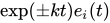
- For Riemannian manifolds of constant negative sectional curvature , any Jacobi field is a linear combination of , and , where .
- For Riemannian manifolds of constant positive sectional curvature , any Jacobi field is a linear combination of , , and , where .
- The restriction of a Killing vector field to a geodesic is a Jacobi field in any Riemannian manifold.



See also[edit]
References[edit]
- Manfredo Perdigão do Carmo. Riemannian geometry. Translated from the second Portuguese edition by Francis Flaherty. Mathematics: Theory & Applications. Birkhäuser Boston, Inc., Boston, MA, 1992. xiv+300 pp. ISBN 0-8176-3490-8
- Jeff Cheeger and David G. Ebin. Comparison theorems in Riemannian geometry. Revised reprint of the 1975 original. AMS Chelsea Publishing, Providence, RI, 2008. x+168 pp. ISBN 978-0-8218-4417-5
- Shoshichi Kobayashi and Katsumi Nomizu. Foundations of differential geometry. Vol. II. Reprint of the 1969 original. Wiley Classics Library. A Wiley-Interscience Publication. John Wiley & Sons, Inc., New York, 1996. xvi+468 pp. ISBN 0-471-15732-5
- Barrett O'Neill. Semi-Riemannian geometry. With applications to relativity. Pure and Applied Mathematics, 103. Academic Press, Inc. [Harcourt Brace Jovanovich, Publishers], New York, 1983. xiii+468 pp. ISBN 0-12-526740-1