


Joseph Petrosino
Joseph Petrosino | |
|---|---|
 Lt. Joe Petrosino, NYPD, Badge No. 285 | |
| Born | Giuseppe Petrosino August 30, 1860 Padula, Campania, Kingdom of the Two Sicilies |
| Died | March 12, 1909 (aged 48) Palermo, Sicily, Kingdom of Italy |
| Cause of death | Gunshots |
| Resting place | Calvary Cemetery, New York City |
| Nationality | Italian |
| Citizenship | American |
| Height | 5 ft 3 in (1.60 m) |
| Spouse | Adelina Saulino |
| Children | Adelina Petrosino Burke |
| Parents |
|
| Relatives | Nino Melito Petrosino (grandnephew, descendants, based in Italy) |
| Website | https://petrosinousa.org/ |
| Police career | |
| Department | New York Police Department |
| Service years | 1883–1909 |
| Rank | Lieutenant |
| Badge no. | 285 |
Joseph Petrosino (born Giuseppe Petrosino, Italian: [dʒuˈzɛppe petroˈziːno; -ˈsiːno]; August 30, 1860 – March 12, 1909) was an Italian-born New York City Police Department (NYPD) officer who was a pioneer in the fight against organized crime. Crime fighting techniques that Petrosino pioneered are still practiced by law enforcement agencies.[1]
Early years and family[edit]


_,_Inspector_Carey_and_Inspector_McCafferty_escorting_Mafia_hitman_Petto_the_Ox_(Tomasso_Petto,_second_from_left)_LCCN2007686607.jpg)
Giuseppe Petrosino was born in Padula, a comune in the province of Salerno, in the southern Italian region of Campania. Young Giuseppe was sent with his cousin, Antonio Puppolo, to live with his grandfather in New York City. A streetcar accident took the life of his grandfather, and the two young cousins wound up in orphans/surrogates court. Rather than send the children to the orphanage, the judge took them home to his own family, and provided for the boys until relatives in Italy could be contacted and arrangements made to bring over family members. So, Joseph Petrosino and his cousin Anthony Puppolo lived with a "politically connected" Irish household for some time, which opened up educational and employment avenues not available to more recent immigrants, especially Italian ones.[2] In 1874, the remainder of the Petrosino family immigrated to the United States.
Petrosino married the widow Adelina Saulino (1869–1957) on January 6, 1908,[3] with whom he had a daughter, Adelina Petrosino Burke (1908–2004), who gave birth to Susan Burke. Burke represented the Petrosino family at functions honoring the fallen NYPD hero.[4]
Career[edit]
On October 19, 1883, he joined the NYPD.[5][2] He was the first Italian language speaker in the NYPD's history. At 5 feet 3 inches (1.60 m), he had to get a waiver of the department's minimum height requirement. He became friends with Theodore Roosevelt, who was a member of the council of police commissioners which governed the NYPD. Fluent in several Italian dialects, Petrosino was able to "make" cases that other officers could not. His ability to solve crimes in the Italian community was such that whenever a serious crime took place in that area, his superiors would call out, "Send for the Dago!"[6]
On July 20, 1895,[2] Roosevelt promoted him to detective sergeant in charge of the department's Homicide Division. The pinnacle of his career came in December 1908[2] when he was promoted to lieutenant and placed in charge of the Italian Squad, an elite corps of Italian-American detectives assembled specifically to deal with the criminal activities of organizations like the Mafia, which Petrosino saw as a shame upon decent Italians and Italian Americans.

The Black Hand and Enrico Caruso[edit]
One notable case in Petrosino's stint with the Italian Squad involved the Italian tenor Enrico Caruso, who was performing at the Metropolitan Opera House in New York City. He was being extorted by Black Hand gangsters who demanded money in exchange for his life. It was Petrosino, a lover of opera, who convinced Caruso to help him catch those behind the blackmail.[7]
Assassination of William McKinley[edit]
A second notable case in Petrosino's stint with the Italian Squad was his infiltration of an Italian-based anarchist organization suspected of ties to the assassination of King Umberto I in 1900. During his mission, he discovered evidence that the organization intended to assassinate President William McKinley during his trip to Buffalo, New York[citation needed]. Petrosino warned the Secret Service, but McKinley ignored the warning, even after Roosevelt, who had by this time become Vice President of the United States, vouched for Petrosino's abilities[citation needed]. McKinley was assassinated by Polish-American Leon Czolgosz during his visit to Buffalo's Pan-American Exposition on September 6, 1901.
Arrest of Cascio Ferro[edit]
Petrosino's investigations into Mafia activities led him to Vito Cascio Ferro, then a low-ranking Black Hand affiliate. In 1903, Petrosino arrested him on suspicion of murder, but Cascio Ferro was acquitted. Ferro later returned to Sicily, where he ascended to the top rank of the Sicilian Mafia. Cascio Ferro was later suspected of Petrosino's murder.
Petrosino also investigated the infamous "barrel murders" case of 1903.
Assassination[edit]

In 1909, Petrosino made plans to travel to Palermo, Sicily on a secret mission. A recently passed federal law allowed the U.S. government to deport any alien who had lived in the country for less than three years if that alien had been convicted of a crime in another country. Petrosino was armed with a long list of known Italian criminals who had taken up residence in the United States, and intended to get enough evidence of their criminal pasts to throw them out of the country once and for all. However, there were already signs that the secrecy and success of the mission was in jeopardy: A few weeks before his departure, The New York Times asked police commissioner Theodore A. Bingham of Petrosino's whereabouts and he cryptically replied "Why, he may be on the ocean bound for Europe, for all I know." In the same news article, The Times then cited another source, not Bingham and unnamed, who had hinted at the purpose of Petrosino's covert mission.[8] The U.S. Ambassador to Italy, Lloyd Carpenter Griscom, expressed concerns directly to Petrosino that he would be recognized in Sicily by "perhaps a thousand criminals".[9] Subsequently, while in Rome, Petrosino became aware that he was being followed—and told a friend that the man following him, whom he recognized from New York and later observed ducking into a telegraph office, had likely alerted his Black Hand Society compatriots in Noto, Sicily that he (Petrosino) was now in Italy.[9]
On March 12, 1909, after arriving in Palermo, Sicily, Petrosino was invited to a nighttime rendezvous in the city's Piazza Marina in order to receive information about the Mafia. While waiting for his "informant", Petrosino was shot in the face by two assailants. It was reported that Petrosino was able to fire off one shot in their direction, but was bleeding profusely and fell to the ground. An Italian sailor heard the shots and rushed to his aid, but it was too late.[9][10]
The day after Petrosino's shooting, the detective's Italian Branch received an anonymous letter stating that the New York Black Hand had arranged the murder. The letter named members of the Morello crime family: Giuseppe Morello, Vincenzo Terranova, Ciro Terranova, Giuseppe Fontana, Ignazio Milone, and Pietro Inzarillo. Cascio Ferro worked with these men during his three-year tenure in New York, so their involvement is possible, but "We will probably never know for sure whether or not the letter was a hoax."[11]
Vito Cascio Ferro was arrested for Petrosino's murder, but was released after an associate provided an alibi. Allegedly, he later (when convicted for murder) claimed that he personally killed once "a gallant man, not an enemy".[12][13]
Palermo's police commissioner, Baldassare Ceola, listed five Sicilian suspects:[11]
- Pasquale Enea, linked to the Black Hand in New York
- Giuseppe Fontana, previously involved with a murder in Sicily and Black Hand activities in New York
- Gioacchino Lima, previously charged with a murder, brother-in-law to Giuseppe Morello
- Ignazio Milone, worked with Fontana in New York
- Giovanni Pecoraro, links to Sicilian and New York crime, and Vito Cascio Ferro
Enrico Alfano had been linked to Petrosino's murder, when he began to run a gambling den in the basement of 108 Mulberry Street; Alfano became one of the primary underworld targets of Petrosino who believed he was a big player in the New York branch of the Camorra.[14][15][16][17] On 17 April 1907, Petrosino and his agents raided the apartment at 108 Mulberry Street where Alfano was living and arrested him. The arrest caused a sensation in Naples.[18]
Lt. Antonio Vachris, the head of the Italian Detective Bureau in Brooklyn, stated that Petrosino was supposed to have been accompanied by police detectives in Palermo. He suspected that Petrosino was betrayed by someone within the Palermo police department and ultimately lured to his death. "He knew, as I do," Vachris told The New York Times, "that Palermo is the worst hole in Southern Italy for the Mafia. In that city there are at least 100 criminals of the most desperate class who knew Petrosino. Because of his work many of them had been deported from this country, and he was a marked man with them."[9] Author and historian Mike Dash identified the most likely assassins as Carlo Costantino and Antonio Passananti. Costantino and Passananti died in the late 1930s and in March 1969, respectively.[19][20] In 2014, during an (unrelated) investigation by Italian police, a descendant claimed that Paolo Palazzotto, a henchman of the Fontana crime ring of Palermo, was the actual killer, executing Cascio Ferro's "hit."[21][22]

Reactions[edit]
The United States Consul in Palermo, W. H. Bishop, sent a cablegram to NYC Police Commissioner Theodore A. Bingham informing him of the tragic news and stating that Petrosino "dies a martyr".[9] Bishop told The New York Times that May that it was misreported that Petrosino was armed when he was murdered; he indicated he spoke to him frequently when he was in Palermo and the night of his murder Petrosino left his revolver in his hotel room and refused a police escort.[23]
Upon hearing the news of his death from reporters, Theodore Roosevelt was taken aback and said "Petrosino was a great man and a good man. I knew him for years, and he did not know the name of fear."[9]
Assistant District Attorney Francis L. Carrao of Brooklyn was also quoted in The New York Times: "The Italian Government must be held largely responsible tor the death of Lieut. Petrosino…The importance of Lieut. Petrosino's mission should have made clear to the Italian Consul General in New York the wisdom of notifying the Italian Minister of the Interior of his coming, that he might be insured the protection of the Government."[9]
Il Telegrafo: The Evening Telegraph, an Italian American newspaper in New York, printed an editorial on March 13, 1909, in response to Petrosino's assassination, which said in part: "The assassination of Petrosino is an evil day for the Italians of America, and none of us can any longer deny that there is a Black Hand Society in the United States."[9]
Funeral[edit]

Funeral rites for Petrosino were performed in Palermo, after which his body was sent to New York aboard the English S/S Slavonia, arriving April 9. On April 12, 1909, funeral rites were conducted in St. Patrick's Cathedral, with over 200,000 people taking part in the funeral procession.[24] New York City declared the day of his burial a holiday to allow its citizens to pay their respects.[25] A pillar topped with an elaborate bust, inaugurated a year after his death,[26] marks his gravesite in Queens, New York, Calvary Cemetery.[27] Multiple organized crime notables are buried there, including members of the Morello crime family which he investigated, (e.g., Giuseppe "Peter" Morello (the Clutch Hand), Ignazio "Lupo the Wolf" Lupo (1877–1947), and the Terranova brothers (who rest in bare graves).[28]
Aftermath[edit]
In May 1909 in Palermo, US Consul Bishop received death threats that he would meet the same fate as Petrosino if he continued to work with Italian authorities in the search for Petrosino's murderers.[23]
On July 17, 1909, Baldassare Ceola was relieved of his position as the police commissioner of Palermo.
Petrosino's widow (b. 1869) died in 1957.[29]
In memoriam[edit]

- In 1987, the name of a small triangular park in lower Manhattan was changed from Kenmare Square to Lieutenant Joseph Petrosino Square in his honor. It is bounded by Cleveland Place and Lafayette and Kenmare streets, two blocks north of the old police headquarters at 240 Centre Street at the juncture of the Little Italy, Nolita, and SoHo neighborhoods.[30][31]
There is also an exhibit dedicated to Petrosino in the Italian American Museum, at 155 Mulberry Street in Manhattan's Little Italy. The exhibit pays tribute to him by displaying memorabilia documenting his career. It includes photographs, a vintage LP record, an original Black Hand letter, as well as both artwork and a comic book about his life. A plaster cast from the original 2014 bronze relief in Petrosino Square was donated to the museum by its creator, artist Carter Jones.
- On March 12, 2003, a small memorial (an engraved brass plate on a pole) was erected on Piazza Marina, Palermo in Petrosino's remembrance.[32]
- The Joe Petrosino Prize for Investigative Reporting (in Italian: Certosa di Padula Joe Petrosino Prize) was named in his honor.[33]
- In 2010, the Italian Post released a postage stamp to commemorate his 150th birthday.The stamp features Petrosino's picture with the Statue of Liberty and the Brooklyn Bridge in the background.
In popular culture[edit]
In film[edit]
- Four biographical films have been made of Petrosino's life, including: Sidney M. Goldin's The Adventures of Lieutenant Petrosino (1912); Joe Petrosino (1934); Pay or Die (1960), starring Ernest Borgnine; and The Black Hand (1973), starring Lionel Stander.
- The character of Lieutenant Louis Lorelli (J. Carrol Naish) in The Black Hand (1950), starring Gene Kelly, is modeled on Petrosino.
In literature[edit]
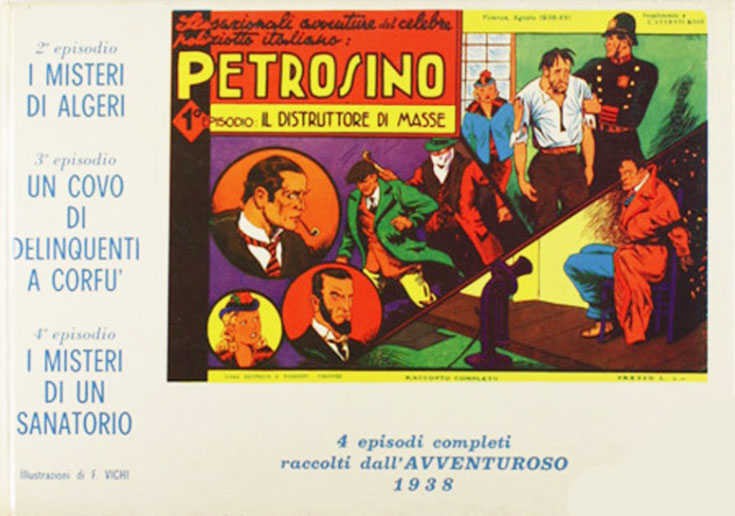
- In the peak of his prominence, Petrosino was immortalized in a series of dime novels in Italy titled Giuseppe Petrosino, il Sherlock Holmes d'Italia (Giuseppe Petrosino, the Italian Sherlock Holmes), portraying him as a crusading master detective in the style of Sherlock Holmes and Nick Carter. There were also dime novels published in Germany Josef Petrosino, der Schrecken der Schwarzen Hand (Josef Petrosino, the Terror of the Black Hand) 1910-1911 and France.[34] Petrosino was the hero of a comic strip series published in the Italian title, L’Avventuroso.[35]
- British novelist Frederick Nolan has written two novels based on Petrosino's career with the NYPD: No Place to Be a Cop (1974)[36][37] and Kill Petrosino! (1975).[38][39]
- Petrosino appears in Laurie Fabiano's novel Elizabeth Street (2010).[40][41][42]
- The January/February 2010 issue of Playboy published the article "Petrosino vs. The Black Hand", written by novelist/screenwriter James Dalessandro.
- In My Ears Are Bent, Joseph Mitchell's collection of his feature articles from the 1930s, Petrosino appears as "Louis Sittenberg, the famous New York detective who was killed on a trip to Italy to bring back a Black Hand agent." Whether Mitchell's informant was confused or Mitchell changed Petrosino's name for some reason is not known.
- In 2017, American journalist Stephan Talty wrote The Black Hand, a history of Petrosino's life and career.[43]
- In 2020, American author Victoria Thompson used Petrosino as one of the characters in her novel Murder on Pleaasant Avenue.[44]
In television[edit]
- Petrosino's story is discussed in the two-hour History Channel program Godfathers, which features commentary by Mario Cuomo, former governor of New York, and Bernard Kerik, former police commissioner of New York City.[45]
- He has been the subject of two Italian television dramas: He was portrayed in Petrosino (miniseries, 1972, directed by Daniele D'Anza) by Adolfo Celi and in Joe Petrosino (TV movie, 2006) by Beppe Fiorello.[46]
See also[edit]
References[edit]
- ^ "Joe Petrosino: the Legendary Italian-American Detective who Fought the Mafia in New York". ITALY Magazine. August 4, 2016. Retrieved August 10, 2023.
- ^ a b c d Jackson, Kenneth T. (1995) The Encyclopedia of New York City. New York and London: Yale University Press
- ^ Talty, Stephan (2017). The Black Hand; The Epic War Between a Brilliant Detective and the Deadliest Secret Society in American History (Paper ed.). New York: Mariner Books. p. 151. ISBN 978-132891119-3.
- ^ "Exhibit shows off mementos of a legendary NYC lawman, Lt. Joseph Petrosino".
- ^ Kane, Michael (June 28, 2015). "The legendary NYPD cop who broke through the 'Italian barrier'". New York Post. Retrieved October 5, 2020.
- ^ Raab, Selwyn. Five Families: The Rise, Decline, and Resurgence of America's Most Powerful Mafia Empires. London: Robson Books, 2006. ISBN 1-86105-952-3. p. 19
- ^ Raab, p. 19-20.
- ^ "New Secret Service to Fight Black Hand". The New York Times. February 20, 1909. Retrieved July 17, 2020.
- ^ a b c d e f g h "Petrosino Slain Assassins Gone". The New York Times. March 14, 1909. Retrieved July 17, 2020.
- ^ "Joe Petrosino Murder", GangRule, retrieved October 16, 2010
- ^ a b "Lt. Giuseppe "Joseph" Petrosino", American Organized Crime, Purcell, Mike, 2000, archived from the original on December 28, 2013, retrieved August 8, 2013
- ^ Minna R. Breve Storia della Mafia. Rome, Riuniti.
- ^ Petacco A.Joe Petrosino, Milan, Mondadori 1972.
- ^ Camorra Chief's Flight; Alfano Reached America After Many Adventures in Italy, The New York Times, April 22, 1907
- ^ Romano, Italian Americans in Law Enforcement, p. 45
- ^ Petacco, Joe Petrosino, p. 83
- ^ Criminal Band That Murdered Petrosino In Police Coils, by Walter Littlefield, The New York Times, September 11, 1910
- ^ Camorra's Chief Caught, The New York Times, April 20, 1907
- ^ Dash, p. 16
- ^ Critchely, David (2008). Routledge Advances in American History, Volume 1. Routledge. ISBN 978-0203889077.
- ^ Boss svela chi uccise Joe Petrosino – Cronaca – ANSA.it
- ^ Culzac, Natasha (2014). "100-year-old murder of anti-mafia officer Joseph Petrosino solved by Italian police". The Independent. Archived from the original on June 17, 2022. Retrieved August 29, 2018.
- ^ a b "Why Petrosino's Killers Will Escape". The New York Times. May 13, 1909. Retrieved July 17, 2020.
- ^ "Joe Petrosino Murder", GangRule, retrieved March 16, 2013
- ^ Martinelli, Candida. "Hero's Send-Off for a Fallen NYCPD Officer". p. Lt. Joe Petrosino, Trail-Blazing Fighter of Organized Crime. Retrieved August 29, 2018.
New York City declared the day Lieutenant Joe Petrosino was buried a holiday, so all those who wanted to pay their respects, could. On April 12, 1909, over 250,000 people paid their respects to the fallen New York City Police Department Officer, who was killed in the line of duty, and who had an amazing 25-year career with the NYCPD.
- ^ Unveil Petrosino Monument; Two Nation's Will Carry on His Work, Says Lieut. Enright, The New York Times, March 14, 1910
- ^ Dash, Epilogue p. 36
- ^ Dash, Epilogue p. 27
- ^ "Giuseppe (Joe) Petrosino". Retrieved August 29, 2018.
- ^ "Petrosino Square", Find A Park, City of New York Parks & Recreation, retrieved August 8, 2013
- ^ Dash, p. 28
- ^ Dash, Mike (2009). The First Family: Terror, Extortion and the Birth of the American Mafia. London: Simon & Schuster. ISBN 978-1-84737-173-7.
- ^ "Link to the prize description at JoePetrosino.org". Archived from the original on April 22, 2016. Retrieved March 17, 2013.
- ^ http://jessnevins.com/pulp/pulpp/petrosino.html
- ^ https://www.outisfumetti.com/wp-content/uploads/2019/11/Joe-Petrosino-Fred-Bongusto-il-fumetto1.jpg
- ^ Nolan, Frederick (August 1, 1974). No Place to Be a Cop. London: Littlehampton Book Services Ltd. ISBN 9780213164751.
- ^ "No Place to Be a Cop by Frederick Nolan". fantasticfiction.com. Retrieved August 29, 2018.
- ^ "Kill Petrosino by Frederick Nolan". fantasticfiction.com. Retrieved August 29, 2018.
- ^ Nolan, Frederick (October 1, 2007). Kill Petrosino!. Leicester: Linford Mystery. ISBN 9781846179501.
- ^ "Elizabeth Street – da Scilla a New York eBook: Laurie Fabiano, Francesca Barbanera: Amazon.it: Kindle Store". Retrieved August 29, 2018.
- ^ "Elizabeth Street – Laurie Fabiano – 13 reviews – AmazonCrossing – Paperback – Italiano – Anobii". Retrieved August 29, 2018.
- ^ Franco, Maria (March 27, 2016). "RECENSIONE: Elizabeth Street-da Scilla a New York di L. Fabiano" (in Italian).
un atto criminoso a fini estorsivi organizzato da una banda di delinquenti che si riconoscevano nella Mano nera, una sorta di mafia, contro cui aveva lottato anche il tenente Petrosino
- ^ "It's man vs. the mob in Stephan Talty's exhilarating history 'The Black Hand'". The Washington Post. Retrieved August 29, 2018.
- ^ Thompson, Victoria (2020). Murder on Pleasant Avenue. New York: Berkley Prime Crime. p. Author's Note. ISBN 9781984805744.
- ^ "The Godfather and the Mafia in Popular Culture". History.com. Archived from the original on March 11, 2013.
- ^ [Lista delle Fiction RAI – RAI Official Site.]
| International | |
|---|---|
| National | |

- 1860 births
- 1909 deaths
- 1909 murders in Italy
- People from the Province of Salerno
- American Roman Catholics
- Italian emigrants to the United States
- New York City Police Department officers
- People murdered by the Sicilian Mafia
- Assassinated American people
- American people murdered abroad
- People murdered in Italy
- Burials at Calvary Cemetery (Queens)
- Assassinated police officers
- Anti-crime activists
- Deaths by firearm in Italy