


Kingdom Hall

| Part of a series on |
| Jehovah's Witnesses |
|---|
 |
A Kingdom Hall is a place of worship used by Jehovah's Witnesses. The term was first suggested in 1935 by Joseph Franklin Rutherford, then president of the Watch Tower Society, for a building in Hawaii.[1] Rutherford's reasoning was that these buildings would be used for "preaching the good news of the Kingdom".[2]
Jehovah's Witnesses use Kingdom Halls for the majority of their worship and Bible instruction. Witnesses prefer the term "Kingdom Hall" over "church", noting that the term often translated "church" in the Bible refers to the congregation of people rather than a structure.[3]
Location and presentation
[edit]
Kingdom Halls are typically modest, functional structures with practicality in mind.[4] As Witnesses do not use religious symbols, such are not displayed on or in Kingdom Halls. An annual yeartext, or "theme scripture", which is the same for all congregations of Jehovah's Witnesses worldwide, is prominently displayed inside each Kingdom Hall.[5] This text can be displayed in several languages if the Hall is used by foreign-language congregations.[6] A Kingdom Hall typically has a library, contribution boxes,[7] and a literature counter, where publications are displayed, stored and dispensed.[8]
Some Kingdom Halls have multiple auditoriums to allow more than one congregation to conduct meetings simultaneously. Where there is more than one auditorium, each auditorium or the entire structure may be referred to as "a Kingdom Hall". Larger Assembly Halls or Convention Centers of Jehovah's Witnesses, or any rented arena or stadium used for larger gatherings of Jehovah's Witnesses are regarded 'as a large Kingdom Hall'. Undignified behavior is considered inappropriate during their religious events, even if the facility is an entertainment venue.[9]
Uses
[edit]
Meetings for worship
[edit]Congregations typically meet in their Kingdom Halls two days each week for worship.[10] Meetings usually open and close with song and prayer. Meetings held in the Kingdom Hall include Bible readings and public talks on matters such as the Bible, family life, Christian qualities and prophecy. There are discussions of specially prepared study articles in The Watchtower magazine and other publications of Jehovah's Witnesses.[11][12][13][14] Witnesses usually meet in Kingdom Halls for preparation and prayer before engaging in their door-to-door ministry.
Classes
[edit]Kingdom Halls may also be used to teach sign language or other language classes.[15] Kingdom Halls are also used for sessions especially developed for particular areas of service, such as the Pioneer Service School for full-time preachers, and the Kingdom Ministry School for elders and ministerial servants.[16] In areas where the literacy rate is low, congregations may arrange to use Kingdom Halls to conduct literacy classes, which non-Witnesses may also attend.[17]
Weddings
[edit]Kingdom Halls may be used for wedding ceremonies of Witness-baptized couples. A couple sends a request in writing to the congregation's "service committee", which assesses whether the couple is "in good standing, living in harmony with Bible principles and Jehovah’s righteous standards" and that they approve of the members of the couple's wedding party, the groomsmen and bridesmaids.[18]
Jehovah's Witnesses attach no special significance to a Kingdom Hall wedding over a secular service. Witness couples may choose to be married elsewhere for personal or practical reasons. Kingdom Halls are not used for wedding receptions or other social events.[19][20]
Funerals
[edit]Funeral services may be held in a Kingdom Hall if the body of elders considers that "the deceased had a clean reputation and was a member of the congregation or the minor child of a member".[21] The family of the deceased may ask any respected male member of the congregation to conduct the service, which involves a simple Bible-based discourse.[22] Depending on family preference and local custom, a Kingdom Hall funeral may or may not have the casketed deceased present.[21][23]
Disaster relief
[edit]Disaster relief efforts of Jehovah's Witnesses are typically channeled through permanent local Disaster Relief Committees[24] under the various branch offices, and are staged at Kingdom Halls and Assembly Halls as close as practical to the disaster area.[25][26][27]
Construction
[edit]
The construction crews of Kingdom Halls and larger Assembly Halls consist of volunteering Jehovah's Witnesses,[28][29] sometimes from other countries, who have been pre-approved[by whom?] for work on construction sites.
Witnesses in many countries use a number of standard designs for construction that can be built in just a few days.[30][31] The act of constructing a Kingdom Hall in this manner after the initial foundations are laid is called a quick-build.[32][33]
A Kingdom Hall or Assembly Hall may originate from the renovation of an existing structure, such as a theater or non-Witness house of worship.[34][35] In areas of repeated or reputed vandalism, particularly in cities, some Kingdom Halls are built without windows to reduce the risk of property damage.[36]
In 2015, it was announced[by whom?] to elders in the United States that new Kingdom Halls worldwide would use standardized designs and materials, suited to local circumstances. [37]
Regional Building Committees
[edit]Jehovah's Witnesses' branch offices formerly appointed local Regional Building Committees (RBC) to oversee the construction and maintenance of their places of worship. Such committees - which usually consisted of five to seven persons, often with experience in construction trades - aimed to coordinate the efforts of those involved so as to provide attractive and functional facilities that are financially viable.[38]
RBCs cooperated with local congregations of Jehovah's Witnesses seeking to build or renovate a place of worship, under the direction of the local branch office. Committees helped in assessing the suitability of a possible construction-site, purchasing the land and materials and coordinating the efforts of volunteers from the wider area.[38] Members of a Regional Building Committee worked voluntarily and received no remuneration for their work.[39]
On Saturday, January 31, 2015, in a special meeting with all elders in the United States via live video-feed, it was announced[by whom?] that Regional Building Committees would be replaced by Local Design/Construction Department of the branch office, but with a more defined organizational structure.[40]
Funding
[edit]In 1983, an arrangement was instituted whereby loans from the Watch Tower Society financed Kingdom Halls. In addition to contribution boxes for local congregation expenses and "the worldwide work", each congregation had a contribution box specifically for voluntary donations toward Kingdom-Hall construction.[41][42] The Watch Tower Society pooled these donations into the Society Kingdom Hall Fund for financing the construction of Kingdom Halls worldwide, particularly in developing nations.[43][44]
When a congregation received local approval to build a new Kingdom Hall, that congregation could apply for a loan from the Society Kingdom Hall Fund.[45] The congregation repaid the loan to the Watch Tower Society, in addition to its continued contributions to the Kingdom Hall Fund. Interest was charged on the loans until September 2008.[46][47][48]
The way Kingdom Halls are funded changed significantly in 2014. The provision of Kingdom Hall loans from the Society ceased, as did the separate Society Kingdom Hall Fund.[49] Instead, all congregations were directed to contribute an ongoing amount to the branch office each month, in addition to donations for other purposes, into a single World Wide Work fund, and the branch office finances new Kingdom Halls. The stated purpose was so that funding from more affluent areas could supplement funding from areas without the resources for a new hall. The monthly amount was initially based on "a confidential survey of all publishers" indicating how much they could commit each month, with a recommendation that the amount be "at least the same amount as the current monthly loan repayment".[49] As of 2020, the amount is "based on a monthly per-publisher amount suggested by the branch office" and reviewed by local congregation elders.[50]
Maintenance
[edit]Routine maintenance of Kingdom Halls is performed by the members of the congregations that use them, typically according to a scheduled checklist.[51] The "Kingdom Hall operating committee" oversees maintenance of the building. At least one elder or ministerial servant from each congregation is selected to be part of the operating committee.[52] Kingdom Hall maintenance costs are covered by donations to a local fund.[53]
Gallery
[edit]- Kingdom Halls at various locations
-
 Cascavel, Brazil
 -
 Toronto, Canada
 -
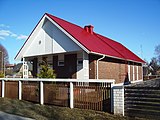 Rapla, Estonia
 -
 Tampere, Finland
 -
 Hamburg, Germany
 -
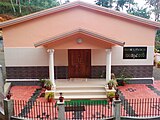 Kerala, India
 -
 Napier, New Zealand
 -
 Harbutowice, Poland
 -
 Târgovişte, Romania
 -
 Vårgårda, Sweden
 -
 West Sussex, United Kingdom
 -
 Lofoten, Norway


References
[edit]- ^ Jehovah's Witnesses – Proclaimers of God's Kingdom chap. 20 p. 319, 721
- ^ Jehovah's Witnesses – Proclaimers of God's Kingdom chap. 20 p. 319 Building Together on a Global Scale
- ^ "Should We Go to Christian Meetings?", Awake!, March 8, 2001, page 12
- ^ Organized to Do Jehovah's Will p.120-123 (Watch Tower Bible and Tract Society, 2005)
- ^ Texas Monthly magazine, July 1980, page 136,138, As Retrieved 2009-08-18, "A Witness house of worship is called a Kingdom Hall. ...Appropriate to the movement's rejection of pomp and display, the [particular Hall visited by the writer], shared with two other congregations, resembled the meeting room of a budget motel, complete with rows of stackable chairs. The lone feature that marked it as a room devoted to religion was a sign, affixed to a plain wooden canopy over the speaker's stand, that bore the entreaty, "And now, Jehovah . . . grant your slaves to keep speaking your word with all boldness." The congregation of approximately 75 included admirably equal portions of blacks, whites, and Mexican Americans, a not uncommon manifestation of ethnic ecumenicity in Witness circles."
- ^ "Question Box", Our Kingdom Ministry, December 1976, page 4, "It is recommended that the yeartext be displayed in the Kingdom Hall in countries where this can be done without difficulties resulting. ...Often it is best to display the yeartext at the front or side of the hall so it can be seen easily."
- ^ “To the House of Jehovah Let Us Go”, Our Kingdom Ministry, April 1993, page 4
- ^ "Bible-based Society of Kingdom Witnesses", The Watchtower, October 15, 1962, page 631
- ^ "Maintain Fine Conduct That Glorifies God", Our Kingdom Ministry, May 2000, page 6
- ^ Organized to Do Jehovah’s Will, ©2005 Watch Tower, page 138
- ^ "Jehovah's Witnesses", World Religions in America: An Introduction by Jacob Neusner, ©2003, Westminster John Knox Press, As Retrieved 2009-08-18, page 197
- ^ Organized to Accomplish Our Ministry, ©1983,1989 Watch Tower, page 131
- ^ "Jehovah's Witnesses", Britannica Encyclopedia of World Religions by Wendy Doniger (editor), ©2006, in association with Merriam-Webster, As Retrieved 2009-08-18, page 563
- ^ "Jehovah's Witnesses", World Religions: An Introduction for Students by Jeaneane D. Fowler, ©1997, Sussex Academic Press, As Retrieved 2009-08-18, page 122
- ^ "Highlights of the Past Year", 2007 Yearbook of Jehovah's Witnesses, pages 6, 15-18
- ^ "Imitate the Greatest Missionary", The Watchtower, February 15, 2008, page 18
- ^ 1986 Yearbook of Jehovah's Witnesses. p. 226.
- ^ "Question Box", Our Kingdom Ministry, November 2008, page 3
- ^ "Marriage Ceremony and Requirements", The Watchtower, September 15, 1956, page 571
- ^ How to Be a Perfect Stranger: The Essential Religious Etiquette Handbook by Stuart M. Matlins, Arthur J. Magida (editors), ©2004, Skylight Paths Publishing, As Retrieved 2009-08-18, page 128-129, "Marriage Ceremony Jehovah's Witnesses view marriage as a sacred vow made before God. ...The marriage ceremony, which may last about 30 minutes, is a ceremony in itself. ...Appropriate Attire Men" A jacket and tie. No head covering is required. Women: A dress or a skirt and blouse. Dress "modestly" and "sensibly". Hems need not reach below the knees nor must clothing cover the arms. Open-toed shoes and modest jewelry are permissible. No head covering is required. There are no rules regarding colors of clothing. ...After the Ceremony Is there usually a reception after the ceremony? Yes. It may be held in homes or a catering hall. It is never held in the Kingdom Hall where the wedding took place."
- ^ a b "Question Box", Our Kingdom Ministry, March 1997, page 7
- ^ "Is Your Course of Life Death-Oriented?", The Watchtower, June 1, 1978, page 7
- ^ How to Be a Perfect Stranger: The Essential Religious Etiquette Handbook by Stuart M. Matlins, Arthur J. Magida (editors), ©2004, Skylight Paths Publishing, As Retrieved 2009-08-18, page 129, "Funerals and Mourning Jehovah's Witnesses believe that the dead are "conscious of nothing at all" and are asleep in the grave awaiting resurrection to life. ...The funeral service, which is a ceremony in itself, may last about 15 to 30 minutes. ...Where will the ceremony take place? Either at a Kingdom Hall or in a funeral home. ...Will there be an open casket? Possibly. This depends on the preference of the immediate family."
- ^ "Volunteers continue Katrina disaster relief work" by David J. Bush, Salisbury Post, September 1, 2007, page F0
- ^ "A Doctor Heads Home to Haiti" by Lionel J. Malebranche, MD, Annals of Internal Medicine, February 18, 2010
- ^ "Caring for Victims of Rwanda's Tragedy", Awake!, December 22, 1994, page 15
- ^ "Love in Action—A Marathon Relief Effort", Awake!, November 22, 2002, page 22
- ^ "Jehovah's Witnesses", The Encyclopedia of Louisville by John E. Kleber, ©2000, University Press of Kentucky, As Retrieved 2009-08-18, page 444, "Jehovah's Witnesses are well known in the Greater Louisville area, having been a part of "Kentucky sod" since the late 1800s. ...From 1947 to 1970 ten more Kingdom Halls were constructed in Louisville, all by volunteer labor."
- ^ "Jehovah's Witnesses", World Religions 101: An Overview for Teens by Margaret O. Hyde, Emily G. Hyde, ©2008, Twenty-First Century Books, As Retrieved 2009-08-18, page 91-92
- ^ "Jehovah's Witnesses", Religion in the contemporary world: a sociological introduction by Alan E. Aldridge, ©2000, Polity Press, As Retrieved 2009-08-18, page 116-117, "Witnesses are extremely well organized. ...One particular way in which the [Watch Tower] society mobilizes its members is to build their places for worship and assembly, the Kingdom Halls. A 'rapid-building crew' of Witness volunteers can erect a functional but well-built Kingdom Hall in a weekend."
- ^ Holbrook by Holbrook Historical Society, ©2004, Arcadia Publishing, As Retrieved 2009-08-18, page 63, "The Kingdom Hall. Shown here is the Kingdom Hall of Jehovah's Witnesses on North Franklin Street. This hall was built by the membership in one weekend."
- ^ "Accelerating the Kingdom Hall Construction Program". Our Kingdom Ministry. Watch Tower Society. December 1986. p. 4.
Usually the 'quick-build' method of construction is preferred by the Regional Building Committees.
- ^ "Watching the World". Awake!. Watch Tower Society. December 22, 1983. p. 29.
- ^ New York: The Movie Lover's Guide : The Ultimate Insider Tour of Movie New York by Richard Alleman, ©2005, Broadway, As Retrieved 2009-08-18, page 416, "Albemarle Theater, 973 Flatbush Avenue. Just like the old Stanley Theater in Jersey City, Brooklyn's 2,700-seat Albemarle movie palace later served as a Kingdom Hall for the Jehovah's Witnesses."
- ^ From Abyssinian to Zion: A Guide to Manhattan's Houses of Worship by David W. Dunlap, ©2004, Columbia University Press, As Retrieved 2009-08-18, page 117, "The remarkable Kingdom Hall at 609 West 161st Street was formerly the Hebrew Tabernacle of Washington Heights, by George and Edward Blum and Ludwig Hanauer, completed in 1925."
- ^ "How Kingdom Halls Are Built", Awake!, August 22, 1972, page 23.
- ^ "Speeding Up Kingdom Hall Construction — Watchtower ONLINE LIBRARY". wol.jw.org. Retrieved 2023-10-05.
- ^ a b Jehovah's Witnesses—Proclaimers of God's Kingdom. Watch Tower Society. 1993. pp. 325–328.
- ^ "Kingdom Hall Construction in the United States". Our Kingdom Ministry. August 1997. p. 3.
- ^ "Speeding Up Kingdom Hall Construction". 2016 Yearbook of Jehovah's Witnesses. February 2016. p. 15. Retrieved 27 February 2020.
The Regional Design/Construction Departments (RDC) in the Australasia, Central Europe, South Africa, and United States branches have been coordinating projects in their respective regions, with emphasis on building Kingdom Halls more speedily and economically. [...] And, at each branch, a Local Design/Construction Department (LDC) coordinates the construction and maintenance of Kingdom Halls and Assembly Halls.
- ^ "How Is It All Financed?", Jehovah's Witnesses - Proclaimers of God's Kingdom, pages 344-345
- ^ "Announcements", Our Kingdom Ministry, June 1991, page 3
- ^ "True Worship Is Expanding in Eastern Europe". Our Kingdom Ministry. September 1999. pp. 3–4.
- ^ "International Kingdom Hall Building in Some European Lands", Our Kingdom Ministry, May 2003, page 3.
- ^ "A New Program for Kingdom Hall Construction". Our Kingdom Ministry. September 1983. p. 3.
- ^ Letter to all Congregations, June 4, 2008
- ^ "Continued Expansion Increases Need for Kingdom Halls". Our Kingdom Ministry. December 1993. p. 3.
- ^ "Society Kingdom Hall Fund". Our Kingdom Ministry. April 1985. p. 4.
These loans are repaid to the Society Kingdom Hall Fund with interest at the rate of 6 percent.
- ^ a b "Untitled". Letter to All Congregations. March 29, 2014.
{{cite press release}}: CS1 maint: others (link) - ^ "Announcements and Reminders". Letter to Elders in all congregations. August 2020.
{{cite press release}}: CS1 maint: others (link) - ^ For example, Our Kingdom Ministry, March 2003, included a "Safety Checklist" on page 4, and a checklist for "Care of Building and Property" on page 5.
- ^ "Let Us Keep Our Place of Worship in Good Repair", Our Kingdom Ministry, August 2003, page 3-4
- ^ "The Giver of “Every Good Gift”", The Watchtower, December 1, 1993, page 29