Sequence of differential equation solutions
Complex color plot of the Laguerre polynomial L n(x) with n as -1 divided by 9 and x as z to the power of 4 from -2-2i to 2+2i In mathematics , the Laguerre polynomials , named after Edmond Laguerre (1834–1886), are nontrivial solutions of Laguerre's differential equation:
x
y
″
+
(
1
−
x
)
y
′
+
n
y
=
0
,
y
=
y
(
x
)
{\displaystyle xy''+(1-x)y'+ny=0,\ y=y(x)}
which is a second-order
linear differential equation . This equation has
nonsingular solutions only if
n is a non-negative integer.
Sometimes the name Laguerre polynomials is used for solutions of
x
y
″
+
(
α
+
1
−
x
)
y
′
+
n
y
=
0
.
{\displaystyle xy''+(\alpha +1-x)y'+ny=0~.}
where
n is still a non-negative integer.
Then they are also named
generalized Laguerre polynomials , as will be done here (alternatively
associated Laguerre polynomials or, rarely,
Sonine polynomials , after their inventor
[1] Nikolay Yakovlevich Sonin ).
More generally, a Laguerre function is a solution when n is not necessarily a non-negative integer.
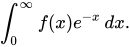
The Laguerre polynomials are also used for Gauss–Laguerre quadrature to numerically compute integrals of the form
∫
0
∞
f
(
x
)
e
−
x
d
x
.
{\displaystyle \int _{0}^{\infty }f(x)e^{-x}\,dx.}
These polynomials, usually denoted L 0 L 1 polynomial sequence which may be defined by the Rodrigues formula ,
L
n
(
x
)
=
e
x
n
!
d
n
d
x
n
(
e
−
x
x
n
)
=
1
n
!
(
d
d
x
−
1
)
n
x
n
,
{\displaystyle L_{n}(x)={\frac {e^{x}}{n!}}{\frac {d^{n}}{dx^{n}}}\left(e^{-x}x^{n}\right)={\frac {1}{n!}}\left({\frac {d}{dx}}-1\right)^{n}x^{n},}
reducing to the closed form of a following section.
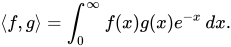
They are orthogonal polynomials with respect to an inner product
⟨
f
,
g
⟩
=
∫
0
∞
f
(
x
)
g
(
x
)
e
−
x
d
x
.
{\displaystyle \langle f,g\rangle =\int _{0}^{\infty }f(x)g(x)e^{-x}\,dx.}
The rook polynomials in combinatorics are more or less the same as Laguerre polynomials, up to elementary changes of variables. Further see the Tricomi–Carlitz polynomials .
The Laguerre polynomials arise in quantum mechanics, in the radial part of the solution of the Schrödinger equation for a one-electron atom. They also describe the static Wigner functions of oscillator systems in quantum mechanics in phase space . They further enter in the quantum mechanics of the Morse potential and of the 3D isotropic harmonic oscillator .
Physicists sometimes use a definition for the Laguerre polynomials that is larger by a factor of n ! than the definition used here. (Likewise, some physicists may use somewhat different definitions of the so-called associated Laguerre polynomials.)
The first few polynomials [ edit ] These are the first few Laguerre polynomials:
n
L
n
(
x
)
{\displaystyle L_{n}(x)\,}
0
1
{\displaystyle 1\,}
1
−
x
+
1
{\displaystyle -x+1\,}
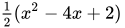
2
1
2
(
x
2
−
4
x
+
2
)
{\displaystyle {\tfrac {1}{2}}(x^{2}-4x+2)\,}
3
1
6
(
−
x
3
+
9
x
2
−
18
x
+
6
)
{\displaystyle {\tfrac {1}{6}}(-x^{3}+9x^{2}-18x+6)\,}
4
1
24
(
x
4
−
16
x
3
+
72
x
2
−
96
x
+
24
)
{\displaystyle {\tfrac {1}{24}}(x^{4}-16x^{3}+72x^{2}-96x+24)\,}
5
1
120
(
−
x
5
+
25
x
4
−
200
x
3
+
600
x
2
−
600
x
+
120
)
{\displaystyle {\tfrac {1}{120}}(-x^{5}+25x^{4}-200x^{3}+600x^{2}-600x+120)\,}
6
1
720
(
x
6
−
36
x
5
+
450
x
4
−
2400
x
3
+
5400
x
2
−
4320
x
+
720
)
{\displaystyle {\tfrac {1}{720}}(x^{6}-36x^{5}+450x^{4}-2400x^{3}+5400x^{2}-4320x+720)\,}
n
1
n
!
(
(
−
x
)
n
+
n
2
(
−
x
)
n
−
1
+
⋯
+
n
(
n
!
)
(
−
x
)
+
n
!
)
{\displaystyle {\tfrac {1}{n!}}((-x)^{n}+n^{2}(-x)^{n-1}+\dots +n({n!})(-x)+n!)\,}
The first six Laguerre polynomials. Recursive definition, closed form, and generating function [ edit ] One can also define the Laguerre polynomials recursively, defining the first two polynomials as
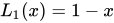
L
0
(
x
)
=
1
{\displaystyle L_{0}(x)=1}
L
1
(
x
)
=
1
−
x
{\displaystyle L_{1}(x)=1-x}
and then using the following
recurrence relation for any
k ≥ 1:
L
k
+
1
(
x
)
=
(
2
k
+
1
−
x
)
L
k
(
x
)
−
k
L
k
−
1
(
x
)
k
+
1
.
{\displaystyle L_{k+1}(x)={\frac {(2k+1-x)L_{k}(x)-kL_{k-1}(x)}{k+1}}.}
Furthermore,
x
L
n
′
(
x
)
=
n
L
n
(
x
)
−
n
L
n
−
1
(
x
)
.
{\displaystyle xL'_{n}(x)=nL_{n}(x)-nL_{n-1}(x).}
In solution of some boundary value problems, the characteristic values can be useful:
L
k
(
0
)
=
1
,
L
k
′
(
0
)
=
−
k
.
{\displaystyle L_{k}(0)=1,L_{k}'(0)=-k.}
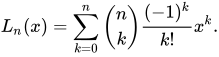
The closed form is
L
n
(
x
)
=
∑
k
=
0
n
(
n
k
)
(
−
1
)
k
k
!
x
k
.
{\displaystyle L_{n}(x)=\sum _{k=0}^{n}{\binom {n}{k}}{\frac {(-1)^{k}}{k!}}x^{k}.}
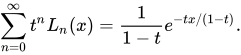
The generating function for them likewise follows,
∑
n
=
0
∞
t
n
L
n
(
x
)
=
1
1
−
t
e
−
t
x
/
(
1
−
t
)
.
{\displaystyle \sum _{n=0}^{\infty }t^{n}L_{n}(x)={\frac {1}{1-t}}e^{-tx/(1-t)}.}
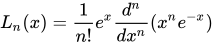
The operator form is
L
n
(
x
)
=
1
n
!
e
x
d
n
d
x
n
(
x
n
e
−
x
)
{\displaystyle L_{n}(x)={\frac {1}{n!}}e^{x}{\frac {d^{n}}{dx^{n}}}(x^{n}e^{-x})}
Polynomials of negative index can be expressed using the ones with positive index:
L
−
n
(
x
)
=
e
x
L
n
−
1
(
−
x
)
.
{\displaystyle L_{-n}(x)=e^{x}L_{n-1}(-x).}
Generalized Laguerre polynomials [ edit ] For arbitrary real α the polynomial solutions of the differential equation[2]
x
y
″
+
(
α
+
1
−
x
)
y
′
+
n
y
=
0
{\displaystyle x\,y''+\left(\alpha +1-x\right)y'+n\,y=0}
are called
generalized Laguerre polynomials , or
associated Laguerre polynomials .
One can also define the generalized Laguerre polynomials recursively, defining the first two polynomials as
L
0
(
α
)
(
x
)
=
1
{\displaystyle L_{0}^{(\alpha )}(x)=1}
L
1
(
α
)
(
x
)
=
1
+
α
−
x
{\displaystyle L_{1}^{(\alpha )}(x)=1+\alpha -x}
and then using the following recurrence relation for any k ≥ 1
L
k
+
1
(
α
)
(
x
)
=
(
2
k
+
1
+
α
−
x
)
L
k
(
α
)
(
x
)
−
(
k
+
α
)
L
k
−
1
(
α
)
(
x
)
k
+
1
.
{\displaystyle L_{k+1}^{(\alpha )}(x)={\frac {(2k+1+\alpha -x)L_{k}^{(\alpha )}(x)-(k+\alpha )L_{k-1}^{(\alpha )}(x)}{k+1}}.}
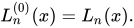
The simple Laguerre polynomials are the special case α = 0
L
n
(
0
)
(
x
)
=
L
n
(
x
)
.
{\displaystyle L_{n}^{(0)}(x)=L_{n}(x).}
The Rodrigues formula for them is
L
n
(
α
)
(
x
)
=
x
−
α
e
x
n
!
d
n
d
x
n
(
e
−
x
x
n
+
α
)
=
x
−
α
n
!
(
d
d
x
−
1
)
n
x
n
+
α
.
{\displaystyle L_{n}^{(\alpha )}(x)={x^{-\alpha }e^{x} \over n!}{d^{n} \over dx^{n}}\left(e^{-x}x^{n+\alpha }\right)={\frac {x^{-\alpha }}{n!}}\left({\frac {d}{dx}}-1\right)^{n}x^{n+\alpha }.}
The generating function for them is
∑
n
=
0
∞
t
n
L
n
(
α
)
(
x
)
=
1
(
1
−
t
)
α
+
1
e
−
t
x
/
(
1
−
t
)
.
{\displaystyle \sum _{n=0}^{\infty }t^{n}L_{n}^{(\alpha )}(x)={\frac {1}{(1-t)^{\alpha +1}}}e^{-tx/(1-t)}.}
The first few generalized Laguerre polynomials, Ln (k ) (x ) Explicit examples and properties of the generalized Laguerre polynomials [ edit ] Laguerre functions are defined by confluent hypergeometric functions and Kummer's transformation as[3]
L
n
(
α
)
(
x
)
:=
(
n
+
α
n
)
M
(
−
n
,
α
+
1
,
x
)
.
{\displaystyle L_{n}^{(\alpha )}(x):={n+\alpha \choose n}M(-n,\alpha +1,x).}
(
n
+
α
n
)
{\textstyle {n+\alpha \choose n}}
binomial coefficient . When n is an integer the function reduces to a polynomial of degree n . It has the alternative expression[4]
L
n
(
α
)
(
x
)
=
(
−
1
)
n
n
!
U
(
−
n
,
α
+
1
,
x
)
{\displaystyle L_{n}^{(\alpha )}(x)={\frac {(-1)^{n}}{n!}}U(-n,\alpha +1,x)}
Kummer's function of the second kind .
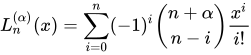
The closed form for these generalized Laguerre polynomials of degree n is[5]
L
n
(
α
)
(
x
)
=
∑
i
=
0
n
(
−
1
)
i
(
n
+
α
n
−
i
)
x
i
i
!
{\displaystyle L_{n}^{(\alpha )}(x)=\sum _{i=0}^{n}(-1)^{i}{n+\alpha \choose n-i}{\frac {x^{i}}{i!}}}
Leibniz's theorem for differentiation of a product to Rodrigues' formula.
Laguerre polynomials have a differential operator representation, much like the closely related Hermite polynomials. Namely, let
D
=
d
d
x
{\displaystyle D={\frac {d}{dx}}}
M
=
x
D
2
+
(
α
+
1
)
D
{\displaystyle M=xD^{2}+(\alpha +1)D}
exp
(
−
t
M
)
x
n
=
(
−
1
)
n
t
n
n
!
L
n
(
α
)
(
x
t
)
{\displaystyle \exp(-tM)x^{n}=(-1)^{n}t^{n}n!L_{n}^{(\alpha )}\left({\frac {x}{t}}\right)}
[citation needed
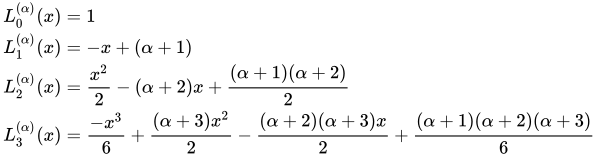
The first few generalized Laguerre polynomials are:
L
0
(
α
)
(
x
)
=
1
L
1
(
α
)
(
x
)
=
−
x
+
(
α
+
1
)
L
2
(
α
)
(
x
)
=
x
2
2
−
(
α
+
2
)
x
+
(
α
+
1
)
(
α
+
2
)
2
L
3
(
α
)
(
x
)
=
−
x
3
6
+
(
α
+
3
)
x
2
2
−
(
α
+
2
)
(
α
+
3
)
x
2
+
(
α
+
1
)
(
α
+
2
)
(
α
+
3
)
6
{\displaystyle {\begin{aligned}L_{0}^{(\alpha )}(x)&=1\\L_{1}^{(\alpha )}(x)&=-x+(\alpha +1)\\L_{2}^{(\alpha )}(x)&={\frac {x^{2}}{2}}-(\alpha +2)x+{\frac {(\alpha +1)(\alpha +2)}{2}}\\L_{3}^{(\alpha )}(x)&={\frac {-x^{3}}{6}}+{\frac {(\alpha +3)x^{2}}{2}}-{\frac {(\alpha +2)(\alpha +3)x}{2}}+{\frac {(\alpha +1)(\alpha +2)(\alpha +3)}{6}}\end{aligned}}}
The coefficient of the leading term is (−1)n n ! ;
The constant term , which is the value at 0, is
L
n
(
α
)
(
0
)
=
(
n
+
α
n
)
=
Γ
(
n
+
α
+
1
)
n
!
Γ
(
α
+
1
)
;
{\displaystyle L_{n}^{(\alpha )}(0)={n+\alpha \choose n}={\frac {\Gamma (n+\alpha +1)}{n!\,\Gamma (\alpha +1)}};}
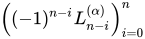
If α L n (α ) has n real , strictly positive roots (notice that
(
(
−
1
)
n
−
i
L
n
−
i
(
α
)
)
i
=
0
n
{\displaystyle \left((-1)^{n-i}L_{n-i}^{(\alpha )}\right)_{i=0}^{n}}
Sturm chain ), which are all in the interval
(
0
,
n
+
α
+
(
n
−
1
)
n
+
α
]
.
{\displaystyle \left(0,n+\alpha +(n-1){\sqrt {n+\alpha }}\,\right].}
[citation needed
The polynomials' asymptotic behaviour for large n , but fixed α and x > 0[6] [7]
L
n
(
α
)
(
x
)
=
n
α
2
−
1
4
π
e
x
2
x
α
2
+
1
4
sin
(
2
n
x
−
π
2
(
α
−
1
2
)
)
+
O
(
n
α
2
−
3
4
)
,
L
n
(
α
)
(
−
x
)
=
(
n
+
1
)
α
2
−
1
4
2
π
e
−
x
/
2
x
α
2
+
1
4
e
2
x
(
n
+
1
)
⋅
(
1
+
O
(
1
n
+
1
)
)
,
{\displaystyle {\begin{aligned}&L_{n}^{(\alpha )}(x)={\frac {n^{{\frac {\alpha }{2}}-{\frac {1}{4}}}}{\sqrt {\pi }}}{\frac {e^{\frac {x}{2}}}{x^{{\frac {\alpha }{2}}+{\frac {1}{4}}}}}\sin \left(2{\sqrt {nx}}-{\frac {\pi }{2}}\left(\alpha -{\frac {1}{2}}\right)\right)+O\left(n^{{\frac {\alpha }{2}}-{\frac {3}{4}}}\right),\\[6pt]&L_{n}^{(\alpha )}(-x)={\frac {(n+1)^{{\frac {\alpha }{2}}-{\frac {1}{4}}}}{2{\sqrt {\pi }}}}{\frac {e^{-x/2}}{x^{{\frac {\alpha }{2}}+{\frac {1}{4}}}}}e^{2{\sqrt {x(n+1)}}}\cdot \left(1+O\left({\frac {1}{\sqrt {n+1}}}\right)\right),\end{aligned}}}
L
n
(
α
)
(
x
n
)
n
α
≈
e
x
/
2
n
⋅
J
α
(
2
x
)
x
α
,
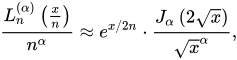
{\displaystyle {\frac {L_{n}^{(\alpha )}\left({\frac {x}{n}}\right)}{n^{\alpha }}}\approx e^{x/2n}\cdot {\frac {J_{\alpha }\left(2{\sqrt {x}}\right)}{{\sqrt {x}}^{\alpha }}},}
J
α
{\displaystyle J_{\alpha }}
Bessel function . As a contour integral [ edit ] Given the generating function specified above, the polynomials may be expressed in terms of a contour integral
L
n
(
α
)
(
x
)
=
1
2
π
i
∮
C
e
−
x
t
/
(
1
−
t
)
(
1
−
t
)
α
+
1
t
n
+
1
d
t
,
{\displaystyle L_{n}^{(\alpha )}(x)={\frac {1}{2\pi i}}\oint _{C}{\frac {e^{-xt/(1-t)}}{(1-t)^{\alpha +1}\,t^{n+1}}}\;dt,}
where the contour circles the origin once in a counterclockwise direction without enclosing the essential singularity at 1
Recurrence relations [ edit ] The addition formula for Laguerre polynomials:[8]
L
n
(
α
+
β
+
1
)
(
x
+
y
)
=
∑
i
=
0
n
L
i
(
α
)
(
x
)
L
n
−
i
(
β
)
(
y
)
.
{\displaystyle L_{n}^{(\alpha +\beta +1)}(x+y)=\sum _{i=0}^{n}L_{i}^{(\alpha )}(x)L_{n-i}^{(\beta )}(y).}
Laguerre's polynomials satisfy the recurrence relations
L
n
(
α
)
(
x
)
=
∑
i
=
0
n
L
n
−
i
(
α
+
i
)
(
y
)
(
y
−
x
)
i
i
!
,
{\displaystyle L_{n}^{(\alpha )}(x)=\sum _{i=0}^{n}L_{n-i}^{(\alpha +i)}(y){\frac {(y-x)^{i}}{i!}},}
in particular
L
n
(
α
+
1
)
(
x
)
=
∑
i
=
0
n
L
i
(
α
)
(
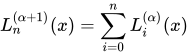
x
)
{\displaystyle L_{n}^{(\alpha +1)}(x)=\sum _{i=0}^{n}L_{i}^{(\alpha )}(x)}
and
L
n
(
α
)
(
x
)
=
∑
i
=
0
n
(
α
−
β
+
n
−
i
−
1
n
−
i
)
L
i
(
β
)
(
x
)
,
{\displaystyle L_{n}^{(\alpha )}(x)=\sum _{i=0}^{n}{\alpha -\beta +n-i-1 \choose n-i}L_{i}^{(\beta )}(x),}
or
L
n
(
α
)
(
x
)
=
∑
i
=
0
n
(
α
−
β
+
n
n
−
i
)
L
i
(
β
−
i
)
(
x
)
;
{\displaystyle L_{n}^{(\alpha )}(x)=\sum _{i=0}^{n}{\alpha -\beta +n \choose n-i}L_{i}^{(\beta -i)}(x);}
moreover
L
n
(
α
)
(
x
)
−
∑
j
=
0
Δ
−
1
(
n
+
α
n
−
j
)
(
−
1
)
j
x
j
j
!
=
(
−
1
)
Δ
x
Δ
(
Δ
−
1
)
!
∑
i
=
0
n
−
Δ
(
n
+
α
n
−
Δ
−
i
)
(
n
−
i
)
(
n
i
)
L
i
(
α
+
Δ
)
(
x
)
=
(
−
1
)
Δ
x
Δ
(
Δ
−
1
)
!
∑
i
=
0
n
−
Δ
(
n
+
α
−
i
−
1
n
−
Δ
−
i
)
(
n
−
i
)
(
n
i
)
L
i
(
n
+
α
+
Δ
−
i
)
(
x
)
{\displaystyle {\begin{aligned}L_{n}^{(\alpha )}(x)-\sum _{j=0}^{\Delta -1}{n+\alpha \choose n-j}(-1)^{j}{\frac {x^{j}}{j!}}&=(-1)^{\Delta }{\frac {x^{\Delta }}{(\Delta -1)!}}\sum _{i=0}^{n-\Delta }{\frac {n+\alpha \choose n-\Delta -i}{(n-i){n \choose i}}}L_{i}^{(\alpha +\Delta )}(x)\\[6pt]&=(-1)^{\Delta }{\frac {x^{\Delta }}{(\Delta -1)!}}\sum _{i=0}^{n-\Delta }{\frac {n+\alpha -i-1 \choose n-\Delta -i}{(n-i){n \choose i}}}L_{i}^{(n+\alpha +\Delta -i)}(x)\end{aligned}}}
They can be used to derive the four 3-point-rules
L
n
(
α
)
(
x
)
=
L
n
(
α
+
1
)
(
x
)
−
L
n
−
1
(
α
+
1
)
(
x
)
=
∑
j
=
0
k
(
k
j
)
(
−
1
)
j
L
n
−
j
(
α
+
k
)
(
x
)
,
n
L
n
(
α
)
(
x
)
=
(
n
+
α
)
L
n
−
1
(
α
)
(
x
)
−
x
L
n
−
1
(
α
+
1
)
(
x
)
,
or
x
k
k
!
L
n
(
α
)
(
x
)
=
∑
i
=
0
k
(
−
1
)
i
(
n
+
i
i
)
(
n
+
α
k
−
i
)
L
n
+
i
(
α
−
k
)
(
x
)
,
n
L
n
(
α
+
1
)
(
x
)
=
(
n
−
x
)
L
n
−
1
(
α
+
1
)
(
x
)
+
(
n
+
α
)
L
n
−
1
(
α
)
(
x
)
x
L
n
(
α
+
1
)
(
x
)
=
(
n
+
α
)
L
n
−
1
(
α
)
(
x
)
−
(
n
−
x
)
L
n
(
α
)
(
x
)
;
{\displaystyle {\begin{aligned}L_{n}^{(\alpha )}(x)&=L_{n}^{(\alpha +1)}(x)-L_{n-1}^{(\alpha +1)}(x)=\sum _{j=0}^{k}{k \choose j}(-1)^{j}L_{n-j}^{(\alpha +k)}(x),\\[10pt]nL_{n}^{(\alpha )}(x)&=(n+\alpha )L_{n-1}^{(\alpha )}(x)-xL_{n-1}^{(\alpha +1)}(x),\\[10pt]&{\text{or }}\\{\frac {x^{k}}{k!}}L_{n}^{(\alpha )}(x)&=\sum _{i=0}^{k}(-1)^{i}{n+i \choose i}{n+\alpha \choose k-i}L_{n+i}^{(\alpha -k)}(x),\\[10pt]nL_{n}^{(\alpha +1)}(x)&=(n-x)L_{n-1}^{(\alpha +1)}(x)+(n+\alpha )L_{n-1}^{(\alpha )}(x)\\[10pt]xL_{n}^{(\alpha +1)}(x)&=(n+\alpha )L_{n-1}^{(\alpha )}(x)-(n-x)L_{n}^{(\alpha )}(x);\end{aligned}}}
combined they give this additional, useful recurrence relations
L
n
(
α
)
(
x
)
=
(
2
+
α
−
1
−
x
n
)
L
n
−
1
(
α
)
(
x
)
−
(
1
+
α
−
1
n
)
L
n
−
2
(
α
)
(
x
)
=
α
+
1
−
x
n
L
n
−
1
(
α
+
1
)
(
x
)
−
x
n
L
n
−
2
(
α
+
2
)
(
x
)
{\displaystyle {\begin{aligned}L_{n}^{(\alpha )}(x)&=\left(2+{\frac {\alpha -1-x}{n}}\right)L_{n-1}^{(\alpha )}(x)-\left(1+{\frac {\alpha -1}{n}}\right)L_{n-2}^{(\alpha )}(x)\\[10pt]&={\frac {\alpha +1-x}{n}}L_{n-1}^{(\alpha +1)}(x)-{\frac {x}{n}}L_{n-2}^{(\alpha +2)}(x)\end{aligned}}}
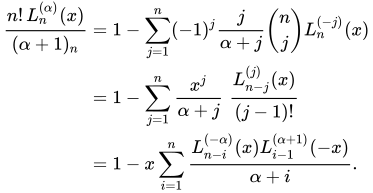
Since
L
n
(
α
)
(
x
)
{\displaystyle L_{n}^{(\alpha )}(x)}
n
{\displaystyle n}
α
{\displaystyle \alpha }
partial fraction decomposition
n
!
L
n
(
α
)
(
x
)
(
α
+
1
)
n
=
1
−
∑
j
=
1
n
(
−
1
)
j
j
α
+
j
(
n
j
)
L
n
(
−
j
)
(
x
)
=
1
−
∑
j
=
1
n
x
j
α
+
j
L
n
−
j
(
j
)
(
x
)
(
j
−
1
)
!
=
1
−
x
∑
i
=
1
n
L
n
−
i
(
−
α
)
(
x
)
L
i
−
1
(
α
+
1
)
(
−
x
)
α
+
i
.
{\displaystyle {\begin{aligned}{\frac {n!\,L_{n}^{(\alpha )}(x)}{(\alpha +1)_{n}}}&=1-\sum _{j=1}^{n}(-1)^{j}{\frac {j}{\alpha +j}}{n \choose j}L_{n}^{(-j)}(x)\\&=1-\sum _{j=1}^{n}{\frac {x^{j}}{\alpha +j}}\,\,{\frac {L_{n-j}^{(j)}(x)}{(j-1)!}}\\&=1-x\sum _{i=1}^{n}{\frac {L_{n-i}^{(-\alpha )}(x)L_{i-1}^{(\alpha +1)}(-x)}{\alpha +i}}.\end{aligned}}}
The second equality follows by the following identity, valid for integer
i and
n and immediate from the expression of
L
n
(
α
)
(
x
)
{\displaystyle L_{n}^{(\alpha )}(x)}
in terms of
Charlier polynomials :
(
−
x
)
i
i
!
L
n
(
i
−
n
)
(
x
)
=
(
−
x
)
n
n
!
L
i
(
n
−
i
)
(
x
)
.
{\displaystyle {\frac {(-x)^{i}}{i!}}L_{n}^{(i-n)}(x)={\frac {(-x)^{n}}{n!}}L_{i}^{(n-i)}(x).}
For the third equality apply the fourth and fifth identities of this section.
Derivatives of generalized Laguerre polynomials [ edit ] Differentiating the power series representation of a generalized Laguerre polynomial k times leads to
d
k
d
x
k
L
n
(
α
)
(
x
)
=
{
(
−
1
)
k
L
n
−
k
(
α
+
k
)
(
x
)
if
k
≤
n
,
0
otherwise.
{\displaystyle {\frac {d^{k}}{dx^{k}}}L_{n}^{(\alpha )}(x)={\begin{cases}(-1)^{k}L_{n-k}^{(\alpha +k)}(x)&{\text{if }}k\leq n,\\0&{\text{otherwise.}}\end{cases}}}
This points to a special case (α = 0α = k
L
n
(
k
)
(
x
)
=
(
−
1
)
k
d
k
L
n
+
k
(
x
)
d
x
k
,
{\displaystyle L_{n}^{(k)}(x)=(-1)^{k}{\frac {d^{k}L_{n+k}(x)}{dx^{k}}},}
the shift by
k sometimes causing confusion with the usual parenthesis notation for a derivative.
Moreover, the following equation holds:
1
k
!
d
k
d
x
k
x
α
L
n
(
α
)
(
x
)
=
(
n
+
α
k
)
x
α
−
k
L
n
(
α
−
k
)
(
x
)
,
{\displaystyle {\frac {1}{k!}}{\frac {d^{k}}{dx^{k}}}x^{\alpha }L_{n}^{(\alpha )}(x)={n+\alpha \choose k}x^{\alpha -k}L_{n}^{(\alpha -k)}(x),}
which generalizes with
Cauchy's formula to
L
n
(
α
′
)
(
x
)
=
(
α
′
−
α
)
(
α
′
+
n
α
′
−
α
)
∫
0
x
t
α
(
x
−
t
)
α
′
−
α
−
1
x
α
′
L
n
(
α
)
(
t
)
d
t
.
{\displaystyle L_{n}^{(\alpha ')}(x)=(\alpha '-\alpha ){\alpha '+n \choose \alpha '-\alpha }\int _{0}^{x}{\frac {t^{\alpha }(x-t)^{\alpha '-\alpha -1}}{x^{\alpha '}}}L_{n}^{(\alpha )}(t)\,dt.}
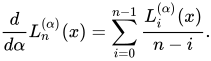
The derivative with respect to the second variable α has the form,[9]
d
d
α
L
n
(
α
)
(
x
)
=
∑
i
=
0
n
−
1
L
i
(
α
)
(
x
)
n
−
i
.
{\displaystyle {\frac {d}{d\alpha }}L_{n}^{(\alpha )}(x)=\sum _{i=0}^{n-1}{\frac {L_{i}^{(\alpha )}(x)}{n-i}}.}
This is evident from the contour integral representation below.
The generalized Laguerre polynomials obey the differential equation
x
L
n
(
α
)
′
′
(
x
)
+
(
α
+
1
−
x
)
L
n
(
α
)
′
(
x
)
+
n
L
n
(
α
)
(
x
)
=
0
,
{\displaystyle xL_{n}^{(\alpha )\prime \prime }(x)+(\alpha +1-x)L_{n}^{(\alpha )\prime }(x)+nL_{n}^{(\alpha )}(x)=0,}
which may be compared with the equation obeyed by the
k th derivative of the ordinary Laguerre polynomial,
x
L
n
[
k
]
′
′
(
x
)
+
(
k
+
1
−
x
)
L
n
[
k
]
′
(
x
)
+
(
n
−
k
)
L
n
[
k
]
(
x
)
=
0
,
{\displaystyle xL_{n}^{[k]\prime \prime }(x)+(k+1-x)L_{n}^{[k]\prime }(x)+(n-k)L_{n}^{[k]}(x)=0,}
where
L
n
[
k
]
(
x
)
≡
d
k
L
n
(
x
)
d
x
k
{\displaystyle L_{n}^{[k]}(x)\equiv {\frac {d^{k}L_{n}(x)}{dx^{k}}}}
for this equation only.
In Sturm–Liouville form the differential equation is
−
(
x
α
+
1
e
−
x
⋅
L
n
(
α
)
(
x
)
′
)
′
=
n
⋅
x
α
e
−
x
⋅
L
n
(
α
)
(
x
)
,
{\displaystyle -\left(x^{\alpha +1}e^{-x}\cdot L_{n}^{(\alpha )}(x)^{\prime }\right)'=n\cdot x^{\alpha }e^{-x}\cdot L_{n}^{(\alpha )}(x),}
which shows that L (α) n n .
Orthogonality [ edit ] The generalized Laguerre polynomials are orthogonal over [0, ∞) with respect to the measure with weighting function xα e −x [10]
∫
0
∞
x
α
e
−
x
L
n
(
α
)
(
x
)
L
m
(
α
)
(
x
)
d
x
=
Γ
(
n
+
α
+
1
)
n
!
δ
n
,
m
,
{\displaystyle \int _{0}^{\infty }x^{\alpha }e^{-x}L_{n}^{(\alpha )}(x)L_{m}^{(\alpha )}(x)dx={\frac {\Gamma (n+\alpha +1)}{n!}}\delta _{n,m},}
which follows from
∫
0
∞
x
α
′
−
1
e
−
x
L
n
(
α
)
(
x
)
d
x
=
(
α
−
α
′
+
n
n
)
Γ
(
α
′
)
.
{\displaystyle \int _{0}^{\infty }x^{\alpha '-1}e^{-x}L_{n}^{(\alpha )}(x)dx={\alpha -\alpha '+n \choose n}\Gamma (\alpha ').}
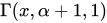
If
Γ
(
x
,
α
+
1
,
1
)
{\displaystyle \Gamma (x,\alpha +1,1)}
∫
0
∞
L
n
(
α
)
(
x
)
L
m
(
α
)
(
x
)
Γ
(
x
,
α
+
1
,
1
)
d
x
=
(
n
+
α
n
)
δ
n
,
m
,
{\displaystyle \int _{0}^{\infty }L_{n}^{(\alpha )}(x)L_{m}^{(\alpha )}(x)\Gamma (x,\alpha +1,1)dx={n+\alpha \choose n}\delta _{n,m},}
The associated, symmetric kernel polynomial has the representations (Christoffel–Darboux formula )[citation needed
K
n
(
α
)
(
x
,
y
)
:=
1
Γ
(
α
+
1
)
∑
i
=
0
n
L
i
(
α
)
(
x
)
L
i
(
α
)
(
y
)
(
α
+
i
i
)
=
1
Γ
(
α
+
1
)
L
n
(
α
)
(
x
)
L
n
+
1
(
α
)
(
y
)
−
L
n
+
1
(
α
)
(
x
)
L
n
(
α
)
(
y
)
x
−
y
n
+
1
(
n
+
α
n
)
=
1
Γ
(
α
+
1
)
∑
i
=
0
n
x
i
i
!
L
n
−
i
(
α
+
i
)
(
x
)
L
n
−
i
(
α
+
i
+
1
)
(
y
)
(
α
+
n
n
)
(
n
i
)
;
{\displaystyle {\begin{aligned}K_{n}^{(\alpha )}(x,y)&:={\frac {1}{\Gamma (\alpha +1)}}\sum _{i=0}^{n}{\frac {L_{i}^{(\alpha )}(x)L_{i}^{(\alpha )}(y)}{\alpha +i \choose i}}\\[4pt]&={\frac {1}{\Gamma (\alpha +1)}}{\frac {L_{n}^{(\alpha )}(x)L_{n+1}^{(\alpha )}(y)-L_{n+1}^{(\alpha )}(x)L_{n}^{(\alpha )}(y)}{{\frac {x-y}{n+1}}{n+\alpha \choose n}}}\\[4pt]&={\frac {1}{\Gamma (\alpha +1)}}\sum _{i=0}^{n}{\frac {x^{i}}{i!}}{\frac {L_{n-i}^{(\alpha +i)}(x)L_{n-i}^{(\alpha +i+1)}(y)}{{\alpha +n \choose n}{n \choose i}}};\end{aligned}}}
recursively
K
n
(
α
)
(
x
,
y
)
=
y
α
+
1
K
n
−
1
(
α
+
1
)
(
x
,
y
)
+
1
Γ
(
α
+
1
)
L
n
(
α
+
1
)
(
x
)
L
n
(
α
)
(
y
)
(
α
+
n
n
)
.
{\displaystyle K_{n}^{(\alpha )}(x,y)={\frac {y}{\alpha +1}}K_{n-1}^{(\alpha +1)}(x,y)+{\frac {1}{\Gamma (\alpha +1)}}{\frac {L_{n}^{(\alpha +1)}(x)L_{n}^{(\alpha )}(y)}{\alpha +n \choose n}}.}
Moreover,[clarification needed
y
α
e
−
y
K
n
(
α
)
(
⋅
,
y
)
→
δ
(
y
−
⋅
)
.
{\displaystyle y^{\alpha }e^{-y}K_{n}^{(\alpha )}(\cdot ,y)\to \delta (y-\cdot ).}
Turán's inequalities can be derived here, which is
L
n
(
α
)
(
x
)
2
−
L
n
−
1
(
α
)
(
x
)
L
n
+
1
(
α
)
(
x
)
=
∑
k
=
0
n
−
1
(
α
+
n
−
1
n
−
k
)
n
(
n
k
)
L
k
(
α
−
1
)
(
x
)
2
>
0.
{\displaystyle L_{n}^{(\alpha )}(x)^{2}-L_{n-1}^{(\alpha )}(x)L_{n+1}^{(\alpha )}(x)=\sum _{k=0}^{n-1}{\frac {\alpha +n-1 \choose n-k}{n{n \choose k}}}L_{k}^{(\alpha -1)}(x)^{2}>0.}
The following integral is needed in the quantum mechanical treatment of the hydrogen atom ,
∫
0
∞
x
α
+
1
e
−
x
[
L
n
(
α
)
(
x
)
]
2
d
x
=
(
n
+
α
)
!
n
!
(
2
n
+
α
+
1
)
.
{\displaystyle \int _{0}^{\infty }x^{\alpha +1}e^{-x}\left[L_{n}^{(\alpha )}(x)\right]^{2}dx={\frac {(n+\alpha )!}{n!}}(2n+\alpha +1).}
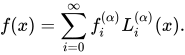
Series expansions [ edit ] Let a function have the (formal) series expansion
f
(
x
)
=
∑
i
=
0
∞
f
i
(
α
)
L
i
(
α
)
(
x
)
.
{\displaystyle f(x)=\sum _{i=0}^{\infty }f_{i}^{(\alpha )}L_{i}^{(\alpha )}(x).}
Then
f
i
(
α
)
=
∫
0
∞
L
i
(
α
)
(
x
)
(
i
+
α
i
)
⋅
x
α
e
−
x
Γ
(
α
+
1
)
⋅
f
(
x
)
d
x
.
{\displaystyle f_{i}^{(\alpha )}=\int _{0}^{\infty }{\frac {L_{i}^{(\alpha )}(x)}{i+\alpha \choose i}}\cdot {\frac {x^{\alpha }e^{-x}}{\Gamma (\alpha +1)}}\cdot f(x)\,dx.}
The series converges in the associated Hilbert space L 2 [0, ∞)if and only if
‖
f
‖
L
2
2
:=
∫
0
∞
x
α
e
−
x
Γ
(
α
+
1
)
|
f
(
x
)
|
2
d
x
=
∑
i
=
0
∞
(
i
+
α
i
)
|
f
i
(
α
)
|
2
<
∞
.
{\displaystyle \|f\|_{L^{2}}^{2}:=\int _{0}^{\infty }{\frac {x^{\alpha }e^{-x}}{\Gamma (\alpha +1)}}|f(x)|^{2}\,dx=\sum _{i=0}^{\infty }{i+\alpha \choose i}|f_{i}^{(\alpha )}|^{2}<\infty .}
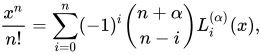
Further examples of expansions [ edit ] Monomials are represented as
x
n
n
!
=
∑
i
=
0
n
(
−
1
)
i
(
n
+
α
n
−
i
)
L
i
(
α
)
(
x
)
,
{\displaystyle {\frac {x^{n}}{n!}}=\sum _{i=0}^{n}(-1)^{i}{n+\alpha \choose n-i}L_{i}^{(\alpha )}(x),}
while
binomials have the parametrization
(
n
+
x
n
)
=
∑
i
=
0
n
α
i
i
!
L
n
−
i
(
x
+
i
)
(
α
)
.
{\displaystyle {n+x \choose n}=\sum _{i=0}^{n}{\frac {\alpha ^{i}}{i!}}L_{n-i}^{(x+i)}(\alpha ).}
This leads directly to
e
−
γ
x
=
∑
i
=
0
∞
γ
i
(
1
+
γ
)
i
+
α
+
1
L
i
(
α
)
(
x
)
convergent iff
ℜ
(
γ
)
>
−
1
2
{\displaystyle e^{-\gamma x}=\sum _{i=0}^{\infty }{\frac {\gamma ^{i}}{(1+\gamma )^{i+\alpha +1}}}L_{i}^{(\alpha )}(x)\qquad {\text{convergent iff }}\Re (\gamma )>-{\tfrac {1}{2}}}
for the exponential function. The
incomplete gamma function has the representation
Γ
(
α
,
x
)
=
x
α
e
−
x
∑
i
=
0
∞
L
i
(
α
)
(
x
)
1
+
i
(
ℜ
(
α
)
>
−
1
,
x
>
0
)
.
{\displaystyle \Gamma (\alpha ,x)=x^{\alpha }e^{-x}\sum _{i=0}^{\infty }{\frac {L_{i}^{(\alpha )}(x)}{1+i}}\qquad \left(\Re (\alpha )>-1,x>0\right).}
In quantum mechanics [ edit ] In quantum mechanics the Schrödinger equation for the hydrogen-like atom is exactly solvable by separation of variables in spherical coordinates. The radial part of the wave function is a (generalized) Laguerre polynomial.[11]
Vibronic transitions in the Franck-Condon approximation can also be described using Laguerre polynomials.[12]
Multiplication theorems [ edit ] Erdélyi gives the following two multiplication theorems [13]
t
n
+
1
+
α
e
(
1
−
t
)
z
L
n
(
α
)
(
z
t
)
=
∑
k
=
n
∞
(
k
n
)
(
1
−
1
t
)
k
−
n
L
k
(
α
)
(
z
)
,
e
(
1
−
t
)
z
L
n
(
α
)
(
z
t
)
=
∑
k
=
0
∞
(
1
−
t
)
k
z
k
k
!
L
n
(
α
+
k
)
(
z
)
.
{\displaystyle {\begin{aligned}&t^{n+1+\alpha }e^{(1-t)z}L_{n}^{(\alpha )}(zt)=\sum _{k=n}^{\infty }{k \choose n}\left(1-{\frac {1}{t}}\right)^{k-n}L_{k}^{(\alpha )}(z),\\[6pt]&e^{(1-t)z}L_{n}^{(\alpha )}(zt)=\sum _{k=0}^{\infty }{\frac {(1-t)^{k}z^{k}}{k!}}L_{n}^{(\alpha +k)}(z).\end{aligned}}}
Relation to Hermite polynomials [ edit ] The generalized Laguerre polynomials are related to the Hermite polynomials :
H
2
n
(
x
)
=
(
−
1
)
n
2
2
n
n
!
L
n
(
−
1
/
2
)
(
x
2
)
H
2
n
+
1
(
x
)
=
(
−
1
)
n
2
2
n
+
1
n
!
x
L
n
(
1
/
2
)
(
x
2
)
{\displaystyle {\begin{aligned}H_{2n}(x)&=(-1)^{n}2^{2n}n!L_{n}^{(-1/2)}(x^{2})\\[4pt]H_{2n+1}(x)&=(-1)^{n}2^{2n+1}n!xL_{n}^{(1/2)}(x^{2})\end{aligned}}}
where the
H n x ) are the
Hermite polynomials based on the weighting function
exp(−x 2 ) , the so-called "physicist's version."
Because of this, the generalized Laguerre polynomials arise in the treatment of the quantum harmonic oscillator .
Relation to hypergeometric functions [ edit ] The Laguerre polynomials may be defined in terms of hypergeometric functions , specifically the confluent hypergeometric functions , as
L
n
(
α
)
(
x
)
=
(
n
+
α
n
)
M
(
−
n
,
α
+
1
,
x
)
=
(
α
+
1
)
n
n
!
1
F
1
(
−
n
,
α
+
1
,
x
)
{\displaystyle L_{n}^{(\alpha )}(x)={n+\alpha \choose n}M(-n,\alpha +1,x)={\frac {(\alpha +1)_{n}}{n!}}\,_{1}F_{1}(-n,\alpha +1,x)}
where
(
a
)
n
{\displaystyle (a)_{n}}
is the
Pochhammer symbol (which in this case represents the rising factorial).
Hardy–Hille formula [ edit ] The generalized Laguerre polynomials satisfy the Hardy–Hille formula[14] [15]
∑
n
=
0
∞
n
!
Γ
(
α
+
1
)
Γ
(
n
+
α
+
1
)
L
n
(
α
)
(
x
)
L
n
(
α
)
(
y
)
t
n
=
1
(
1
−
t
)
α
+
1
e
−
(
x
+
y
)
t
/
(
1
−
t
)
0
F
1
(
;
α
+
1
;
x
y
t
(
1
−
t
)
2
)
,
{\displaystyle \sum _{n=0}^{\infty }{\frac {n!\,\Gamma \left(\alpha +1\right)}{\Gamma \left(n+\alpha +1\right)}}L_{n}^{(\alpha )}(x)L_{n}^{(\alpha )}(y)t^{n}={\frac {1}{(1-t)^{\alpha +1}}}e^{-(x+y)t/(1-t)}\,_{0}F_{1}\left(;\alpha +1;{\frac {xyt}{(1-t)^{2}}}\right),}
where the series on the left converges for
α
>
−
1
{\displaystyle \alpha >-1}
and
|
t
|
<
1
{\displaystyle |t|<1}
. Using the identity
0
F
1
(
;
α
+
1
;
z
)
=
Γ
(
α
+
1
)
z
−
α
/
2
I
α
(
2
z
)
,
{\displaystyle \,_{0}F_{1}(;\alpha +1;z)=\,\Gamma (\alpha +1)z^{-\alpha /2}I_{\alpha }\left(2{\sqrt {z}}\right),}
(see
generalized hypergeometric function ), this can also be written as
∑
n
=
0
∞
n
!
Γ
(
1
+
α
+
n
)
L
n
(
α
)
(
x
)
L
n
(
α
)
(
y
)
t
n
=
1
(
x
y
t
)
α
/
2
(
1
−
t
)
e
−
(
x
+
y
)
t
/
(
1
−
t
)
I
α
(
2
x
y
t
1
−
t
)
.
{\displaystyle \sum _{n=0}^{\infty }{\frac {n!}{\Gamma (1+\alpha +n)}}L_{n}^{(\alpha )}(x)L_{n}^{(\alpha )}(y)t^{n}={\frac {1}{(xyt)^{\alpha /2}(1-t)}}e^{-(x+y)t/(1-t)}I_{\alpha }\left({\frac {2{\sqrt {xyt}}}{1-t}}\right).}
This formula is a generalization of the
Mehler kernel for
Hermite polynomials , which can be recovered from it by using the relations between Laguerre and Hermite polynomials given above.
Physics Convention [ edit ] The generalized Laguerre polynomials are used to describe the quantum wavefunction for hydrogen atom orbitals.[16] [17] [18] [19]
L
n
(
α
)
(
x
)
=
Γ
(
α
+
n
+
1
)
Γ
(
α
+
1
)
n
!
1
F
1
(
−
n
;
α
+
1
;
x
)
,
{\displaystyle L_{n}^{(\alpha )}(x)={\frac {\Gamma (\alpha +n+1)}{\Gamma (\alpha +1)n!}}\,_{1}F_{1}(-n;\alpha +1;x),}
where
1
F
1
(
a
;
b
;
x
)
{\displaystyle \,_{1}F_{1}(a;b;x)}
confluent hypergeometric function .
In the physics literature,[18]
L
¯
n
(
α
)
(
x
)
=
[
Γ
(
α
+
n
+
1
)
]
2
Γ
(
α
+
1
)
n
!
1
F
1
(
−
n
;
α
+
1
;
x
)
.
{\displaystyle {\bar {L}}_{n}^{(\alpha )}(x)={\frac {\left[\Gamma (\alpha +n+1)\right]^{2}}{\Gamma (\alpha +1)n!}}\,_{1}F_{1}(-n;\alpha +1;x).}
The physics version is related to the standard version by
L
¯
n
(
α
)
(
x
)
=
(
n
+
α
)
!
L
n
(
α
)
(
x
)
.
{\displaystyle {\bar {L}}_{n}^{(\alpha )}(x)=(n+\alpha )!L_{n}^{(\alpha )}(x).}
There is yet another, albeit less frequently used, convention in the physics literature [20] [21] [22]
L
~
n
(
α
)
(
x
)
=
(
−
1
)
α
L
¯
n
−
α
(
α
)
.
{\displaystyle {\tilde {L}}_{n}^{(\alpha )}(x)=(-1)^{\alpha }{\bar {L}}_{n-\alpha }^{(\alpha )}.}
Umbral Calculus Convention [ edit ] Generalized Laguerre polynomials are linked to Umbral calculus by being Sheffer sequences for
D
/
(
D
−
I
)
{\displaystyle D/(D-I)}
n
!
{\displaystyle n!}
[23]
L
n
(
x
)
=
n
!
L
n
(
−
1
)
(
x
)
=
∑
k
=
0
n
L
(
n
,
k
)
(
−
x
)
k
{\displaystyle {\mathcal {L}}_{n}(x)=n!L_{n}^{(-1)}(x)=\sum _{k=0}^{n}L(n,k)(-x)^{k}}
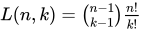
where
L
(
n
,
k
)
=
(
n
−
1
k
−
1
)
n
!
k
!
{\textstyle L(n,k)={\binom {n-1}{k-1}}{\frac {n!}{k!}}}
are the signless
Lah numbers .
(
L
n
(
x
)
)
n
∈
N
{\textstyle ({\mathcal {L}}_{n}(x))_{n\in \mathbb {N} }}
is a sequence of polynomials of
binomial type ,
ie they satisfy
L
n
(
x
+
y
)
=
∑
k
=
0
n
(
n
k
)
L
k
(
x
)
L
n
−
k
(
y
)
{\displaystyle {\mathcal {L}}_{n}(x+y)=\sum _{k=0}^{n}{\binom {n}{k}}{\mathcal {L}}_{k}(x){\mathcal {L}}_{n-k}(y)}
See also [ edit ]
^ N. Sonine (1880). "Recherches sur les fonctions cylindriques et le développement des fonctions continues en séries" . Math. Ann. 16 (1): 1–80. doi :10.1007/BF01459227 . S2CID 121602983 . ^ A&S p. 781
^ A&S p. 509
^ A&S p. 510
^ A&S p. 775
^ Szegő, p. 198.
^ D. Borwein, J. M. Borwein, R. E. Crandall, "Effective Laguerre asymptotics", SIAM J. Numer. Anal. , vol. 46 (2008), no. 6, pp. 3285–3312 doi :10.1137/07068031X
^ A&S equation (22.12.6), p. 785
^ Koepf, Wolfram (1997). "Identities for families of orthogonal polynomials and special functions". Integral Transforms and Special Functions . 5 (1–2): 69–102. CiteSeerX 10.1.1.298.7657 doi :10.1080/10652469708819127 . ^ "Associated Laguerre Polynomial" .^ Ratner, Schatz, Mark A., George C. (2001). Quantum Mechanics in Chemistry . 0-13-895491-7: Prentice Hall. pp. 90–91. {{cite book }}: CS1 maint: location (link ) CS1 maint: multiple names: authors list (link )^ Jong, Mathijs de; Seijo, Luis; Meijerink, Andries; Rabouw, Freddy T. (2015-06-24). "Resolving the ambiguity in the relation between Stokes shift and Huang–Rhys parameter" . Physical Chemistry Chemical Physics . 17 (26): 16959–16969. Bibcode :2015PCCP...1716959D . doi :10.1039/C5CP02093J . hdl :1874/321453 ISSN 1463-9084 . PMID 26062123 . S2CID 34490576 . ^ C. Truesdell, "On the Addition and Multiplication Theorems for the Special Functions ", Proceedings of the National Academy of Sciences, Mathematics , (1950) pp. 752–757.
^ Szegő, p. 102.
^ W. A. Al-Salam (1964), "Operational representations for Laguerre and other polynomials" , Duke Math J. 31 (1): 127–142.
^ Griffiths, David J. (2005). Introduction to quantum mechanics (2nd ed.). Upper Saddle River, NJ: Pearson Prentice Hall. ISBN 0131118927 ^ Sakurai, J. J. (2011). Modern quantum mechanics (2nd ed.). Boston: Addison-Wesley. ISBN 978-0805382914 ^ a b Merzbacher, Eugen (1998). Quantum mechanics (3rd ed.). New York: Wiley. ISBN 0471887021 ^ Abramowitz, Milton (1965). Handbook of mathematical functions, with formulas, graphs, and mathematical tables . New York: Dover Publications. ISBN 978-0-486-61272-0 ^ Schiff, Leonard I. (1968). Quantum mechanics (3d ed.). New York: McGraw-Hill. ISBN 0070856435 ^ Messiah, Albert (2014). Quantum Mechanics . Dover Publications. ISBN 9780486784557 ^ Boas, Mary L. (2006). Mathematical methods in the physical sciences (3rd ed.). Hoboken, NJ: Wiley. ISBN 9780471198260 ^ Rota, Gian-Carlo; Kahaner, D; Odlyzko, A (1973-06-01). "On the foundations of combinatorial theory. VIII. Finite operator calculus" . Journal of Mathematical Analysis and Applications . 42 (3): 684–760. doi :10.1016/0022-247X(73)90172-8 ISSN 0022-247X .
References [ edit ] Abramowitz, Milton ; Stegun, Irene Ann , eds. (1983) [June 1964]. "Chapter 22" . Handbook of Mathematical Functions with Formulas, Graphs, and Mathematical Tables ISBN 978-0-486-61272-0 LCCN 64-60036 . MR 0167642 . LCCN 65-12253 .G. Szegő, Orthogonal polynomials , 4th edition, Amer. Math. Soc. Colloq. Publ. , vol. 23, Amer. Math. Soc., Providence, RI, 1975.
Koornwinder, Tom H.; Wong, Roderick S. C.; Koekoek, Roelof; Swarttouw, René F. (2010), "Orthogonal Polynomials" , in Olver, Frank W. J. ; Lozier, Daniel M.; Boisvert, Ronald F.; Clark, Charles W. (eds.), NIST Handbook of Mathematical Functions ISBN 978-0-521-19225-5 MR 2723248 B. Spain, M.G. Smith, Functions of mathematical physics , Van Nostrand Reinhold Company, London, 1970. Chapter 10 deals with Laguerre polynomials.
"Laguerre polynomials" , Encyclopedia of Mathematics EMS Press , 2001 [1994]Eric W. Weisstein , "Laguerre Polynomial ", From MathWorld—A Wolfram Web Resource.George Arfken and Hans Weber (2000). Mathematical Methods for Physicists . Academic Press. ISBN 978-0-12-059825-0 External links [ edit ]
International National Other



_with_n_as_-1_divided_by_9_and_x_as_z_to_the_power_of_4_from_-2-2i_to_2%2B2i.svg)






























![{\displaystyle \left(0,n+\alpha +(n-1){\sqrt {n+\alpha }}\,\right].}](https://wikimedia.org/api/rest_v1/media/math/render/svg/268387cf6ed314caa46b2a11e87acbaf9695875d)
![{\displaystyle {\begin{aligned}&L_{n}^{(\alpha )}(x)={\frac {n^{{\frac {\alpha }{2}}-{\frac {1}{4}}}}{\sqrt {\pi }}}{\frac {e^{\frac {x}{2}}}{x^{{\frac {\alpha }{2}}+{\frac {1}{4}}}}}\sin \left(2{\sqrt {nx}}-{\frac {\pi }{2}}\left(\alpha -{\frac {1}{2}}\right)\right)+O\left(n^{{\frac {\alpha }{2}}-{\frac {3}{4}}}\right),\\[6pt]&L_{n}^{(\alpha )}(-x)={\frac {(n+1)^{{\frac {\alpha }{2}}-{\frac {1}{4}}}}{2{\sqrt {\pi }}}}{\frac {e^{-x/2}}{x^{{\frac {\alpha }{2}}+{\frac {1}{4}}}}}e^{2{\sqrt {x(n+1)}}}\cdot \left(1+O\left({\frac {1}{\sqrt {n+1}}}\right)\right),\end{aligned}}}](https://wikimedia.org/api/rest_v1/media/math/render/svg/a65232999dd61f4298266965f24f79d6d0923b05)






![{\displaystyle {\begin{aligned}L_{n}^{(\alpha )}(x)-\sum _{j=0}^{\Delta -1}{n+\alpha \choose n-j}(-1)^{j}{\frac {x^{j}}{j!}}&=(-1)^{\Delta }{\frac {x^{\Delta }}{(\Delta -1)!}}\sum _{i=0}^{n-\Delta }{\frac {n+\alpha \choose n-\Delta -i}{(n-i){n \choose i}}}L_{i}^{(\alpha +\Delta )}(x)\\[6pt]&=(-1)^{\Delta }{\frac {x^{\Delta }}{(\Delta -1)!}}\sum _{i=0}^{n-\Delta }{\frac {n+\alpha -i-1 \choose n-\Delta -i}{(n-i){n \choose i}}}L_{i}^{(n+\alpha +\Delta -i)}(x)\end{aligned}}}](https://wikimedia.org/api/rest_v1/media/math/render/svg/e449381aff6f2b593def172ab03c17cb1bb57dfb)
![{\displaystyle {\begin{aligned}L_{n}^{(\alpha )}(x)&=L_{n}^{(\alpha +1)}(x)-L_{n-1}^{(\alpha +1)}(x)=\sum _{j=0}^{k}{k \choose j}(-1)^{j}L_{n-j}^{(\alpha +k)}(x),\\[10pt]nL_{n}^{(\alpha )}(x)&=(n+\alpha )L_{n-1}^{(\alpha )}(x)-xL_{n-1}^{(\alpha +1)}(x),\\[10pt]&{\text{or }}\\{\frac {x^{k}}{k!}}L_{n}^{(\alpha )}(x)&=\sum _{i=0}^{k}(-1)^{i}{n+i \choose i}{n+\alpha \choose k-i}L_{n+i}^{(\alpha -k)}(x),\\[10pt]nL_{n}^{(\alpha +1)}(x)&=(n-x)L_{n-1}^{(\alpha +1)}(x)+(n+\alpha )L_{n-1}^{(\alpha )}(x)\\[10pt]xL_{n}^{(\alpha +1)}(x)&=(n+\alpha )L_{n-1}^{(\alpha )}(x)-(n-x)L_{n}^{(\alpha )}(x);\end{aligned}}}](https://wikimedia.org/api/rest_v1/media/math/render/svg/ff755ad59b503998c9e8898cb25b5ff1545520d7)
![{\displaystyle {\begin{aligned}L_{n}^{(\alpha )}(x)&=\left(2+{\frac {\alpha -1-x}{n}}\right)L_{n-1}^{(\alpha )}(x)-\left(1+{\frac {\alpha -1}{n}}\right)L_{n-2}^{(\alpha )}(x)\\[10pt]&={\frac {\alpha +1-x}{n}}L_{n-1}^{(\alpha +1)}(x)-{\frac {x}{n}}L_{n-2}^{(\alpha +2)}(x)\end{aligned}}}](https://wikimedia.org/api/rest_v1/media/math/render/svg/fc32e1d35979f9126c29a1b4fe1d3ae723d4641d)








![{\displaystyle xL_{n}^{[k]\prime \prime }(x)+(k+1-x)L_{n}^{[k]\prime }(x)+(n-k)L_{n}^{[k]}(x)=0,}](https://wikimedia.org/api/rest_v1/media/math/render/svg/18d6805dbdf16f74423e00fc23ca5ea675eabd49)
![{\displaystyle L_{n}^{[k]}(x)\equiv {\frac {d^{k}L_{n}(x)}{dx^{k}}}}](https://wikimedia.org/api/rest_v1/media/math/render/svg/94adaf2e2b6fca61a722420bcb1a66576e10593a)




![{\displaystyle {\begin{aligned}K_{n}^{(\alpha )}(x,y)&:={\frac {1}{\Gamma (\alpha +1)}}\sum _{i=0}^{n}{\frac {L_{i}^{(\alpha )}(x)L_{i}^{(\alpha )}(y)}{\alpha +i \choose i}}\\[4pt]&={\frac {1}{\Gamma (\alpha +1)}}{\frac {L_{n}^{(\alpha )}(x)L_{n+1}^{(\alpha )}(y)-L_{n+1}^{(\alpha )}(x)L_{n}^{(\alpha )}(y)}{{\frac {x-y}{n+1}}{n+\alpha \choose n}}}\\[4pt]&={\frac {1}{\Gamma (\alpha +1)}}\sum _{i=0}^{n}{\frac {x^{i}}{i!}}{\frac {L_{n-i}^{(\alpha +i)}(x)L_{n-i}^{(\alpha +i+1)}(y)}{{\alpha +n \choose n}{n \choose i}}};\end{aligned}}}](https://wikimedia.org/api/rest_v1/media/math/render/svg/bdbc06de0ef9a87d70e951a09cacec0b7da13396)



![{\displaystyle \int _{0}^{\infty }x^{\alpha +1}e^{-x}\left[L_{n}^{(\alpha )}(x)\right]^{2}dx={\frac {(n+\alpha )!}{n!}}(2n+\alpha +1).}](https://wikimedia.org/api/rest_v1/media/math/render/svg/0bb8646b87b220d879aec2c64ff9e7e15228b32a)





![{\displaystyle {\begin{aligned}&t^{n+1+\alpha }e^{(1-t)z}L_{n}^{(\alpha )}(zt)=\sum _{k=n}^{\infty }{k \choose n}\left(1-{\frac {1}{t}}\right)^{k-n}L_{k}^{(\alpha )}(z),\\[6pt]&e^{(1-t)z}L_{n}^{(\alpha )}(zt)=\sum _{k=0}^{\infty }{\frac {(1-t)^{k}z^{k}}{k!}}L_{n}^{(\alpha +k)}(z).\end{aligned}}}](https://wikimedia.org/api/rest_v1/media/math/render/svg/419e3fd18bf2b0ef484d747b9670be1f38888684)
![{\displaystyle {\begin{aligned}H_{2n}(x)&=(-1)^{n}2^{2n}n!L_{n}^{(-1/2)}(x^{2})\\[4pt]H_{2n+1}(x)&=(-1)^{n}2^{2n+1}n!xL_{n}^{(1/2)}(x^{2})\end{aligned}}}](https://wikimedia.org/api/rest_v1/media/math/render/svg/015273f34e288fc1847a90dd793e433e9dbb23d0)









![{\displaystyle {\bar {L}}_{n}^{(\alpha )}(x)={\frac {\left[\Gamma (\alpha +n+1)\right]^{2}}{\Gamma (\alpha +1)n!}}\,_{1}F_{1}(-n;\alpha +1;x).}](https://wikimedia.org/api/rest_v1/media/math/render/svg/12bfdcde9315fd8f61b7556fb8b93652a9ba59f2)