


Lyndhurst (mansion)
Lyndhurst (Jay Gould Estate) | |
.jpg) The front facade of Lyndhurst | |
 Interactive house showing Lyndhurst’s location | |
| Location | Tarrytown, New York, U.S. |
|---|---|
| Nearest city | White Plains, New York, U.S. |
| Coordinates | 41°03′14.3″N 73°52′02.2″W / 41.053972°N 73.867278°W |
| Area | 67 acres (27 ha) |
| Built | 1838 |
| Architect | Alexander Jackson Davis |
| Architectural style | Gothic Revival |
| Website | www.lyndhurst.org |
| NRHP reference No. | 66000582 |
| NYSRHP No. | 11950.000006 |
| Significant dates | |
| Added to NRHP | November 13, 1966[2] |
| Designated NHL | November 13, 1966[1] |
| Designated NYSRHP | June 23, 1980 |
Lyndhurst, also known as the Jay Gould estate, is a Gothic Revival country house that sits in its own 67-acre (27 ha) park beside the Hudson River in Tarrytown, New York, about a half mile south of the Tappan Zee Bridge on US 9. The house was designated a National Historic Landmark in 1966.[3][4]
History[edit]
The home was designed in 1838 by Alexander Jackson Davis, and owned in succession by New York City mayor William Paulding Jr., merchant George Merritt, and railroad tycoon Jay Gould.
Paulding named his house "Knoll", although critics quickly dubbed it "Paulding's Folly" because of its unusual design that includes fanciful turrets and asymmetrical outline. Its limestone exterior was quarried at Sing Sing in present-day Ossining, New York.
Merritt, the house's second owner, engaged Davis as his architect, and in 1864–1865 doubled the size of the house, renaming it "Lyndenhurst" after the estate's linden trees. Davis' new north wing included an imposing four-story tower, a new porte-cochere (the old one was reworked as a glass-walled vestibule), a new dining room, two bedrooms and servants' quarters.
Gould purchased the property in 1880 to use as a country house, shortened its name to "Lyndhurst" and sometimes spelled it "Lindhurst;[5] he occupied it until his death in 1892. In 1961, Gould's daughter Anna Gould donated it to the National Trust for Historic Preservation. The house is now open to the public.
Architecture[edit]

Lyndhurst's rooms are strongly Gothic in character. Hallways are narrow, windows small and sharply arched, and ceilings are fantastically peaked, vaulted, and ornamented. The effect is at once gloomy, somber, and highly romantic; the large, double-height art gallery provides a contrast of light and space.
The house sits within a landscape park, designed in the English naturalistic style by Ferdinand Mangold, whom Merritt hired. Mangold drained the surrounding swamps, created lawns, planted specimen trees, and built a conservatory. The park is an outstanding example of 19th-century landscape design with a curving entrance drive that reveals "surprise" views of rolling lawns accented with shrubs and specimen trees. The 390-foot-long (120 m) onion-domed, iron-framed, glass conservatory was one of the largest privately owned greenhouses in the United States when constructed.[6]
In popular culture[edit]
- ABC's holiday television film The Halloween That Almost Wasn't (1979), a.k.a. The Night Dracula Saved the World, was shot here. The scenes were used as the backdrop for both Count Dracula and the Witch's castle. It later aired on the Disney Channel during its Halloween season, until the late 1990s.
- From 1992 until the program changed filming locations from New York to Los Angeles in 2009, Lyndhurst served as the exterior of “Wildwind,” the home of Dimitri Marick, in establishing shots on the ABC daytime drama All My Children. Elements of Lyndhurst's interior architecture influenced the design of the Wildwind sets.
- Lyndhurst was the set for the movies House of Dark Shadows (1970) and Night of Dark Shadows (1971), both based on the gothic soap opera Dark Shadows. It is also seen in Reversal of Fortune (1990) and Gloria (1999).[7]
- The History Channel's The Men Who Built America filmed at Lyndhurst in the summer of 2012.[8]
- Winter's Tale (2013) was filmed at Lyndhurst in January 2013.[9]
- Lyndhurst was featured on Season 1, Episode 3 of Travel Channel's Castle Secrets & Legends series (original airdate February 9, 2014).[10]
- Lyndhurst was also used as a filming location for ABC's Forever in 2014, using the cottage on the property for exterior shots.
- Lyndhurst's landscape, bowling alley, and mansion interior were used as a filming location for NBC's The Blacklist, starring James Spader.
- In 2017, the Lifetime series Project Runway filmed an episode at Lyndhurst, challenging the designers to draw inspiration from the exteriors and gardens.
- The 2021 and 2022 Westminster Kennel Club Dog Show was held outdoors at Lyndhurst on account of concerns about the COVID-19 pandemic in New York City.
- Lyndhurst serves as a filming location for The Gilded Age. The mansion interior serves as the home of the character Aurora Fane and her husband, and the Lyndhurst Carriage House is the location of the New York Globe offices. Season 1 also featured the Lyndhurst grounds and greenhouse. The ferry terminal in the series' premiere episode was modeled after the Lyndhurst Bowling Alley.
- Arcadia, the debut album by the american singer-songwriter and producer Caroline Polachek under the name Ramona Lisa, has the mansion on the album cover.
Gallery[edit]
-
 Gould's office
 -
 The north library
 -
 A dining room fireplace
 -
 A view from the front park
 -
 The estate in bloom
 -
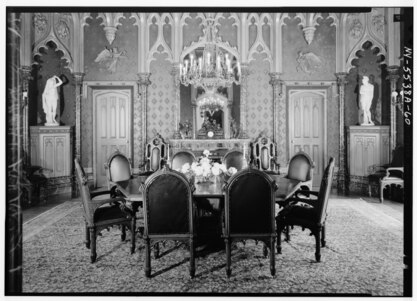 View of dining room to north, Lyndhurst, Main House
 -
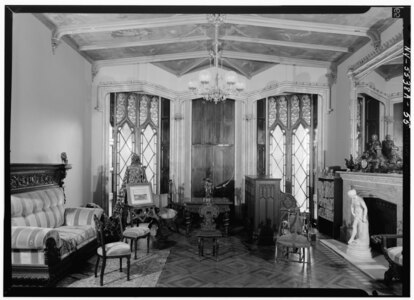 View music room from east, Lyndhurst, Main House




See also[edit]
- List of National Historic Landmarks in New York
- National Register of Historic Places listings in northern Westchester County, New York
References[edit]
Notes
- ^ "Lyndhurst". National Historic Landmark summary listing. National Park Service. Archived from the original on March 22, 2009. Retrieved September 15, 2007.
- ^ "National Register Information System". National Register of Historic Places. National Park Service. March 13, 2009.
- ^ "Jay Gould Estate (Lyndhurst)". National Historic Landmark summary listing. National Park Service. Archived from the original on March 22, 2009. Retrieved September 15, 2007.
- ^ Richard Greenwood (May 30, 1975), National Register of Historic Places Inventory-Nomination: Jay Gould Estate, Lyndhurst, National Park Service and Accompanying photos, exterior, 1975 and undated. (3.32 MB)
- ^ Gould, Jay (January 23, 1890). Catalogue of books: forming the library of Jay Gould, Lindhurst, Irvington-on-Hudson, prepared by John Thomson. Philadelphia: Globe Printing House, 1890.
- ^ Great Houses of the Hudson River, Michael Dwyer, editor, with a preface by Mark Rockefeller, Boston, MA: Little, Brown and Company, 2001.
- ^ "Lyndhurst Earning Keep as a Film Site". The New York Times. November 30, 1997. Retrieved February 11, 2014.
- ^ "Lyndhurst Closed Friday For Documentary Filming". Tarrytown-Sleepy Hollow Patch. July 2, 2012. Retrieved February 11, 2014.
- ^ "Hollywood Snow Falls on Lyndhurst". Rye Patch. January 29, 2013. Retrieved February 11, 2014.
- ^ "Hound of the Baskervilles, Lord Gordon Gordon, Escape from Colditz". Castle Secrets & Legends. Travel Channel. February 9, 2014. Retrieved February 11, 2014.
Further reading
- Dwyer, Michael Middleton, editor (2001) Great Houses of the Hudson River, Preface by Mark Rockefeller. Boston, Massachusetts: Little, Brown and Company in association with Historic Hudson Valley ISBN 0-8212-2767-X.
External links[edit]

- Official website
- Historic American Buildings Survey (HABS) No. NY-5538-A, "Lyndhurst, Main House, 635 South Broadway, Tarrytown, Westchester County, NY", 98 photos, 16 measured drawings, 5 data pages, 6 photo caption pages
- HABS No. NY-5538-B, "Lyndhurst, Greenhouse", 38 photos, 5 data pages, 4 photo caption pages
- HABS No. NY-5538-C, "Lyndhurst, Outbuildings", 8 photos, 2 color transparencies, 3 photo caption pages
- HABS No. NY-5538-D, "Lyndhurst, Stables", 5 photos, 1 photo caption page
- HABS No. NY-5538-E, "Lyndhurst, Swimming Pool", 4 photos, 1 photo caption page
- HABS No. NY-5538-F, "Lyndhurst, Boat Landing", 3 photos, 1 photo caption page


| National | |
|---|---|
| Geographic | |
| Other | |

- Houses on the National Register of Historic Places in New York (state)
- National Historic Landmarks in New York (state)
- National Register of Historic Places in Westchester County, New York
- Gothic Revival architecture in New York (state)
- Houses completed in 1838
- Tarrytown, New York
- U.S. Route 9
- Alexander Jackson Davis buildings
- Historic house museums in Westchester County, New York
- Biographical museums in New York (state)
- Hudson River Valley National Heritage Area
- Historic American Buildings Survey in New York (state)
- National Trust for Historic Preservation
- Gould family residences
- Gilded Age mansions
- New York State Register of Historic Places in Westchester County