Mang'u High School

From Wikipedia, the free encyclopedia
Jump to: navigation, search

Mang'u High School is a prestigious Kenyan National High School established in 1925, located in Kiambu County along the Nairobi-Thika Highway six kilometres from Thika, Kenya.

The current Principal is Mr. Henry Raichenah, DSM.

Mang'u High School
Mang'u High School logo

Contents

[edit] History

Mang'u High School was started in 1925 at Kabaa by a Dutch priest, Father Michael Witte, C.S.Sp. of the Holy Ghost Fathers (Spiritans as they were known in Continental Europe) . On 2nd July, 1913 the first priest moved to Kabaa to start a mission on a 5-acre piece of land. This mission was abandoned in 1920 due to lack of sufficient converts. By then, a Catholic mission had been established at Kilungu. At this mission, Father Michael Joseph Witte C.S.Sp., a Dutch, was running a Central School for Catechists in 1923. It was decided to expand this school to a Central Training School for Catechists. Fr. Witte and his superior at Kilungu, Fr. Horber decided that the expanded school was not suited at Kilungu for several reasons. They suggested Mang'u, Riruta or Kabaa. Fr. Witte was more liberal in thinking and chose Kabaa. The choice was approved by the Bishop. His choice of Kabaa was because he wanted to be far away from the ecclesiastical and civil authorities and could use his initiative to get things done.

On 15th September, 1924 Fr. Witte accompanied by Fr. Blais set off for Kabaa. Fr. Witte was a very happy man because he had at last found the challenge and freedom he had always wanted to have in order to do something for the Africans. He re-occupied the evacuated mission to set up a Catholic Central School. The birth of the school was unplanned and haphazard especially the choice of the site: a deserted mission site that is remote. At the site, the two priests were assisted by a local catechist, Yakobo, who had been looking after the abandoned mission church. Fr. Witte also recruited a Muganda called Bartolomeo to assist them. The obtained building materials (wattle poles and sisal poles) from White Sisters at Mang'u and the sisal farms at Donyo Sabuk, respectively.

On 15th December, 1924, Fr. Witte announced opening of the school though this did not happen due to delay in completion of the buildings. Fr. Witte wrote a new circular to every Catholic Parish informing them that Kabaa School would now open on 15th January 1925. With a light touch, the circular said in part “....among other things, the pupils were to meet him at Thika from where they were to walk with him 34 miles to Kabaa and begin clearing the site to build their houses, for Kabaa was an unbuilt school”.

On 19th January, 1925 the school opened with 35 pupils, drawn from Bura, Msongari (St. Austin’s), Mangu, Kiambu, Lioki and St. Peter Claver’s Nairobi. Some of the pupils had reached standard 4 while others were nearly illiterate except for little religious knowledge. 19th January to 24th January, 1925: a retreat was organised for all pupils after which they were all made to sign the “Promise” to complete a 3-year course and to give 5-year service to Catholic Missions.

THE PROMISE:For the glory of God and for the redemption of our bretheren, we promise before God and before our priests to follow this three-year course (without a salary, receiving only clothes and food) and after that, to serve the schools as our priests shall direct, for five years.”

According to Fr. Witte, the official date of birth was 24th January, 1925, after the swearing in the students. Some students deserted during February but by 18th March, the school had 43 pupils. Enrollment:

  • 1925 - 45 pupils
  • 1926 - 80 pupils
  • 1927 – 120 pupils
  • 1928 – 145 pupils

First staff: Fr. Michael J. Witte, Brother Egidius Schisphorst (Dutch), mason cum technical teacher (27-11-1925), Brother Florian (Dutch) to teach capentry (April 1927), Mr. Oomen (Dec. 1927) a lay teacher to take care of school farm and teach agriculture, Fr. Michael Murren (28-10-1928) to teach high school and Bro. Savinus – Building projects (before 1930) The mission was Named St. Michael Catholic Mission.

[edit] Kabaa curriculum

1. Academic subjects: Religion (Old Testament, catechism and prayer), Arithmetic, Swahili, English, Geography, Hygiene, Physical Education, Singing, Music, General Knowledge (including History), Games and Manners.

2. Technical Subjects: Agriculture, Building, Masonry, Brick making, Carpentry, Ironwork, Pottery, Local crafts, Engineering, Shoe making, Tailoring, Drawing, Typing, Book-binding, Spinning and weaving.

3. Vocational programmes: Teacher Training – training catechists Novitiate for training lay brothers (1927) Junior seminary (1927)

The official medium of instruction was Kiswahili. Francis J. Khamisi attended brotherhood and the seminary.

[edit] Early academic performance

The first public examination was the Vernacular Examination of 1926. It was Swahili and was done on 11th October 1926. 32 out of 35 pupils passed.

In December 1926, during the Standard 7 Elementary C Examination, 32 out of 33 candidates passed.

In December 1927, the B-Teacher Grade, 50 candidates entered and 90% passed.

In 1928, B-Teacher Grade, 34 passed from Kabaa of the 140 nationwide. C-Teacher Grade, 16 passed from Kabaa of the 22 nationwide.

[edit] Discipline

According to Fr. Witte, a pupil who did not accept a few strokes of the cane when found at fault was considered to be the wrong sort, since no punishment was ever given arbitrarily or in anger at Kabaa. It was an accepted procedure that before punishment was meted out by or before the principal, the fault of the defender was first carefully considered by a council of fellow students, after which the culprit was made to see that he had been in the wrong. Only then was the punishment administered, usually before all the boys. Father Witte would say that “You are sentenced by common consent of your peers, and only after recognizing your guilt”. Punishments included caning and watering or manuring the trees and flowers. Under no circumstances did he allow work on the farm or regular forms of manual labour to be used as punishment; he wished boys to like those activities as one of the most important aspects of their education. Pupils found at fault at night were sent to the chapel to pray and ask God’s pardon for their waywardness, while Fr. Witte kept watch. He always went to bed late. There were few rules but strictly enforced:

  • Juniors were not allowed to mix with senior boys; habitual breaking of bounds resulted in dismissal.
  • No one was allowed to go out alone but in pairs or in 3’s.
  • Anyone found loitering or sitting idle was due for punishment.

An interesting fact is that till today Juniors and Seniors are still differentiated in uniforms, dining and bedtimes. Seniors also have a separate route known as "Senior Route" to the dorms which Juniors are not allowed to use. The students must also ran to class whenever the bell rings.

[edit] The School Motto

The school motto was “JISHINDE USHINDE”. It was chosen to stress the role of discipline at school and in life generally. Translated “Conquer yourself so that you may conquer”. It also means: One must discipline oneself even in small things if one is to succeed. Initially Kabaa was more intent on producing teachers because they felt this was the most urgent need of the Catholics; Alliance (started in 1926) aimed at African education.

[edit] START OF THE CATHOLIC HIGH SCHOOL

The Catholics wanted to start a High School but faced opposition from the protestants who had already been allowed to start Alliance High School (Kenya). The Government was also delay darling over the issue. They even proposed that the Catholics should be accommodated at Alliance but the protestants made it difficult for such a proposal to be implemented. The Catholics thought of starting the school in Limuru. The Government delayed in approving a grant for the school. Meanwhile, Fr. Witte had quietly started a pilot class of four pupils in 1929. The pioneers were: Cyrillus Ojoo, Paul Njoroge, Stefan Kimani, Lukas Kibe. In January 1930 Fr. Witte started the High School officially by ignoring the delaying tactics of the Government. 27 boys started the first class. At the end of 1930, the 4 pioneer students sat the Public Examination called Junior Secondary School Examination. All of them passed. In 1933 a few pupils attempted the Senior Secondary Examination. After that the school concentrated on Junior Secondary curriculum.

[edit] Fr. Michael Joseph Witte’s Departure

On 30th April 1934, the ‘Captain’ as he was sometimes referred to, left Kabaa to procede home on leave. On 1st May 1934 he left Nairobi by train for Mombasa where he was to board a ship to Europe. He expected to come back to Kabaa after his leave. Bishop Heffernan decided to transfer him to Waa School, formerly an unsuccessful school at the coast which had been handed over to the Catholics early in 1935. Since he was a man of great zeal, it was thought he would turn this school around, the same way he developed Kabaa. He was replaced by Fr. Alfonsus Loogman C.S.Sp., also a Dutch. In 1937 up to sometime in 1938, Fr. Paul White C.S.Sp., an Irish priest took over as Principal. The era of the Dutch thus ended and the Irish Holy Ghost Fathers took over.

The seminary was closed at the end of 1937. Its only candidate, Paul Njoroge, was sent to Rome where he studied and was ordained a priest in 1942. Unfortunately he died there of T.B. in 1944 shortly before his planned return to Kenya. The seminary was re-started in 1938 with 3 young recruits but was moved elsewhere in the Vicariate a few years later. Fr. Robert Farrelly took over the headship of the school in 1938, after Fr. Paul White left for further studies in London.

[edit] Senior Secondary Class re-established

Starting in 1940, Cambridge School Certificate Examination was to replace the Kenya Senior Secondary Examination. This development encouraged the Catholic Authorities to re-establish the Senior Secondary section at Kabaa in 1939. The best three pupils from the 1938 Junior Secondary class were enrolled in Form 3. These were: Stephen Kioni, Philip Getao and Hilary Oduol. Hilary dropped out of the course during the course of the year. The other two were later to be transferred to Mangu along with the whole school at the end of that year and became the first Cambridge School Certificate candidates of Kabaa-Mangu High School. They sat the examination at Mangu at the end of 1940 and both of them passed. Kioni was admitted to Makerere College.

[edit] THE BIRTH OF MANG'U HIGH SCHOOL

After school Inspectors visited Kabaa and made recommendations, the Department of Education in 1934 requested that Kabaa be decentralised as follows: Kabaa retains a primary boarding school, A secondary school be transferred to another centre. Bishop Hoffernan resisted the idea at the beginning. He fered that splitting the school would make the primary school lose out on Government grant as only one school would be funded. Thus decentralisation delayed until the Catholics saw their way of going about it.

The Brothers Noviciate had disbanded years before. The institutions that were at Kabaa at the beginning of 1938 were: The secondary school, The Elementary Teacher Training Centre, The Lower Primary Teacher Training Centra, The Elementary Out-School, The Primary School and The Technical School

The Catholics decided that the Secondary School should move to a more accessible place. The Principal, Fr. Farrelly with two other priests were asked to search for a suitable site. Machakos was suggested but rejected on the following grounds:Land was not readily available, The Local Native Council appeared reluctant to consider the matter, The African Inland Mission that was already in the area opposed the idea.

9th October 1938 – The 3 priests visited Mang'u mission to consider the site. 11th October 1938 – They chose Mang'u as the site for the High School. 13th October 1938 – The news was broken to the staff at Kabaa. Some priests didn’t like the idea, reason being “difficult in maintaining discipline among the boys in such a heavily populated area like Mangu. Many outsiders would be there on Sundays and would be mixing with students and therefore problems would arise.” They suggested a plot 3 miles away near the White Sisters Convent but the Sisters objected. Eventually Mang'u was confirmed.

[edit] Construction of the school

On 5th February 1939 drawings were done at Kabaa by An Architect, Mr. Ward who had visited Kabaa. Apprentices from the Native Industrial Training Depot (N.I.T.D.) were hired to undertake the construction. Brother Savinus and a European supervisor were part of the team. Work started and the school was built almost entirely using funds from the Bishop’s own sources. The Catholic authorities stopped funding of buildings because “Kabaa had not abided by some of the decisions of the Vicariate Council..”. At Mangu only classrooms and dormitories had been built. No staff houses were built. When the High School moved to the new site, the staff had to put up with little accommodation that there was. The Principal’s small office doubled up as his bedroom. The other priests had to use small rooms. The situation remained like that in the early years.

[edit] The High School moves

The transfer of equipment had to be done before the short rains. The school at Kabaa was closed early, in the third week of November,1939. Only pupils sitting public examinations remained behind. All high school boys were directed to report to Mang'u after the holidays. The other sections of Kabaa were to go back to Kabaa pending their transfer to other places later. The High School moved out of Kabaa at the end of 1939. Fr. Paul White who had returned from his studies stayed at Kabaa to head the remaining sections. Fr. Farrelly moved to Mang'u as Principal, together with Fr. P. Kelly and Fr. G. Foley. All the other teachers remained at Kabaa. The Mangu staff was reinforced with the appointment of Mr. Ignatius Mkok (an old boy of Kabaa) who had just completed his teacher’s course at Makerere College.

[edit] HOLY GHOST COLLEGE MANGU

“The end of 1939 saw the bowing out the era of the ‘battleship’ and 1940 ushered in the era of the conventional school.” The school started with a completely different tempo and on a different note from that of the old Kabaa. It was named the Holy Ghost College Mang'u. It was under the management of the Holy Ghost Fathers (Spiritans) from Ireland. Even a new motto: “FIDES ET SCIENTIA” was coined which is also used by the Roman Catholic High School of Philadelphia meaning "Faith and Knowledge." On the surface the objectives themselves appear to have been different, except in the basic Catholic principles over which there could be no disagreement. It was like starting all over again, even though officially Kabaa High School had merely been transferred to a new site and the change of name was necessary only to avoid confusion. The three Irish priests who made up the first staff saw the change real and a complete break with Kabaa. They did not want any of Fr. Witte’s unorthodox ideas to seep into Mang'u. None of the mad rush to get quick results: hurry and tight schedules were not to be part of Mang'u life. Mang'u was to be a typical Irish school where approach was to be on the lines of gradual but sure development, laying the current foundations for conventional academic excellence and truly a Catholic atmosphere. The difference in approach between Fr. Witte and of the Irish priests at Mang'u was that:

  • The Irish believed in a school of the “European” type right here in Africa (with minor modifications)
  • Fr. Witte – employed inventiveness and originality to try and get an approach that would suit and appeal to Africans, even if such an approach were going to be unorthodox by European concepts and standards.

Each one of the above approaches had its strong points.

[edit] Opening of the school

The school opened its doors for the first term, on 11th January 1940. 49 pupils reported. Form 1:19, Form 2:22, Form 3:6 and Form 4:2. Many Form 3’s who were in Form 2 at Kabaa had dropped out. In Form 4, the two were: Philip Gitau and Stephen Kioni. The third student from Kabaa, H.P. Oduol had dropped out in 1939 and joined the East African Railways and Harbours Corporation. Gitau became the first school captain of Mangu. The first pupils were well pleased with their “new luxurious school” despite the numerous teething problems. The school was occupying part of the mission land and some coffee had to be uprooted to create a playing field. The problems of a new site were numerous. Fr. Farrelly was so overwhelmed by the challenges that he asked to be relieved of the responsibilities of being principal. He went back to Kabaa to teach under Fr. P. White. Fr. Peter J. Kelly C.S.Sp. was appointed new Principal from 11th February 1940. The break out of the war caused stress on the priests at Mangu. They were given extra responsibilities of taking care of some missions that had been deserted e.g. Mangu, Gatanga and Rocho. This led to frequent “free days” sometimes with picnics, Holydays of obligation, significantly St. Patrick’s Day which took similar importance as St. Michael’s Day at Kabaa during Fr. Witte’s time. (St. Patrick is the patron saint of Ireland). Sunday afternoons were always free for walks and boys would walk as far as Thika and Ndarugu. Evenings were not exhaustively utilized for studies. These activities wore down students at the expense of learning especially on Mondays.

There was great stress on religious observance at Mang'u. Retreats were frequent. All mass feasts were observed liturgically according to the Church calendar, complete with appropriate hymns, church music and recitals sang by the boys. Protestants who wished to join the church choir were free to do so. An example is that of Karuga Koinange who knows all the hymns and chants. Many records at that time were of religious character and few details on academic activities. The stress on religion resulted in some pupils deciding to go to the seminary after sitting Cambridge exams. Maurice Michael Otunga, after sitting Cambridge exams in 1943, joined the seminary to train as a priest. John Njenga did the same at a later date.

Protestants were required to go to church but were not coerced into converting to Catholicism, though some did it voluntarily. Many developed a high opinion of the religious fervour of the Catholics at Mangu. These include: Karuga Koinange, James Maura, Samuel Waruhiu. According to Fr. John Joseph O’Meara: Mangu’s objective was to “ produce solid Catholics, men of good character who would be good and responsible citizens of the contemporary world; men of high principles who saw the need to practice self denial to urges even in small things, and who would be able to stand up for what they believed to be right”. These had been the aims of Fr. Michael J. Witte at Kabaa, and are still the aims of every Catholic School worth the name.

Due to the war and financial constraints the government could not give building grant to the school. During 3rd term, Mr. Mkok, the only African teacher became disgruntled. He was not housed in school because there were no houses. He was earning an official salary of shs.70 per month; he demanded shs120 p.m. because he was teaching 7 lessons a day and was staying outside the school. He could not be reconciled and was dismissed on 17th October 1940. Fr. Farrelly and Mr. Cyrillus Ojoo (an old boy of Kabaa) came in from Kabaa to help out due to shortage of staff. Mr. Ojoo stayed on the following year as replacement for Mr. Mkok.

1940 At the end of the year, two classes sat public examinations: The Junior Secondary class (Form 2), The Cambridge class (Form 4) with two candidates. This examination was spread out over many days partly because the candidates needed to copy out their answers to provide a spare copy so that in case the original copies were sank on the ship on their way to England (it was war time) the extra copy would be used instead. Both pupils passed making the first Cambridge results of Kabaa-Mangu High School 100% success. Stephen Kioni proceeded to Makerere College. Philip Gitau could not make it; he died not long after. The Junior Secondary class, 10 out of 20 who sat passed (50%). 5 qualified to proceed to senior secondary (Form 3) but only one was anxious to join Form 3.

1941 The school opened on 17th January with 31 boys. By February the number had increased to 40. During the year, The Franciscan Nuns arrived from Uganda to open a convent, a dispensary and a primary school for girls opposite Mangu boys school. At year end, only 1 out of 5 passed Cambridge and 12 out of 17 passed Junior Secondary exam. The Kabaa-Mangu Old Boys Association was inaugurated on 12th October 1941.

1942 The school opened on 17th January with 30 boys. At the end of the year, 2 out of 4 passed Cambridge, 6 out of 12 passed Junior Secondary exams and only 1 of the Cambridge class passed the Makerere entrance exam. Mangu had qualified staff but the school did not place examinations foremost in its practices (not a bad educational approach). 9th June 1942 Fr. Peter J. Kelly, the Principal transferred to Bura. In his place, Fr. John Joseph O’Meara C.S.Sp. was appointed the new Principal. The mission was merged with the school and Fr. Murren was appointed local superior of the whole place and also the bursar.

1943 This was a difficult year because of the war and famine. It was difficult to satisfy the boys food needs and grambling was common. At one stage all Form 2 were sent home except 2 of them. At beginning of 2nd term 7 were re-admitted. The situation improved in 3rd term when the Maize Control Board placed the school on its ration programme of one pound of maize per pupil per day. Football became a very important part of Mang'u High School. In co-curricular activities, Titus Wambogo took 2nd place in Inter-Territorial Essay Competition in April and Maurice Michael Otunga took 1st prize in Swahili Essay Competition. Shortly after sitting Cambridge Examinations he walked out of Mang'u straight into the Major Seminary at Kakamega without waiting for his results. This frustrated his father’s ambition of making him his successor as Chief of South Bukusu. He was later in life to become a Religious Chief of the whole Catholic Church in Kenya.

1942 – 1946 This period paused many challenges for the school. There were many and frequent staff changes, making stability of staff a big challenge. The 1943-45 staff remained 3 priests and Mr. Cyrillus Ojoo. These were: Fr. J.J. O’Meara (Principal), Fr. F. O’Sullivan, Fr. James B. Lynch, Mr. Cyrillus Ojoo

In 1945 Fr. O’Meara relinquished the Catholic Education Secretarial duties.

1946 Fr. Meade replaced Fr. Lynch. Fr. M.F. Soughley replaced Fr. O’Sullivan. Mr. Herman Muraya (old student) joined the school after completing his studies at Makerere, to become the second African teacher.

[edit] Fr. J.J. O’Meara’s last years

Fr. O’Meara was a great disciplinarian and ruled Mangu with “an iron hand”. He was a holder of a B.A. degree and Diploma in Education from London. He knew his job thoroughly but his hard discipline made him to be dreaded by the student body. He used the rod frequently and effectively. He was always everywhere over the compound. He was so discerning that the erring pupils got the exaggerated impression that he could see through walls and thick fences. Many students appreciated his discipline because they felt that he instilled in them certain principles which came in useful in adult life. Fr. O’Meara Built 2 more dormitories, extended the Fathers’ house (the double storey building that was completed in 1946), He brought the science laboratory up-to-date such that with a few additions after his departure, Mang'u was to pride itself on having the best laboratory in all of Africa, He also carried out improvements on the lawns and pitches, there was improvement in games and Mang'u started to beat Alliance High School (Kenya).

1947 The total pupil population was 93. He proceeded to Europe on leave at the beginning of February, 1948. Fr. James Meade C.S.Sp. was appointed Principal in February, 1948. A record admission of 97 pupils during this year was registered. The new dormitory started by Fr. O’Meara was completed quickly to accommodate the increased number. However the many problems were too much for Fr. Meade. He threw in the towel and was replaced by Fr. Lynch. Fr. James B. Lynch C.S.Sp. arrived from Pungu in Tanzania to take over as Principal on 9th April 1948. Fr. Meade left 6 weeks later for Kiambu. The Cambridge results that year were: 11 very good passes out of 13. Six joined Makerere College.

1949 106 boys were enrolled. The first Board of Governors was inaugurated on 30th May 1949. There were some staff changes. Exam results: 28 out of 31 passed Junior Secondary exams. 16 of them qualified for senior secondary. 15 out of 16 passed Cambridge School Certificate with very good grades. A good number went to Makerere. At the end of the year, Fr. Lynch transferred to Pungu in Tanzania along with Fr. Nugent.

1950 – 1960 was the decade of Emergency in Kenya. A new Principal, Fr. B. McCourt took over beginning of 1950. The school for the first time opened with its full quarter of pupils in nearly every class. The Silver Jubilee of the founding of Kabaa School was held at Kabaa on 23rd and 24th September 1950. A new band instruments were acquired to start Mangu’s own flute and drum band. A decision was made to start rearing pigs and few cattle. In December, Mr. Ojoo transferred to Nyanza. Mr. Ambrose Lukalo (an old boy) from Makerere, joined the staff. RESULTS:

  • 31 out of 33 passed Junior Secondary exams; 11 qualified for senior school.
  • Cambridge: 23 secured 22 passes, 16 being 1st grade. A total of 12 boys went to Makerere College. These included Emilio Mwai Kibaki.

1951 Fr. McCourt transferred to Nairobi to become Education Secretary.

1952 Fr. Frank M. Soughley C.S.Sp. took over as acting Principal. This year is referred to as the building year. The government gave the school the biggest grant ever; £ 31,000. As a result:2 new classrooms, new kitchen and stores, 2 new dormitories, extension to Fathers’ house, new dining hall, new library, new Laboratory, 4 teachers houses, borehole and better lighting system. The actual construction of buildings were done by Brother Josphat and Brother Simon. A double stream was started in Form 1. There were some staff changes in the year. Mr. Lukalo left for U.K. later in the year to study chemistry; he was replaced by Mr. Simon Katua (old boy) from Makerere. Fr. Soughley became full Principal on 16th August, 1952.

1953 Mr. Joseph Karanja (old boy) joined the staff after his teacher’s course at Kagumo College. A new tennis court was constructed.

1954 Due to ill health, Fr. Soughley, the Principal was replaced. Fr. J.C. O’Connor C.S.Sp. took over as Principal. He had an M.Sc. and Higher Diploma in Education. He introduced Fr. Witte’s style of keeping the boys on their toes and maintained Fr. Soughley’s strict discipline. (Hilary Ngweno joined the school during this year). The African staff had increased to four: Mr. Simon Katua, Mr. J. Karanja, Mr. Albert Maleche (his brother, Simon was later to become the school bursar for many years), and Mr. Paul Erulu. Under the pupilage of Fr. O’Shea, the football team became a formidable force beating teams like Thika Police, The Royal Insiskilling Fusiliers, Alliance High School (Kenya) (twice) and many others. The Fathers’ house was extended. The year also witnessed the arrival of a huge bell weighing over one ton, ordered from Burns Oates and Washbourne – at a cost of £300.

1955 Fr. James Griffin C.S.Sp. took over as Principal. The staff had grown large; 12 teachers. The African staff were five: Mr. David Irungu, Mr. Joseph Karanja, Mr. Paul Erulu, Mr. Daniel Owino and Mr. John Namwamba. The frequent changes of staff caused problems. The first signs of trouble arose within the African staff in mid 1955. Most of them were dissatisfied because they felt they were being treated like “senior students of High school”. Erulu, Owino and Namwamba wrote letters of resignation from Mangu and requested the Director of Education to transfer them to schools in their home area, the greater Nyanza Province. They sited dissatisfaction as they had been posted to Mangu against their wishes and did not wish to stay beyond 1955. They complained of the “dictatorial” rule of Fr. Griffin at Mangu. Fr. Griffin was an elderly and seasoned teacher and had considered them a bad lot. He had told one or two of them that he sometimes wondered why some of the African teachers had been appointed at Mangu in the first place. The teachers considered the attitude provoking. Daniel Owino managed to transfer to Kisii at the end of 1955 because the Principal there needed a science teacher. 8th December 1955, Fr. Paul Cunningham C.S.Sp. was appointed Principal and superior of Mangu replacing Fr. Griffin who remained on the staff. The new Principal had on his staff, two former Principals in Fr. Griffin and Fr. O’Connor who had been posted back.

1956 Fr. Cunningham did not stay long. He was transferred at the beginning of May 1956 to become Principal of St. Mary’s School Nairobi. His place was taken by Fr. James Barrett shortly after his return from Europe. He was a tough disciplinarian and an awesome individual. He embarked on an intensive programme to put the school back to an acceptable standard. In October of that year Mang'u experienced the biggest strike in the history of Kabaa-Mangu. It was possibly caused by students’ complaints about “harsh discipline” and general dissatisfaction by the African teachers. A liberal teacher, Mr. Claudius Mwashumbe, was the first African graduate who had joined the school at the beginning of the year. He was suspected to have incited the boys as he was popular with the boys. They went on strike on 21st October. The school resumed normal classes on 29th October. Mwashumbe was given 1½ months salary in lieu of notice and asked to quit. Namwamba opted to resign so did Erulu. The strike had an impact on Fr. Barrett and his staff. He however pressed on.

1958 was a quiet year, with the usual staff changes. On 14th November, the school was visited for the first and last time by the Governor, Sir Evelyn Baring. He stayed for one hour. Work started on a new European-type house for one of the European lay staff, at a cost of £2,500 that had been received in the 1958 government grant. A new Volkswagen bus was bought, a telephone was installed in the Principal’s office and 90 double-decker beds were purchased in preparation for the anticipated 1959 increased intake. The Cambridge class of 1958 (the Form 2 class that gave Fr. Barrett much trouble during the 1956 strike) surprised the Principal with a party in his honour and gave him several expensive gifts.

1959 Two African teachers joined the staff. They were Mr. Duncan Mwangi (after completing a B.A. course at Makerere College) and Mr. Henry Agoya. The school presented, for the first time, candidates in Agricultural Science for the Cambridge School Certificate Examinations. Fr. Barrett and other Holy Ghost Fathers got sad news that Mang'u was not going to start Higher School Certificate (A-level) work in 1959 as had been anticipated. It had been decided that the Opus Dei would instead start this programme at present day site of Strathmore School. However, Fr. Cummins, an Opus Dei priest visited Mang'u and stated that they were not ready to start A-level class. The other sad news was that the bishop had decided to hand over the school to a teaching order of Catholic Brothers within a couple of years. Eventually Strathmore College, came into being and Mang'u lost its opportunity of embarking on Higher School Certificate. It was a great disappointment to the priests at Mang'u, since it meant that Mang'u would be considered junior to its old and friendly rival, Alliance High School (Kenya).

1960 Mr. J. Karanja left for a year’s study at Hull University in Britain. There were the usual staff changes involving priests. Fr. Barrett moved the Intermediate school to a new plot outside the school to provide more room for the congested High School. A new Lister engine for generating electricity was installed at a cost of £1,200 provided by the government. The Mission was also separated from the High School. Apparently, Archbishop McArthy had been negotiating behind the scenes, with the Principal Superior of the Marianists of Dayton, Ohio, Rev. James M. Darby, S.M. to get the Marianists of that Province to take the offer which had earlier been made to the Marianists of England. The Archbishop had not given up because he wanted the priests that were tied up in education institutions to be released for the badly needed area of opening more missions.

1961 After 21 years of managing Mang'u, the Holy Ghost Fathers handed the school over to the Society of Mary (Marianists) or Marianist Brothers of United States of America. It was an agonizing decision by the Archdiocese of Nairobi and Archbishop McArthy. Mang'u was their oldest and best school; it was a show-place and treasure of the Holy Ghost world in the Diocese of Zanzibar. The first 2 Brothers arrived by air on January 10th 1961. They were Brother Frank Russell and Brother Francis Muller. Brother Charles Barnett arrived four days later from Nigeria. Within 2 days of his arrival he was in the classroom teaching Biology. It was agreed that Fr. Barrett continues to act as Principal while the Brothers familiarized themselves with their new job. Brother Frank Russell took over as Principal shortly afterwards. He had previous experience in the USA as a sports master and basketball coach in several schools. The school was also known as Dayton because of the school's association with University of Dayton, a Catholic university founded by the Society of Mary (Marianists) in 1850 in Dayton, Ohio, United States. He quickly built a new basketball court at Mangu, He built a new library and recreational hall, He installed fluorescent lights in all the classrooms, He decorated the dining hall, He got most of the funding from the Marianists though the school continued getting government funding. Fr.Killian O’Nuallain, C.S.Sp. remained at the school throughout 1961 to serve as Chaplain till the arrival of Fr. Eldon Reichert, S.M. a Marianist priest from Asaba, Nigeria. There were 5 Africans on the staff: Mr. Duncan Mwangi, Mr. Francis Oluta, Mr. Henry Agoya, Mr. David Irungu, Mr. Nocholas Muraguri. The school lost all of them shortly before independence in 1963 as they left one by one to join various government establishments e.g. Ministry of Education head office, Government Chemist, Provincial Education Office and other administrative posts. Suitable replacements were later found.

The Marianists came with plenty of ideas but realized that the Holy Ghost Fathers had laid a strong foundation based on the British system of education. This was somehow different from the American one. They decided to build on the foundation they found. They stressed on practical teaching of science (following in the footsteps of Fr. J.C. O’Connor, C.S.Sp.) that had quickly established a scientific tradition at the school. They established separate laboratory instruction in Chemistry, Physics and Biology with the aim of meeting the current demand for qualified African technicians and agriculturalists in Kenya. The Marianists realized that the Holy Ghost Fathers turned over to them their best school, so they were determined to live up to the trust placed upon them. More Marianists arrived. These were: Bro. Pat Muller,S.M., Bro. Michael Stimac,S.M., Bro. John O’Connor,S.M. Realising that the education system was ‘examination-geared’, the Marianists embarked on preparing the students for Cambridge syllabus. New and fancy programmes would only be introduced if they acted as a stimulus for the Cambridge subjects. The switching of attention towards academics made Mang'u results in examinations to compare favourably with the best standards in the country. This slowed down the electronics and aeronautics programmes.

After settling in Mang'u, the Marianists were later requested to staff a new school that had been started by Fr. J.C. O’Connor, near Madaraka, called Aquinas High School. Fr. Reichert, Bro. John O’Connor and Bro. Michael Stimac were transferred from Mangu for the purpose. In their place, Fr. Robert Ouellette, S.M. , a French-Canadian (arrived from Abidjan in Cotê d’Ivoire), Bro. John Schneider, S.M. Bro. Charles Barnett, S.M. (who had gone back after arriving with Bro. Frank in 1961). Fr. Ouellette established the Department of French at Mang'u, making the school one of the first to take up the study of French in East Africa. Bro. Barnett maintained a high level of teaching science in the school because of his vast experience in USA and West Africa. Bro. John Schneider was very experienced in teaching English and in Journalism. He introduced Speed Reading; brought products of Science Research Association designed to improve the level of speed, comprehension, interest and ability of each individual student. Within 2 years, the results in English brought 20 distinctions.

1964 Bro. Frank Russell was transferred to Malawi. Bro. James Kilroy arrived to replace him as Principal of Mang'u. He was accompanied by Bro. Paul Koller and Bro. James Vorndran (both science teachers). Bro. Paul Koller took over the air programme and the Radio club from Bro. Michael Stimac. Bro. James Vorndran took over the Biology department from Bro. Barnett who had been posted to Malawi. The government continued to give grant to the school. In addition, the government offered £7,000 to cover the necessary additions and repairs to buildings and to bring the equipment up to date. The school had to decline this latter offer because of the plans of moving it to another site.

After the Government’s decision to allow 35 instead of 30 pupils per class, Mangu’s double stream classes faced a possible maximum of 280 pupils, too many for the present site and available accommodation. Then there was the need to start Higher School Certificate classes. Accordingly, the Marianists started a drive to raise funds from local and international sources to make it possible to move the school to a completely new site bought from Bos Harries, thirteen miles away from Mang'u. This would lead to the school transfer of the High School. Unlike the first transfer from Kabaa, careful planning and unhurried selection of a site, coupled with the availability of more funds would ensure that Mangu High School at last gets a suitable, spacious and permanent home.

1967 Bro. John Schneider took over as Principal and continued with the plans of moving the school to a new site.

1970 the first African Principal, Mr. Raphael J. Njoroge (an old boy of Mang'u) took over. He put the movement of the school in top gear. Due to the Marianist Brothers introducing the Aviation programme in Mang'u there was an urgent need for expansion. To create room for the aviation programme, the Board of Governors purchased a new site for the school, acquiring land 214 acres (0.87 km2) six kilometres from Thika Town along the Thika-Nairobi Highway.

1972 the Marianist Brothers moved Mang'u High School to its current site. At the time of moving the Principal was Prof. Raphael J. Njoroge, the first African principal of the school. The school was to be put up in three phases.

[edit] Admission

New Students

The school is very competitive to join, with only the top performing students in the Kenya Certificate of Primary Education being offered admission. There has been controversy in the past where powerful politicians secure a place for their children though they did not perform well. In 2001, the students went on strike to protest the forced transfer of the Principal Paul Agali Otula after he refused to admit the son of a powerful government official. The school admits students from both public and private schools in a quota system to ensure that top students from every county are admitted. The school applies an affirmative action policy to ensure marginalised students from hardship semi-arid areas are given a chance.

[edit] Departments

The Heads of Departments (H.O.D) are appointed by the Teachers Service Commission. The School has a

  • Science Department,
  • Humanities Department,
  • Geography Department,
  • Department of Technical Subjects,
  • Mathematics Department,
  • Business Education Department,
  • Languages Department
  • Clubs Department and a
  • Boarding, Guidance and Counselling Department.

The Humanities department is comprised of subjects such as History, Christian Religious Education (C.R.E), Social Education and Ethics (S.E.E) and Islamic Religious Education (I.R.E). The Humanities Department was headed by Mrs Chege Bernice and is a well established department with nine teachers and works to encourage students in these subjects that foster nationalism and promote morals. The Science Department is comprised of subjects such as Physics, Chemistry, Biology and was headed by Mrs Anastasia Maina and has been one of the best performing in its subjects . The Department of Technical Subjects was headed by Mr Peter Mungai and is comprised of Aviation Technology, Agriculture, Power mechanics, Electricity and Computer Studies and prepares students for industrialization toward Kenya Vision 2030 goals. The Geography Department was headed by Mrs Beatrice Mungai and enlightens students on current issues economic, social, physical etc both nationally and internationally as it is interacts with all disciplines in one way or another. The Languages Department is comprised of English, Swahili, German and French. The Boarding, Guidance and Counselling Department was headed by Paul Kibuuka and is tasked with ensuring the students welfare and organising for guest speakers to students and researching on career opportunities in various fields available to students both after school and in the future. Paul Kibuuka was one of the longest serving teachers. He taught Geography from 1972 to 2002. The Dean of Studies keeps the academic records of students. The Counselling services are taken care of by a large team of teachers under co-ordination of the H.O.D. In addition the Chaplain plays a vital role in this department.

[edit] Academics

In 1951 Mang'u High School made history in East African education by presenting its candidates for the full science subjects: Physics, Chemistry, Biology – the first time an African school in East Africa had presented the full science course. It was the result effort of Fr. J.C. O’Connor C.S.Sp., a well qualified and competent teacher of science. At the end of the year, the results were 100% pass for both Junior Secondary and Cambridge School Certificate.

Mang'u High School has a very rigorous and challenging academic program and the students are in class from 6am to 4pm with a short break and back to class at 6.30pm till 10.30pm. The syllabus for each year are usually completed early to give students time to prepare for exams. The science teachers perform some of the experiments at night, lunch-break, games time or during the weekend so as to cover the syllabus. The school has a tradition of challenging and motivating its students to work very hard. During the holidays, form four students report back to school for an intense session known as "Summer Camp".

Mang'u High School has consistently maintained itself as leading institution of competitive and challenging academics. It does well in the Kenya Certificate of Secondary Education and is consistently ranked among the top schools nationwide. In 2006 Mang'u High School was seventh nationwide in the Kenya Certificate of Secondary Education but in 2007,it regained its top position it last held 1989 by once again leading the whole country in the national exam. In 2008 the school was fourth in the country. The school has produced the top performing student nationally in the Kenya Certificate of Secondary Education many times.

The school also hosts the Moi National Mathematics Contest an exam prepared by Mang'u High School teachers that brings together students from all High schools in Kenya. The contest was started in 1996 with 19 schools and increased to 74 schools in 1999. The number of participating students also increased from 278 to 1,200 in the same period. The National Maths Contest has gained fame as a very tough, competitive and challenging mathematics exam that prepares students for the Kenya Certificate of Secondary Education. The school also hosts a Science Congress and Aviation Symposium annually.

Alliance High School (Kenya) has been Mang'u High School's longtime academic rival with both institutions of learning producing the social elite of Kenya. Most of Mang'u High School's students are admitted into high profile courses like Pharmacy, Medicine, Architecture, Law and Engineering. Many students are admitted to prestigious foreign universities in the United States, Europe and Australia such as Yale, Harvard, Stanford and Oxford.

[edit] Aviation

Mang'u High's Beechcraft Queen Air 5Y-MHS

The school has always welcomed changes and embraced new technology. It was the first school in Kenya to introduce Aviation Technology as an examinable subject. In 1961 Brother Michael Stimac introduced new science activities at the school. He started the Amateur Radio Club and Electronics. He also started the Air Programme to interest the boys in things connected with aviation. He aimed at building interest in things connected with aviation such as weather, mechanics, radio, the physics of aviation, designing, plotting air speed and ground speed and allied operations. This became a success. Many Mang'u students joined the Air Force and the East African Airways. The first training programme was inaugurated by Minister for Education, Hon. Otiende on 25th July 1963. This was on the school’s airstrip which was constructed by the boys on the land of Mr. Peter Harries who also lent all the machinery. The minister landed on the airstrip in a Cessna aircraft. 6 boys were taken for the first two training flights by Captain Z. Boskovic. Other training flights were to be given by Bro. Michael, the school’s science teacher who was also a qualified pilot. This first flight was watched by an old boy, Mr. Hilary Ngweno who was then working with Esso Company. The company was giving 500 gallons of petrol towards the programme. Mr. John Gordon, the Vice-President of Blackwell Campling offered the company’s Cessna Aircraft to be used for training 60 boys up to a reasonable level of flight and mechanical training. The Company also gave 150 hours free flying time to the school.

In 1983, President Daniel arap Moi was having a function at Central Province and stopped by the school's gate to greet students and inquired about the Aviation program which used to be offered at Mang'u. He was told they did not have a teacher and instructed the Ministry of Education to post a teacher to the school so that next time he passes by he should find the course being offered. In 1984, The Teachers Service Commission posted Mr.Francis Obilo to teach Aviation Technology. He taught and left for Kenya Airways. In 1987, Mr. Aloys Owiti was posted to take over. The K.I.E instituted a panel to write the syllabus based on the 7-4-2-3 but the first group had not done practicals hence were given certificates of participation. The first form one intake of 1987 started the subject with a draft modified by the Directorate of Civil Aviation, Kenya Polytechnic, Kenya Technical College, Mang'u, K.I.E and Kenya Air Force Technical College (K.A.F.T.E.C). Fifteen students did their exams in 1990. The course has been very popular. In 1995, Mr. Mugo Gicobi was posted from the Kenya Air Force to reduce the workload which was over 40 periods per week. Mr. Julius Asiro also joined the following year but left for Makini School. Mr. Simeon Situma an alumni and former Aviation student was also posted to the school. The program is open to anyone during the first two years but only the top 20 performing students are selected to proceed in the final two years of High School.

The Aviation Technology program is the school's pride and is heavily focused on technical skills such as propulsion, thermodynamics, meteorology. The Aviation students undertake most of their studies at Wilson Airport and Moi Air Force Base in Embakasi. The aviation workshop is undergoing upgrades. The original Schweizer Aircraft glider N3909A used by the Marianist Brothers for Aviation training crashed and became unairworthy hence is in the workshop as a memorial and is used for educational purposes only. The school acquired a Beechcraft Queen Air 5Y-MHS twin engined light aircraft. The Kenya Air Force assists with repairs of the aircraft and training. The school received alot of materials, tools and teaching aids from various Airlines such as Kenya Airways, Airkenya Express, CMC Aviation, Aviation Luxeken and British Airways. Kenya School of Flying used to give scholarships during the last two years of High School to the students. The visits to Wilson Airport continue, to keep the student abreast of new technologies and many students obtain internships and permanent employment with regional airlines and the national carrier Kenya Airways. Some have procedeed to join the Kenya Air Force while others have studied Aeronautical Engineering at American, British and Russian universities.

The school needs a properly equipped hanger to house its aircraft and perform practicals and ground and flight training so that students don't have to miss classes to visit the respective places for their education. The school is appealing to its well wishers to continue supporting the future of Kenyan Aviation.

[edit] School Anthem (In Swahili)

The melody is borrowed from the Tanzanian and South African National Anthems.

Mungu ibariki Mang'u High,
Ibariki viongozi wake,
Katika michezo masomo,
Mang'u High tuwe washindi,
Mang'u High na watu wake,

Ibariki, Mang'u High! (X2)
Ibariki, Mang'u High na watu wake,
Mang'u High tuwe washindi!

[edit] Facilities

The nomadic history of the school has greatly disadvantaged it, as a lot of physical facilities were left behind as it tried to find a suitable resting place. The first phase of construction was completed in 1972 and the 253 students moved in. By 1992, very little had been done to complete the second phase and nothing for the third phase, yet the student population was already in the third phase. The student population increased to 800. A new dormitory comprising of two houses Brother Raymond and Ndingi Mwana Nzeki was built in 1996 using funds raised by alumni Vice President George Saitoti. This helped solve the problem of congestion. There are now ten houses in use. The older dormitories were put up in 1972 and require renovations.

French Ambassador Etienne de Poncins launches the French Language Resource Centre at Mang’u High School

The ten Houses are:

The school admits bright students from financially challenging backgrounds and this has led to a shortfall of available funds for development. However, the school has obtained additional funding from the government and is constructing new modern facilities to supplement the existing laboratory and provide offices for the Head of Departments. The current facility has three laboratories for Physics, Chemistry and Biology and an Aviation Workshop. A modern school chapel was also completed in 2002. The school management has also bought two new buses. The school has Power Mechanics and Electricity workshops and farming areas and dairy facilities for Agriculture students. The school needs a Social/Lecture Hall as most events are held in the Dining Hall and Chapel.

In June 2011, the school was hit by a bad storm that damaged the kitchen and dining hall, knocking out the power supply for sometime.

The school now has a fully functional computer lab with upgraded computers and high speed internet.

On 16th May 2011, The French ambassador to Kenya, H. E. Mr. Etienne de Poncins and the Ministry of Education, launched a French Language Resource Centre at Mang’u High School. Students from neighbouring Compuera Mangu Girls School, Mary Hill Girls School, Thika High School and Thika School for the Blind will also benefit from the resource center.

The School is also leading in the effort to go green by using Biogas energy. Effluent from the institutions are collected in three different digester tanks and then piped over 3kms to the gas chamber where the gas is collected. It is then used to power a generator that is used in the school.

[edit] Sports

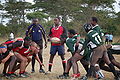
Rift Valley Academy take on Mang'u High School in a Prescott Cup game
Mang'u High Swimming Pool

Mang'u High School has not only been an academic powerhouse but also been leading in extra-curricular activities such as drama, music and mainly sports. It strives to produce well rounded gentlemen. The Sports include Basketball, Football, Rugby, Swimming, Tennis, Decathlon, Volleyball and others. The school has two rugby pitches, two basketball courts, a football pitch, a hockey pitch, an athletics track and a swimming pool. Other facilities are table tennis and a handball field. The Basketball team is known as the 'Panthers' and have been the National Champions for many years.

The school is also known for its strong rugby team known as 'Wazimba'. Rugby was introduced into the school in early 1987. There was no rugby pitch at the time but the school administration allocated some land which was converted to two standard size rugby pitches which are used by the players today. The game was quite new to most of the students and the game took sometime to be learnt, accepted and enjoyed by the students. The passion for the game flared up in the 1990’s when more students took interest and the school started competing against other schools. Wazimba over the years has become a remarkable household name in Kenyan rubgy being famous for its perfect line outs. It participates in the various tournaments e.g. Camp David(mangu), Mangu Open(Mangu), Changez Open(Lenana school), Damu Pevu Tournament, Bush Open(alliance school), Impala Floodlights, Uttermost(Nairobi school), 7’s Aside School League, 15’s Aside Secondary League and Prescott Tournament. In 2010, Wazimba scooped the Kenya Rugby Union and Ministry of Rugby's Elliptics School of the Year Awards after scooping the East African Schools, Impala Floodlit, Prescott Cup and national schools titles. On October 29th 2011 the rugby team retained the Zuku Impala Floodlit title. Wazimba have also played in many East African Regional tournaments. Many former rugby team alumni have played for the Kenya national rugby union team. The team has also produced outstanding players with international recognition like the late Joshua Gathumbi, Vincent Ongera, Daniel Kiptoo Bargoria, Dennis Karanja, Matthew Msalia, Polycap Odhiambo and Ted Munene. The team natures young talent to excellent players. The team is at the moment being coached by two very experienced coaches: Steve Maongo and John Boscow - mwamba (a world class referee with 10 international appearances and a IRB certified educator).

In August 2010, Mang'u High School hockey team won the Brookside East Africa Secondary School hockey title when they defeated St Mary's College Kisubi of Uganda 4-0.

[edit] Clubs and Societies

The Clubs Department is headed by Ms. Purity Chege. The clubs help the students in various disciplines. Some are academic while others are social. The clubs invite and visit other schools for various functions pertaining to their societies. The students are prepared to be useful people in the society in the future as they organize all the activities in the clubs and societies. The school administration has given the clubs full support in their endeavours. For every club, there is a Patron who acts as a consultant, currently a teacher. The school has many clubs including Debate, Law, Drama, Music, History, Charity, Scouts, Red Cross, Chess, Young Farmers, Football, Rugby, Christian Union, Seventh Day Adventist, Engineering, Gym, Wildlife, Science, Aviation, Journalism, French, German and Computer clubs. Students appoint their own officials and raise their own funds which are held in the Bursar office. The Journalism Club produces the popular 'Savannah Magazine. The Aviation Club is very popular and hosts the annual Aviation Symposium. Kenya Airways invited the Aviation Club members for a demo flight during the delivery of its first Boeing 767. The Biotechnology Club's aims is to assist students to explore their knowledge on matters of concern in the field of Biotechnology and to engage students in the learning of new ways of using scientific tools modify organisms to achieve traits useful to humankind. The school also has a German exchange program. The school needs alumni who are professionals in various fields to volunteer as Patrons to mentor the various clubs.

Junior achievement club is basically an opportunity for young entrepreneurs to gain vital business knowledge. Each year a company is formed by members in form one to three to undertake the year’s programme. The members choose a business idea and after assessing its viability develop it into a project that can help them gain practical skills in business. At the end of the year students take part in a national competitive expo where all companies show case their products. A team of highly experienced judges drawn from the corporate sector then choose the best placed companies a host of awards. The best company takes the Biashara award. The form four's(former company members) are taken through a job shadowing program where they get to meet with members of the corporate world to learn more about the job they usually do.

[edit] Notable Alumni

President Mwai Kibaki, Alumni

Mang'u High School has been highly influential in shaping the history and future of Kenya with most spheres dominated by its alumni. Alumni share a strong bond and are known to give each other preferential treatment in job offers and contracts. The school has a respectful profile of many successful alumni, including politicians, businessmen, lawyers, engineers, doctors, scientists, clergymen and pilots. Mang'u High School will probably be the only high school in Kenya's history to have its alumni running the country as President and Vice President at the same time. From 25th September 2003 to 9 January 2008 Mang'u High School alumni ruled Kenya as President and Vice President including many members of cabinet. Among the high profile politicians who studied at Mang'u High School are President Mwai Kibaki who attained the maximum possible score, former Vice-President Moody Awori, Cabinet Ministers George Saitoti who was also a Vice President of Kenya, John Michuki who was a school captain and also met President Mwai Kibaki at Mang'u. Another Alumni who served as Cabinet Minister in Mwai Kibaki's administration is Kipruto Arap Kirwa. Other Alumni who served as Cabinet Ministers are Cyrus Jirongo and the late Tom Mboya who was one of Kenya's principal leaders that agitated for Kenya's independence. Other notable alumni include Cardinal Maurice Michael Otunga who was in the first graduating class. Shortly after sitting Cambridge Examinations he walked out of Mangu straight into the Major Seminary at Kakamega without waiting for his results. This frustrated his father’s ambition of making him his successor as Chief of South Bukusu. He was later in life to become a Religious Chief of the whole Catholic Church in Kenya. Other clergymen are Archbishop Ndingi Mwana Nzeki, Archbishop John Njenga who also met Mwai Kibaki and Moody Awori at Mang'u and says he taught Moody Awori catechism. Others are Bishop Anthony Muheria, a close friend of President Mwai Kibaki and was appointed by him to be a member of the Judicial Service Commission. Various other alumni have been appointed to head Parastatals and Commissions by the President. Joseph Konzolo is a former director of the National Social Security Fund (Kenya) and was also a former chairman of the Board of Governors of Mang'u High School. Dr. Joshua Noreh performed Kenya's first In vitro fertilisation. Prof. Raphael J. Njoroge, PhD. is an educationist who is an alumni and was also its first African principal. Some of the pilots of the now defunct East African Airways and senior pilots at Kenya Airways came from Mang'u High School.


  • Dr. Evans Kidero, CEO Mumias Sugar Company , former MD Smithkline Beecham and Nation Newspapers
  • Maxx Ng'ang'a, CEO Crysoft Labs
  • Michael JK Sang, Chairman, Mumias Sugar Company (1991–2003), 1st Commissioner of Sports(1988–1990), Educationist(1956–1988).
  • Dr Kipkerich Kosgei, Chief Government Pharmacist, Pharmacy and Poisons Board
  • George Muhoho, CEO Kenya Airports Authority
  • Mr Francis Lekolol, Former PC Nairobi and Western, 1st Samburu to join Mang'u in 1956
  • Mr Hillary Ng'weno, Media Magnate, nuclear scientist educated at Harvard, first Kenyan Editor-in-Chief of Daily Nation
  • Mr Wilfred Kiboro, CEO Nation Media Group
  • Dr K.K Gakombe, CEO Metropolitan Hospital
  • Dr. Samuel MG Mwinzi, Neurologist Nairobi Hospital, Chief Medical Specialist Kenyatta National Hospital
  • Dr Joseph Barrage Wanjui(Joe Wanjui) CBS, Chancellor University of Nairobi, Chairman and CEO of East African Industries (Unilever)
  • The late Prof Hillary Ojiambo, 1st Cardiologist in sub-Saharan Africa, co-founder of Kenya Cardiac Society
  • Prof Raphael Munavu, Commissioner, Commission on Revenue Allocation, previously Chairman, Kenya National Examinations Council
  • Dr Gitahi Kariuki PHD , Nuclear Safety Engineer, Canada.
  • Dr Stephen Mbithi, CEO Horticultural Council of Africa and CEO Fresh Produce Exporters Association of Kenya (FPEAK)
  • Prof. Fulbert Namwamba, Southern University Baton Rouge, Louisiana, USA
  • Hon. Titus Mbathi, Chairman, Kenya Electricity Generating Company
  • Hon. Peter Nyakiamo, General Manager of Barclays Bank Kenya Limited, Elected Kenya African National Union (KANU) MP for Mbita (in 1983 and 1988), Minister of State in the Office of the President (1983-85), Minister of Health (1985-87), Minister of Lands and Settlements (1987-88), Chairman of the Kenya Revenue Authority (1995-98), Executive Chairman of Kenya Commercial Bank (KCB, since March, 1998)
  • The late Sam Waruhiu, pioneer lawyer, businessman, classmate with Mwai Kibaki at Mang'u High School, Eisenhower fellow 1965.
  • Mr Vincent Kambo
  • Binyavanga Wainaina, author, journalist and winner of the Caine Prize, nominated by the World Economic Forum as a "Young Global Leader" but declined the award.
  • Dr. Gitahi Githinji Managing Director, Monitor Publications, a subsidiary of Nation Media Group, former Smile Train's Regional Director of Africa
  • Mr Raphael Ngethe
  • Mr David Oniango
  • Mr Dominic Odipo, columnist and lecturer, University of Nairobi
  • Mr Mayaka

The school currently needs a networking platform where alumni can exchange opportunities with each other in the job market.

[edit] Faith

Mang'u High School Chapel

The Archbishop of Nairobi took the initiative to establish a chaplaincy in the school. The activities of the chaplaincy pivots around the mission to teach, guide and counsel. Every Monday and Friday the chaplain offers prayers during assembly. Every sunday there is a period of worship. The muslims are provided a room which serves as a "mosque", the Protestants worship in the dining hall while the Catholics attend Mass in the school chapel. The first and last sundays of the terms are joint worship. The Archbishop visits to administer sacrament of confirmation and prior to the start of the Kenya Certificate of Secondary Education. The Protestants are guided by the Christian Union Patron assisted by Christian Union Fellowship.

The Chaplain offers catechism instructions to those willing to be baptised, receive the Holy Communion or Sacrament of Confirmation. Guidance is given collectively during school assemblies and indivudually. The Chaplain also assists the school administration in inspiring the school community to uphold or maintain the ideal of a catholic sponsored school where the formation of character is the foundation of sound discipline, academic excellence and of an all rounded personality.

[edit] Culture and Traditions

In Mang'u there is a famous saying that "there are only two schools, Mang'u and the rest". Other popular sayings are "In Mang'u we make things happen and not just let them happen", "To some greatness is born, to others it is thrust upon them but to Mang'u it is achieved." Another common slogan is "aluta continua". Students are taught to not just be book smart but also sociable. The school has a vibrant cheering squad during sport competitions. Alumni are also very loyal to their alma mater and frequently attend sporting competitions and candidate dedications.

Students are required to be responsible in various duties and chores in the Houses and classrooms.At any time when the bell rings, all students must run to wherever they are going. This culture trains the students to be responsible with time. Every year the most disciplined and responsible students interview to become captains in various areas of responsibility. During Interview Day, no classes are held as all teachers interview the candidates. The School Captain is the most powerful and gives a speech every friday during assembly. The most famous School Captain was the late Hon. John Michuki who was a Cabinet Minister. The Principal, Deputy Principal and Discipline Master chose the Pentagon. The Pentagon is made up of the School Captain, his Deputy, the Dining Hall captain, his Deputy and the Sports Captain. The pentagon is the highest policy making organ for the students in running the affairs of the school. The House Captains are also essential in managing the affairs of the Houses. They assign duties and give punishments. The Houses compete in every area from cleanliness to drama and music festivals to sports. The most popular prefect is the Entertainment prefect who selects movies for saturday 'movie nights'. The Captains have certain priviledges to compensate the additional work of assisting in managing the students. They are expected to lead by example and be conversant with the school traditions and contribute ideas contained in the Principal's speech.

Alliance High School is a sworn rival of every student from their admission and the goal of every student is to defeat Alliance in every competition and to bring the trophy back home. This culture has been passed down over generations. Fights have at times broken out with Alliance students during sporting competitions. Many of Mang'u cheering songs directly mock Alliance.

[edit] Further Reading

  • Paul Kibuuka Kyazze, "Mang'u High History", former Geography teacher at Mangu High School,(1972 -2002)

[edit] References

[edit] External links


Coordinates: 1°04′19″S 37°02′46″E / 1.07195°S 37.046149°E / -1.07195; 37.046149

Personal tools
Namespaces

Variants
Actions
Navigation
Interaction
Toolbox
Print/export