


Płońsk
Płońsk | |
|---|---|
 Main square (15 Sierpnia Square) | |
 Flag  Coat of arms | |
  Płońsk | |
| Coordinates: 52°38′N 20°23′E / 52.633°N 20.383°E | |
| Country |  Poland Poland |
| Voivodeship | Masovian |
| County | Płońsk |
| Gmina | Płońsk (urban gmina) |
| Established | 10th century |
| Town rights | 1400 |
| Government | |
| • Mayor | Andrzej Józef Pietrasik |
| Area | |
| • Total | 11.6 km2 (4.5 sq mi) |
| Population (2022-12-31) | |
| • Total | 21,591[1] |
| Time zone | UTC+1 (CET) |
| • Summer (DST) | UTC+2 (CEST) |
| Postal code | 09-100 |
| Area code | +48 023 |
| Car plates | WPN |
| Highways |  |
| National roads |   |
| Voivodeship roads |  |
| Website | http://www.plonsk.pl |
Płońsk (Polish: [pwɔj̃sk] ⓘ; Yiddish: פּלאָנסק, romanized: Plonsk) is a town in central Poland with 21,591 inhabitants (2022[1]). Situated at the Płonka river in the historic region of Mazovia, it is the seat of Płońsk County in the Masovian Voivodeship.
History[edit]
According to archaeological research, the Płońsk stronghold was built in the late 10th century within the early Polish state. Dating back to 1155, is the first historical record confirming the existence of Płońsk. Around the castle a group of inhabitants was formed, most of whom initially worked on the land. As a result of the fragmentation of medieval Piast-ruled Poland, it was part of the duchies of Masovia and Płock, and then it was a royal town of the Polish Crown, administratively located in the Płock Voivodeship in the Greater Poland Province. In 1400, Siemowit IV of Masovia, granted it town rights under Chełmno law, then merchants and craftsmen started to come to the town. Płońsk was located on a trade route connecting Toruń with Brześć.[2]
In the early twentieth century, the population of 10,000 was equally divided between Poles and Jews. It was a centre of the garment industry.[3] The Jews lived mostly within the city, whilst the Poles were more scattered and tended to live in the countryside. On the 16th October 1886 David Ben Gurion was born in Płońsk. Like him, also many other Jewish residents of the city immigrated to Palestine for Zionist reasons, spurred on by the idea of building a Jewish homeland.[4]
On August 14–17, 1920, the Poles successfully defended the town during a Soviet invasion.[5]
During the joint German-Soviet invasion of Poland, which started World War II in September 1939, Germany invaded the town and the Einsatzgruppe V entered the town to commit various crimes against the populace.[6] Under German occupation the town was annexed directly to Nazi Germany and was renamed Plöhnen. The Germans established and operated a court prison in the town.[7] In 1940, the occupiers expelled around 1,000 Poles, whose houses and workshops were then handed over to German colonists as part of the Lebensraum policy.[8] In September 1940, Jews from the town and the surrounding areas were imprisoned in a ghetto. Soon a typhus epidemic broke out. A hospital, a bathhouse for the sick, a pharmacy, and a folk kitchen were organized in the ghetto.[9] In total, 12,000 Jews were prisoners of the ghetto and from October 1942, they were sent to the Auschwitz extermination camp. In 1943 in Berlin, the Germans sentenced six members of the local Polish resistance movement, some to death.[10] On January 16–18, 1945, shortly before retreating, the German police carried out a massacre of 78 Poles in the town.[11]
The town was administratively part of the Ciechanów Voivodeship from 1975 to 1998.
Landmarks[edit]
- Saint Michael Archangel Church - former monastery of Calced Carmelites, founded before 1417 by the Duke Siemowit IV of Masovia and his wife Aleksandra, sister of Polish King Władysław II Jagiełło
- David Ben Gurion’s family home - 18th century tenement house at 21A 15 Sierpnia Square, where Ben Gurion lived until his emigration to Palestine in 1908
- The Memorial House at 2 Warszawska Street - the museum of Płońsk's Jews
- David Ben Gurion Square - monument on a place where he was born
- The old Sienkiewiczówka manor - home of Polish novelist and Nobel Prize laureate Henryk Sienkiewicz, located in the Poświętne district. There he wrote his first unpublished novel Ofiara.
-
 Saint Michael Archangel Church
 -
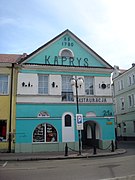 David Ben Gurion’s family home
 -
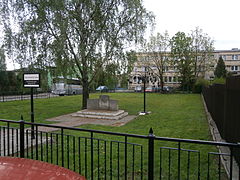 David Ben Gurion Square
 -
 Manor in the Poświętne district, home of Polish novelist and Nobel Prize laureate Henryk Sienkiewicz in the 1860s

.JPG)


Demographics[edit]
|
| |||||||||||||||||||||||||||
| Source: [12][13] | ||||||||||||||||||||||||||||
Museums[edit]
- Płońsk Memorial House - museum with permanent exhibition “Glance and recall” showing the history of the Jewish community of Płońsk, of the Holocaust and of David Ben-Gurion
- Muzeum Ziemi Płońskiej - local history museum being created at the railway station, to be opened in spring 2024[14]
Transport[edit]
Płońsk is located at the intersection of the Polish S7 highway (partly under construction as of February 2022) and National roads No. 10 and 50. There is also a railway station in the town.
Events[edit]
.jpg)
- Memoriał Andrzeja Trochanowskiego - one-day cycling race based in Płońsk, which takes place annually on May 1
- Jewish Culture Festival - held annually in October or November
In 2018, local Poles held a celebration in honor of David Ben-Gurion, who was born in the town, for the 70th anniversary of the re-establishment of the State of Israel.[15]
Notable people[edit]
- Jan Walery Jędrzejewicz (1835-1887), Polish astronomer and doctor
- Henryk Sienkiewicz (1846–1916), novelist and journalist, Nobel Prize laureate
- David Ben-Gurion (1886–1973), the first Prime Minister of Israel
- Joanna Mucha (born 1976), from 2011 to 2012 Minister of Sport and Tourism of Poland
- Tomasz Majewski (born 1981), Polish shot putter and a double Olympic gold medalist
References[edit]
- ^ a b Płońsk w liczbach - 31.12.2022 | www.polskawliczbach.pl
- ^ Bartoszewicz, Henryk (1994). "Drogi handlowe ziemi dobrzyńskiej w XV–XVI w.". Miscellanea Historico-Archivistica (in Polish). Vol. IV. Warszawa: Naczelna Dyrekcja Archiwów Państwowych, Wydawnictwo DiG. p. 167. ISSN 0860-1054.
- ^ Segev, Tom (2018 - 2019 translation Haim Watzman) A State at Any Cost. The Life of David Ben-Gurion. Apollo. ISBN 9-781789-544633 p.48
- ^ Memoirs: David Ben-Gurion (1970), p. 36
- ^ Tomasz Gąsowski. "Obrona Płońska (14–17 sierpnia 1920)". TwojaHistoria.pl (in Polish). Retrieved 6 February 2021.
- ^ Wardzyńska, Maria (2009). Był rok 1939. Operacja niemieckiej policji bezpieczeństwa w Polsce. Intelligenzaktion (in Polish). Warszawa: IPN. p. 54.
- ^ Wardzyńska (2009), p. 224
- ^ Wardzyńska, Maria (2017). Wysiedlenia ludności polskiej z okupowanych ziem polskich włączonych do III Rzeszy w latach 1939-1945 (in Polish). Warszawa: IPN. p. 395. ISBN 978-83-8098-174-4.
- ^ "Historia społeczności | Wirtualny Sztetl" (in Polish). Sztetl.org.pl. Retrieved 2021-12-02.
- ^ Katarzyna Olszewska (13 July 2010). "Z historii płońskiej konspiracji". plonszczak.pl (in Polish). Retrieved 6 February 2021.
- ^ "Uczczono pamięć ofiar zbrodni na Piaskach". Plonsk.pl (in Polish). Retrieved 6 February 2021.
- ^ Dokumentacja Geograficzna (in Polish). Vol. 3/4. Warszawa: Instytut Geografii Polskiej Akademii Nauk. 1967. p. 38.
- ^ Stan i struktura ludności oraz ruch naturalny w przekroju terytorialnym w 2010 r. (PDF) (in Polish). Warszawa: Główny Urząd Statystyczny. 2011. p. 75. Archived from the original (PDF) on 13 November 2011.
- ^ "Mirosława Krysiak patronem Muzeum Ziemi Płońskiej? Obiekt powstanie na wiosnę". Radio Płońsk (in Polish). 2023-10-12. Retrieved 2024-03-07.
- ^ "Hundreds of locals march through the Polish birthplace of Ben Gurion - Diaspora - Jerusalem Post". Archived from the original on 2018-04-16.
External links[edit]

- Interactive map of Płońsk
- Płońsk official website
- Independent forum of Płońsk citizens
- Jewish Community in Płońsk on Virtual Shtetl
- The Story of the Jewish Community of Plonsk - an online exhibition in Yad Vashem website
| Urban gminas |  | |
|---|---|---|
| Rural gminas | ||

| International | |
|---|---|
| National | |
| Geographic | |

- Cities and towns in Masovian Voivodeship
- Płońsk County
- 10th-century establishments in Poland
- Populated places established in the 10th century
- Populated riverside places in Poland
- Płock Governorate
- Warsaw Voivodeship (1919–1939)
- Holocaust locations in Poland
- Sites of Nazi war crimes in Poland
- Historic Jewish communities in Poland