


Pinna nobilis
| Pinna nobilis | |
|---|---|

| |
| Live specimen of Pinna nobilis, in Levanto, Liguria (Italy) | |
Scientific classification 
| |
| Domain: | Eukaryota |
| Kingdom: | Animalia |
| Phylum: | Mollusca |
| Class: | Bivalvia |
| Order: | Pteriida |
| Superfamily: | Pinnoidea |
| Family: | Pinnidae |
| Genus: | Pinna |
| Species: | P. nobilis
|
| Binomial name | |
| Pinna nobilis | |
| Synonyms | |
| |

Pinna nobilis, whose common name is the noble pen shell or fan mussel, is a large species of Mediterranean clam, a marine bivalve mollusc in the family Pinnidae, the pen shells.[2]
It reaches up to 120 cm (4 ft) of shell length.[3] It produces a rare manganese-containing porphyrin protein known as pinnaglobin.[4]
Description[edit]

.jpg)
The bivalve shell is usually 30–50 cm (1.0–1.6 ft) long,[5] but can reach 120 cm (4 ft).[3] Its shape differs depending on the region it inhabits. Like all pen shells, it is relatively fragile to pollution and shell damage. It attaches itself to rocks using a strong byssus composed of many silk-like threads which used to be made into cloth. The animal secretes these fibres from its byssus gland; they consist of keratin and other proteins and may be as long as 6 cm (2.4 in). The inside of the shell is lined with brilliant mother-of-pearl.[6]
As with other members of its genus, Pinna nobilis hosts symbiotic shrimp which live inside its shell.[7] It is believed that when it sees a threat, the shrimp warns the host, perhaps by retracting its claws or even by pinching. The clam then closes shut. It has been demonstrated that the shrimp has a similar filter-feeding diet to its host and the relationship is likely mutualistic.[8]
Distribution[edit]
This species is endemic to the Mediterranean Sea, where it lives offshore at depths ranging between 0.5 and 60 m (1.6 and 196.9 ft).[9] It could be found buried beneath soft-sediment areas (fine sand, mud, often anoxic).[10]
Human relevance[edit]
This species is the origin of sea silk, which was made from the byssus of the animal.[11]
Threats[edit]
In 2016, there was an outbreak of a disease that caused the mortality of 99% of its population in Spain. The cause of the disease is a newly discovered pathogen, Haplosporidium pinnae and it is posing a serious threat to the survival of the species. By 2019, mortality spots had been detected in Greece, Croatia, Turkey, Tunisia, France and Morocco. In the Trieste area, considerable efforts have also been made to conserve the deposits since 2020.[12][13] In the past, Pinna nobilis has been threatened with extinction, due in part to fishing, incidental killing by trawling and anchoring, and the decline in seagrass fields; pollution kills eggs, larvae, and adult mussels.[11] Such threats, however, have been very localised and have not led to such a widespread and rapid population decline. The pathogen, which is still present in the environment, will make recovery a challenge, so continuing declines are expected. The percentage of population size reduction over the last ten years is over 80%. In December 2019, Pinna nobilis has entered the IUCN Red List as critically endangered.[14][15]
The noble pen shell has been listed as an endangered species in the Mediterranean Sea. The European Council Habitats Directive 92/43/EEC, on conservation of natural habitats and the wild fauna and flora, proclaims that P. nobilis is strictly protected (by the Annex IV of EEC, 1992) – all forms of deliberate capture or killing of fan mussel specimens are prohibited by law.[10]
As part of the Costa Concordia disaster recovery effort in Italy in 2012, a group of about 200 Pinna nobilis was relocated to a nearby area due to the threat posed by subsequent engineering work.[16]
Gallery[edit]
-
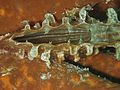 Live specimen of P. nobilis, looking into the shell from above
 -
 Pinna nobilis: shell and byssus
 -
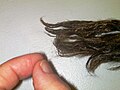 The very fine byssus threads of P. nobilis
 -
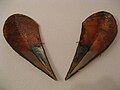 Shell of Pinna nobilis
 -
 Releasing male gametes, Pula, Croatia
 -
 Marthasterias glacialis attack, Pula, Croatia


See also[edit]
References[edit]
- ^ Kersting, D.; Benabdi, M.; Čižmek, H.; Grau, A.; Jimenez, C.; Katsanevakis, S.; Öztürk, B.; Tuncer, S.; Tunesi, L.; Vázquez-Luis, M.; Vicente, N.; Otero Villanueva, M.M. (2019). "Pinna nobilis". IUCN Red List of Threatened Species. 2019: e.T160075998A160081499. doi:10.2305/IUCN.UK.2019-3.RLTS.T160075998A160081499.en. Retrieved 20 November 2021.
- ^ *Pinna gigas Chemnitz
- ^ a b Zavodnik, D., Hrs-Brenko, M., & Legac, M. (1991). Synopsis of the fan shell P. nobilis L. in the eastern Adriatic sea. In the C. F. Boudouresque, M. Avon, & V. Gravez (Eds.), Les Especes Marines a Proteger en Mediterranee (pp. 169–178). Marseille, France: GIS Posidonie publ.
- ^ "Manganese and "pinnaglobin" in Pinna nobilis". Science Direct.
- ^ Acquario di Genova (2006). Pinna nobilis. Retrieved 15 September 2014.
- ^ Tyndale (1849): The Island of Sardinia, including Pictures of the Manners and Customs of the Sardinians, . . . Three Volumes. John Warre Tyndale. London: Richard Bentley. pp. 77–79.
- ^ Rabaoui, Lofti; Zouari, Sabiha; Ben Hassine, Oum (2008). "Two species of Crustacea (Decapoda) associated with the fan mussel, Pinna nobilis Linnaeus, 1758 (Mollusca, Bivalvia)". Crustaceana. 81 (4): 433–446. doi:10.1163/156854008783797507.
- ^ Kennedy, H.; Richardson, C.A.; Duarte, C.M.; Kennedy, D.P. (2001). "Diet and association of Pontonia pinnophylax occurring in Pinna nobilis: insights from stable isotope analysis". Journal of the Marine Biological Association of the United Kingdom. 81 (1): 177–178. doi:10.1017/s0025315401003575. hdl:10261/54392. S2CID 83483952.
- ^ Butler, A., Vicente, N., De Gaulejac, B. (1993). Ecology of the pteroid bivalves P. nobilis bicolor Gmelin and P. nobilis L. Marine Life, 3(1–2), 37–45.
- ^ a b Centoducati, G., Tarsitano, E., Bottalico, A., Marvulli, M., Lai, O., Crescenzo, G. (2006). Monitoring of the Endangered Pinna nobilis Linee, 1758 in the Mar Grande of Taranto (Ionian Sea, Italy). In the Environ Monit Assess (2007) 131:339–347.
- ^ a b Hill, John E. (2009) Through the Jade Gate to Rome: A Study of the Silk Routes during the Later Han Dynasty, 1st to 2nd centuries CE. John E. Hill. BookSurge, Charleston, South Carolina. ISBN 978-1-4392-2134-1. See Section 12 plus "Appendix B – Sea Silk". pp. 468–476.
- ^ Chiara D'Incà "Nel Golfo di Trieste l’epidemia sterminante della Pinna nobilis" In: Trieste All News 25.1.2020.
- ^ Il Piccolo: Almost disappeared in Miramare for years, the Pinna nobilis reappears in Istria
- ^ "Examples of other species that have been added to the Red List". Retrieved 14 December 2019.
- ^ "IUCN Red List, Assessment Information". IUCN Red List of Threatened Species. Retrieved 14 December 2019.
- ^ Reuters video about the Pinna nobilis relocation
Further reading[edit]
- Hill, John E. 2004. The Peoples of the West. A draft annotated translation of the 3rd century Weilüe – see Section 12 of the text and Appendix D.
- Laufer, Berthold. 1915. "The Story of the Pinna and the Syrian Lamb", The Journal of American Folk-lore 28.108:103–128.
- McKinley, Daniel L. 1988. "Pinna and Her Silken Beard: A Foray Into Historical Misappropriations". Ars Textrina: A Journal of Textiles and Costumes, Vol. Twenty-nine, June 1998, Winnipeg, Canada. pp. 9–223.
- Maeder, Felicitas 2002. "The project Sea-silk – Rediscovering an Ancient Textile Material." Archaeological Textiles Newsletter, Number 35, Autumn 2002, pp. 8–11.
- Maeder, Felicitas, Hänggi, Ambros and Wunderlin, Dominik, Eds. 2004. Bisso marino : Fili d’oro dal fondo del mare – Muschelseide : Goldene Fäden vom Meeresgrund. Naturhistoriches Museum and Museum der Kulturen, Basel, Switzerland. (In Italian and German).
- Schafer, Edward H. 1967. The Vermillion Bird: T'ang Images of the South. University of California Press.
- Turner, Ruth D. and Rosewater, Joseph 1958. "The Family Pinnidae in the Western Atlantic" Johnsonia, Vol. 3 No. 38, 28 June 1958, pp. 285–326.
- R. Tucker Abbott & S. Peter Dance, 1982, “Compendium of seashells: a color guide to more than 4,200 of the world’s marine shells”, E.P. Dutton Inc., New York. ISBN 0-525-93269-0.
External links[edit]

- Images of shells
- Photos of Pinna nobilis on Sealife Collection