


Pulsatilla vulgaris
| Pulsatilla vulgaris | |
|---|---|
_(17022184800).jpg)
| |
Scientific classification 
| |
| Kingdom: | Plantae |
| Clade: | Tracheophytes |
| Clade: | Angiosperms |
| Clade: | Eudicots |
| Order: | Ranunculales |
| Family: | Ranunculaceae |
| Genus: | Pulsatilla |
| Species: | P. vulgaris
|
| Binomial name | |
| Pulsatilla vulgaris | |
| Synonyms[2] | |
|
Synonyms list
| |
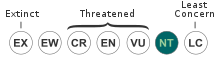
Pulsatilla vulgaris, the pasqueflower,[3] is a species of flowering plant belonging to the buttercup family (Ranunculaceae), found locally on calcareous grassland in Europe,[4] and widely cultivated in gardens. It was considered part of the genus Anemone, to which it is closely related.[5] Several sources still list Anemone pulsatilla as the accepted name, with Pulsatilla vulgaris as a synonym.[6]
Other variations of its common name include European pasqueflower and common pasqueflower. The name may also be split in two - pasque flower.
Description[edit]
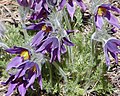
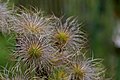
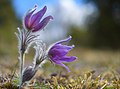
This herbaceous perennial plant develops upright rhizomes, which function as food-storage organs. Its leaves and stems are long, soft, silver-grey and hairy. It grows to 15–30 cm (6–12 in) high and when it is fruit-bearing up to 40 cm (16 in). The roots go 1 m (39 in) deep into the soil. The finely-dissected leaves are arranged in a rosette and appear with the bell-shaped flower in early spring. The purple flowers are followed by distinctive silky seed-heads which can persist on the plant for many months.
The flower is 'cloaked in myth'; one legend has it that Pasque flowers sprang up in places that had been soaked by the blood of Romans or Danes because they often appear on old barrows and boundary banks.[7]
This plant has gained the Royal Horticultural Society's Award of Garden Merit.[3][8]
Designation[edit]
It is classified as a Priority Species in the UK Biodiversity Action Plan[9] and as Vulnerable in Britain on the Red Data List.[7]
Location[edit]
It grows in sparsely wooded pine forests or meadows, often on a sunny sloping side with calcium-rich soil. A large colony occurs on publicly accessible land in the Cotswolds, UK, at the Gloucestershire Wildlife Trust's Pasqueflower reserve.[10]
Cultural Significance[edit]
It is the county flower of the English counties of Cambridgeshire and Hertfordshire.[11]
Varieties[edit]
While the species Pulsatilla vulgaris has purplish flowers; variants include red ('Rubra') and white ('Alba') forms (see images).
-
-
-
-

-
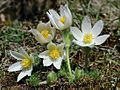 'Alba'
 -
 'Grandis'
 -
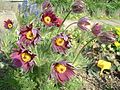 'Rubra'


References[edit]
- ^ Schweizer, F.; Hasinger, O. (2014). "Pulsatilla vulgaris". IUCN Red List of Threatened Species. 2014: e.T161913A50786112. doi:10.2305/IUCN.UK.2014-1.RLTS.T161913A50786112.en. Retrieved 18 November 2021.
- ^ "Pulsatilla vulgaris Mill. | Plants of the World Online | Kew Science". Plants of the World Online.
- ^ a b "RHS Plant Selector - Pulsatilla vulgaris". Retrieved 23 February 2020.
- ^ Shorter Oxford English Dictionary, 6th edition. United Kingdom: Oxford University Press. 2007. p. 3804. ISBN 978-0199206872.
- ^ RHS encyclopedia of plants & flowers. United Kingdom: Dorling Kindersley. 2010. p. 744. ISBN 978-1405354233.
- ^ "Pulsatilla vulgaris". World Flora Online. Retrieved 24 March 2021.
- ^ a b "Species detail on the Wildlife Trusts' website". Archived from the original on 2013-05-19. Retrieved 2012-04-11.
- ^ "AGM Plants - Ornamental" (PDF). Royal Horticultural Society. July 2017. p. 82. Retrieved 23 September 2018.
- ^ Joint Nature Conservation Committee - UK Biodiversity Action Plan. The Committee operates in a statutory advisory capacity to the UK Government.
- ^ "Pasqueflower reserve information on the Gloucestershire Wildlife Trust website".
- ^ "Pasqueflower | Plant & fungi species | Wild plants". www.plantlife.org.uk. Retrieved 2016-01-03.
External links[edit]

