


Quadric
In mathematics, a quadric or quadric surface (quadric hypersurface in higher dimensions), is a generalization of conic sections (ellipses, parabolas, and hyperbolas). It is a hypersurface (of dimension D) in a (D + 1)-dimensional space, and it is defined as the zero set of an irreducible polynomial of degree two in D + 1 variables; for example, D = 1 in the case of conic sections. When the defining polynomial is not absolutely irreducible, the zero set is generally not considered a quadric, although it is often called a degenerate quadric or a reducible quadric.
In coordinates x1, x2, ..., xD+1, the general quadric is thus defined by the algebraic equation[1]
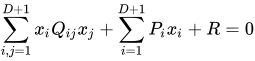
which may be compactly written in vector and matrix notation as:

where x = (x1, x2, ..., xD+1) is a row vector, xT is the transpose of x (a column vector), Q is a (D + 1) × (D + 1) matrix and P is a (D + 1)-dimensional row vector and R a scalar constant. The values Q, P and R are often taken to be over real numbers or complex numbers, but a quadric may be defined over any field.
A quadric is an affine algebraic variety, or, if it is reducible, an affine algebraic set. Quadrics may also be defined in projective spaces; see § Normal form of projective quadrics, below.
Euclidean plane[edit]
As the dimension of a Euclidean plane is two, quadrics in a Euclidean plane have dimension one and are thus plane curves. They are called conic sections, or conics.

Euclidean space[edit]
In three-dimensional Euclidean space, quadrics have dimension two, and are known as quadric surfaces. Their quadratic equations have the form

where are real numbers, and at least one of A, B, and C is nonzero.

The quadric surfaces are classified and named by their shape, which corresponds to the orbits under affine transformations. That is, if an affine transformation maps a quadric onto another one, they belong to the same class, and share the same name and many properties.
The principal axis theorem shows that for any (possibly reducible) quadric, a suitable change of Cartesian coordinates or, equivalently, a Euclidean transformation allows putting the equation of the quadric into a unique simple form on which the class of the quadric is immediately visible. This form is called the normal form of the equation, since two quadrics have the same normal form if and only if there is a Euclidean transformation that maps one quadric to the other. The normal forms are as follows:

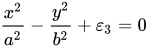
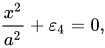
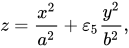
where the are either 1, –1 or 0, except which takes only the value 0 or 1.


Each of these 17 normal forms[2] corresponds to a single orbit under affine transformations. In three cases there are no real points: (imaginary ellipsoid), (imaginary elliptic cylinder), and (pair of complex conjugate parallel planes, a reducible quadric). In one case, the imaginary cone, there is a single point (). If one has a line (in fact two complex conjugate intersecting planes). For one has two intersecting planes (reducible quadric). For one has a double plane. For one has two parallel planes (reducible quadric).






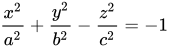
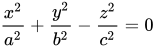
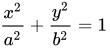
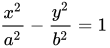
Thus, among the 17 normal forms, there are nine true quadrics: a cone, three cylinders (often called degenerate quadrics) and five non-degenerate quadrics (ellipsoid, paraboloids and hyperboloids), which are detailed in the following tables. The eight remaining quadrics are the imaginary ellipsoid (no real point), the imaginary cylinder (no real point), the imaginary cone (a single real point), and the reducible quadrics, which are decomposed in two planes; there are five such decomposed quadrics, depending whether the planes are distinct or not, parallel or not, real or complex conjugate.
| Non-degenerate real quadric surfaces | ||
|---|---|---|
| Ellipsoid | 
| |
| Elliptic paraboloid | 
| |
| Hyperbolic paraboloid | 
| |
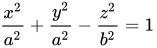
| Hyperboloid of one sheet or Hyperbolic hyperboloid |

| |
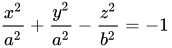
| Hyperboloid of two sheets or Elliptic hyperboloid |

| |
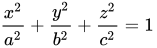
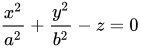
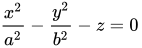
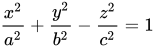
| Degenerate real quadric surfaces | ||
|---|---|---|
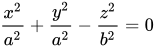
| Elliptic cone or Conical quadric |

| |
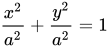
| Elliptic cylinder | 
| |
| Hyperbolic cylinder | 
| |
| Parabolic cylinder | 
| |
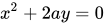
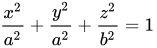
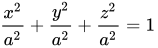
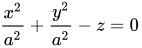
When two or more of the parameters of the canonical equation are equal, one obtains a quadric of revolution, which remains invariant when rotated around an axis (or infinitely many axes, in the case of the sphere).
| Quadrics of revolution | ||
|---|---|---|
| Oblate and prolate spheroids (special cases of ellipsoid) |  
| |
| Sphere (special case of spheroid) | 
| |
| Circular paraboloid (special case of elliptic paraboloid) | 
| |
| Hyperboloid of revolution of one sheet (special case of hyperboloid of one sheet) | 
| |
| Hyperboloid of revolution of two sheets (special case of hyperboloid of two sheets) | 
| |
| Circular cone (special case of elliptic cone) | 
| |
| Circular cylinder (special case of elliptic cylinder) | 
| |
Definition and basic properties[edit]
An affine quadric is the set of zeros of a polynomial of degree two. When not specified otherwise, the polynomial is supposed to have real coefficients, and the zeros are points in a Euclidean space. However, most properties remain true when the coefficients belong to any field and the points belong in an affine space. As usual in algebraic geometry, it is often useful to consider points over an algebraically closed field containing the polynomial coefficients, generally the complex numbers, when the coefficients are real.
Many properties becomes easier to state (and to prove) by extending the quadric to the projective space by projective completion, consisting of adding points at infinity. Technically, if
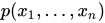
is a polynomial of degree two that defines an affine quadric, then its projective completion is defined by homogenizing p into

(this is a polynomial, because the degree of p is two). The points of the projective completion are the points of the projective space whose projective coordinates are zeros of P.
So, a projective quadric is the set of zeros in a projective space of a homogeneous polynomial of degree two.
As the above process of homogenization can be reverted by setting X0 = 1:

it is often useful to not distinguish an affine quadric from its projective completion, and to talk of the affine equation or the projective equation of a quadric. However, this is not a perfect equivalence; it is generally the case that will include points with , which are not also solutions of because these points in projective space correspond to points "at infinity" in affine space.


Equation[edit]
A quadric in an affine space of dimension n is the set of zeros of a polynomial of degree 2. That is, it is the set of the points whose coordinates satisfy an equation

where the polynomial p has the form

for a matrix with and running from 0 to . When the characteristic of the field of the coefficients is not two, generally is assumed; equivalently . When the characteristic of the field of the coefficients is two, generally is assumed when ; equivalently is upper triangular.


The equation may be shortened, as the matrix equation

with

The equation of the projective completion is almost identical:

with

These equations define a quadric as an algebraic hypersurface of dimension n – 1 and degree two in a space of dimension n.
A quadric is said to be non-degenerate if the matrix is invertible.
A non-degenerate quadric is non-singular in the sense that its projective completion has no singular point (a cylinder is non-singular in the affine space, but it is a degenerate quadric that has a singular point at infinity).
The singular points of a degenerate quadric are the points whose projective coordinates belong to the null space of the matrix A.
A quadric is reducible if and only if the rank of A is one (case of a double hyperplane) or two (case of two hyperplanes).
Normal form of projective quadrics[edit]
In real projective space, by Sylvester's law of inertia, a non-singular quadratic form P(X) may be put into the normal form

by means of a suitable projective transformation (normal forms for singular quadrics can have zeros as well as ±1 as coefficients). For two-dimensional surfaces (dimension D = 2) in three-dimensional space, there are exactly three non-degenerate cases:
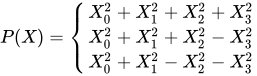
The first case is the empty set.
The second case generates the ellipsoid, the elliptic paraboloid or the hyperboloid of two sheets, depending on whether the chosen plane at infinity cuts the quadric in the empty set, in a point, or in a nondegenerate conic respectively. These all have positive Gaussian curvature.
The third case generates the hyperbolic paraboloid or the hyperboloid of one sheet, depending on whether the plane at infinity cuts it in two lines, or in a nondegenerate conic respectively. These are doubly ruled surfaces of negative Gaussian curvature.
The degenerate form

generates the elliptic cylinder, the parabolic cylinder, the hyperbolic cylinder, or the cone, depending on whether the plane at infinity cuts it in a point, a line, two lines, or a nondegenerate conic respectively. These are singly ruled surfaces of zero Gaussian curvature.
We see that projective transformations don't mix Gaussian curvatures of different sign. This is true for general surfaces.[3]
In complex projective space all of the nondegenerate quadrics become indistinguishable from each other.
Rational parametrization[edit]
Given a non-singular point A of a quadric, a line passing through A is either tangent to the quadric, or intersects the quadric in exactly one other point (as usual, a line contained in the quadric is considered as a tangent, since it is contained in the tangent hyperplane). This means that the lines passing through A and not tangent to the quadric are in one to one correspondence with the points of the quadric that do not belong to the tangent hyperplane at A. Expressing the points of the quadric in terms of the direction of the corresponding line provides parametric equations of the following forms.
In the case of conic sections (quadric curves), this parametrization establishes a bijection between a projective conic section and a projective line; this bijection is an isomorphism of algebraic curves. In higher dimensions, the parametrization defines a birational map, which is a bijection between dense open subsets of the quadric and a projective space of the same dimension (the topology that is considered is the usual one in the case of a real or complex quadric, or the Zariski topology in all cases). The points of the quadric that are not in the image of this bijection are the points of intersection of the quadric and its tangent hyperplane at A.
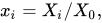
In the affine case, the parametrization is a rational parametrization of the form

where are the coordinates of a point of the quadric, are parameters, and are polynomials of degree at most two.


In the projective case, the parametrization has the form

where are the projective coordinates of a point of the quadric, are parameters, and are homogeneous polynomials of degree two.


One passes from one parametrization to the other by putting and


For computing the parametrization and proving that the degrees are as asserted, one may proceed as follows in the affine case. One can proceed similarly in the projective case.
Let q be the quadratic polynomial that defines the quadric, and be the coordinate vector of the given point of the quadric (so, Let be the coordinate vector of the point of the quadric to be parametrized, and be a vector defining the direction used for the parametrization (directions whose last coordinate is zero are not taken into account here; this means that some points of the affine quadric are not parametrized; one says often that they are parametrized by points at infinity in the space of parameters) . The points of the intersection of the quadric and the line of direction passing through are the points such that






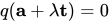
for some value of the scalar This is an equation of degree two in except for the values of such that the line is tangent to the quadric (in this case, the degree is one if the line is not included in the quadric, or the equation becomes otherwise). The coefficients of and are respectively of degree at most one and two in As the constant coefficient is the equation becomes linear by dividing by and its unique solution is the quotient of a polynomial of degree at most one by a polynomial of degree at most two. Substituting this solution into the expression of one obtains the desired parametrization as fractions of polynomials of degree at most two.


Example: circle and spheres[edit]
Let consider the quadric of equation

For this is the unit circle; for this is the unit sphere; in higher dimensions, this is the unit hypersphere.


The point belongs to the quadric (the choice of this point among other similar points is only a question of convenience). So, the equation of the preceding section becomes


By expanding the squares, simplifying the constant terms, dividing by and solving in one obtains
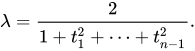
Substituting this into and simplifying the expression of the last coordinate, one obtains the parametric equation
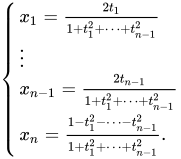
By homogenizing, one obtains the projective parametrization
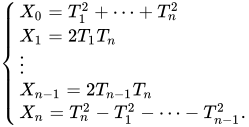
A straightforward verification shows that this induces a bijection between the points of the quadric such that and the points such that in the projective space of the parameters. On the other hand, all values of such that and give the point




In the case of conic sections (), there is exactly one point with and one has a bijection between the circle and the projective line.


For there are many points with and thus many parameter values for the point On the other hand, the other points of the quadric for which (and thus ) cannot be obtained for any value of the parameters. These points are the points of the intersection of the quadric and its tangent plane at In this specific case, these points have nonreal complex coordinates, but it suffices to change one sign in the equation of the quadric for producing real points that are not obtained with the resulting parametrization.


Rational points[edit]
A quadric is defined over a field if the coefficients of its equation belong to When is the field of the rational numbers, one can suppose that the coefficients are integers by clearing denominators.


A point of a quadric defined over a field is said rational over if its coordinates belong to A rational point over the field of the real numbers, is called a real point.

A rational point over is called simply a rational point. By clearing denominators, one can suppose and one supposes generally that the projective coordinates of a rational point (in a quadric defined over ) are integers. Also, by clearing denominators of the coefficients, one supposes generally that all the coefficients of the equation of the quadric and the polynomials occurring in the parametrization are integers.
Finding the rational points of a projective quadric amounts thus to solve a Diophantine equation.
Given a rational point A over a quadric over a field F, the parametrization described in the preceding section provides rational points when the parameters are in F, and, conversely, every rational point of the quadric can be obtained from parameters in F, if the point is not in the tangent hyperplane at A.
It follows that, if a quadric has a rational point, it has many other rational points (infinitely many if F is infinite), and these points can be algorithmically generated as soon one knows one of them.
As said above, in the case of projective quadrics defined over the parametrization takes the form

where the are homogeneous polynomials of degree two with integer coefficients. Because of the homogeneity, one can consider only parameters that are setwise coprime integers. If is the equation of the quadric, a solution of this equation is said primitive if its components are setwise coprime integers. The primitive solutions are in one to one correspondence with the rational points of the quadric (up to a change of sign of all components of the solution). The non-primitive integer solutions are obtained by multiplying primitive solutions by arbitrary integers; so they do not deserve a specific study. However, setwise coprime parameters can produce non-primitive solutions, and one may have to divide by a greatest common divisor to arrive at the associated primitive solution.


Pythagorean triples[edit]
This is well illustrated by Pythagorean triples. A Pythagorean triple is a triple of positive integers such that A Pythagorean triple is primitive if are setwise coprime, or, equivalently, if any of the three pairs and is coprime.

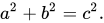


By choosing the above method provides the parametrization

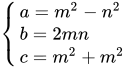
for the quadric of equation (The names of variables and parameters are being changed from the above ones to those that are common when considering Pythagorean triples).

If m and n are coprime integers such that the resulting triple is a Pythagorean triple. If one of m and n is even and the other is odd, this resulting triple is primitive; otherwise, m and n are both odd, and one obtains a primitive triple by dividing by 2.

In summary, the primitive Pythagorean triples with even are obtained as


with m and n coprime integers such that one is even and (this is Euclid's formula). The primitive Pythagorean triples with odd are obtained as


with m and n coprime odd integers such that

As the exchange of a and b transforms a Pythagorean triple into another Pythagorean triple, only one of the two cases is sufficient for producing all primitive Pythagorean triples.
Projective quadrics over fields[edit]
The definition of a projective quadric in a real projective space (see above) can be formally adapted by defining a projective quadric in an n-dimensional projective space over a field. In order to omit dealing with coordinates, a projective quadric is usually defined by starting with a quadratic form on a vector space.[4]
Quadratic form[edit]
Let be a field and a vector space over . A mapping from to such that


- (Q1) for any and .



- (Q2) is a bilinear form.

is called quadratic form. The bilinear form is symmetric.

In case of the bilinear form is , i.e. and are mutually determined in a unique way.
In case of (that means: ) the bilinear form has the property , i.e. is
symplectic.




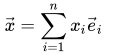
For and ( is a base of ) has the familiar form



- and

- .
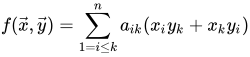
For example:

n-dimensional projective space over a field[edit]
Let be a field, ,

- an (n + 1)-dimensional vector space over the field
- the 1-dimensional subspace generated by ,
- the set of points ,
- the set of lines.
- is the n-dimensional projective space over .
- The set of points contained in a -dimensional subspace of is a -dimensional subspace of . A 2-dimensional subspace is a plane.
- In case of a -dimensional subspace is called hyperplane.







Projective quadric[edit]
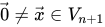
A quadratic form on a vector space defines a quadric in the associated projective space as the set of the points such that . That is,



Examples in .:
(E1): For one obtains a conic.
(E2): For one obtains the pair of lines with the equations and , respectively. They intersect at point ;


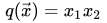


For the considerations below it is assumed that .

Polar space[edit]
For point the set
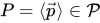

is called polar space of (with respect to ).

If for all , one obtains .


If for at least one , the equation is a non trivial linear equation which defines a hyperplane. Hence

- is either a hyperplane or .


Intersection with a line[edit]
For the intersection of an arbitrary line with a quadric , the following cases may occur:

- a) and is called exterior line
- b) and is called a line in the quadric
- c) and is called tangent line
- d) and is called secant line.


Proof:
Let be a line, which intersects at point and is a second point on .
From one obtains
I) In case of the equation holds and it is
for any . Hence either
for any or for any , which proves b) and b').
II) In case of one obtains and the equation
has exactly one solution .
Hence: , which proves c).














Additionally the proof shows:
- A line through a point is a tangent line if and only if .


f-radical, q-radical[edit]
In the classical cases or there exists only one radical, because of and and are closely connected. In case of the quadric is not determined by (see above) and so one has to deal with two radicals:


- a) is a projective subspace. is called f-radical of quadric .
- b) is called singular radical or -radical of .
- c) In case of one has .



A quadric is called non-degenerate if .

Examples in (see above):
(E1): For (conic) the bilinear form is
In case of the polar spaces are never . Hence .
In case of the bilinear form is reduced to
and . Hence
In this case the f-radical is the common point of all tangents, the so called knot.
In both cases and the quadric (conic) ist non-degenerate.
(E2): For (pair of lines) the bilinear form is and the intersection point.
In this example the quadric is degenerate.







Symmetries[edit]
A quadric is a rather homogeneous object:
- For any point there exists an involutorial central collineation with center and .


Proof: Due to the polar space is a hyperplane.

The linear mapping
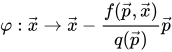
induces an involutorial central collineation with axis and centre which leaves invariant.
In the case of , the mapping produces the familiar shape with and for any .

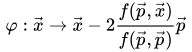


Remark:
- a) An exterior line, a tangent line or a secant line is mapped by the involution on an exterior, tangent and secant line, respectively.
- b) is pointwise fixed by .
q-subspaces and index of a quadric[edit]
A subspace of is called -subspace if


For example: points on a sphere or lines on a hyperboloid (s. below).
- Any two maximal -subspaces have the same dimension .[5]

Let be the dimension of the maximal -subspaces of then
- The integer is called index of .

Theorem: (BUEKENHOUT)[6]
- For the index of a non-degenerate quadric in the following is true:
- .

Let be a non-degenerate quadric in , and its index.
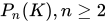
- In case of quadric is called sphere (or oval conic if ).
- In case of quadric is called hyperboloid (of one sheet).


Examples:
- a) Quadric in with form is non-degenerate with index 1.
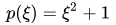
- b) If polynomial is irreducible over the quadratic form gives rise to a non-degenerate quadric in of index 1 (sphere). For example: is irreducible over (but not over !).
- c) In the quadratic form generates a hyperboloid.




Generalization of quadrics: quadratic sets[edit]
It is not reasonable to formally extend the definition of quadrics to spaces over genuine skew fields (division rings). Because one would obtain secants bearing more than 2 points of the quadric which is totally different from usual quadrics.[7][8][9] The reason is the following statement.
- A division ring is commutative if and only if any equation , has at most two solutions.

There are generalizations of quadrics: quadratic sets.[10] A quadratic set is a set of points of a projective space with the same geometric properties as a quadric: every line intersects a quadratic set in at most two points or is contained in the set.
See also[edit]
References[edit]
- ^ Silvio Levy Quadrics in "Geometry Formulas and Facts", excerpted from 30th Edition of CRC Standard Mathematical Tables and Formulas, CRC Press, from The Geometry Center at University of Minnesota
- ^ Stewart Venit and Wayne Bishop, Elementary Linear Algebra (fourth edition), International Thompson Publishing, 1996.
- ^ S. Lazebnik and J. Ponce, "The Local Projective Shape of Smooth Surfaces and Their Outlines" (PDF)., Proposition 1
- ^ Beutelspacher/Rosenbaum p.158
- ^ Beutelpacher/Rosenbaum, p.139
- ^ F. Buekenhout: Ensembles Quadratiques des Espace Projective, Math. Teitschr. 110 (1969), p. 306-318.
- ^ R. Artzy: The Conic in Moufang Planes, Aequat.Mathem. 6 (1971), p. 31-35
- ^ E. Berz: Kegelschnitte in Desarguesschen Ebenen, Math. Zeitschr. 78 (1962), p. 55-8
- ^ external link E. Hartmann: Planar Circle Geometries, p. 123
- ^ Beutelspacher/Rosenbaum: p. 135

Bibliography[edit]
- M. Audin: Geometry, Springer, Berlin, 2002, ISBN 978-3-540-43498-6, p. 200.
- M. Berger: Problem Books in Mathematics, ISSN 0941-3502, Springer New York, pp 79–84.
- A. Beutelspacher, U. Rosenbaum: Projektive Geometrie, Vieweg + Teubner, Braunschweig u. a. 1992, ISBN 3-528-07241-5, p. 159.
- P. Dembowski: Finite Geometries, Springer, 1968, ISBN 978-3-540-61786-0, p. 43.
- Iskovskikh, V.A. (2001) [1994], "Quadric", Encyclopedia of Mathematics, EMS Press
- Weisstein, Eric W. "Quadric". MathWorld.
