


The Richest Man in Babylon (book)

From Wikipedia, the free encyclopedia

  (Redirected from Richest Man In Babylon)
Jump to: navigation, search

The Richest Man in Babylon is a book by George Samuel Clason which dispenses financial advice through a collection of parables set in ancient Babylon. Through their experiences in business and managing household finance, the characters in the parables learn simple lessons in financial wisdom. By basing these parables in ancient times, but involving situations that modern people can understand and identify with, the author presents these lessons as timeless wisdom that is as relevant today as it was back then.
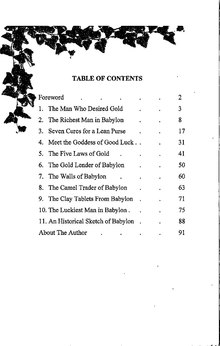
The book began in 1926 as a series of informational pamphlets. Banks and insurance companies began to distribute these pamphlets, and the most famous ones were eventually compiled into this book. It was most recently reissued by Signet in 2004, and an updated version (using modern English instead of "King James" language) was issued by BN Publishing in March 2007. According to the 2002 edition book cover, more than two million copies have been sold.

Contents

[edit] Chapter Summary

[edit] Chapter One: The Man Who Desired Gold

Babylon was a land of great disparity between the rich and the poor. Bansir was a simple Babylonian chariot builder. He sat and looked over his meager home, and the unfinished chariot in his workshop. He wondered why he worked so hard, and yet remained so poor.

Bansir's friend Kobbi, a musician, wandered up and greeted him happily. Kobbi asked if he could borrow two shekels until the noblemen's feast that night. Bansir replied that even if he had two sheckels, he could not lend it, because it would be his entire fortune. This shocked Kobbi, who had assumed his friend must have plenty, since Bansir spent so much time sitting and dreaming instead of working.

Bansir told Kobbi of his dreams of possessing fabulous wealth, and said his sitting and moping was a result of how disappointing reality was compared to his dreams.

The two friends reflected on how much money they had earned over the course of their lives, and how little they had to show for it now. Bansir lamented that future generations of his family would continue to toil and struggle. He concluded that the Gods had not bestowed wealth upon him because They failed to notice his good works.

They observed slaves marching, loaded with heavy goatskins of water, and realized that they were quite lucky to be free men. Kobbi wondered if one could become wealthy by learning what the wealthy do and mimicking it. Bansir decided there must be a secret to acquiring gold, and they decided to ask their old friend Arkad, who is the richest man in Babylon to instruct them.

[edit] Chapter Two: The Richest Man in Babylon

Arkad, the richest man in Babylon, was very generous with his family, and gave much to charity. Though he was very giving, his wealth continued to grow. Bansir and his party met with Arkad, and asked why fate should make one man so wealthy when any of them were equally deserving. Arkad replied that if they were not wealthy, it was because they had failed to learn the laws of wealth building, or else had failed to adhere to them. He said if "fickle fate" brings wealth, wanton spending will take it away. Furthermore, a person who lucks into wealth clings fearfully to their fortune, knowing they can not replace it. He said that few men can use their money wisely and can live happily.

During his youth, Arkad noticed that wealth magnifies power and happiness. He decided to be rich in order to acquire that which he desired. To be rich, he would have to immerse himself in the study of wealth accumulation, and once the laws were discovered, he would adhere closely to them.

Arkad stated that it's not just what you know that's important, but also being able to learn what you don't already know.

Arkad found employment as a scribe in the hall of records. He worked hard, but felt that his earnings were not enough for him to acquire not only his necessities but his desire.

One day a wealthy money lender named Algamish ordered a copy from Arkad. He needed it in two days, and offered Arkad two coppers for express service. Arkad worked hard, but wasn't able to finish the job. Algamish was angry that the job wasn't finished, but Arkad made a deal with him. He would work all night to finish the job if Algamish would tell him the secret of how to be rich. Algamish accepted the deal, and Arkad completed the job.

Algamish said that he reached his status when he decided to “keep a part of all he earned for himself”, so he must do the same. Algamish explained that if Arkad spends all his earnings then it means that he labored for the merchants and not for himself. If he would keep one tenth of his earnings and didn't spend it no matter what, then it would grow. When these savings have accumulated, it will be the time for him to invest it, to make his wealth work for him.

While putting this lesson into practice, Arkad was tempted to spend all of his money, but he didn't give in. A year later, Algamish returned, and asked Arkad if he pays himself one tenth of his earnings. Arkad proudly stated that he does. Algamish asked Arkad where he invested his earnings. Arkad said that he gave it to Azmur, the brick-maker to invest in jewels. Algamish said that Arkad was a fool, he should have ask the jewel merchants about jewels, not the brick-maker. Advice is given freely, but should be looked upon skeptically. Sure enough, Azmur had been cheated, and had lost all of Arkad's money.

Arkad continued to save, and twelve months later Algamish returned. He again asked Arkad about his savings. Arkad said that he loaned his money to Agger, the shieldmaker, who paid it back with interest. Arkad used the interest for luxuries. Algamish told him to continue to acquire wealth, and only when wealthy enjoy the fruits of that fortune.

Two years later, Algamish returned. He praised Arkad for having learned his lessons well: 1. Live on less than you earn, 2. Seek advice from those who are competent through their own experiences to give it, 3. Make your gold work for you.

Algamish invited Arkad to work with him. He asked Arkad to take charge of his properties, and promised to give him a part of his estate when he dies. Arkad accepted the offer, and because of his ambitions made the property more prosperous. When Algamish died, he gave a part of his property to Arkad.

As the tale ended, one of the party said that Arkad was lucky because Algamish made him an heir. Arkad replied that he was fortunate only in that he had a desire to prosper before he met Algamish. His friends were really amazed and they told Arkad that he has a strong willpower. Arkad replied that willpower is only an unflinching purpose to carry a task to completion. He said that if you set a task, you must complete it whatever happens, so don't begin tasks lightly. He advised his friends to take the wisdom of Algamish and to prosper like him. Remember "part of all I earn is mine to keep." Make gold your slave. Seek wise counsel. But don’t stress out in practicing the principles, instead enjoy life while ensuring your future.

[edit] Chapter Three: Seven Cures for a Lean Purse

Babylon, the richest city during that time is experiencing an economic down turn. It was because a few rich men acquired the wealth of the city and left the majority of the citizens in poverty. Because of this the good King Sargon was very worried as the Royal Chancellor told it to him after he came back from the battle with the Elimates. King ordered the Royal Chancellor to bring Arkad to him because they believe that he knew the answers to the problem of their city.

The next day, the Royal Chancellor brought Arkad in front of the King. The King asked Arkad what is the secret on acquiring wealth and if it can be taught to others. Arkad replied that it is practical and it can be taught to others. The King was happy to hear that from Arkad. Arkad asked the King to command the Chancellor to arrange a class of one hundred men and he will teach them the seven cures to fatten their purse. On that night, with the command of the King the class of one hundred men assembled in the Great Hall of the Temple of Learning.

[edit] The First Cure: Start thy purse to fattening

Arkad stated the first cure to a lean purse which is “Start thy purse to fattening”. He asked some of the men what their works are. After questioning them he said that there are many trading and labor into which they can acquire gold and in their purse flow a stream of coins. He turned to an egg merchant and he set an example. He stated that if the egg merchant will choose only one basket and put each morning ten eggs but take out from it only nine eggs, and then what will happen? The egg merchant answered that it will overflow as time passed by. Then, Arkad smiled to the class and stated the first remedy to a lean purse. He stated that for every ten coins that you place within your purse, take out only for use but nine. Then after that your purse will start to fatten at once and its increasing weight will feel good in your hands and bring satisfaction to the soul. He stated that “for each ten coins he put in, to spend but nine”. He said that it is simple but effective, that upon practicing this he can manage his wealth very well and he has not shorten like before. Then, the class was dismissed on that day.

[edit] The Second Cure: Control thy expenditures

On the next day, some of the class asked Arkad how they could save one-tenth of their earnings if it was not enough for their necessary expenses. Arkad answered that do not confuse the necessary expenses to the desires because each of them has so many desires in which their earnings cannot gratify. He continued that they should learn to live in a simple ways and must budget their earnings to their necessary expenses. Budget is necessary to control expenditures and to fatten their purses. He stated to them the second cure which is “Budget thy expenses that thou mayest have coins to pay for thy necessities, to pay for thy enjoyments and to gratify thy worthwhile desires without spending more than nine-tenths of thy earnings”.

[edit] The Third Cure: Make thy Gold Multiply

On the third day, Arkad explained to the class the third cure. He said that they should put their treasure or savings to labor and make it multiply. They must put it into investment because a man’s wealth is not in the coins he carries in his purse but it is the income that he builds. He continued that the golden stream of money that continually flows in their purses is the important one and which every man should desire. After that, he stated the third cure which is: “to put each coin to laboring that it may reproduce its kind even as the flocks of the field and help bring to thee income, a stream of wealth that shall flow constantly into thy purse.”

[edit] The Fourth Cure: Guard thy treasure from loss

Arkad explained to his class during the fourth day to study carefully the flow of business before making an investment. They must assure their investment from risk of loss. He said that do not be intrigued by earning a large income and they must acquaint themselves first to the dangers that they might encounter. He advised to consult the wisdom of those who are experienced in handling money for profit because such advice is free and its value is the same with that of the gold. He related with them his own misfortune during his first investment to Azmur. Then, he stated the fourth cure which is “Guard thy treasure from loss by investing only thy principal is safe, where it may be reclaimed if desirable and where thou will not fail to collect a fair rental. Consult with wise men. Secure the advice of those experienced in the profitable handling of gold. Let their wisdom protect thy treasure from unsafe investments”

[edit] The Fifth Cure: Make of thy dwelling a Profitable Investment

Arkad suggested to his class during the fifth day to “own their own home”, which is the fifth cure, for them to enjoy fully their lives. He explained that if they choose to rent a room or house then their families would not be at ease. He also stated that a man who has his own domicile will receive many blessings and will reduce his cost of living and lastly will satisfy his desires.

[edit] The Sixth Cure: Insure a Future Income

On the sixth day, Arkad stated the sixth cure which is “provide in advance for the needs of thy growing age and the protection of thy family”. He said that they must give way for their future days and they must also plan for their certain investments or provisions that may endure safely for many years. He related to them the story of Ansan, the sandal maker. He said that Ansan had accumulated great income by depositing his silver to the money lender and because of this he can assure an income for the future.

[edit] The Seventh Cure: Increase thy Ability to Earn

Arkad said to the class that they must have a desire to increase their earnings and that desire must be strong and definite. He also enumerated the things that a man can do to make his life rich with gainful experiences. And these are as follows: “He must pay his debts with all the promptness within his power, not purchasing that for which he is unable to pay” “He must take care of his family that they may think and speak well of him” “He must make a will of record that, in case the Gods call him, proper and honorable division of his property be accomplished” “He must have compassion upon those who are injured and smitten by misfortune and aid them within reasonable limits. He must do deeds of thoughtfulness to those dear to him.” Then, he stated the seventh cure for a lean purse which is “to cultivate thy own powers, to study and become wiser, to become more skillful, to so act as to respect thyself”. He told to his students that Babylon has plenty of gold, so they must practice what he has taught to them for them to prosper and grow wealthy.

[edit] Chapter Four: Meet the Goddess of Good Luck

This chapter started with a Babylonian proverb about luck which is “If a man be lucky, there is no foretelling the possible extent of his good fortune. Pitch him into the Euphrates and like as not he will swim out with a pearl in his hand.” Then, it continues with the discussion about Good Luck. The men of ancient Babylon wished to know if there are ways of attracting good luck. In the distant past it is said that there are no schools or colleges in Babylon. They only have a center of learning which was called the “Temple of Learning”. This temple has the same important with the Palace of the King, the Hanging Gardens and the Temple of Gods. This temple was expounded by voluntary teachers and the subjects of popular interest were discussed in open forums. Within this temple, they all met as equal. Among the many who frequented the temple was a wise rich man named Arkad, called the richest man in Babylon. He has his own special hall where almost every evening a large group of men gathered to discuss and argue interesting subjects. Its halls are filled with infinite knowledge and can only be unlocked by those who need its powers.

One night, they had a discussion about attracting Goddess of Good Luck to oneself which was triggered by a tall clothe weaver. This man shared a story about a purse with pieces of gold in which he has found that day. Arkad stated that luck to some men is like a chance or accident which can befall without purpose or reason. And others do believe to the Goddess of Good Luck, who is Ashtar. Then, a well robed young man shared a story about the gaming table where Goddess of good luck was not at all present. After that, they asked Arkad how did he decide to bet on the gray horses from Niniveh yesterday and won unexpectedly. Arkad explained that he does believe to the Goddess of love and dignity, who aid those in need and reward those deserving. He said that he found the Goddess not only in the games but in other places where the doings of men are more worth while like in honest trading where there are opportunities to make profit out of his efforts and transactions. He explained that when a man plays the games, the situation is reverse for the chances of profit are always against him and always in favor of the game keeper. He further discussed that wagers placed upon the cubes. Each time it is cast we bet which side will be uppermost. If it be the red side, the game master will pay four times the bet. And if any other of the five sides come uppermost, then they will lose the bet. Thus the figures show that for each cast the chances of losing are five.

After that, Arkad asked the class if who among them have had good luck within their grasp only to see it escape. When he saw that there are many hands rising, he shared a story of an old father insisting his young married child to invest in plan to build waterwheels and raise life giving waters to the fertile soil. And the child after postponing the opportunity, realize his biggest mistake of his life. Then a man commented that good luck waits to come to that man who accepts opportunity.

Then, a Syrian shared a story about procrastinator of merchant who deals in camels and horses and sheep sometime. After traveling long in the dark, he got an offer to buy nine hundred flocks but to pay immediately because the farmer needed the money urgently. Even after accepting the deal he refused to pay the farmer and he said that he can only pay in daylight. On the next morning, the farmer sells the flocks at three times the price because the city was threatened with siege.

At the last part of the story, Arkad summarized the lessons from the discussion; He said that it is necessary to take advantage of the opportunities because the Goddess of good luck can be enticed by accepting opportunities. He continued that those who are eager to grasp opportunities for their betterment do attract the interest of the good Goddess because she is ever anxious to aid those who pleased her. The one who pleased her are the men of action. He said that action will lead them forward to the success of their desires. At the last part of the story, the main lesson is “Men of action are favored by the Goddess of Good luck”.

[edit] Chapter Five: The Five Laws of Gold

On their journey to the desert heading to Babylon, an old man named Kalabab decided to tell to his companions a story about Nomasir, who is the son of Arkad. The story was to illustrate the difficulty leaving the difference between executing wisdom when dealing with gold and being overcome by greed. The story started when Kalabab was just a lad and his master and he went to the palace of Nomasir in Niniveh to bring great bundles of fine rugs for Nomasir to choose. When Nomasir was pleased, he invited the two to drink with him while he was telling his own tale. Nomasir started the tale by stating that one of the Babylonian customs is to maintain that the son lives with their parents and will inherit their parents’ wealth. He said that his father Arkad didn’t mind the tradition and instead sent him outside for him to learn how to handle and acquire his own wealth. He said that his father ordered him to journey for ten years and go back after that. Arkad gave him a bag of gold and a clay tablet in which carved the wisdom on managing his gold. Nomasir agreed to his father and journeyed to Niniveh which was the growing city that time. After ten years he came back and told his journey to his parents and his relatives. This resulted them to feast. He said that during his journey he joined a caravan and met some friends. Among his friends were the two men who later deceived him in a horse racing that’s why he lose many gold. Then, another man also deceived him after promising that they will become partners in buying the merchant’s shop. This resulted him to sell his horse, slave and his extra robe to earn money for his needs. After that, he remembered the clay tablet that his father gave him. He learned the wisdom by heart and realized that if he studies it first then he didn’t lose his gold.

In the feast, he stated the five laws of gold:
1. Gold cometh gladly and in increasing quantity to any man who will put by not less than one-tenth of his earnings to create an estate for his future and that of his family.
2. Gold laboreth diligently and contentedly for the wise owner who finds for it profitable employment, multiplying even as the flocks of the field.
3. Gold clingeth to the protection of the cautious owner who invests it under the advice of men wise in its handling.
4. Gold slippeth away from the man who invests it in businesses or purposes with which he is not familiar or which are not approved by those skilled in its keep.
5. Gold flees the man who would force it to impossible earning or who followeth the alluring advice of tricksters and schemers or who trusts it to his own inexperience and romantic desires in investment.
Then, the story goes back to Kalabab and his companions. He encourages his companions to apply the learning that they have gained from his story.

[edit] Chapter Six: The Gold Lender of Babylon

Rodan, the spearmaker of old babylon is awarded with fifty pieces of gold that’s why he was looking for an advice to lend 50 pieces of gold to his sister's husband or not. Mathon is only visted by men in need of gold or men returning gold. Mathon is delighted to see somebody visiting him for an expert advice. Mathon shares Rodan that the "Gold bringeth unto its possessor responsibility and a changed position with his fellow men. It bringeth a fear lest he lose it or it be tricked away from him. It bringeth a feeling of power and ability to do well. Likewise, it bringeth opportunities whereby his very good intentions may bring him into difficulties." Mathon told Rodan a story in Niniveh about a donkey and ass. After the story, he explained the moral lesson which is "If you desire to help thy friend, do so in a way that will not bring thy friend's burden upon thyself." Then, Rodan was very curious if gold borrowers pay back or not that’s why Mathon shows the chest of tokens that he collects from gold borrowers. He enumerated the following: “Safest loans are those whose possessions are of more value than the one they desire. They own lands, or jewels, or camels, or other things which could be sold to repay the loan.” “Other Safe loans are those who have the capacity to earn. They labor or serve and repay. They have income and if they are honest and suffer no misfortune, they also repay. These loans are based on human efforts.” “Others are those who have neither the property nor assured earning capacity. Some of them who cannot adjust themselves fail to repay.” Mathon further explained Rodan to "Be not swayed by foolish sentiments of obligation to trust thy treasure to any person. If thou wouldst help thy family or thy friends, find other ways than risking the loss of thy treasure. Forget not that gold slippeth away in unexpected ways from those unskilled in guarding it. As well waste thy treasure in extravagance as let others lose it for thee.’ Seek to associate thyself with men and enterprises whose success is established that thy treasure may earn liberally under their skillful use and be gaurded safely by 'their wisdom and experience. At the last part of the story the moral lesson is “Better a little caution than a great regret”

[edit] Chapter Seven: The Walls of Babylon

In this story, the King of Babylon had taken his army to fight with Elamities which is the neighboring country. During that time Asyrian attack Babylon from the north. Pains, disappointment and fear were discussed in various contexts about the War. Banzar keeps assuring the inmates of safety and normal functioning. On fifth night of fourth week the war ends. In the story, the Walls of Babylon are compared with man's desire for protection. This desire is inherent in the human race. Behind the impregnable walls of insurance, saving accounts and dependable walls of insurance we can guard ourselves against the unexpected tragedies that may enter the door and seat themselves before any fireside. At the last part of the story the lesson is “We cannot afford to be without adequate protection”

[edit] Chapter Eight: The Camel Trader of Babylon

Tarkad, the son of Azure had borrowed enough of copper and silver from all the people in Babylon. Now he is not having a single copper for food since two days. Hunger had never enhanced his sensitivity to food odors so strong. He encounters Debasir from whom he had borrowed two pieces of copper and one piece of silver long back. Debasir catches Tarkad and shares his story as a moral. Debasir with his excellent wife lived in Babylon. He realized shopkeepers let him pay later because of trust he built. One fine day Debasir realized he could not use his earning to live or pay debts. His life became miserable and his wife returned to her father. Unsuccessfully working with caravans Debasir got in group of robbers who attacked unarmed caravans. In one of the robbery he was caught and stripped and sold in Damascus for two pieces of silver. Sira first of four wives of Debasirs owner asked Debasir to lead her camel in desert to take her to her sick mother. When Debasir conveyed that he is not born slave Sira gives him the lesson "How can you call yourself a free man when your weakness has bought you to this? If a man has in himself the should of a slave will he not become one no matter what his birth, even as water seeks its level? If a man has within him the should of a free man, will he not become respected and honored in has own city in spite of his misfortune?" "Does not they great king fight his enemies in every way he can and with every force he has? Thy depths are the enemies. They ran thee out of Babylon." Sira once again goes to her sick mother, this time with more food and two camels. After reaching she told Debasir that he can be free man again and he can run away with food and camels. In search of Babylon Debasir goes in deserts with two camels for nine days. With great hunger and no food and water he is at the verge of dying. Then he asks himself "Have I the soul of a slave or the sould of a free man?" These lines gave him the power to struggle further and touch the limits. Soon after walking some more he gets the water and then the food. This way he returns to Babylon Debasir gets his good wife back from her fathers place and gradually pays every debt to become respectful man in Babylon Tarkad realizes the mistake he has done and assures that he will repay his debt Debasir with the help of Mathon learns the camel trade from Nebatur and becomes camel trader in Babylon. Then the moral lesson is “Where the determination is, the way can be found”.

[edit] Chapter Nine: The Clay Tablets from Babylon

In the story, five Clay tablets were deciphered by Alfred H. Shrewsbury during 1934. These tablets tell the inscribed by Debasir in Babylon. Story covered in the chapter "The Camel Trader of Babylon". What is described clearly how Debasir came out of his debt by basic rule. Debasir started earning silvers from Camel Trade. He kept 1/10 for himself, 2/10 paid to debtors, 7/10 used for living. Fortunately by using these rules even Alfred H. Shrewsbury came out of debts.

[edit] Chapter Ten: The Luckiest Man in Babylon

Sharru Nada was the merchant prince of Babylon and enjoys good lifestyle. He was heading the caravan from Damascus to Babylon. Arad Gula was his great partner in business they carried out. He is no more and gone to darkness. Then, Hadan Gula is Arad Gula's grandson. Sharru Nada felt he owed a debt of gratitude to Arad Gula, so he should do something for Hadan Gula being his grandson. Hadan Gula and his father are not going through good times of their life. Sharru Nada said if "Why wish his spirit to linger on earth beyond its allotted time? Thou and they father can well carry on his good work". There is difference of opinion between both of them at the beginning of journey. Hadan Gula believes that work was made for slaves. Young man has spendthrift ideas and bejeweled hands. During the journey, Sharru Nada tells his story how he raised himself from a slave to prince merchant. Megiddo who was also slave kept on preaching about work to Sharru Nada "Some men hate it. They make it their enemy. Better to treat it like a friend, make you like it. Don't mind because it is hard. If thou thickest about what a good house thou build, then who cares if the beams are heavy and it is far from the well to carry the water for the plaster. Promise me, boy, if thou get a master, work for him as hard as hard as thou canst. If he does not appreciate all thou do, never mind. Remember, work, well-done, does well to the man who does it. It makes him a better man." Sharru Nada tells something about Arad Gula: "Work attracted his many friends who admired his industry and the success it brought. Work brought him the honors he enjoyed so much in Dumascus." Life is rich with many pleasures for men to enjoy. Each has its place. I am glad that work is not reserved for slaves. Were that the case I would be deprived of my greatest pleasure. Many things do I enjoy but nothing takes the place of work." At the last part of the story, Sharru Nada convinced Hadan Gula. Hadan Gula now has the same perception about work and slavery with that of Sharru Nada.

[edit] Chapter Eleven: A Historical Sketch of Babylon

Babylon: Its name conjures vision of wealth and splendor. It is located beside the Euphrates River, in a flat, arid valley. Babylon is an outstanding example of man’s ability to achieve great objectives, using whatever means is at his disposal. All of the resources supporting this large city were man-developed. Babylon possessed just two natural resources - a fertile soil and water in the river. Its engineers diverted the waters from the river by means of dams and immense irrigation canals. The outstanding rulers of Babylon live in history because of their wisdom, enterprise and justice. The site of the city is in Asia about six hundred miles east of the Suez Canal, just north of Persian Gulf. Its latitude is about thirty degree above the Equator, practically the same as that of Yuma, Arizona. It possessed a climate similar to that of this American city, hot and dry. Built originally of brick, all exposed walls had disintegrated and gone back to earth once more. Such is Babylon, the wealthy city, today. A heap of dirt, so long abandoned that no living person even knew its name until it was discovered by carefully removing the refuse of centuries from the streets and the fallen wreckage of its noble temples and palaces. The civilization of Babylon is believed to be reaching back 8000 years. One of the outstanding wonders of Babylon was the immense walls surrounding the city. The ancients ranked them with the great pyramid of Egypt as belonging to the "Seven wonders of the world". About six hundred years before the time of Christ, King Nabopolassar rebuilt the famous walls of Babylon. Re-built took so long that work was continued by his son King Nebuchadnezzar. Babylon was never entered by hostile armies until about 540 BC. By Cyrus who conquered the Babylon. The eons of time have crumbled but the wisdom of Babylon endures.

[edit] Plot summary

George S. Clason, the author of the book "The Richest Man in Babylon", presented a series of stories about the ancient Babylonians in order to teach the readers about the lessons and principles on acquiring wealth. The stories in this book set the readers on a sure path to happiness and prosperity. In each story, the author describes and begins in a certain character who will be the one to narrate his past experiences and lessons to the new characters so that the reader can gradually understand how to manage their personal wealth and obligations based on simple principles and processes. The author used characters that can be easily identified by the readers so that they can adopt easily and see themselves in the story. In each story there is a corresponding lesson for the readers to apply in their daily living. Actually, these lessons or principles on acquiring wealth are really simple or basic but it is also really hard to do for a reason that we, humans with strong motives and desire for wealth have no contentment and self-control on spending it. So for us to follow those rules, we must be industrious and must have self-control on budgeting and spending our wealth. We must be prudent and wise all the time.

[edit] Setting

There are several settings in the story. The first was the simple house of Bansir, then the Palace of the King, the Temple of Learning, the Palace of Nomasir in Niniveh, the house of Arkad, the house of Mathon, the desert, the streets of Babylon and etc.

[edit] Conflict in the Plot

The conflict in the plot is man vs. himself because each man in the story struggles against himself on having self-control and discipline on spending and handling wealth.

The story also shows man vs. man because there is a part in the story where there is a battle between Babylonians and the conquerors. It also shows man vs. luck because some characters in the story believe in the blessings of the Goddess of Good Luck.

[edit] Kind of Plot

The story possesses a comic plot because the central characters successfully solved the problems and attain his or her goal. The central characters in the story lives “happily ever after”, which is the main requisite in the comic plot.

[edit] Devices in Plot

The author use the flash back as a device in the plot. The writer presented scenes or incidents that already occurred at an early part of the story. He added scenes or events that reveal the background information in a dramatic way. The author presented it in the recollection of the characters. He used this device to solve the problems that the characters want to resolve. These incidents that happened earlier contribute to the present life of the characters.

[edit] Theme

The author presented several themes after each story or chapters. Those themes are moral lessons in which the author presented to teach the readers. For me the general theme of the story is that handling of wealth can be learned and practiced by anyone so that he can achieve his desires by making him prosperous and at the same time happy.

[edit] Tone

The tone of the story is casual because the topic that was presented by the author was simple and clear yet informative and has a specific purpose which is how to become wealthy and happy.

The book also has explicit knowledge that teaches the reader many ideas and strategies on frugality that can be considered common sense that is often forgotten and/or overanalyzed.

[edit] Characterization

The characterization was dramatic or indirect because the author just allows the readers to deduce the traits of the characters through their thoughts, words, actions and decisions. He infers the characteristics of those characters from what they say and do.

[edit] Point of View

The author utilized the omniscient point of view for the story. He allows the narrator to act as if he knows everything that happens including the thoughts of the characters. To be specific, it is an editorial omniscient point of view because the narrator gave comments on the action by telling the readers its significance.

[edit] References

  • The Richest Man in Babylon - The Success Secrets of the Ancients, by George S. Clason. Publisher - Signet / First published in 1926 / ISBN 0451205367

[edit] External links

Languages