


Schwartz space
In mathematics, Schwartz space is the function space of all functions whose derivatives are rapidly decreasing. This space has the important property that the Fourier transform is an automorphism on this space. This property enables one, by duality, to define the Fourier transform for elements in the dual space of , that is, for tempered distributions. A function in the Schwartz space is sometimes called a Schwartz function.


Schwartz space is named after French mathematician Laurent Schwartz.
Definition[edit]
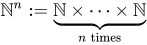
Let be the set of non-negative integers, and for any , let be the n-fold Cartesian product. The Schwartz space or space of rapidly decreasing functions on is the function space








To put common language to this definition, one could consider a rapidly decreasing function as essentially a function f(x) such that f(x), f ′(x), f ′′(x), ... all exist everywhere on R and go to zero as x→ ±∞ faster than any reciprocal power of x. In particular, S(Rn, C) is a subspace of the function space C∞(Rn, C) of smooth functions from Rn into C.
Examples of functions in the Schwartz space[edit]
- If α is a multi-index, and a is a positive real number, then
- Any smooth function f with compact support is in S(Rn). This is clear since any derivative of f is continuous and supported in the support of f, so (xαDβ) f has a maximum in Rn by the extreme value theorem.
- Because the Schwartz space is a vector space, any polynomial can be multiplied by a factor for a real constant, to give an element of the Schwartz space. In particular, there is an embedding of polynomials inside a Schwartz space.



Properties[edit]
Analytic properties[edit]
- From Leibniz's rule, it follows that 𝒮(Rn) is also closed under pointwise multiplication:
- If f, g ∈ 𝒮(Rn) then the product fg ∈ 𝒮(Rn).
- The Fourier transform is a linear isomorphism F:𝒮(Rn) → 𝒮(Rn).
- If f ∈ 𝒮(R) then f is uniformly continuous on R.
- 𝒮(Rn) is a distinguished locally convex Fréchet Schwartz TVS over the complex numbers.
- Both 𝒮(Rn) and its strong dual space are also:
- complete Hausdorff locally convex spaces,
- nuclear Montel spaces,
- It is known that in the dual space of any Montel space, a sequence converges in the strong dual topology if and only if it converges in the weak* topology,[1]
Relation of Schwartz spaces with other topological vector spaces[edit]
- If 1 ≤ p ≤ ∞, then 𝒮(Rn) ⊂ Lp(Rn).
- If 1 ≤ p < ∞, then 𝒮(Rn) is dense in Lp(Rn).
- The space of all bump functions, C∞
c(Rn), is included in 𝒮(Rn).
See also[edit]
References[edit]
- ^ Trèves 2006, pp. 351–359.
Sources[edit]
- Hörmander, L. (1990). The Analysis of Linear Partial Differential Operators I, (Distribution theory and Fourier Analysis) (2nd ed.). Berlin: Springer-Verlag. ISBN 3-540-52343-X.
- Reed, M.; Simon, B. (1980). Methods of Modern Mathematical Physics: Functional Analysis I (Revised and enlarged ed.). San Diego: Academic Press. ISBN 0-12-585050-6.
- Stein, Elias M.; Shakarchi, Rami (2003). Fourier Analysis: An Introduction (Princeton Lectures in Analysis I). Princeton: Princeton University Press. ISBN 0-691-11384-X.
- Trèves, François (2006) [1967]. Topological Vector Spaces, Distributions and Kernels. Mineola, N.Y.: Dover Publications. ISBN 978-0-486-45352-1. OCLC 853623322.
This article incorporates material from Space of rapidly decreasing functions on PlanetMath, which is licensed under the Creative Commons Attribution/Share-Alike License.
| Spaces |
| ||||
|---|---|---|---|---|---|
| Theorems | |||||
| Operators | |||||
| Algebras | |||||
| Open problems | |||||
| Applications | |||||
| Advanced topics | |||||
