


Semiclassical gravity
Semiclassical gravity is an approximation to the theory of quantum gravity in which one treats matter and energy fields as being quantum and the gravitational field as being classical.
In semiclassical gravity, matter is represented by quantum matter fields that propagate according to the theory of quantum fields in curved spacetime. The spacetime in which the fields propagate is classical but dynamical. The dynamics of the theory is described by the semiclassical Einstein equations, which relate the curvature of the spacetime that is encoded by the Einstein tensor to the expectation value of the energy–momentum tensor (a quantum field theory operator) of the matter fields, i.e.


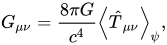
where G is the gravitational constant, and indicates the quantum state of the matter fields.

Energy–momentum tensor[edit]
There is some ambiguity in regulating the energy–momentum tensor, and this depends upon the curvature. This ambiguity can be absorbed into the cosmological constant, the gravitational constant, and the quadratic couplings[1]
- and
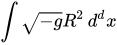
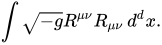
There is another quadratic term of the form
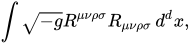
but in four dimensions this term is a linear combination of the other two terms and a surface term. See Gauss–Bonnet gravity for more details.
Since the theory of quantum gravity is not yet known, it is difficult to precisely determine the regime of validity of semiclassical gravity. However, one can formally show that semiclassical gravity could be deduced from quantum gravity by considering N copies of the quantum matter fields and taking the limit of N going to infinity while keeping the product GN constant. At a diagrammatic level, semiclassical gravity corresponds to summing all Feynman diagrams that do not have loops of gravitons (but have an arbitrary number of matter loops). Semiclassical gravity can also be deduced from an axiomatic approach.
Experimental status[edit]
There are cases where semiclassical gravity breaks down. For instance,[2] if M is a huge mass, then the superposition
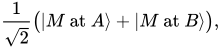
where the locations A and B are spatially separated, results in an expectation value of the energy–momentum tensor that is M/2 at A and M/2 at B, but one would never observe the metric sourced by such a distribution. Instead, one would observe the decoherence into a state with the metric sourced at A and another sourced at B with a 50% chance each. Extensions of semiclassical gravity that incorporate decoherence have also been studied.
Applications[edit]
The most important applications of semiclassical gravity are to understand the Hawking radiation of black holes and the generation of random Gaussian-distributed perturbations in the theory of cosmic inflation, which is thought to occur at the very beginning of the Big Bang.
Notes[edit]
References[edit]
- Birrell, N. D. and Davies, P. C. W., Quantum fields in curved space, (Cambridge University Press, Cambridge, UK, 1982).
- Page, Don N.; Geilker, C. D. (1981-10-05). "Indirect Evidence for Quantum Gravity". Physical Review Letters. 47 (14). American Physical Society (APS): 979–982. Bibcode:1981PhRvL..47..979P. doi:10.1103/physrevlett.47.979. ISSN 0031-9007.
- Eppley, Kenneth; Hannah, Eric (1977). "The necessity of quantizing the gravitational field". Foundations of Physics. 7 (1–2). Springer Science and Business Media LLC: 51–68. Bibcode:1977FoPh....7...51E. doi:10.1007/bf00715241. ISSN 0015-9018. S2CID 123251640.
- Albers, Mark; Kiefer, Claus; Reginatto, Marcel (2008-09-18). "Measurement analysis and quantum gravity". Physical Review D. 78 (6). American Physical Society (APS): 064051. arXiv:0802.1978. Bibcode:2008PhRvD..78f4051A. doi:10.1103/physrevd.78.064051. ISSN 1550-7998. S2CID 119232226.
- Robert M. Wald, Quantum Field Theory in Curved Spacetime and Black Hole Thermodynamics. University of Chicago Press, 1994.
See also[edit]
| Central concepts | |||||||||
|---|---|---|---|---|---|---|---|---|---|
| Toy models | |||||||||
| Quantum field theory in curved spacetime | |||||||||
| Black holes | |||||||||
| Approaches |
| ||||||||
| Applications | |||||||||
| |||||||||
