


Silver gull
| Silver gull | |
|---|---|
_Freycinet.jpg)
| |
| Adult C. n. novaehollandiae, Tasmania | |
Scientific classification 
| |
| Domain: | Eukaryota |
| Kingdom: | Animalia |
| Phylum: | Chordata |
| Class: | Aves |
| Order: | Charadriiformes |
| Family: | Laridae |
| Genus: | Chroicocephalus |
| Species: | C. novaehollandiae
|
| Binomial name | |
| Chroicocephalus novaehollandiae (Stephens, 1826)
| |
| Subspecies | |
|
C. n. forsteri (Mathews, 1912) | |
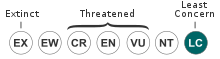
The silver gull (Chroicocephalus novaehollandiae) is the most common gull of Australia. It has been found throughout the continent, but particularly at or near coastal areas. It is smaller than the Pacific gull (Larus pacificus), which also lives in Australia.
The silver gull should not be confused with the herring gull, which is called "silver gull" in many other languages (scientific name Larus argentatus, German Silbermöwe, French Goéland argenté, Dutch zilvermeeuw), but is a much larger, robust gull with no overlap in range.
Taxonomy[edit]
It has traditionally been placed in the genus Larus, as is the case with many gulls, but is now placed in the genus Chroicocephalus. Hartlaub's gull (C. hartlaubii) of South Africa was formerly sometimes considered to be subspecies of the silver gull.[citation needed]
There are three subspecies:[2]
- C. n. forsteri (Mathews, 1912) – north and northeast Australia, New Caledonia, Loyalty Islands
- C. n. novaehollandiae (Stephens, 1826) – southern Australia and Tasmania
- C. n. scopulinus (Forster, JR, 1844) or red-billed gull – New Zealand
Description[edit]

Adult[edit]
The head, body, and tail of an adult silver gull are white, and the wings are light grey with white-spotted, black tips.[3] Adults range from 40–45cm (15-17 Inches) in length.[3] Their wingspan ranges from 271 to 314mm (10-12 Inches).[4] Adults have bright red beaks which gets brighter during breeding or when they get older.[5][4]
Juvenile[edit]
Juveniles have brown patterns on their wings, and a dark beak.[4][6]
Distribution and habitat[edit]
Silver gulls are found in all states of Australia,[5] as well as New Zealand and New Caledonia.[3] It is a common species, having adapted well to urban environments and thriving around shopping centres and garbage dumps. Their successful adaption to urban habitats have seen their population increase in areas of human activity, with the availability of nesting grounds the only limiting factor on population growth.[3]
Silver gulls have twice been recorded in the United States; one bird was shot in August 1947 at the mouth of the Genesee River, Lake Ontario, and another was photographed in Salem County, New Jersey, in autumn 1996. Both are believed to have escaped from captivity.[7]
Behaviour[edit]
The silver gull has a sharp voice consisting of a variety of calls. The most common call is a harsh, high pitched 'kwarwh'.[3]
Feeding[edit]
The silver gull naturally feeds on worms, fish, insects and crustaceans. It is a successful scavenger, allowing increased numbers near human settlements. It is known to pester humans for scraps and steal unattended food.[3]
Breeding[edit]
Breeding occurs from August to December, typically in large colonies on offshore islands.[5] The nest is located on the ground and consists of seaweed, roots, and plant stems.[5] The nests may be found in low shrubs, rocks and jetties.[5] Typical clutch size is one to three eggs.[3][5] Often two broods are raised in a year, and both adults share nest-building, incubation and feeding.[3]
Gallery[edit]
-
A silver gull performs its distinctive screaming call.
-
 Foraging by oscillating its foot in sand at low tide to uncover prey.
 -
 Egg and nestlings in nest at Phillip Island Nature Park, Victoria
 -
 Eggs - MHNT
 -
 Immature in flight
 -
 Bathing
 -
In flight, near Gold Coast, Australia
-
 Mature adult on the pier of Green Island east of Cairns
 -
 On Michaelmas Cay, Great Barrier Reef, Queensland, Australia


References[edit]


- ^ BirdLife International. (2018). "Larus novaehollandiae". IUCN Red List of Threatened Species. 2018: e.T62021891A132670177. doi:10.2305/IUCN.UK.2018-2.RLTS.T62021891A132670177.en. Retrieved 19 October 2021.
- ^ Gill, Frank; Donsker, David, eds. (2019). "Noddies, gulls, terns, auks". World Bird List Version 9.2. International Ornithologists' Union. Retrieved 24 June 2019.
- ^ a b c d e f g h "Silver Gull". Birds in Backyards, Australian Museum. 23 January 2007. Archived from the original on 13 April 2010. Retrieved 10 May 2009.
- ^ a b c The Australian Bird Guide (Revised ed.). CSIRO. 2019. pp. 100–101. ISBN 9781486311934.
- ^ a b c d e f Pizzey, Graham; Knight, Frank (1997). Field Guide to the Birds of Australia. Sydney, Australia: HarperCollinsPublishers. p. 111. ISBN 0-207-18013-X.
- ^ "Silver Gull - eBird". ebird.org. Retrieved 3 December 2023.
- ^ *American Ornithologists' Union (2000): Forty-second supplement to the American Ornithologists' Union Check-list of North American Birds. Auk 117(3): 847–858. DOI: 10.1642/0004-8038(2000)117[0847:FSSTTA]2.0.CO;2.
Further reading[edit]
- Harrison, Peter (1988): Seabirds (2nd ed.). Christopher Helm, London. ISBN 0-7470-1410-8
- Pons J.M., Hassanin, A., and Crochet P.A.(2005). Phylogenetic relationships within the Laridae (Charadriiformes: Aves) inferred from mitochondrial markers. Molecular Phylogenetics and Evolution 37(3):686-699