


Sphynx cat
| Sphynx | |
|---|---|
 | |
| Origin |  Canada Canada |
| Breed standards | |
| CFA | standard |
| FIFe | standard |
| TICA | standard |
| ACFA/CAA | standard |
| CCA-AFC | standard |
| Domestic cat (Felis catus) | |
The Sphynx cat (pronounced SFINKS, /ˈsfɪŋks/) also known as the Canadian Sphynx, is a breed of cat known for its lack of fur. Hairlessness in cats is a naturally occurring genetic mutation, and the Sphynx was developed through selective breeding of these animals, starting in the 1960s.[1]
The skin has a texture of chamois leather,[2] as it has fine hairs, or the cat may be completely hairless. Whiskers may be present, either whole or broken, or may be totally absent. Per the breed standards, they have a somewhat wedge-shaped head with large eyes and ears, quite long legs and tail, and neat rounded paws. Their skin is the color that their fur would be, and all the usual cat markings (solid, point, van, tabby, tortie, etc.) may be found on the Sphynx cat's skin. Because they have no fur, Sphynx cats lose body heat more readily than coated cats, making them both warm to the touch and prone to seeking out warm places.
Breed standards[edit]

The breed standard from The International Cat Association (TICA) calls for:[3]
- Wedge-shaped heads with prominent cheekbones
- Large, lemon-shaped eyes
- Very large ears with hair on inside, but soft down on outside base
- Well-muscled, powerful neck of medium length
- Medium length torso, barrel-chested, and full, round abdomen, sometimes called a pot belly
- Paw pads thicker than other cats, giving the appearance of walking on cushions
- Whiplike, tapering tail from body to tip, (sometimes with fur all over tail or a puff of fur on the tip, like a lion)
- Muscular body
History of the cat breed[edit]
The contemporary breed of Sphynx cat is distinct from the Russian hairless cat breeds, like Peterbald and Donskoy. Although hairless cats have been reported throughout history, breeders in Europe have been developing the Sphynx breed since the early 1960s.[4] Two different sets of hairless felines discovered in North America in the 1970s provided the foundation cats for what was shaped into the existing Sphynx breed.
The current American and European Sphynx breed is descended from two lines of natural mutations:
- Dermis and Epidermis (1975) barn cats from the Pearson family of Wadena, Minnesota[5]
- Bambi, Punkie and Paloma (1978) stray cats found in Toronto, Ontario, Canada, and raised by Shirley Smith[4]
Toronto[edit]
The Canadian Sphynx breed was started in 1966 in Toronto, Ontario when a hairless male kitten named Prune was born to a black and white domestic shorthair queen (Elizabeth).[4] The kitten was mated with his mother (called backcrossing), which produced one more naked kitten. Together with a few naked kittens found later, the cat Prune was the first attempt to create a hairless breed.[citation needed]
After purchasing these cats in 1966 and initially referring to them as "Moonstones" and "Canadian Hairless", Ridyadh Bawa, a science graduate of the University of Toronto, combined efforts with his mother Yania, a longtime Siamese breeder,[6] and Keese and Rita Tenhoves to develop a breed of cats which was subsequently renamed as Sphynx. The Bawas and the Tenhoves were the first individuals able to determine the autosomal recessive nature of the Sphynx gene for hairlessness while also being successful in transforming this knowledge into a successful breeding program with kittens which were eventually capable of reproducing.[7] The Tenhoves were initially able to obtain for the new breed provisional showing status through the Cat Fanciers' Association (CFA) but ultimately had the status revoked in 1971, when it was felt by the CFA Board that the breed had concerns over fertility.[6]
The first breeders had rather vague ideas about Sphynx genetics and faced a number of problems. The genetic pool was very limited and many kittens died. There was also a problem with many of the females suffering convulsions. In 1978, cat breeder Shirley Smith found three hairless kittens on the streets of her neighborhood. In 1983, she sent two of them to Dr. Hugo Hernandez in the Netherlands to breed the two kittens, named Punkie and Paloma, to a white Devon Rex named Curare van Jetrophin.[8] The resulting litter produced five kittens: two males from this litter (Q. Ramses and Q. Ra) were used, along with Punkie's half-sister, Paloma.[6]
Minnesota[edit]
The first noted naturally occurring foundation Sphynx originated as hairless stray barn cats in Wadena, Minnesota, at the farm of Milt and Ethelyn Pearson.[5] The Pearsons identified hairless kittens occurring in several litters of their domestic shorthair barn cats in the mid-1970s.[5] Two hairless female kittens born in 1975 and 1976, Epidermis and Dermis, were sold to Oregon breeder Kim Mueske, and became an important part of the Sphynx breeding program.[8][5] Also working with the Pearson line of cats was breeder Georgiana Gattenby of Brainerd, Minnesota, who outcrossed with Cornish Rex cats.[8]
Genetics and breeding[edit]
Other hairless breeds may have body shapes or temperaments that differ from those of Sphynx standards. There are, for example, new hairless breeds, including the Don Sphynx and the Peterbald from Russia, which arose from their own spontaneous gene mutations. The standard for the Sphynx differs between cat associations such as The International Cat Association (TICA), Fédération Internationale Féline (FIFE) and Cat Fanciers' Association (CFA).
Breeding[edit]
In 2010, DNA analysis confirmed that Sphynx hairlessness was produced by a different allele of the same gene that produces the short curly hair of the Devon Rex (termed the "re" allele), with the Sphynx's allele being incompletely dominant over the Devon allele and both being recessive to the wild type.[9] The Sphynx's allele is termed "hr", for hairless. The only allowable outcross breeds in the CFA are now the American Shorthair and domestic shorthair.[citation needed] Other associations may vary, and the Russian Blue is a permitted outcross in the Governing Council of the Cat Fancy (GCCF).[10]
Genetics[edit]
The Sphynx's distinctive hairlessness is primarily due to a mutation in the KRT71 gene, which also affects other breeds, such as the Devon Rex and Selkirk Rex, albeit with different outcomes. This gene is responsible for the keratinization of the hair follicle. In the Sphynx, the mutation, known as "hr", leads to a complete loss of function, damaging the structure of the hair. Normally, KRT71 helps produce strong hair that is securely anchored to the skin. However, due to the "hr" mutation, the hair of Sphynx cats lacks a solid root or bulb, making it extremely weak. Consequently, the hair is fragile and loosely attached, causing it to fall out easily and contributing to the breed's nearly hairless appearance.[9] Sphynx cats may still retain very soft, short hair on parts of their body, such as the nose, tails, and toes, but overall, their coat is significantly reduced and lacks the typical structure seen in other cats.[9]
In the Devon Rex mutation, a residual activity of the protein still exists.[9] The Selkirk Rex allele (sadr) is dominant over the wild type gene, which is dominant over the Devon Rex allele (re) and the Sphynx (hr), which forms an allelic series of : KRT71SADRE > KRT71+ > KRT71re > KRT71hr.[11]
-
 Sphynx mother with kittens
 -
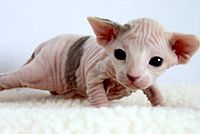 Two-week-old Sphynx kitten

.jpg)
Behavior[edit]
Sphynx are known for their extroverted behavior. They display a high level of energy, intelligence, curiosity and affection for their owners.[12] They are one of the more dog-like breeds of cats, frequently greeting their owners at the door and are friendly when meeting strangers.[12] Sphynx cats tend to be highly attached to their owners, often demanding large amounts of attention, and if said attention is not given, can get into trouble. The mischievous cats love to cuddle for body warmth, due to their lack of fur.[13] A study was conducted by the Journal of Veterinary Behavior in 2012, and while further research needs to be conducted, purebred Sphynx cats were rated by their owners as friendlier than purebred European cats.[14] [further explanation needed]
Care[edit]
Care should be taken to limit the Sphynx cat's exposure to outdoor sunlight at length, as they can develop sunburn and skin damage similar to that of humans. In general, Sphynx cats should never be allowed outdoors unattended, as they have limited means to conserve body heat when it is cold. In some climates, owners provide coats or other clothing in the winter to help them conserve body heat.[15]
While they lack much of the fur of other cat breeds, Sphynxes are not necessarily hypoallergenic.[16] Allergies to cats are triggered by a protein called Fel d1, not cat hair itself.[17] Fel d1 is a protein primarily found in cat saliva and sebaceous glands.[17] Those with cat allergies may react to direct contact with Sphynx cats.[17] Even though reports exist that some people with allergies successfully tolerate Sphynx cats, they are fewer than those who have allergic reactions.[18][better source needed]
The skin of the Sphynx cat is known for its excessive production of a greasy secretion, which often results in the accumulation of a sticky, dark brown, or reddish-brown layer that necessitates regular cleaning.[19] Furthermore, Sphynx cats typically produce more earwax than most hairy domestic cats. This increased wax production is attributed to the minimal to absent hair within their ears, which allows for the accumulation of dirt, skin oils (sebum), and ear wax, thereby requiring frequent cleaning. Additionally, they often accumulate oils and debris under their nails and within their numerous skin folds due to the lack of fur. Regular maintenance of these areas, including the nails and skin folds, is essential for the health and hygiene of the breed.[19]
Health[edit]
The Sphynx faces challenges because of its lack of protective fur. Skin cancer may be a problem if exposed to sunlight for long durations of time.[20]
The lack of hair can cause health issues with kittens in the first weeks of life because of susceptibility to respiratory infections. Reputable breeders should not let their kittens go to new homes without being at least 14 weeks of age to ensure the kitten is mature enough to cope in a new environment.[21]
In a review of over 5,000 cases of urate urolithiasis the Sphynx was over-represented, with four recorded cases out of a population of 28.[22]
Hypertrophic cardiomyopathy[edit]
The breed does have instances of the genetic disorder hypertrophic cardiomyopathy (HCM). Other domestic cat breeds prone to HCM include Persian,[23] Ragdoll, Norwegian Forest cat, Siberian cats, British Shorthair and Maine Coon;[24] however, any domestic cat including mixed breeds can acquire HCM.[25] Studies are being undertaken to understand the links in breeding and the disorder.[26] Cats are screened for HCM disease with echocardiography (ultrasound of the heart), as well as with additional tests determined by the veterinarian cardiologist including electrocardiogram (EKG, ECG), chest radiographs (X-rays), and/or blood tests.[25]
The Sphynx cat has a high rate of heart disease, either as HCM or mitral valve dysplasia. In a 2012 study of 114 Sphynx cats, 34% were found to have an abnormal heart, with 16 cats having mitral valve dysplasia and 23 cats having HCM.[27] These prevalences were found in cats with an average age of 2.62 years. Male cats developed more severe disease than female cats and often developed it earlier, at an average age of 19 months for males and 29 months for females.[24] Since the prevalence of genetic heart disease is high in this breed, many breeders will recommend screening for HCM yearly.
As HCM progresses into an advanced stage, cats may experience congestive heart failure (CHF) or thromboembolism.[25]
Congenital myasthenic syndrome[edit]
Congenital myasthenic syndrome (CMS) previously referred to as muscular dystrophy, myopathy or spasticity, is a type of inherited neuromuscular disorder associated with alpha-dystroglycan deficiency, found in Sphynx and in Devon Rex cats as well as variants of these breeds, which can occur between the first 3 to 23 weeks of their life.[28][29][30] This condition has also been described, but is rarely seen.[31][29] Cats affected by CMS show generalized muscle weakness and fatigue, as well as ventroflexion of the head and neck, head bobbing, and scapulae protrusion.[28]
See also[edit]
References[edit]
- ^ "The Sphynx". The Cat Fanciers' Association. Retrieved 27 October 2020.
In 1966 a domestic cat gave birth to a hairless kitten in Toronto Canada. It was discovered to be a natural genetic mutation and the Sphynx cat, as we know it today, came into existence.
- Kirstin Fawcett (15 May 2015). "11 Not-So-Fluffy Facts About Sphynx Cats". Mental Floss. Retrieved 27 October 2020.But the modern-day Canadian Sphynx—the hairless breed we know in North America—has been defying expectations since the mid-1960s, when an Ontario cat gave birth to a hairless kitten, the result of a natural genetic mutation. Then, in the mid-1970s, two separate sets of hairless kittens were born to owners in Toronto and Minnesota. Thanks to various breeding efforts, their lineages resulted in the affectionate animal we love today.
- ^ "TICA Sphynx Breed Introduction" (PDF). The International Cat Association. Archived (PDF) from the original on 4 February 2024. Retrieved 4 February 2024.
- ^ "Sphynx Standard 05/02/2014" (PDF). The International Cat Association. Retrieved 27 October 2020.
- ^ a b c James Thoene (15 July 2016). "Sphynx History". Beeblebrox Sphynx. Archived from the original on 26 February 2013. Retrieved 27 October 2020.
- ^ a b c d "Prestigious Sphynx cats once considered 'feral' breed". Wadena Pioneer Journal. 21 January 2012. Retrieved 27 October 2020.
- ^ a b c Julia Wilson (5 July 2017). "Sphynx Cat Breed Profile". Cat-World. Retrieved 20 October 2020.
- ^ Jamie Bradburn (20 March 2013). "Toronto Invents: The Sphynx Cat". Torontoist. Retrieved 27 October 2020.
- ^ a b c "Sphynx / Hairless Cat". Petfinder. Retrieved 27 October 2020.
- ^ a b c d Gandolfi, Barbara; Outerbridge, Catherine A.; Beresford, Leslie G.; Myers, Jeffrey A.; Pimentel, Monica; Alhaddad, Hasan; Grahn, Jennifer C.; Grahn, Robert A.; Lyons, Leslie A. (October 2010). "The naked truth: Sphynx and Devon Rex cat breed mutations in KRT71". Mammalian Genome. 21 (9–10): 509–515. doi:10.1007/s00335-010-9290-6. ISSN 0938-8990. PMC 2974189. PMID 20953787.
- ^ "Sphynx Registration Policy" (PDF). Sphynx Breed Advisory Committee. 2017. Retrieved 30 October 2019.
- ^ Gandolfi, B.; Alhaddad, H.; Joslin, S. E.; Khan, R.; Filler, S.; Brem, G.; Lyons, L. A. (2000). "A splice variant in KRT71 is associated with curly coat phenotype of Selkirk Rex cats". Scientific Reports. 3: 2000. doi:10.1038/srep02000. PMC 3683669. PMID 23770706.
- ^ a b "Cat breed directory: Sphynx". Animal Discovery. Discovery Communications, LLC. 10 September 2008. Archived from the original on 1 July 2012. Retrieved 27 October 2020.
- ^ Findlay, Sonia. "What to Know About a Sphynx Cat". WebMD. Retrieved 2023-10-19.
- ^ Asselineau, B.; Abitbol, M.; Deputte, B. L. (2012-11-01). "Do cats from established breeds behave differently toward humans than outbred cats?". Journal of Veterinary Behavior. 7 (6): e1. doi:10.1016/j.jveb.2012.09.006. ISSN 1558-7878.
- ^ "How To Keep Sphynx Cats and Other Hairless Cats Warm". PetMD. Retrieved 2021-07-11.
- ^ Allred, Alexandra Powe (2014-05-14). Cats' Most Wanted: The Top 10 Book of Mysterious Mousers, Talented Tabbies, and Feline Oddities. Potomac Books, Inc. p. 102. ISBN 978-1-61234-293-1.
- ^ a b c Robbins, Nancy. Domestic Cats: Their History Breeds and Other Facts. Barnes and Noble Press. p. 264. ISBN 978-1-9870-6180-2.
- ^ "The Big Question, What about allergies?". Ankhamun and Utopia Sphynx. Archived from the original on July 18, 2011. Retrieved February 9, 2017.
- ^ a b Åhman, Susanne E.; Bergström, Karin E. (December 2009). "Cutaneous carriage of Malassezia species in healthy and seborrhoeic Sphynx cats and a comparison to carriage in Devon Rex cats". Journal of Feline Medicine and Surgery. 11 (12): 970–976. doi:10.1016/j.jfms.2009.04.011. ISSN 1098-612X – via Elsevier Science Direct.
- ^ "About the Sphynx". Cat Fanciers Association. Archived from the original on 23 April 2019. Retrieved 27 October 2020.
- ^ Irvine, Angela; Trevor, Dawes; McAuliffe, Michael; Bowd, Neil (2006). Sphynx: The Australian Experience. OzSphynx. p. 14. ISBN 9780646473093.
- ^ Albasan, H.; Osborne, C. A.; Lulich, J. P.; Lekcharoensuk, C. (2012). "Risk factors for urate uroliths in cats". Journal of the American Veterinary Medical Association. 240 (7): 842–847. doi:10.2460/javma.240.7.842. PMID 22443437.
- ^ "Hypertrophic Cardiomyopathy". Cornell University College of Veterinary Medicine. January 2014. Retrieved 11 January 2020.
- ^ a b Kittleson, Mark D.; Meurs, Kathryn M.; Harris, Samantha P. (December 2015). "The Genetic Basis of Hypertrophic Cardiomyopathy in Cats and Humans". Journal of Veterinary Cardiology. 17 (Suppl 1): S53–S73. doi:10.1016/j.jvc.2015.03.001. ISSN 1760-2734. PMC 5909964. PMID 26776594.
- ^ a b c "Feline Hypertrophic Cardiomyopathy (HCM)". MedVet Medical & Cancer Centers for Pets. 2 December 2016. Retrieved 31 October 2019.
- ^ "Sphynx HCM Research". North Carolina State University school of veterinary medicine. Archived from the original on 18 June 2015. Retrieved 1 February 2013.
- ^ Chetboul, V.; Petit, A.; Gouni, V.; Trehiou-Sechi, E.; Misbach, C.; Balouka, D.; Carlos Sampedrano, C.; Pouchelon, J. L.; Tissier, R.; Abitbol, M. (December 2012). "Prospective echocardiographic and tissue Doppler screening of a large Sphynx cat population: Reference ranges, heart disease prevalence and genetic aspects". Journal of Veterinary Cardiology. 14 (4): 497–509. doi:10.1016/j.jvc.2012.08.001. PMID 23131204.
- ^ a b "Congenital Myasthatic Syndrome". Sphynx Cat Association (SCA). Archived from the original on 31 October 2019. Retrieved 31 October 2019.
- ^ a b "Sphynx - Hereditary Myopathy". The International Animal Welfare Science Society. Retrieved 30 October 2019.
- ^ Martin, Paul T.; Shelton, G. Diane; Dickinson, Peter J.; Sturges, Beverly K.; Xu, Rui; LeCouteur, Richard A.; Guo, Ling T.; Grahn, Robert A.; Lo, Harriet P.; North, Kathryn N.; Malik, Richard (2008-12-01). "Muscular dystrophy associated with α-dystroglycan deficiency in Sphynx and Devon Rex cats". Neuromuscular Disorders. 18 (12): 942–952. doi:10.1016/j.nmd.2008.08.002. ISSN 0960-8966. PMC 2646259. PMID 18990577.
- ^ Martin, P. T.; et al. (2008). "Muscular dystrophy associated alpha-dystroglycan deficiency in Sphynx and Devon Rex cat". Neuromuscular Disorders. 12. 18 (12): 942–52. doi:10.1016/j.nmd.2008.08.002. PMC 2646259. PMID 18990577.
External links[edit]
 Media related to Sphynx (cat) at Wikimedia Commons

