


Sridhara
 | This article needs additional citations for verification. (September 2023) |
Śrīdhara or Śrīdharācārya (8th–9th century) was an Indian mathematician who most likely came from the Bengal region of India. He was probably born around (c. 870 CE) in Bhuriśreṣṭi (Bhurisriṣṭi or Bhurśuṭ) village in South Rādha at present day Hugli in West Bengal, then undivided Bengal with its Capital at Gaur. His father's name was Baladevācārya and his mother's name was Acchoka. His father was a Sanskrit pandit and philosopher. [1] [2] [3] [4][5] An alternative viewpoint that he was born in southern India is also held by some. Very little is known about his life beyond the content of his two extant treatises about arithmetic, Pāṭī-gaṇita and Tri-śatikā. He was mentioned by Bhāskara II (12th century), and made apparent reference to Brahmagupta (7th century). Govindasvāmin (9th century) quoted a passage also found in Tri-śatikā, and overlapping material is found in the work of Mahāvīra (9th century), from which historians estimate Śrīdhara to have lived in the 8th or 9th century.[6]
Notable work[edit]
He is known for two main treatises: Pāṭīgaṇitasāra (also called Triśatikā (300) because it was written in three hundred ślokas) and Pāṭīgaṇita (Bengali: পাটীগণিত). Triśatika discusses counting of numbers, natural number, zero, measures, multiplication, fraction, division, squares, cubes, rule of three, interest-calculation, joint business or partnership, and mensuration (the main part of geometry concerned with ascertaining sizes, lengths, areas, and volumes).
Three other works have been attributed to him, namely the Bījaganita, Navasatī, and Bṛhatpati. Some historians believe that Sridhara may have authored another mathematical treatise called Gaṇitapañcaviṃśi.[7]
His notable works include–[8]
- He gave an exposition on the zero. He wrote, "If zero is added to any number, the sum is the same number; if zero is subtracted from any number, the number remains unchanged; if zero is multiplied by any number, the product is zero".
- In the case of dividing a fraction he has found out the method of multiplying the fraction by the reciprocal of the divisor.
- He wrote on the practical applications of algebra.
- He separated algebra from arithmetic.
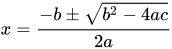
- He was one of the first to give an algorithm for solving quadratic equations (although there is no indication that he considered two solutions). The modern-day quadratic formula is called Sridharacharya's formula or Sridharacharya's method in some places. The solution to a quadratic equation of the general form ax2 + bx + c = 0, a ≠ 0 is given by
References[edit]
- ^ Sharma, Rahul. "शून्य की व्याख्या करने वाला विद्वान : श्रीधराचार्य". ajabgajabfacts.
- ^ "source1". dbpedia.
- ^ "source2". vedicmathschool.
- ^ "source3". getbengal.
- ^ "source3". medium.
- ^ Gupta 1987; Plofker, Kim (2009). "Appendix B: Biographical Data on Indian Mathematicians". Mathematics in India. Princeton University Press. p. 325. ISBN 978-0-691-12067-6.
- ^ Subrata, Bhowmik. (2010). GREAT INDIAN MATHEMATICIANS OF POST-CHRISTIAN ERA. Bulletin of Tripura Mathematical Society. XXX. 17-18.
- ^ O'Connor & Robertson 2000.
Bibliography[edit]
- Hayashi, Takao (2002). "Shridhara". Encyclopaedia Britannica.
- Gupta, Radha Charan (1987). "On the Date of Śrīdhara". Gaṇita Bhāratī (1–4): 54–56. Reprinted in Ramasubramanian, K., ed. (2019). Gaṇitānanda. Springer. pp. 19–20. doi:10.1007/978-981-13-1229-8_4.
- O'Connor, John J.; Robertson, Edmund F. (2000). "Sridhara". MacTutor History of Mathematics Archive. University of St Andrews.
- Pingree, David (1975). "Śrīdhara". In Gillispie, Charles C. (ed.). Dictionary of Scientific Biography. Vol. 12 (Rushd–Stas). New York: Scribner. pp. 597–598. ISBN 0-684-12924-8.
- Ramanujacharia, N.; Kaye, George R., eds. (1912–1913). "The Triśatikā of Śrīdharācārya". Bibliotheca Mathematica. Ser. 3. 13: 203–217.
- Sastri, S. Srikanta (1948). "The Date of Sridharacharya". The Jaina Antiquary. 13 (2): 12–17.
- Shukla, Kripa Shankar, ed. (1959). The Patiganita of Sridharacarya. Lucknow University.
