


C++ Technical Report 1
 | This article has multiple issues. Please help improve it or discuss these issues on the talk page. (Learn how and when to remove these template messages)
|


C++ Technical Report 1 (TR1) is the common name for ISO/IEC TR 19768, C++ Library Extensions, which is a document that proposed additions to the C++ standard library for the C++03 language standard. The additions include regular expressions, smart pointers, hash tables, and random number generators. TR1 was not a standard itself, but rather a draft document. However, most of its proposals became part of the later official standard, C++11. Before C++11 was standardized, vendors used this document as a guide to create extensions. The report's goal was "to build more widespread existing practice for an expanded C++ standard library".
The report was first circulated in draft form in 2005 as Draft Technical Report on C++ Library Extensions, then published in 2007 as an ISO/IEC standard as ISO/IEC TR 19768:2007.
Overview[edit]
Compilers did not need to include the TR1 components in order to conform to the C++ standard, because TR1 proposals were not part of the standard itself, only a set of possible additions that were still to be ratified. However, most of TR1 was available from Boost, and several compiler/library distributors implemented all or some of the components. TR1 is not the complete list of additions to the library that appeared in C++11. For example, C++11 includes a thread support library that is not available in TR1.
The new components were defined in the std::tr1 namespace to distinguish them from the then-current standard library.
Components[edit]
TR1 includes the following components:
General utilities[edit]
Reference wrapper – enables passing references, rather than copies, into algorithms or function objects. The feature was based on Boost.Ref.[1] A wrapper reference is obtained from an instance of the template class reference_wrapper. Wrapper references are similar to normal references (‘&’) of the C++ language. To obtain a wrapper reference from any object the template class ref is used (for a constant reference cref is used).
Wrapper references are useful above all for template functions, when argument deduction would not deduce a reference (e.g. when forwarding arguments):
#include <iostream>
#include <tr1/functional>

void f( int &r )  { ++r; }

template< class Funct, class Arg >
void g( Funct f, Arg t )
{
  f(t);
}

int main()
{
  int i = 0;

  g( f, i );                   // 'g< void(int &r), int >' is instantiated
  std::cout << i << "\n";      // Output: 0

  g( f, std::tr1::ref(i) );    // 'g< void(int &r), reference_wrapper<int> >' is instanced
  std::cout << i << "\n";      // Output: 1
}
Smart pointers – adds several classes that simplify object lifetime management in complex cases. Three main classes are added:
shared_ptr– a reference-counted smart pointerweak_ptr– a variant ofshared_ptrthat doesn't increase the reference count
The proposal is based on Boost Smart Pointer library.[2]
Function objects[edit]
These four modules are added to the <functional> header file:
Polymorphic function wrapper (function) – can store any callable function (function pointers, member function pointers, and function objects) that uses a specified function call signature. The type does not depend on the kind of the callable used. Based on Boost.Function[3]
Function object binders (bind) – can bind any parameter parameters to function objects. Function composition is also allowed. This is a generalized version of the standard std::bind1st and std::bind2nd bind functions. The feature is based on Boost Bind library.[4]
Function return types (result_of) – determines the type of a call expression.
Member functions (mem_fn) – enhancement to the standard std::mem_fun and std::mem_fun_ref. Allows pointers to member functions to be treated as function objects. Based on Boost Mem Fn library.[5]
Metaprogramming and type traits[edit]
There is now <type_traits> header file that contains many useful trait meta-templates, such as is_pod, has_virtual_destructor, remove_extent, etc. It facilitates metaprogramming by enabling queries on and transformation between different types. The proposal is based on Boost Type Traits library.[6]
Numerical facilities[edit]
Random number generation[edit]
- new
<random>header file –variate_generator,mersenne_twister,poisson_distribution, etc. - utilities for generating random numbers using any of several Pseudorandom number generators, engines, and probability distributions
Mathematical special functions[edit]
Some features of TR1, such as the mathematical special functions and certain C99 additions, are not included in the Visual C++ implementation of TR1. The Mathematical special functions library was not standardized in C++11.
These functions will likely be of principal interest to programmers in the engineering and scientific disciplines.
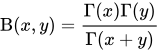
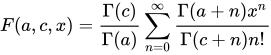
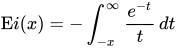
The following table shows all 23 special functions described in TR1.
| Function name | Function prototype | Mathematical expression |
|---|---|---|
| Associated Laguerre polynomials | double assoc_laguerre( unsigned n, unsigned m, double x ) ; | |
| Associated Legendre polynomials | double assoc_legendre( unsigned l, unsigned m, double x ) ; | |
| Beta function | double beta( double x, double y ) ; | |
| Complete elliptic integral of the first kind | double comp_ellint_1( double k ) ; | |
| Complete elliptic integral of the second kind | double comp_ellint_2( double k ) ; | |
| Complete elliptic integral of the third kind | double comp_ellint_3( double k, double nu ) ; | |
| Confluent hypergeometric functions | double conf_hyperg( double a, double c, double x ) ; | |
| Regular modified cylindrical Bessel functions | double cyl_bessel_i( double nu, double x ) ; | |
| Cylindrical Bessel functions of the first kind | double cyl_bessel_j( double nu, double x ) ; | |
| Irregular modified cylindrical Bessel functions | double cyl_bessel_k( double nu, double x ) ; | |
| Cylindrical Neumann functions | double cyl_neumann( double nu, double x ) ; | |
| Incomplete elliptic integral of the first kind | double ellint_1( double k, double phi ) ; | |
| Incomplete elliptic integral of the second kind | double ellint_2( double k, double phi ) ; | |
| Incomplete elliptic integral of the third kind | double ellint_3( double k, double nu, double phi ) ; | |
| Exponential integral | double expint( double x ) ; | |
| Hermite polynomials | double hermite( unsigned n, double x ) ; | |
| Hypergeometric series | double hyperg( double a, double b, double c, double x ) ; | |
| Laguerre polynomials | double laguerre( unsigned n, double x ) ; | |
| Legendre polynomials | double legendre( unsigned l, double x ) ; | |
| Riemann zeta function | double riemann_zeta( double x ) ; | |
| Spherical Bessel functions of the first kind | double sph_bessel( unsigned n, double x ) ; | |
| Spherical associated Legendre functions | double sph_legendre( unsigned l, unsigned m, double theta ) ; | |
| Spherical Neumann functions | double sph_neumann( unsigned n, double x ) ; |







![{\displaystyle {\begin{aligned}K_{\nu }(x)&=\textstyle {\frac {\pi }{2}}i^{\nu +1}{\big (}J_{\nu }(ix)+iN_{\nu }(ix){\big )}\\&={\begin{cases}\displaystyle {\frac {I_{-\nu }(x)-I_{\nu }(x)}{\sin \nu \pi }},&{\text{for }}x\geq 0{\text{ and }}\nu \notin \mathbb {Z} \\[10pt]\displaystyle {\frac {\pi }{2}}\lim _{\mu \to \nu }{\frac {I_{-\mu }(x)-I_{\mu }(x)}{\sin \mu \pi }},&{\text{for }}x<0{\text{ and }}\nu \in \mathbb {Z} \\\end{cases}}\end{aligned}}}](https://wikimedia.org/api/rest_v1/media/math/render/svg/e8d646ba293d4f342b91f22512cc15b9e806f65a)
![{\displaystyle N_{\nu }(x)={\begin{cases}\displaystyle {\frac {J_{\nu }(x)\cos \nu \pi -J_{-\nu }(x)}{\sin \nu \pi }},&{\text{for }}x\geq 0{\text{ and }}\nu \notin \mathbb {Z} \\[10pt]\displaystyle \lim _{\mu \to \nu }{\frac {J_{\mu }(x)\cos \mu \pi -J_{-\mu }(x)}{\sin \mu \pi }},&{\text{for }}x<0{\text{ and }}\nu \in \mathbb {Z} \\\end{cases}}}](https://wikimedia.org/api/rest_v1/media/math/render/svg/3c66be74cfc1c8031c51d5708ecff69c5ca88a75)







![{\displaystyle \mathrm {Z} (x)={\begin{cases}\displaystyle \sum _{k=1}^{\infty }k^{-x},&{\text{for }}x>1\\[10pt]\displaystyle 2^{x}\pi ^{x-1}\sin \left({\frac {x\pi }{2}}\right)\Gamma (1-x)\zeta (1-x),&{\text{for }}x<1\\\end{cases}}}](https://wikimedia.org/api/rest_v1/media/math/render/svg/69e29aeabd3424a1cec969811e561dac61537949)

![{\displaystyle Y_{l}^{m}(\theta ,0){\text{ where }}Y_{l}^{m}(\theta ,\phi )=(-1)^{m}\left[{\frac {(2l+1)}{4\pi }}{\frac {(l-m)!}{(l+m)!}}\right]^{1 \over 2}P_{l}^{m}(\cos \theta )e^{\mathrm {i} m\phi },{\text{ for }}|m|\leq l}](https://wikimedia.org/api/rest_v1/media/math/render/svg/7c3aa1faf895c57a379625ee72c414ebdb42903f)

Each function has two additional variants. Appending the suffix ‘f’ or ‘l’ to a function name gives a function that operates on float or long double values respectively. For example:
float sph_neumannf( unsigned n, float x ) ;
long double sph_neumannl( unsigned n, long double x ) ;
Containers[edit]
Tuple types[edit]
- new
<tuple>header file –tuple - based on Boost Tuple library[7]
- vaguely an extension of the standard
std::pair - fixed size collection of elements, which may be of different types
Fixed size array[edit]
- new
<array>header file –array - taken from Boost Array library[8]
- as opposed to dynamic array types such as the standard
std::vector
Hash tables[edit]
- new
<unordered_set>,<unordered_map>header files - they implement the
unordered_set,unordered_multiset,unordered_map, andunordered_multimapclasses, analogous toset,multiset,map, andmultimap, respectively- unfortunately,
unordered_setandunordered_multisetcannot be used with theset_union,set_intersection,set_difference,set_symmetric_difference, andincludesstandard library functions, which work forsetandmultiset
- unfortunately,
- new implementation, not derived from an existing library, not fully API compatible with existing libraries
- like all hash tables, often provide constant time lookup of elements but the worst case can be linear in the size of the container
Regular expressions[edit]
- new
<regex>header file –regex,regex_match,regex_search,regex_replace, etc. - based on Boost RegEx library[9]
- pattern matching library
C compatibility[edit]
C++ is designed to be compatible with the C programming language, but is not a strict superset of C due to diverging standards. TR1 attempts to reconcile some of these differences through additions to various headers in the C++ library, such as <complex>, <locale>, <cmath>, etc. These changes help to bring C++ more in line with the C99 version of the C standard (not all parts of C99 are included in TR1).
Technical Report 2[edit]
In 2005, a request for proposals for a TR2 was made with a special interest in Unicode, XML/HTML, Networking and usability for novice programmers.TR2 call for proposals.
Some of the proposals included:
- Threads [1]
- The Asio C++ library (networking [2][3]).
- Signals/Slots [sigc Proposal for standardization in C++ Library TR2][4]
- Filesystem Library Filesystem Library for TR2 – Based on the Boost Filesystem Library, for query/manipulation of paths, files and directories.
- Boost Any Library Any Library Proposal for TR2
- Lexical Conversion Library Conversion Library Proposal for TR2
- New String Algorithms Proposal for new string algorithms in TR2
- Toward a More Complete Taxonomy of Algebraic Properties for Numeric Libraries in TR2 ISO/IEC JTC1/SC22/WG21 - Papers 2008
- Adding heterogeneous comparison lookup to associative containers for TR2 [5]
After the call was issued for proposals for TR2, ISO procedures were changed, so there will not be a TR2. Instead, enhancements to C++ will be published in a number of Technical Specifications. Some of the proposals listed above are already included in the C++ standard or in draft versions of the Technical Specifications.
See also[edit]
- C++11, standard for the C++ programming language; the library improvements were based on TR1
- C11 (C standard revision), a revision of the C standard which incorporated some features proposed in TR1
- Boost library, a large collection of portable C++ libraries, several of which were included in TR1
- Standard Template Library, part of the current C++ Standard Library
References[edit]
- ^ "ref - 1.72.0". www.boost.org.
- ^ "Boost.SmartPtr: The Smart Pointer Library - 1.72.0". www.boost.org.
- ^ "Chapter 16. Boost.Function - 1.72.0". www.boost.org.
- ^ "Chapter 1. Boost.Bind - 1.72.0". www.boost.org.
- ^ "Chapter 1. Boost.Member Function - 1.72.0". www.boost.org.
- ^ "Chapter 1. Boost.TypeTraits - 1.37.0". www.boost.org.
- ^ "The Boost Tuple Library – Boost 1.48.0". Archived from the original on 2006-05-26. Retrieved 2006-05-27.
- ^ "Chapter 5. Boost.Array - 1.72.0". www.boost.org.
- ^ "Boost.Regex - 1.36.0". www.boost.org.
Sources[edit]
- ISO/IEC JTC1/SC22/WG21 — Draft Technical Report on C++ Library Extensions (PDF) (Report). 2005-06-24.
- ISO/IEC TR 19768:2007 — Information technology — Programming languages — Technical Report on C++ Library Extensions (Report). Nov 2007.
- Becker, Peter (2006). The C++ Standard Library Extensions: A Tutorial and Reference. Addison-Wesley Professional. ISBN 0-321-41299-0.
External links[edit]
- Scott Meyers' Effective C++: TR1 Information – contains links to the TR1 proposal documents which provide background and rationale for the TR1 libraries.