


Tokay gecko
| Tokay gecko | |
|---|---|

| |
Scientific classification 
| |
| Domain: | Eukaryota |
| Kingdom: | Animalia |
| Phylum: | Chordata |
| Class: | Reptilia |
| Order: | Squamata |
| Family: | Gekkonidae |
| Genus: | Gekko |
| Species: | G. gecko
|
| Binomial name | |
| Gekko gecko | |
| Synonyms | |
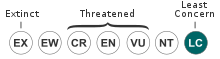
The tokay gecko (Gekko gecko)[1] is a nocturnal arboreal gecko in the genus Gekko, the true geckos. It is native to Asia and some Pacific Islands.
Etymology[edit]
The word "tokay" is an onomatopoeia of the sound made by males of this species.[3]: 120 [4]: 253 The common and scientific names, as well as the family name Gekkonidae and the generic term "gecko" come from this species, too, from ge'kok in Javanese,[5] corresponding to tokek in Malay.[6]
Subspecies[edit]
Two subspecies are currently recognized:[7]
- G. g. gecko (Linnaeus, 1758) occurs in tropical Asia from northeastern India to eastern Indonesia.
- G. g. azhari (Mertens, 1955) is found only in Bangladesh.
Distribution and habitat[edit]
This species is found in northeast India, Bhutan, Nepal, and Bangladesh; throughout Southeast Asia, including Cambodia, Thailand, the Philippines, Malaysia, Vietnam and Indonesia; and toward western New Guinea. Its native habitat is rainforests, where it lives on trees and cliffs, and it frequently adapts to rural human habitations, roaming walls and ceilings at night in search of insect prey. This is an introduced species in some areas outside its native range. It is established in Florida in the United States, Martinique, the islands of Belize, and possibly Hawaii.[8] Increasing urbanization is reducing its range.
Whether the species is native but very uncommon in Taiwan or whether the rare reports of individuals since the 1920s are based on repeated anthropogenic translocations that may or may not have resulted in established populations by now is unclear.[9]
Physical characteristics[edit]
_adult_male_and_juvenile.jpg)

The tokay gecko is a large nocturnal[1] gecko, reaching a total length (including tail) of 25–30 cm (10–12 inches) on average, but some grow as large as 40 cm (16 inches) long. It is believed to be the third-largest species of gecko, after the giant leaf-tail gecko (Uroplatus giganteus) and New Caledonian giant gecko (Rhacodactylus leachianus). It is cylindrical, but somewhat flattened in body shape. The eyes have vertical pupils.
The skin is soft to the touch and is generally blue-gray with red or orange spots and speckles, but the animal can change the color of its skin to blend into the environment. The species is sexually dimorphic, with the males being more brightly colored and slightly larger than females.[10] They have two visual pigments: a “green” with λmax at 521 nm and a “blue” at 467 nm.[11]
It is a strong climber with foot pads that can support the entire weight of its body on a vertical surface for a long period of time. Compared to other gecko species, the tokay gecko has a robust build, with a semiprehensile tail, a large head, and muscular jaws.
Behaviour[edit]
Tokay geckos are generally aggressive and territorial, and can inflict a strong bite. Though common in the pet trade, the strong bite of the tokay gecko makes it ill-suited for inexperienced keepers.[12] In addition, the strength of the bite depends on the gecko's size; larger (usually male) tokay geckos are capable of piercing skin, which often results in immediate bleeding.
Females lay clutches of one or two hard-shelled eggs and guard them until they hatch.
Diet[edit]
The tokay gecko feeds on insects and small vertebrates.[10][13] In captivity, they usually feed on springtails, mealworms, cockroaches, crickets, grasshoppers, locusts, and pink mice.[14] In a study conducted in Thailand, researchers noticed little variation in the diets of males, females, and juveniles, which was likely due to low insect availability in this area. In Southern Florida, roaches, caterpillars, spiders, and beetles were the most numerous taxa present and common to the greatest number of stomachs.[15][16]
Call[edit]

The male's mating call, a loud croak, is variously described as sounding like token, gekk-gekk, tuck-too, túc-key, tou-kay or tokay.[3]: 120 [4]: 253 Most of the time, the call is often preceded by a quick "cackling", similar to the chirping sounds made by house geckos albeit much lower in pitch. When threatened or alarmed, tokay geckos usually "bark" while opening their mouth in a defensive posture.
The tokay gecko's call is also responsible for the name given to it by Filipino residents: "Tuko," and by U.S. soldiers during the Vietnam War, the "Fuck-you lizard".[17][18]
Light and temperature can affect its vocalizations. The most frequent calling occurs in May at dusk, and the second peak of call frequency occurs in May at dawn. Vocalizations and associated behavior were strongly affected by ambient temperature in both the lab and field and could thus play a role in regulating animal energetic metabolism[19]
Conservation and relationship with humans[edit]
.JPG)

The tokay gecko is culturally significant in many East Asian countries. Regional folklore has attributed supernatural powers to the gecko. In Southeast Asia it is a symbol of good luck and fertility.[10] It is believed to be descended from dragons.[20]
This species is poached for the medicinal trades in parts of Asia.[21] The tokay gecko is an ingredient in traditional Chinese medicine, known as Ge Jie (蛤蚧). It is believed to nourish the kidneys and lungs, beliefs that are not substantiated by medical science. The animal remains highly sought after in China, Hong Kong, Taiwan, Vietnam, Malaysia, Singapore and other parts of Asia with Chinese communities, to the point where unscrupulous merchants have taken to disfiguring monitor lizards with prosthetics to pass them off as colossal tokay gecko specimens.[20]
From 2009 to 2011, the poaching of tokay geckos intensified because of a short-lived belief that they were an effective HIV cure.[22]
The tokay gecko is quickly becoming a threatened species in the Philippines because of indiscriminate hunting. Collecting, transporting and trading in geckos without a license can be punishable by up to 12 years in jail and a fine of up to ₱1 million under Republic Act 9147, in addition to other applicable international laws.[23] However, the trade runs unchecked because of the sheer number of illegal traders and reports of lucrative deals. Chinese buyers and other foreign nationals are rumored to pay thousands of dollars for large specimens, because of their alleged medicinal value or as commodities in the illegal wildlife trade.[24]

The species is protected under Appendix II of the Convention on International Trade in Endangered Species (CITES) meaning international trade (including in parts and derivatives) is subject to the CITES permitting system.[2]
Captivity[edit]
Tokay geckos are becoming more popular as pets because of their striking colors and large size.[citation needed] Most of them are wild-caught imports, but captive-bred ones are becoming more common.[citation needed] Wild-caught adults can be difficult to keep because of their aggressive nature and powerful bite, but captive-bred juveniles can be less aggressive if handled from a young age.[citation needed]

When well cared for, tokay geckos can live up to 15–20 years.[25]
References[edit]
- ^ a b c Lwin, K.; Neang, T.; Phimmachak, S.; Stuart, B.L.; Thaksintham, W.; Wogan, G.; Danaisawat, P.; Iskandar, D.; Yang, J.; Cai, B. (2019). "Gekko gecko". IUCN Red List of Threatened Species. 2019: e.T195309A2378260. doi:10.2305/IUCN.UK.2019-1.RLTS.T195309A2378260.en. Retrieved 19 November 2021.
- ^ a b "Appendices | CITES". cites.org. Archived from the original on 5 December 2017. Retrieved 14 January 2022.
- ^ a b Siti Zaleha Mat Diah; Rosli Hashim; Yong Hoi Sen; Daicus Belabut; Syuhadah Dzarawi N.; Lim Boo Liat (2010). "Preliminary Survey of Lizards of Pantai Melawi, Bachok, Kelantan, Malaysia". Malaysian Journal of Science. 29 (special issue): 117–120. doi:10.22452/mjs.vol29nosp.13.
- ^ a b Marcellini, Dale (February 1977). "Acoustic and Visual Display Behavior of Gekkonid Lizards". American Zoologist. 17 (1): 251–260. doi:10.1093/icb/17.1.251.
- ^ Wilkinson, Richard James (1932). "ge'kok". A Malay-English dictionary (romanised). Vol. I. Mytilene, Greece: Salavopoulos & Kinderlis. p. 337. Archived from the original on 10 December 2022. Retrieved 7 January 2023 – via TROVE, National Library of Australia.
- ^ Wilkinson, Richard James (1932). "to'kek". A Malay-English dictionary (romanised). Vol. II. Mytilene, Greece: Salavopoulos & Kinderlis. p. 597. Archived from the original on 7 January 2023. Retrieved 7 January 2023 – via TROVE, National Library of Australia.
- ^ Gekko gecko at the Reptarium.cz Reptile Database
- ^ Tokay Gecko (Gekko gecko) established on South Water Caye, Belize. Archived 21 July 2011 at the Wayback Machine BiologicalDiversity.info.
- ^ Norval, G.; Dieckmann, S.; Huang, S. C.; Mao, J. J.; Chu, H. P.; Goldberg, S. R. (2011). "Does the tokay gecko (Gekko gecko [Linnaeus, 1758]) occur in the wild in Taiwan". Herpetology Notes. 4 (1): 203–205.
- ^ a b c Corl, J. 1999. Gekko gecko. Archived 5 February 2016 at the Wayback Machine Animal Diversity Web. University of Michigan. Retrieved 19 February 2016.
- ^ Loew, Ellis R. (June 1994). "A third, ultraviolet-sensitive, visual pigment in the Tokay gecko (Gekko gekko)". Vision Research. 34 (11): 1427–1431. doi:10.1016/0042-6989(94)90143-0. PMID 8023453.
- ^ Baldwin, R. Tokay Gecko Information. Archived 27 October 2018 at the Wayback Machine Reptile Magazine.
- ^ "Tokay Gecko Housing & Enclosure Requirements". Archived from the original on 22 October 2020. Retrieved 30 May 2020.
- ^ "Gekko gecko (Tokay Gecko)". Animal Diversity Web.
- ^ Meshaka, Walter; Clouse, Ronald; McMahon, Laura (1997). "Diet of the Tokay Gecko (Gekko gecko) in Southern Florida". Florida Field Naturalist. 25 (3).
- ^ Aowphol, Anchalee; Thirakhupt, Kumthorn; Nabhitabhata, Jarujin; Voris, Harold K. (2006). "Foraging ecology of the Tokay gecko, Gekko gecko in a residential area in Thailand". Amphibia-Reptile. 27 (4): 491–503. doi:10.1163/156853806778877121.
- ^ Dalzell, Tom (2014). Vietnam War Slang: A Dictionary on Historical Principles. Routledge. p. 63. ISBN 978-0-415-83940-2. Archived from the original on 17 April 2022. Retrieved 9 November 2020.
- ^ Wise, E. Tayloe (2004). Eleven Bravo: A Skytrooper's Memoir of War in Vietnam. McFarland. p. 59. ISBN 0-7864-1916-4. Archived from the original on 10 February 2023. Retrieved 9 November 2020.
- ^ Tang, Ye-Zhong; Zhuang, Lin-Zhi; Wang, Zu-Wang (February 2001). "Advertisement Calls and Their Relation to Reproductive Cycles in Gekko gecko (Reptilia, Lacertilia)". Copeia. 2001 (1): 248–253. doi:10.1643/0045-8511(2001)001[0248:ACATRT]2.0.CO;2. S2CID 86133035.
- ^ a b Naish, D. People are modifying monitors to make gargantuan geckos. Archived 25 September 2015 at the Wayback Machine Scientific American Blog 16 April 2015.
- ^ Stuart, Bryan L. (2004). "The harvest and trade of reptiles at U Minh Thuong National Park, southern Viet Nam" (PDF). Traffic Bulletin. 20 (1): 25–34. Archived (PDF) from the original on 31 August 2021. Retrieved 4 August 2012.
- ^ Turton, Michael (16 November 2020). "Tokay Geckos: not the cure for all that ails". www.taipeitimes.com. Taipei Times. Archived from the original on 15 November 2020. Retrieved 16 November 2020.
- ^ Illegal trading of gecko poses threat to the environment. Archived 2 March 2016 at the Wayback Machine ASEAN Centre for Biodiversity.
- ^ Agence France-Presse (12 July 2011). "Jail warning to save Philippine geckos". Philippine Daily Inquirer. Archived from the original on 7 July 2015. Retrieved 7 July 2015.
- ^ Healey, Mariah. "Tokay Gecko Care Sheet". ReptiFiles. Archived from the original on 18 January 2022. Retrieved 18 January 2022.
External links[edit]


- Tokay Gecko Archived 16 November 2020 at the Wayback Machine – Reptile Parkreptilepark.com.au.
- Tokay Gecko – EcologyAsia.
- Tokay Gecko Care. TokayGecko.org
- The sound of a Balinese geko in Sanur. Recorded October 2004. SoundCloud.
- Nonnatives – Tokay Gecko. Archived 23 November 2018 at the Wayback Machine Florida Fish and Wildlife Conservation Commission.
- [1] Archived 16 November 2020 at the Wayback Machine Australian Reptile Park.
| Authority control databases: National |
|---|
