


True anomaly

| Part of a series on |
| Astrodynamics |
|---|
 |
In celestial mechanics, true anomaly is an angular parameter that defines the position of a body moving along a Keplerian orbit. It is the angle between the direction of periapsis and the current position of the body, as seen from the main focus of the ellipse (the point around which the object orbits).
The true anomaly is usually denoted by the Greek letters ν or θ, or the Latin letter f, and is usually restricted to the range 0–360° (0–2π rad).
The true anomaly f is one of three angular parameters (anomalies) that defines a position along an orbit, the other two being the eccentric anomaly and the mean anomaly.
Formulas[edit]
From state vectors[edit]
For elliptic orbits, the true anomaly ν can be calculated from orbital state vectors as:
-
- (if r ⋅ v < 0 then replace ν by 2π − ν)
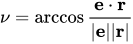
where:
- v is the orbital velocity vector of the orbiting body,
- e is the eccentricity vector,
- r is the orbital position vector (segment FP in the figure) of the orbiting body.
Circular orbit[edit]
For circular orbits the true anomaly is undefined, because circular orbits do not have a uniquely determined periapsis. Instead the argument of latitude u is used:
-
- (if rz < 0 then replace u by 2π − u)
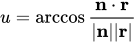
where:
- n is a vector pointing towards the ascending node (i.e. the z-component of n is zero).
- rz is the z-component of the orbital position vector r
Circular orbit with zero inclination[edit]
For circular orbits with zero inclination the argument of latitude is also undefined, because there is no uniquely determined line of nodes. One uses the true longitude instead:
-
- (if vx > 0 then replace l by 2π − l)
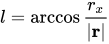
where:
- rx is the x-component of the orbital position vector r
- vx is the x-component of the orbital velocity vector v.
From the eccentric anomaly[edit]
The relation between the true anomaly ν and the eccentric anomaly is:

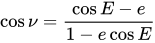
or using the sine[1] and tangent:
![{\displaystyle {\begin{aligned}\sin {\nu }&={{{\sqrt {1-e^{2}\,}}\sin {E}} \over {1-e\cos {E}}}\\[4pt]\tan {\nu }={{\sin {\nu }} \over {\cos {\nu }}}&={{{\sqrt {1-e^{2}\,}}\sin {E}} \over {\cos {E}-e}}\end{aligned}}}](https://wikimedia.org/api/rest_v1/media/math/render/svg/e78fa556ab9265fb1281a7a87ae21f9e290615a9)
or equivalently:
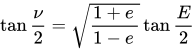
so

Alternatively, a form of this equation was derived by [2] that avoids numerical issues when the arguments are near , as the two tangents become infinite. Additionally, since and are always in the same quadrant, there will not be any sign problems.


- where
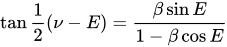
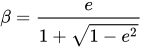
so

From the mean anomaly[edit]
The true anomaly can be calculated directly from the mean anomaly via a Fourier expansion:[3]

![{\displaystyle \nu =M+2\sum _{k=1}^{\infty }{\frac {1}{k}}\left[\sum _{n=-\infty }^{\infty }J_{n}(-ke)\beta ^{|k+n|}\right]\sin {kM}}](https://wikimedia.org/api/rest_v1/media/math/render/svg/e62a3776e7b4fb5f247edb91b14c857e93fc8fd9)
with Bessel functions and parameter .

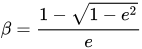
Omitting all terms of order or higher (indicated by ), it can be written as[3][4][5]



Note that for reasons of accuracy this approximation is usually limited to orbits where the eccentricity is small.

The expression is known as the equation of the center, where more details about the expansion are given.

Radius from true anomaly[edit]
The radius (distance between the focus of attraction and the orbiting body) is related to the true anomaly by the formula
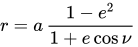
where a is the orbit's semi-major axis.
See also[edit]
References[edit]
- ^ Fundamentals of Astrodynamics and Applications by David A. Vallado
- ^ Broucke, R.; Cefola, P. (1973). "A Note on the Relations between True and Eccentric Anomalies in the Two-Body Problem". Celestial Mechanics. 7 (3): 388–389. Bibcode:1973CeMec...7..388B. doi:10.1007/BF01227859. ISSN 0008-8714. S2CID 122878026.
- ^ a b Battin, R.H. (1999). An Introduction to the Mathematics and Methods of Astrodynamics. AIAA Education Series. American Institute of Aeronautics & Astronautics. p. 212 (Eq. (5.32)). ISBN 978-1-60086-026-3. Retrieved 2022-08-02.
- ^ Smart, W. M. (1977). Textbook on Spherical Astronomy (PDF). p. 120 (Eq. (87)). Bibcode:1977tsa..book.....S.
- ^ Roy, A.E. (2005). Orbital Motion (4 ed.). Bristol, UK; Philadelphia, PA: Institute of Physics (IoP). p. 78 (Eq. (4.65)). Bibcode:2005ormo.book.....R. ISBN 0750310154. Archived from the original on 2021-05-15. Retrieved 2020-08-29.
Further reading[edit]
- Murray, C. D. & Dermott, S. F., 1999, Solar System Dynamics, Cambridge University Press, Cambridge. ISBN 0-521-57597-4
- Plummer, H. C., 1960, An Introductory Treatise on Dynamical Astronomy, Dover Publications, New York. OCLC 1311887 (Reprint of the 1918 Cambridge University Press edition.)
External links[edit]
Gravitational orbits | |||||||||
|---|---|---|---|---|---|---|---|---|---|
| Types |
| ||||||||
| Parameters |
| ||||||||
| Maneuvers | |||||||||
| Orbital mechanics |
| ||||||||
