


Orbital speed
 | This article needs additional citations for verification. (September 2007) |
| Part of a series on |
| Astrodynamics |
|---|
 |
In gravitationally bound systems, the orbital speed of an astronomical body or object (e.g. planet, moon, artificial satellite, spacecraft, or star) is the speed at which it orbits around either the barycenter (the combined center of mass) or, if one body is much more massive than the other bodies of the system combined, its speed relative to the center of mass of the most massive body.
The term can be used to refer to either the mean orbital speed (i.e. the average speed over an entire orbit) or its instantaneous speed at a particular point in its orbit. The maximum (instantaneous) orbital speed occurs at periapsis (perigee, perihelion, etc.), while the minimum speed for objects in closed orbits occurs at apoapsis (apogee, aphelion, etc.). In ideal two-body systems, objects in open orbits continue to slow down forever as their distance to the barycenter increases.
When a system approximates a two-body system, instantaneous orbital speed at a given point of the orbit can be computed from its distance to the central body and the object's specific orbital energy, sometimes called "total energy". Specific orbital energy is constant and independent of position.[1]
Radial trajectories
[edit]In the following, it is assumed that the system is a two-body system and the orbiting object has a negligible mass compared to the larger (central) object. In real-world orbital mechanics, it is the system's barycenter, not the larger object, which is at the focus.
Specific orbital energy, or total energy, is equal to Ek − Ep (the difference between kinetic energy and potential energy). The sign of the result may be positive, zero, or negative and the sign tells us something about the type of orbit:[1]
- If the specific orbital energy is positive the orbit is unbound, or open, and will follow a hyperbola with the larger body the focus of the hyperbola. Objects in open orbits do not return; once past periapsis their distance from the focus increases without bound. See radial hyperbolic trajectory
- If the total energy is zero, (Ek = Ep): the orbit is a parabola with focus at the other body. See radial parabolic trajectory. Parabolic orbits are also open.
- If the total energy is negative, Ek − Ep < 0: The orbit is bound, or closed. The motion will be on an ellipse with one focus at the other body. See radial elliptic trajectory, free-fall time. Planets have bound orbits around the Sun.
Transverse orbital speed
[edit]The transverse orbital speed is inversely proportional to the distance to the central body because of the law of conservation of angular momentum, or equivalently, Kepler's second law. This states that as a body moves around its orbit during a fixed amount of time, the line from the barycenter to the body sweeps a constant area of the orbital plane, regardless of which part of its orbit the body traces during that period of time.[2]
This law implies that the body moves slower near its apoapsis than near its periapsis, because at the smaller distance along the arc it needs to move faster to cover the same area.[1]
Mean orbital speed
[edit]For orbits with small eccentricity, the length of the orbit is close to that of a circular one, and the mean orbital speed can be approximated either from observations of the orbital period and the semimajor axis of its orbit, or from knowledge of the masses of the two bodies and the semimajor axis.[3]
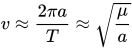
where v is the orbital velocity, a is the length of the semimajor axis, T is the orbital period, and μ = GM is the standard gravitational parameter. This is an approximation that only holds true when the orbiting body is of considerably lesser mass than the central one, and eccentricity is close to zero.
When one of the bodies is not of considerably lesser mass see: Gravitational two-body problem
So, when one of the masses is almost negligible compared to the other mass, as the case for Earth and Sun, one can approximate the orbit velocity as:[1]

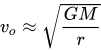
or:

Where M is the (greater) mass around which this negligible mass or body is orbiting, and ve is the escape velocity at a distance from the center of the primary body equal to the radius of the orbit.
For an object in an eccentric orbit orbiting a much larger body, the length of the orbit decreases with orbital eccentricity e, and is an ellipse. This can be used to obtain a more accurate estimate of the average orbital speed:[4]
![{\displaystyle v_{o}={\frac {2\pi a}{T}}\left[1-{\frac {1}{4}}e^{2}-{\frac {3}{64}}e^{4}-{\frac {5}{256}}e^{6}-{\frac {175}{16384}}e^{8}-\cdots \right]}](https://wikimedia.org/api/rest_v1/media/math/render/svg/ad5791feac5142d389ffda8b958ab12c3ac7de32)
The mean orbital speed decreases with eccentricity.
Instantaneous orbital speed
[edit]For the instantaneous orbital speed of a body at any given point in its trajectory, both the mean distance and the instantaneous distance are taken into account:
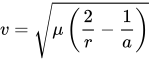
where μ is the standard gravitational parameter of the orbited body, r is the distance at which the speed is to be calculated, and a is the length of the semi-major axis of the elliptical orbit. This expression is called the vis-viva equation.[1]
For the Earth at perihelion, the value is:

which is slightly faster than Earth's average orbital speed of 29,800 m/s (67,000 mph), as expected from Kepler's 2nd Law.
Tangential velocities at altitude
[edit]| Orbit | Center-to-center distance |
Altitude above the Earth's surface |
Speed | Orbital period | Specific orbital energy |
|---|---|---|---|---|---|
| Earth's own rotation at surface (for comparison— not an orbit) | 6,378 km | 0 km | 465.1 m/s (1,674 km/h or 1,040 mph) | 23 h 56 min 4.09 sec | −62.6 MJ/kg |
| Orbiting at Earth's surface (equator) theoretical | 6,378 km | 0 km | 7.9 km/s (28,440 km/h or 17,672 mph) | 1 h 24 min 18 sec | −31.2 MJ/kg |
| Low Earth orbit | 6,600–8,400 km | 200–2,000 km |
|
1 h 29 min – 2 h 8 min | −29.8 MJ/kg |
| Molniya orbit | 6,900–46,300 km | 500–39,900 km | 1.5–10.0 km/s (5,400–36,000 km/h or 3,335–22,370 mph) respectively | 11 h 58 min | −4.7 MJ/kg |
| Geostationary | 42,000 km | 35,786 km | 3.1 km/s (11,600 km/h or 6,935 mph) | 23 h 56 min 4.09 sec | −4.6 MJ/kg |
| Orbit of the Moon | 363,000–406,000 km | 357,000–399,000 km | 0.97–1.08 km/s (3,492–3,888 km/h or 2,170–2,416 mph) respectively | 27.27 days | −0.5 MJ/kg |

Planets
[edit]The closer an object is to the Sun the faster it needs to move to maintain the orbit. Objects move fastest at perihelion (closest approach to the Sun) and slowest at aphelion (furthest distance from the Sun). Since planets in the Solar System are in nearly circular orbits their individual orbital velocities do not vary much. Being closest to the Sun and having the most eccentric orbit, Mercury's orbital speed varies from about 59 km/s at perihelion to 39 km/s at aphelion.[5]
| Planet | Orbital velocity |
|---|---|
| Mercury | 47.9 km/s (29.8 mi/s) |
| Venus | 35.0 km/s (21.7 mi/s) |
| Earth | 29.8 km/s (18.5 mi/s) |
| Mars | 24.1 km/s (15.0 mi/s) |
| Jupiter | 13.1 km/s (8.1 mi/s) |
| Saturn | 9.7 km/s (6.0 mi/s) |
| Uranus | 6.8 km/s (4.2 mi/s) |
| Neptune | 5.4 km/s (3.4 mi/s) |
Halley's Comet on an eccentric orbit that reaches beyond Neptune will be moving 54.6 km/s when 0.586 AU (87,700 thousand km) from the Sun, 41.5 km/s when 1 AU from the Sun (passing Earth's orbit), and roughly 1 km/s at aphelion 35 AU (5.2 billion km) from the Sun.[7] Objects passing Earth's orbit going faster than 42.1 km/s have achieved escape velocity and will be ejected from the Solar System if not slowed down by a gravitational interaction with a planet.
| Object | Velocity at perihelion | Velocity at 1 AU (passing Earth's orbit) |
|---|---|---|
| 322P/SOHO | 181 km/s @ 0.0537 AU | 37.7 km/s |
| 96P/Machholz | 118 km/s @ 0.124 AU | 38.5 km/s |
| 3200 Phaethon | 109 km/s @ 0.140 AU | 32.7 km/s |
| 1566 Icarus | 93.1 km/s @ 0.187 AU | 30.9 km/s |
| 66391 Moshup | 86.5 km/s @ 0.200 AU | 19.8 km/s |
| 1P/Halley | 54.6 km/s @ 0.586 AU | 41.5 km/s |
See also
[edit]References
[edit]- ^ a b c d e Lissauer, Jack J.; de Pater, Imke (2019). Fundamental Planetary Sciences: physics, chemistry, and habitability. New York, NY, US: Cambridge University Press. pp. 29–31. ISBN 9781108411981.
- ^ Gamow, George (1962). Gravity. New York, NY, US: Anchor Books, Doubleday & Co. pp. 66. ISBN 0-486-42563-0.
...the motion of planets along their elliptical orbits proceeds in such a way that an imaginary line connecting the Sun with the planet sweeps over equal areas of the planetary orbit in equal intervals of time.
- ^ Wertz, James R.; Larson, Wiley J., eds. (2010). Space mission analysis and design (3rd ed.). Hawthorne, CA, US: Microcosm. p. 135. ISBN 978-1881883-10-4.
- ^ Stöcker, Horst; Harris, John W. (1998). Handbook of Mathematics and Computational Science. Springer. pp. 386. ISBN 0-387-94746-9.
- ^ "Horizons Batch for Mercury aphelion (2021-Jun-10) to perihelion (2021-Jul-24)". JPL Horizons (VmagSn is velocity with respect to Sun.). Jet Propulsion Laboratory. Retrieved 26 August 2021.
- ^ "Which Planet Orbits our Sun the Fastest?".
- ^ v = 42.1219 √1/r − 0.5/a, where r is the distance from the Sun, and a is the major semi-axis.
Gravitational orbits | |||||||||
|---|---|---|---|---|---|---|---|---|---|
| Types |
| ||||||||
| Parameters |
| ||||||||
| Maneuvers | |||||||||
| Orbital mechanics |
| ||||||||
