


Turkish Van
| Turkish Van | |
|---|---|
 A Turkish Van with heterochromia. | |
| Other names | Turkish cat (obsolete) |
| Origin | Turkey (foundation stock), United Kingdom (initial breeding programme) |
| Breed standards | |
| CFA | standard |
| FIFe | standard |
| TICA | standard |
| ACF | standard |
| ACFA/CAA | standard |
| GCCF | standard |
| Domestic cat (Felis catus) | |
The Turkish Van is a semi-long-haired, standardised breed of domestic cat, which was developed in the United Kingdom from a selection of cats obtained from various cities of modern Turkey, especially southeast Turkey.[1]: 112 The breed is rare,[2] is one of the larger breeds, and is distinguished by the Van pattern (named after the breed), where the colour is restricted to the head and the tail, and the rest of the cat is white;[2] this is due to the expression of the piebald white spotting gene, a type of partial leucism.[3]: 148 A Turkish Van may have blue or amber eyes, or be odd-eyed (having one eye of each colour).
The breed was first recognised as such by a breeder/fancier organisation, the UK-based Governing Council of the Cat Fancy (GCCF), in 1969, under the name Turkish cat.[1]: 113 It was later renamed Turkish Van to better distinguish it from the Turkish Angora breed. The Turkish Van has been claimed to be descended from (and is often confused with) the landrace of usually all-white Van cats, mostly found near Lake Van,[2] though one of the two original breeders' own writings indicate clearly that none of the breed's foundation cats came from the Van area.[1]: 114 [4]
Breed standards
[edit]
Breed standards allow for one or more body spots as long as there is no more than 20% colour and the cat does not give the appearance of a bicolour. A few random spots are acceptable, but they should not detract from the pattern. The rest of the cat is white. Although red tabby and white is the classic Van colour, the colour on a Van's head and tail can be one of the following: red, cream, black, blue, red tabby, cream tabby, brown tabby, blue tabby, tortoiseshell, dilute tortoiseshell (also known as blue-cream), brown-patched tabby, blue-patched tabby, and any other colour not showing evidence of crossbreeding with the point-coloured breeds (Siamese, Himalayan, etc.). Not all registries recognise all of these colour variations.
While A registries recognise all-white specimens as Turkish Vans, most do not. The US-based Cat Fanciers' Association (CFA, the world's largest registry of pedigreed cats) and Fédération Internationale Féline (FIFe, the largest international cat fancier organisation) recognise only Van-patterned specimens, as they define the breed by both its type and pattern. The Germany-based but international World Cat Federation (WCF) considers the all-white specimens a separate breed, which it calls the Turkish Vankedisi,[5] a name that is easily confused with the landrace Van cat, which is called Van kedisi (two words) in Turkish. In other registries, the all-white cats are not considered show quality and are therefore actively bred against. They are prone to deafness; this is a common defect with many all-white animals.[6]
Varieties
[edit]-
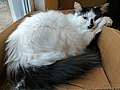 Mostly-white bicolour
 -
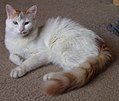 Red
Red -
 Red tabby
 -
 Calico
 -
 Black and white Turkish Van


History
[edit]
In 1955, two British photographers, Laura Lushington and Sonia Halliday, while on assignment in Turkey for the Turkish Ministry of Tourism, were given two unrelated cats in Turkey, which Lushington took home with her and allowed to mate. When the offspring came out identical to their parents – chalk white with dark tail and head markings – she set to establishing a standardised breed, originally named Turkish cat, later Turkish Van, and having it recognised by the British cat fancy organisations. Lushington returned to Turkey to find another pair, with the goal of breeding to the standard "three clear generations".[6]
According to Lushington, her original imported cats were: Van Iskenderun Guzelli (female), a cat that came from Hatay Province, Iskenderun, and Stambul Byzantium (male), a cat given by a hotel manager in Istanbul, both in 1955. Two later additions to the gene pool were Antalya Anatolia (female), from the city of Antalya, and Burdur (male), from Burdur city, both in 1959. Lushington did not see Van city before 1963, and only stayed there "for two days and two nights".[4] It is unclear why the name "Turkish Van" was chosen, or why one of the original 1955 kittens was named "Van Iskenderun Guzelli", given their provenance. Of the founding 1955 pair, Lushington wrote, in 1977:
I was first given a pair of Van kittens in 1955 while travelling in Turkey, and decided to bring them back to England, although touring by car and mainly camping at the time – the fact that they survived in good condition showed up the great adaptability and intelligence of their breed in trying circumstances. Experience showed that they bred absolutely true. They were not known in Britain at that time and, because they make such intelligent and charming pets, I decided to try to establish the breed, and to have it recognised officially in Britain by the GCCF.[1]: 114
It is unclear whether Lushington was intending to imply that the Hatay and Istanbul kittens had originally come from the Lake Van region, or was simply referring to the Turkish Van foundation stock as "Van kittens" for short. Neither city is near Van Province, and there is no evidence that specimens of the Van cat landrace were ever among the foundation stock.
The Turkish Van was given full pedigree status in 1969 by the Governing Council of the Cat Fancy (GCCF). Called simply the Turkish cat at this point,[7] the name was changed in 1979 in the UK (1985 in the US) to Turkish Van[2][8] to better distance the breed from the Turkish Angora cat (originally called simply Angora,[1]: 35 an old spelling of Ankara).
The Turkish Van began to be imported into America in the 1970s. Beginning in 1983, two Florida breeders, Barbara and Jack Reark,[citation needed] worked to popularise this breed, and in 1985, The International Cat Association (TICA) granted the Turkish Van championship status. In 1988, the Cat Fanciers' Association (CFA) accepted the breed for registration in the miscellaneous class. The CFA later bestowed provisional status to the Van in 1993, and championship status in 1994. In that first year, four Turkish Vans attained the grand title.
Physical characteristics
[edit].jpg)
The Turkish Van is a large, muscular cat with a moderately long body and tail. It has strong, broad shoulders and a short neck; the jock of the cat world. The body of a Van should neither be stocky, or thin. It should call to mind the body build of an athlete, and indeed, it is one of the largest cats.[6] They take from 3 to 5 years to reach their full maturity and when they do males range in weight from 10 - 20 pounds with females ranging from 7 - 12 pounds.[9]
The coat on a Turkish Van is considered semi-long-haired.[2] While many cats have three distinct hair types in their coat – guard hair, awn hair, and down hair – the Turkish Van has no evident undercoat, only one coat.[6] This makes their coat feel like cashmere[2] or rabbit fur. The lack of an undercoat gives a sleek appearance.[2] The coat is uncommonly water repellent,[2] which makes bathing these cats a challenge, though the coat dries quickly. The breed actually has two lengths of hair, determined by season. In the winter, the hair is thick and long. In the summer, the hair sheds to leave a shorter, lighter coat.[6] The coat begins short at birth and grows in gradually over a period of three to five years, so that the kittens may be short-haired in appearance, with thin tails, but as they mature, the fur on the chest will fill out, and the tail will thicken into a full brush tail. The tail does not shed hair or change according to the season, but remains long and full. The ears remain feathered with fur, so that even with its summer coat, the Van looks soft and fluffy.[6]
The Turkish Van is one of the larger cat breeds. Ideal type should feature broad shoulders with a body that is "top-heavy", that is, a cat with its center of gravity forward. The cat is moderately long, and its back legs are slightly longer than its front legs, but neither the cat itself nor its legs are so long as to be disproportionate. They have large paws and rippling hard muscle structure which allows them to be very strong jumpers. Vans can easily hit the top of a refrigerator from a cold start on the floor. They are slow to mature and this process can take 3 years, possibly longer. Vans have been known to reach 3 ft (1 m) long from nose to tip of tail.
A Turkish Van may have blue eyes, amber eyes, or be odd-eyed[2] (having one eye of each colour, a condition known as heterochromia iridis).
The breed typically has very large ears when it is a kitten, growing into its ears over time. The nose is straight and Asiatic, considered long for a semi-longhair, and with its high cheek bones, and startlingly bright eyes, it gives off quite an exotic appearance.[6]
Behavior
[edit] | This section needs additional citations for verification. (May 2014) |
The TICA standard[9] notes several characteristics, including their high intelligence, energy and playfulness – also making them somewhat mischievous. Muscular and highly driven, they like to climb and perch high up, to study their environment, and they get around their domain with impressive athleticism. They make quite successful hunters as a consequence. Their drive makes them easily trainable with positive reinforcement – to play fetch, do tricks or walk on a leash. Although there may be efforts to move the breed towards greater sociability.[2] a 2021 study in Finland[10] did find that the Turkish Vans in their research showed higher than average tendencies towards fearfulness, aggression towards humans, as well as a lower stress tolerance (notable excessive grooming and litter-box problems), and lower sociability to humans and cats.
Curious, Turkish Vans want to be with their owner participating in whatever is happening, and so they may follow a person from room to room.[9] While Turkish vans are affectionate to their family members, these are not normally lap cats. They may lie next to their owners and will happily allow themselves to be petted, but this is not a breed that tolerates being picked up and often wants to be near their owner, not on their owner.[11]
Turkish Vans do well in a single-pet household and don't seem to suffer much from separation anxiety. When put in a home with other cats, they much prefer being around other Turkish Vans. Dogs can be no problem as long as they are introduced properly and patiently.[11]
When it comes to families, Turkish Vans are happy to play with children, but care must be taken to make sure small ones are reminded that the breed may not enjoy being held, and may strike out if forced into such a situation.[11] The native Van cats of Turkey have been nicknamed the "swimming cats", due to an unusual fascination with water.[4] Despite the modern Turkish Van breed consisting almost entirely of pedigreed, indoor-only cats with no access to large bodies of water, and despite dubious connections between them and the cats of the Lake Van area, some feel that the Turkish Van has a notable affinity for water; for example, instead of swimming in a lake, they may stir their water bowls or play with water in the toilet,[6] and some may even follow their owners into water.[2] However, the idea that the breed likes water more than other cats may be mistaken according to some pet writers.[12]
Genetics
[edit]The Turkish Van is largely free of genetic issues and breed-specific health defects. Unlike the Turkish Angora, the Turkish Van does not have issues with deafness.[11]
Additionally, due to the Turkish Van's larger size, spay or neutering procedures are sometimes delayed to around 1 year of age, as an early adjustment to their hormone levels can affect how their bones and muscles grow.[11]
The piebald spotting gene (partial leucism) appears in other different species (like the horse and the ball python). It also shows up in other breeds of cat, since the Van pattern is merely an extreme expression of the gene.[3]: 148
The breed's variability of eye colour is genetically caused by the white spotting factor, which is a characteristic of this breed. The white spotting factor is the variable expression of the piebald gene that varies from the minimal degree (1), as in the blue-eyed cats with white tip on the tail to the maximal degree (8–9) that results in a Van-patterned cat, when coloured marks occupy at most 20% of the white background, but the white background in the breed covers about 80% of the body. Breeding two cats together with the same level of white spotting will produce cats with a similar degree of spotting.[3]: 148
Van-patterned Turkish Vans are not prone to deafness, because their phenotype is associated with the Van pattern (Sv) semi-dominant gene. Solid-white Turkish Angoras carry the epistatic (masking) white colour (W) dominant gene associated with white fur, blue eyes, and often deafness. All-white cats of Turkish Van stock may share this gene. All three types of cat may exhibit eye colours that are amber, blue or odd. Deafness is principally associated with white cats having two blue eyes.[3]: 191
See also
[edit]
References
[edit]- ^ a b c d e f Pond, Grace, ed. (1972). The Complete Cat Encyclopedia. London: Walter Parrish Intl. ISBN 0-517-50140-6. This tertiary source reuses information from other sources but does not name them.
- ^ a b c d e f g h i j k "Turkish Van Cats". Retrieved 8 April 2014. This tertiary source reuses information from other sources but does not name them. This source, in some places, conflates the Turkish Van breed and the Van cat landrace.
- ^ a b c d Vella, Carolyn; Shelton, Lorraine; McGonagle, John; Stanglein, Terry (1999), Robinson's Genetics for Cat Breeders and Veterinarians (4th ed.), Oxford: Butterworth Heineman, p. 253, ISBN 0-7506-4069-3
- ^ a b c Lushington, Laura (1963), "The Swimming Cats", Animals, 1 (17): 24–27, archived from the original on 2 August 2014,
My photographer and I were given special permits visit Van by air, for two days and two nights (...) Now at least I have been to Van, in Eastern Turkey, and seen with my own eyes the ancient city of Van and the glorious Lake Van
- ^ "Recognized and Admitted Breeds in the WCF". WCF-Online.de. Essen, Germany: World Cat Federation. 2009. Archived from the original on 8 August 2014. Retrieved 13 February 2013.
- ^ a b c d e f g h "Turkish Van". PetMD.com. Retrieved 17 July 2021.
- ^ Rex, Abyssinian and Turkish Cats, by Alison Ashford and Grace Pond, ISBN 0-668-03356-8
- ^ Turkish Van Cat Club, Van Cat Chat, No. 5, Winter 1985/1986
- ^ a b c "Turkish Van". TICA.org. Retrieved 30 September 2024.
- ^ Mikkola, Salla (4 June 2021). "Reliability and Validity of Seven Feline Behavior and Personality Traits". Animals. 11 (7): 7. doi:10.3390/ani11071991. PMC 8300181. PMID 34359119.
- ^ a b c d e "Turkish Van". Daily Paws. Retrieved 17 July 2021. [unreliable source?]
- ^ Hart, Robert (2010). Hart's Original Petpourri. Vol. 1. Langdon Street Press. p. 4. ISBN 9781934938621. Hart cites a Cat Fancy magazine article as his source.
External links
[edit]
