


Documentary theatre
 |
Documentary theatre is theatre that uses pre-existing documentary material (such as newspapers, government reports, interviews, journals, and correspondences) as source material for stories about real events and people, frequently without altering the text in performance. The genre typically includes or is referred to as verbatim theatre, investigative theatre, theatre of fact, theatre of witness, autobiographical theatre, and ethnodrama.[1]
History[edit]
Zhivaya Gazeta and Piscator[edit]
While fact-based drama has been traced back to ancient Greece and Phrynichus' production of The Capture of Miletus in 492 BC,[2] contemporary documentary theatre is rooted in theatrical practices developed in Eastern Europe during the 1920s and 1930s. In the years after the Russian Revolution, the USSR's Department of Agitation and Propaganda employed theatre troupes known as the Blue Blouses[3] (so called because they wore factory workers' overalls) to stage current events for the largely illiterate population.[4] The Blue Blouses dramatized news items and current events through song, dance, and staging. By 1924 these performances were standardized into the form of the zhivaya gazeta, or living newspaper.[5]
Meanwhile, in Germany, Erwin Piscator was experimenting with incorporating documentary film footage and other primary source material into his "mass spectacles"[6] In 1925 he wrote In Spite of Everything, a piece derived entirely from contemporary political documents and often cited as the beginning of the first period of modern documentary drama.[7] In this and other early works, Piscator sought to depict the "absolute truth".[8] He focused on the presentation of factual material in montage and collage form rather than trying to express the internal lives of the characters.[9]
Depression-era America[edit]
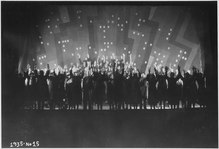
Documentary theatre spread west during the 1930s. In England, the form was employed by left-leaning political theatre groups like the Unity Theatre, which presented both documentary and historical dramas in order to expose the truths of the common man, frequently combining fiction and reality to achieve truth. Unity Theatre's documentary shows focused on the "living newspaper" aesthetic of Eastern Europe. Their first piece, Busmen (1938), combined naturalistic dialogue with abstract and stylized design aesthetics culled from expressionist and constructivist genres.[10]
In the United States, the form was adapted by Hallie Flanagan Davis and Morris Watson into the large-scale Living Newspapers of the Federal Theatre Project of the President Franklin D. Roosevelt administration.[11] Initially conceived as an "animated newsreel," the form evolved into a distinct theatrical genre; practitioners used spectacle and vaudeville techniques in addition to agitprop and Piscatorian conventions to tackle issues such as labor, housing, and agriculture during the Great Depression.[12] Often, they included characters such as Little Man and Loudspeaker to stand in and speak for and to the audience during the action, fusing fact with dramatic symbol and clarifying the narrative arc. These plays, like later iterations of documentary theatre, were frequently communally created, often by groups of newspaper writers and theatre artists.[13] The end of the Federal Theatre Project in 1939 brought documentary theatre in the United States to a halt until the early 1960s.[9]
Post-war era and the 1970s[edit]
While the documentary theatre of the 1930s stressed the involvement of the audience, much of the work of the 1960s into the 1970s was influenced by Bertolt Brecht's distancing of the audience, through aesthetic practices, in order to question dominant ideologies.[14] The work of this era focused more intensely on new or alternative perspectives of historical events by restructuring the documents to raise questions about perceived reality. In Germany, these documentary plays focused mainly on the aftermath of Nazism and the genocide of the Holocaust.[6] Many works drew from transcripts from tribunals, such as Heinar Kipphardt's In the Matter of J. Robert Oppenheimer and Peter Weiss's The Investigation.[9]
In his essay "Notes on the Contemporary Theatre", Weiss details 14 elements of documentary theatre, stating that "the strength of the documentary theatre resides in its ability to arrange fragments of reality into a usable model," and that the artistic power of the genre comes from a partisan interpretation and presentation of factual material. He also identified many potential sources for documentary theatre, including
minutes of proceeding, files, letters, statistical tables, stock-exchange communiques, presentations of balance-sheets of banks and industrial undertakings, official commentaries, speeches, interviews, statements by well-known personalities, press, radio, photo, or film reporting of events and all the other media bearing witness to the present.[15]
This type of documentary drama was exported to Israel and the Middle East by Nola Chilton, whose theatre of testimony focused on marginalized groups in the area and later influenced the work of American practitioners.[16] During this period of time, however, the American genre became more overtly political with plays such as Martin Duberman's In White America, a piece based in Living Newspaper techniques of narration and song, presented by the Free Southern Theatre, a company that sought to make theatre for black audiences in the south.[17] Plays also became more experimental, leading to documentary-style performances, as artists such as Joseph Chaikin and The Open theatre used historical documents as source material for improvisations (Viet Rock)[18] or Luis Valdez combined verbatim text from newspapers, transcripts, and correspondence with a fictionalized story and characters in Zoot Suit.[19]
In England, meanwhile, the use of tape-recorded testimony to generate script became a hallmark of the Stoke Local Documentary Method, developed by Peter Cheeseman.[20] In his many plays, including Fight for Shelton Bar (1977), Hands Up, For You the War Is Ended! (1971), Cheeseman focused on the exact transcription of recorded interviews, and is one of the earliest pioneers of the sub-genre "verbatim theatre." The theories of Cheeseman and other British practitioners of verbatim theatre informed the development much of American documentary theatre of the late 20th-century.[7]
Late 20th-century and early 21st-century[edit]
.jpg)
The focus on individuals within the context of historical events that permeated the documentary theatre of the 1960s and 1970s paved the way for artist- and individual-centric documentary theatre in the 1980s and 1990s. During this period of time, the focus shifted even further away from broad historical presentations to focus more specifically on how identity shaped personal relationships with major events. The seminal works of this period, which highlight the work of the artist as interpreter of the factual material, include one-person shows such as Anna Deavere Smith's Fires in the Mirror (1992), collectively created shows like Tectonic Theatre Project's The Laramie Project (2000),[21] and playwright-driven work like Anne Nelson's The Guys (2001) and Jessica Blank and Erik Jensen's The Exonerated (2002).[22] In Eastern Europe, new German documentary theatre also focused on the importance of the artist as interpreter through the development of media-driven non-narrative creations of auteur directors like Hans-Werner Kroesinger.[6]
Contemporary practice[edit]
Contemporary documentary theatre is defined by its privileging of subjectivity over universality and questioning of the definition of truth in an age where digital and physical realities collide.[23] Many contemporary practitioners reject the term "documentary theatre" in favor of more equivocal labels like "investigative theatre" that allow for more leeway in the artistic interpretation of reality and moves away from the original concept of the artist as moral arbiter of the truth.[24] Just as Piscator utilized the new media of film and projection to enhance his productions, so contemporary documentary theatre continues to rely on new media to explore the increasingly fuzzy line between reality and representation of reality. Similarly, documentary theatre continues to rely on a democratic process of interview gathering and multiple artistic perspectives to create new narratives.[21] This has led to a proliferation of plays, both verbatim and fictionalized, that focus on the stories of refugees and migrants that use interviews and workshops as the starting point for narrative plays.[25] A very recent iteration of documentary theatre has been undertaken by Anuja Ghosalkar and Kai Tuchmann`s Festival "Connecting Realities", which has attempted "to [...] contribute to an examination of Indian and Asian performance practices, both traditional and contemporary, that relate to performing reality."[26]
Verbatim theatre[edit]
Verbatim theatre is a form of documented theatre in which plays are constructed from the precise words spoken by people interviewed about a particular event or topic.
Definition[edit]
The playwright interviews people who are connected to the topic that is the play's focus and then uses their testimony to construct the play. In this way, the playwright seeks to present a multi-voiced approach to events. Such plays may be focused on politics, disasters, sporting and other social events.[citation needed]
A verbatim (word-for-word) style of theatre uses documented words from interviewees or records, such as court transcripts, to construct the play. Campion Decent, Australian playwright and author of the verbatim theatre play Embers, said it is “not written in a traditional sense… but is... conceived, collected and collated”.[27] It is a creative type of drama to help tell the story of what happened in events. Verbatim theatre exists as conceived in the United Kingdom. But in the United States, verbatim theatre is not always distinguished from the broader genre of documentary theatre. Therefore, the plays, movies and TV listed below – as verbatim theatre, written by playwrights living and writing in the United States, should be considered as documentary theatre.
History[edit]
British-American playwright and critic Eric Bentley's 1974 play Are You Now Or Have You Ever Been: The Investigations of Show-Business by the Un-American Activities Committee was built on testimonies delivered before the US House Un-American Activities Committee in the 1950s.[28]
American actress/playwright Anna Deavere Smith has been described as a pioneer of verbatim theatre due to two of her one-woman plays in the early 1990s: Fires in the Mirror (1992), about the 1991 Crown Heights riot in Brooklyn, New York, and Twilight: Los Angeles, 1992 (1994), about the 1992 Los Angeles riots. For both plays, she conducted interviews with numerous people connected to the events, then fashioned the plays by selecting from her interview transcripts.
High-profile pieces of verbatim theatre include The Laramie Project (2000) by Moises Kaufman & members of the Tectonic Theater Project and its sequel, The Laramie Project-Ten Years Later, both about the murder of Matthew Shepard in Laramie, Wyoming in 1998; Talking to Terrorists by Robin Soans, My Name is Rachel Corrie by Alan Rickman and Katharine Viner, Deep Cut by Philip Ralph and Katharine Viner, The Permanent Way by David Hare and Counted (2010) by LookLeftLookRight.[29] Unusually, London Road (2011) by Alecky Blythe and Adam Cork, is a verbatim musical, in which the verbatim spoken text is coupled with music composed and sung to resemble the source interviews as closely as possible. In 2017, the Russian production "In Touch"[30] (director - Ruslan Malikov) premiered its international version at London's National Theater (the Russian premiere was held in Moscow in 2015). It is the first documentary theater production in the world that features an ensemble cast of deafblind actors and seeing/hearing ones performing together - and performing verbatim about their own lives.
More recent examples of political verbatim theatre are Tess Berry-Hart's plays Someone To Blame (2012) and Sochi 2014 (2014). In Someone To Blame (about the miscarriage of justice related to teenager Sam Hallam[31]) the words were taken solely from witness statements, court transcripts, media headlines, and interviews with those involved.[32] Sochi 2014 was created from interviews with various LGBT citizens in Russia after Vladimir Putin's anti-gay laws were passed (see LGBT rights in Russia) in the run-up to the 2014 Winter Olympics.[33] On The Record (2011)[34] by Christine Bacon and Noah Birksted-Breen, produced by iceandfire theatre company[35] at the Arcola Theatre, directed by Michael Longhurst,[36] followed the lives of six real journalists around the globe, showing the professional and personal risks taken in the name of investigative journalism.
Black Watch (2006) integrates interviews taken with members of the Black Watch with dramatized versions of their stories and dance pieces. The piece originated in the Edinburgh Festival Fringe and was created by the National Theatre of Scotland and Gregory Burke. 8, a play by Dustin Lance Black, is an example that uses interviews and courtroom transcripts in order to reenact the legal argument and witness testimony of the Perry v. Schwarzenegger case.
Major examples of documentary theatre[edit]
Early 20th-century[edit]
- One-Third of a Nation (1938)
Mid 20th-century[edit]
- The Investigation (1965)
- In the Matter of J. Robert Oppenheimer (1969)
Late 20th- and early 21st-century[edit]
- Fires in the Mirror (1992)
- The Laramie Project (2000)
- The Exonerated (2000)
- The Guys (2001)
- Bystander 9/11 (2001)
- I Am My Own Wife (2003)
- The Permanent Way (2003)
- My Name is Rachel Corrie (2005)
- The Judy Monologues (2010)
- 8 (2011)
- London Road (2011)
- Come from Away (2017)
- The Jungle (2018)
See also[edit]
References[edit]
- ^ Martin, Carol. Theatre of the Real. Palgrave Macmillan, 2013, p. 5.
- ^ Favorini, Attilio (1995). Voicings: Ten Plays from the Documentary Theatre. Ecco Press. ISBN 9780880013970.
- ^ "Documentary drama and theatre." The Oxford Companion to Theatre and Performance. 2010, p. 173.
- ^ Senelick, Laurence, and Ostrovsky, Sergei. The Soviet Theater: A Documentary History. Yale University Press, 2014. 3 April 2018 http://www.myilibrary.com?ID=614054
- ^ Innes, C.D. Erwin Piscator's Political Theatre: The Development of Modern German Drama. CUP Archive, 1972, pp. 24
- ^ a b c Irmer, Thomas. "A Search for New Realities: Documentary Theatre in Germany." TDR The Drama Review, vol. 50, no. 3, 2006, pp. 16–28. JSTOR, JSTOR, www.jstor.org/stable/4492692.
- ^ a b Dawson, Gary Fisher. Documentary Theatre in the United States: An Historical Survey and Analysis of Its Content, Form, and Stagecraft. Greenwood Press, 1999, p. 14, 16, 21.
- ^ Piscator, Erwin. The Political Theatre. Berlin, 1929, p. 65.
- ^ a b c Mason, Gregory (1977). "Documentary Drama from the Revue to the Tribunal". Modern Drama. 20 (3): 263–278. doi:10.3138/md.20.3.263. S2CID 192057269.
- ^ Chambers, Colin. "Unity Theatre and the Embrace of the Real." Get Real: Documentary Theatre Past and Present, edited by Alison Forsyth and Chris Megson, Palgrave MacMillan, 2011, pp. 38-52.
- ^ "Living newspaper", The Oxford Companion to Theatre and Performance. 2010. ISBN 9780191727917.
- ^ Nadler, Paul (1995). "Liberty Censored: Black Living Newspapers of the Federal Theatre Project". African American Review. 29 (4): 615–622. doi:10.2307/3042154. JSTOR 3042154.
- ^ O'Connor, John, and Brown, Lorraine. Free, Adult, Uncensored: The Federal Theatre Project. Eyre Methuen, 1980, pp. 10-11.
- ^ "Documentary Theatre," The Continuum Companion to Twentieth Century Theatre, 2002.
- ^ Weiss, Peter. "Notizen zum dokumentarischen Theater," Rapporte 2, Frankfurt am Main: Suhrkamp Verlag, 1971.
- ^ Ben-Zvi, Linda (2006). "Staging the Other Israel: The Documentary Theatre of Nola Chilton". TDR. 50 (3): 42–55. doi:10.1162/dram.2006.50.3.42. S2CID 57572595.
- ^ Bean, Annemarie. "The Free Southern Theater: Mythology and the Moving Between Movements." Restaging the Sixties: Radical Theatres and Their Legacies, edited by James M. Harding and Cindy Rosenthal, University of Michigan, 2006, pp. 269-285.
- ^ Shank, Theodore. American Alternative Theater. Grove Press Inc., 1982, p. 38.
- ^ O'Connor, Jacqueline. "Documentary Theatre and Zoot Suit." Interrogating America through Theatre and Performance, Palgrave MacMillan, 2007.
- ^ Paget, Derek. "The 'Broken Tradition' of Documentary Theatre and Its Continued Powers of Endurance," Get Real: Documentary Theatre Past and Present, edited by Alison Forsyth and Chris Megson, Palgrave MacMillan, 2011, pp. 224-236.
- ^ a b Odendahl-James, Jules. "A History of U.S. Documentary Theatre in Three Stages." American Theatre Magazine, August 22, 2017. https://www.americantheatre.org/2017/08/22/a-history-of-u-s-documentary-theatre-in-three-stages/
- ^ Collins-Hughes, Laura. "The play's the thing: the dramatic and narrative appeal of documentary theater." Nieman Reports, Summer 2015, p. 8. Academic OneFile, http://link.galegroup.com.ez-proxy.brooklyn.cuny.edu:2048/apps/doc/A431081527/AONE?u=cuny_broo39667&sid=AONE&xid=89597130 . Accessed 30 Apr. 2018.
- ^ Martin, Carol. "Our Reflection Talks Back." American Theatre Magazine, August 22, 2017, https://www.americantheatre.org/2017/08/22/our-reflection-talks-back/
- ^ Parenteau, Amelia. "How Do You Solve a Problem Like Documentary Theatre?" American Theatre Magazine, August 22, 2017, https://www.americantheatre.org/2017/08/22/how-do-you-solve-a-problem-like-documentary-theatre/
- ^ Jeffers, Alison. Refugees, Theatre and Crisis: Performing Global Identities. Palgrave MacMillan, 2012, p. 56.
- ^ https://connectingrealities.org/
- ^ Whitton, Rebecca (August 10, 2006). "Embers". Sydney Stage Online. Archived from the original on August 19, 2006. Retrieved September 27, 2018.
- ^ Bentley, E. (1974). Are You Or Have You Ever Been. NY: Harper & Row
- ^ Jupp, Emily (April 13, 2010). "The rise of democratic theatre". The Independent.
- ^ "National Theatre hosts in Touch".
- ^ "Sam Hallam Released after Seven Years", The Guardian, 16 May 2012
- ^ "Sam Hallam campaigners make drama of Hoxton murder case". 16 March 2011.
- ^ "Gay Russia Finds a Voice in London Play", The Independent
- ^ Bacon, Christine; Birksted-Breen, Noah (2014). Forsyth, Alison (ed.). The Methuen Drama Anthology of Testimonial Plays. Bloomsbury. pp. 215–264. ISBN 9781408176528.
- ^ "iceandfire website".
- ^ "Arcola Theatre production page". 15 May 2019.
| Authority control databases: National |
|---|
