


Wiggers diagram

A Wiggers diagram, named after its developer, Carl Wiggers, is a unique diagram that has been used in teaching cardiac physiology for more than a century.[1][2] In the Wiggers diagram, the X-axis is used to plot time subdivided into the cardiac phases, while the Y-axis typically contains the following on a single grid:
- Blood pressure
- Aortic pressure
- Ventricular pressure
- Atrial pressure
- Ventricular volume
- Electrocardiogram
- Arterial flow (optional)
- Heart sounds (optional)
The Wiggers diagram clearly illustrates the coordinated variation of these values as the heart beats, assisting one in understanding the entire cardiac cycle.[1]
Events[edit]
| Phase | EKG | Heart sounds | Semilunar valves | Atrioventricular valves | |
| A | Atrial systole | P | S4* | closed | open |
| B | Ventricular systole – Isovolumetric/isovolumic contraction | QRS | S1 ("lub") | closed | closed |
| C1 | Ventricular systole – Ejection 1 | ST | open | closed | |
| C2 | Ventricular systole – Ejection 2 | T | open | closed | |
| D | Ventricular diastole – Isovolumetric/isovolumic relaxation | – | S2 ("dub") | closed | closed |
| E1 | Ventricular diastole – Ventricular filling 1 | – | S3* | closed | open |
| E2 | Ventricular diastole – Ventricular filling 2 | – | closed | open |
Note that during isovolumetric/isovolumic contraction and relaxation, all the heart valves are closed; at no time are all the heart valves open.[1] *S3 and S4 heart sounds are associated with pathologies and are not routinely heard.
Additional images[edit]
-
 Ventricular systole
 -
 Cardiac diastole
 -

-
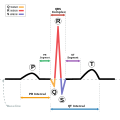 The EKG complex. P=P wave, PR=PR interval, QRS=QRS complex, QT=QT interval, ST=ST segment, T=T wave
 -
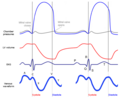 Wiggers with jugular venous waveform
 -
![Wiggers diagram with mechanical (echo), electrical (ECG), and aortic pressure (catheter) waveforms, together with an in-ear dynamic pressure waveform measured using a novel infrasonic hemodynography technology, for a patient with severe aortic stenosis. Modified from [3]](//upload.wikimedia.org/wikipedia/commons/thumb/f/f2/CathWiggers.png/75px-CathWiggers.png) Wiggers diagram with mechanical (echo), electrical (ECG), and aortic pressure (catheter) waveforms, together with an in-ear dynamic pressure waveform measured using a novel infrasonic hemodynography technology, for a patient with severe aortic stenosis. Modified from [3]
Wiggers diagram with mechanical (echo), electrical (ECG), and aortic pressure (catheter) waveforms, together with an in-ear dynamic pressure waveform measured using a novel infrasonic hemodynography technology, for a patient with severe aortic stenosis. Modified from [3]


![Wiggers diagram with mechanical (echo), electrical (ECG), and aortic pressure (catheter) waveforms, together with an in-ear dynamic pressure waveform measured using a novel infrasonic hemodynography technology, for a patient with severe aortic stenosis. Modified from [3]](/wiki/File:CathWiggers.png)
See also[edit]
References[edit]
- ^ a b c d Mitchell, Jamie R.; Wang, Jiun Jr (2014-06-01). "Expanding application of the Wiggers diagram to teach cardiovascular physiology". Advances in Physiology Education. 38 (2): 170–175. doi:10.1152/advan.00123.2013. ISSN 1043-4046. PMC 4056172. PMID 24913453.
- ^ Wiggers, Carl (1915). Circulation in Health and Disease. Philadelphia, PA: Lea & Febiger.
- ^ Waldman, Carly E; Patel, Siddarth (16 November 2021). "Abstract 13654: Can a Novel Earbud Technology Detect Severe Aortic Stenosis? Modernizing the Wiggers Diagram Through Infrasonic Hemodynography Synchronized With Echocardiography and Cardiac Catheterization". Circulation. 144 (Suppl_1). American Heart Association: A13654–A13654.
 | This cardiovascular system article is a stub. You can help Wikipedia by expanding it. |