


Yotvingians


Yotvingians (also called: Sudovians, Jatvians, or Jatvingians; Yotvingian: Jotvingai; Lithuanian: Jotvingiai, Sūduviai; Latvian: Jātvingi; Polish: Jaćwingowie, Belarusian: Яцвягі, German: Sudauer) were a Western Baltic people who were closely tied to the Old Prussians.[1][2] The linguist Petras Būtėnas asserts that they were closest to the Lithuanians.[3] The Yotvingians contributed to the formation of the Lithuanian state.[4]
Culture[edit]
Etymology[edit]
According to Vytautas Mažiulis, the name Sūduva derives from a local hydronym *Sūd(a)vā, in turn derived from a Baltic verbal root *sū-: to flow, pour.[5]
A. S. Kibin proposed Yotvingian, or the "Slavic Jatviagi as the group name goes back to O. N. patronymic derivative játvingar meaning "the descendants of Játvígr", or "the people of Játvígr"" – "the name Játvígr mentioned by Knytlinga saga".[6]
J. Pashka, acknowledging Kibin's proposal, has similarly interpreted the ethnonym as derived from the Old Norse Játvígr, with a genitive Játvígs liðsmenn (ᛃᚨᛏᚢᛁᚴᛋ ᚱᛟᚦᛋ) label of Játvígr's Viking expedition and his Norse Rus' settlers (i.e. Indura, Belarus) by the Nemunas river. Pashka asserts the nasal infixation in the original Old Norse Játvíg name of the 944-945 Kiev Treaty was probably an insignificant scribal error or misinterpretation, that has survived to the present.[7][8]
Language[edit]
Numerous linguists consider the Yotvingian language as a dialect of the Old Prussian language.[1] The Lithuanian linguist Petras Būtėnas states that such an opinion is incorrect, because the Lithuanian kalnas predominates in Yotvingian toponymy instead of the Old Prussian garbis.[3] The Lithuanian professor Zigmas Zinkevičius also wrote that the Yotvingians spoke a dialect of Western Baltic that was closer to Lithuanian than Prussian.[9] The only known written source of the Yotvingian language is the manuscript "Pagan Dialects from Narew".[10]
Geography[edit]
The Yotvingian lived in the area of Sudovia (Yotvingia) and Dainava, southwest from the upper Nemunas. Today this area corresponds mostly to the Podlaskie Voivodeship in Poland, portions of Lithuania west of Nemunas and a part of Hrodna Province in Belarus. The territory was between later the Marijampolė and Merkinė (Lithuania); Slonim and Kobryn (Belarus); and Białystok, and Lyck, in Prussia now Ełk (Poland). Before the 10th century, in the south, Yotvingian homesteads were reaching Brest area, Narew river basin in the west, while in the north – Vilnius and Kaunas southern outskirts, but the territory was shrinking over time.
- Kurgans of Sudovian culture predate Yotvingian presence
-

-
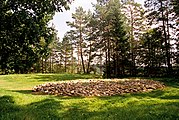 A kurgan in the area of Suwałki
 -
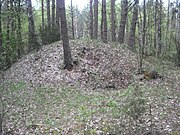 A kurgan in the area of Jatwieź Duża


History[edit]
 | This article needs additional citations for verification. (October 2010) |
Ancient history[edit]
According to The Histories of Herodotus (5th century B.C.), the Neuri (Νευροί) were a tribe living beyond the Scythian cultivators, one of the nations along the course of the river Hypanis (Bug river), west of the Borysthenes (Dniepr river).[citation needed] This was roughly the area of modern Belarus and Eastern Poland by the Narew river, coinciding with the Yotvingian linguistic territory of toponyms and hydronyms (Narew river)[11] and the Scythian[12] tribe of the Aroteres to the south-east.[11][13]
Ptolemy in the 2nd century AD called the people Galindai kai Soudinoi (Σουδινοί). Peter of Dusburg called them Galindite and Suduwite.[citation needed] In the Hypatian Codex the spellings are changing: Jatviagy, Jatviezie, Jatviažin, zemlia Jatveskaja, na zemliu Jatviažs´kuju and more. Polish sources also used Russian spellings: Jazviagi, Iazvizite, Jazvizite, Yazvizite.[citation needed] This name was taken by the papal administration: terra Jatwesouie, Gretuesia, Gzestuesie, Getuesia und Getvesia.[citation needed] The Knights called this tribe Sudowite, Sudowia, in qua Sudowit.[11] and the Scythian[12] tribe of the Aroteres to the south-east.[11][13]
10th century[edit]
In 944, during the treaty between the Kievan Rus' prince Igor and the emperor of the Byzantine Empire, the Yotvingians were hired by the Kievan ruler to serve as mercenaries.[citation needed] Also Vladimir I of Kiev, in 983, hired the Yotvingians to add to his army.[citation needed]
13th century[edit]


In two dotations (1253 and 1259) of Mindaugas, a new name was recorded: Dainava, Deynowe, Dainowe, Denowe (land of songs). The forests were named Deinova Jatvež.[citation needed] In the treaty with the Teutonic Knights in 1260, the region is called "terre Getuizintarum".[citation needed][clarification needed] Skalmantas, leader of the Yotvingians was responsible for single-handedly raiding Pinsk in the Principality of Turov.
14th century[edit]
In the sentence of Breslau of the emperor Sigismund of Luxembourg to the Livonian Order from 1325, this area is called Suderlandt alias Jetuen.[citation needed]
15th century[edit]
Vytautas the Great wrote about "terra Sudorum", in a letter to King Sigismund of March 11, 1420.
A census by the clergy of the Belarus Grodno area in 1860 had as many as 30,929 inhabitants identifying as Yatviags.[14]
Modern history[edit]
Though very small there is an active movement to revive the Yotvingian culture. Or "Sudovian" as the people who participate in it call themselves. They are actively trying to revive the language and its culture. This movement got its start earlier. But this is the most modern form of the Neo-Sudovian movement. They are active in Poland and Lithuania. They communicate with each other through the internet and have even held some gatherings. This movement has a long way ahead of it but its people are optimistic.[citation needed]
Historical persons[edit]
- Komantas of Sudovia led the Yotvingians in the Prussian uprisings.[15]

See also[edit]
Literature[edit]
- Totoraitis, Jonas (2003) [1938]. Sūduvos Suvalkijos istorija (in Lithuanian). Marijampolė: Piko valanda. ISBN 978-9986-875-87-1.
- Witczak, K. T., Traces of Dual Forms in Old Prussian and Jatvingian in Woljciech Smoczynski and Axel Holvoet, eds, Colloquium Pruthenicum primum, 1992, pp 93–98
- Gerullis, G., Zur Sprache der Sudauer-Jadwinger, in Festschrift A. Bezzenberger, Göttingen 1927
- Toporov,V., ИНДОЕВРОПЕЙСКЕ ЯЗЫКИ [Indo-European languages] Лингвистический энциклопеический словарь.[Linguistic encyclopedic dictionary] Moskva, 1990, pp 186–189
- Mažiulis, V., Baltic languages. Britannica Online Encyclopedia
- Henning, E., De rebus Jazygum sive Jazuin-gorum, Regiomonti, 1812
- Sjoegren, A., Ueber die Wohnsitz Verhaeltnisse und der Jatwaeger, St. Petersburg, 1859
- Sembrzycki, J., Die Nord-und Westgebiete the Jadwinger und deren Grenzen, Altpreussischeme Monatschrift, XXVIII, 1891, pp. 76–89
- W. R. Schmalstieg, Studies in Old Prussian, University Park and London, 1976.
- V. Toporov, Prusskij jazyk: Slovar', A - L, Moskva, 1975–1990.
- V. Mažiulis, Prūsų kalbos etimologijos žodynas, Vilnius, t. I-IV, 1988–1997.
- Archäologie der UDSSR: Die Finno-Ugrier und die Balten im Mittelalter, Teil II, Balten, S. 411–419, Moskau 1987
- Lepa, Gerhard (Hrsg): Die Sudauer, in Tolkemita-Texte Nr. 55, Dieburg 1998
- Lepa, Gerhard: Gedanken über die Prußen und ihre Lieder, in Tolkemita-Texte "25 Lieder der Sudauer" Nr. 56, Dieburg 1999
- Litauische Enzyklopädie, Bd. XXVX, Boston, USA, 1963
- Salemke, Gerhard: Lagepläne der Wallburganlagen von der ehemaligen Provinz Ostpreußen, Gütersloh, 2005, Karten 19/ 7 - 19/ 13
- Žilevičius, Juozas: Grundzüge der kleinlitauischen Volksmusik, in Tolkemita-Texte "25 Lieder der Sudauer" Nr. 56, Dieburg 1999
References[edit]
- ^ a b Sužiedėlis 2011, p. 334.
- ^ Zinkevičius, Zigmas; Černelienė, Marytė; Makauskas, Bronius; Maksimavičius, Petras; Birgelis, Sigitas; Paransevičius, Juozas Sigitas; Mikėnaitė, Palmira; Burdinaitė-Ołów, Birutė; Balčiūnaitė, Taida (2009). Terra Jatwezenorum: Jotvingių krašto istorijos paveldo metraštis (PDF) (in Lithuanian). Punsko „Aušros“ leidykla. Retrieved 27 January 2023.
- ^ a b Būtėnas 1957, p. 314.
- ^ Budreckis 1967.
- ^ Mažiulis 1997, pp. 166–167.
- ^ Kibin 2008, p. 117-132.
- ^ Pashka 1994.
- ^ Thomsen, Vilhelm (1882). "121 (Ryska rikets grundläggning genom Skandinaverna)". runeberg.org (in Swedish).
- ^ Zinkevičius 1996, p. 51.
- ^ Witczak, Krzysztof Tomasz (2015). ""The Pagan dialects from Narew" in the light of Yatvingian onomastic remnants" (PDF). Baltic from an Indo-European Perspective: 43–44.
- ^ a b c d Sulimirski 1985, p. 184.
- ^ a b Sulimirski 1985, p. 153.
- ^ a b Sulimirski & Taylor 1991, p. 585.
- ^ Sabaliauskas 1995, p. 80.
- ^ Kapočius 1970–1978, p. 210.
Sources[edit]
- Būtėnas, Petras (December 1957). "Sudūviai - Jotvingiai - Dainuviai" (PDF). Karys (in Lithuanian). 10 (1337): 314–316.
- Budreckis, Algirdas (1967). "Etnografinės Lietuvos rytinės ir pietinės sienos". Karys (in Lithuanian).
- Gimbutas, Marija (1963). The Balts. Ancient peoples and places. Vol. 33. London: Thames and Hudson. pp. 97–102.
- Mažiulis, Vytautas (1993). Prūsų kalbos etimologijos žodynas [Etymological Dictionary of the Prussian Language] (in Lithuanian). Vol. II. Vilnius: Mokslas. pp. 7–12. ISBN 978-5-420-00791-4.
- Mažiulis, Vytautas (1997). Prūsų kalbos etimologijos žodynas [Etymological Dictionary of the Prussian Language] (in Lithuanian). Vol. IV. Vilnius. pp. 166–167. ISBN 978-5-420-01406-6.
{{cite book}}: CS1 maint: location missing publisher (link) - Sabaliauskas, Algirdas (1995). Mes Baltai [We, the Balts] (in Lithuanian). Vilnius, Lithuania: Science and Encyclopedia Publishers. p. 80.
- Antoniewicz, Jerzy (1958). "The mysterious Sudovian people". Archaeology. II (3): 158–161.
- Antoniewicz, Jerzy (1962). The Sudovians. Białystok.
{{cite book}}: CS1 maint: location missing publisher (link) - DUSBURG (PETRI DE DUSBURG), Chronicon Prussiae, ed. Chr. Hartknock, Jena, 1879
- Kibin, A.S. (2008). "Ятвяги в X-XI вв.: "балтское племя" или "береговое братство"?" [Yatvingians in the 10th-11th centuries: "Baltic tribe" or "coastal brotherhood"?]. Studia Slavica et Balcanica Petropolitana (in Russian). 2 (4): 117–132.
- Pashka, Joseph (1994). "Virdainas".
- Kapočius, Juozas (1970–1978). "Skomantas". In Sužiedėlis, Simas (ed.). Encyclopedia Lituanica. Boston, Massachusetts. LCCN 74-114275.
{{cite encyclopedia}}: CS1 maint: location missing publisher (link) - Sužiedėlis, Saulius A. (2011). Historical Dictionary of Lithuania. Scarecrow Press. ISBN 9780810875364.
- Zinkevičius, Zigmas (1996). The History of the Lithuanian Language. Mokslo ir enciklopedijų leidykla. ISBN 9785420013632.
- Sulimirski, T. (1985). "The Scyths". In Gershevitch, I. (ed.). The Median and Achaemenian Periods. The Cambridge History of Iran. Vol. 2. Cambridge, United Kingdom: Cambridge University Press. pp. 149–199. ISBN 978-1-139-05493-5.
- Sulimirski, Tadeusz; Taylor, T. F. (1991). "The Scythians". In Boardman, John; Edwards, I. E. S.; Hammond, N. G. L.; Sollberger, E.; Walker, C. B. F. (eds.). The Assyrian and Babylonian Empires and other States of the Near East, from the Eighth to the Sixth Centuries B.C. The Cambridge Ancient History. Vol. 3. Cambridge, United Kingdom: Cambridge University Press. pp. 547–590. ISBN 978-1-139-05429-4.