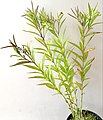
Amsonia tabernaemontana
| Amsonia tabernaemontana | |
|---|---|
| Scientific classification | |
| Kingdom: | Plantae |
| Clade: | Embryophytes |
| Clade: | Tracheophytes |
| Clade: | Spermatophytes |
| Clade: | Angiosperms |
| Clade: | Eudicots |
| Clade: | Asterids |
| Order: | Gentianales |
| Family: | Apocynaceae |
| Genus: | Amsonia |
| Species: | A. tabernaemontana
|
| Binomial name | |
| Amsonia tabernaemontana | |
Amsonia tabernaemontana, the eastern bluestar, is a North American species of flowering plant in the family Apocynaceae, found in central and eastern North America.[1]
It is valued as an ornamental perennial for its pale blue spring flowers, yellow fall foliage, and adaptability to dry, low-input landscapes.[2]
Description
[edit]Amsonia tabernaemontana is a clump-forming herbaceous perennial with upright stems and narrow, willow-like leaves.[2] It produces clusters of star-shaped, pale blue flowers in spring and develops elongated paired follicles that contain cylindrical seeds.[2]
Seeds are typically about 9.9 mm long and 2.5 mm in diameter, with embryos arranged longitudinally within the seed.[2]
Distribution and habitat
[edit]The species is native to the eastern United States, with a range extending from southern New York to northern Florida and west to eastern Texas.[2] It commonly occurs in open woodlands, floodplains, and along stream banks.[2]
Cultivation
[edit]Eastern bluestar is widely cultivated as an ornamental plant due to its drought tolerance, low pest and disease incidence, and seasonal ornamental interest.[2]
Historically, many plants sold in the nursery trade were collected from wild populations due to difficulties in seed propagation.[2] Increasing demand and conservation concerns have led to efforts to improve propagation techniques using seed.[2]
Propagation and germination
[edit]Propagation is typically by seed; however, germination has historically been slow, uneven, and low in percentage under standard conditions. A 2013 study demonstrated that seeds exhibit primarily physical dormancy imposed by the seed coat rather than a limitation in water uptake. The most effective method involved removing approximately 1–2 mm of the seed coat at one end to expose the embryo without causing damage. Scarified seeds imbibed water at similar rates to unscarified seeds, indicating that the seed coat is permeable and that dormancy is mechanical rather than physical. The study concluded that overcoming the mechanical barrier of the seed coat is essential for successful propagation and can significantly improve germination speed, uniformity, and commercial production efficiency.[2]
Gallery
[edit]-
Detail of inflorescence
-
Container plant in fruit, showing paired follicles
-
Paired follicles at the tip of fruiting stem
-
Unripe, V-shaped pair of follicles detached from plant
-

Ripe paired follicles with seeds removed and juxtaposed
-
Cylindrical/prismatic seeds (x10 approx) showing deeply fissured testae
References
[edit]- ^ "PLANTS Profile Amsonia tabernaemontana". USDA Natural Resources Conservation Service. Retrieved July 13, 2019.
- ^ a b c d e f g h i j Martin, Michael T.; Chappell, Matthew R.; Opie, Lindsay R. (2013). "Scarification and Germination of Amsonia tabernaemontana (Walt.) Seeds" (PDF). Journal of Environmental Horticulture. 31 (1): 54–58.