


Monodactylus argenteus
| Monodactylus argenteus | |
|---|---|

| |
| Monodactylus argenteus, commonly known as the silver moony, Mono angel | |
Scientific classification 
| |
| Domain: | Eukaryota |
| Kingdom: | Animalia |
| Phylum: | Chordata |
| Class: | Actinopterygii |
| Order: | Perciformes |
| Family: | Monodactylidae |
| Genus: | Monodactylus |
| Species: | M. argenteus
|
| Binomial name | |
| Monodactylus argenteus | |
| Synonyms | |
| |
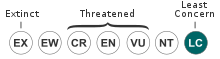
Monodactylus argenteus is a species of fish in the family Monodactylidae, the moonyfishes. Its common names include silver moonyfish, or natal moony,[2] butter bream, and diamondfish.[3] It is native to the western Pacific and Indian Oceans, including the Persian Gulf, Red Sea, and associated estuaries, such as the Mekong Delta.[2]
This species reaches a maximum length of about 27 centimeters. It is bright shiny silver with yellowish edges to the fins.[2] The dorsal and anal fins have black tips.[3] Juveniles have more yellow coloration[2] and are distinguished by two vertical black bands.[4]

This species occurs in a wide variety of habitat types, including the open ocean, brackish waters, and the freshwater habitat of rivers.[2] In Australia it can be found in harbors and estuaries around piers.[3] Its ability to survive in a wide range of salinities makes it a model organism in the study of salinity tolerance.[4][5] Juveniles are especially tolerant to salinity changes, easily maintaining homeostasis in variable environments such as estuaries.[4]
Although the silver moony displays territorial behavior,[2] the species can be kept in saltwater aquaria and is easy to rear in captivity.[5] It can remain solitary or form schools. It is a detritivore and planktivore.
The myxozoan parasite Kudoa monodactyli was first described from and named after this fish.[6]
References
[edit]- ^ Azeroual, A.; Kaymaram, F.; Abdulqader, E.; Alnazry, H.; Al-Husaini, M.; Almukhtar, M.; Hartmann, S.; Alam, S.; Sparks, J.S. (2017). "Monodactylus argenteus". IUCN Red List of Threatened Species. 2017: e.T166925A46644370. doi:10.2305/IUCN.UK.2017-3.RLTS.T166925A46644370.en. Retrieved 20 November 2021.
- ^ a b c d e f Froese, R. and D. Pauly, Editors. Monodactylus argenteus. FishBase. 2017.
- ^ a b c Monodactylus argenteus. Fishes of Australia.
- ^ a b c Kang, C., et al. (2012). Effects of low environmental salinity on the cellular profiles and expression of Na, K-ATPase and Na, K, 2Cl 2 cotransporter 1 of branchial mitochondrion-rich cells in the juvenile marine fish Monodactylus argenteus. Fish Physiol Biochem 38 665-678.
- ^ a b Yang, S., et al. (2015) Comparisons of two types of teleostean pseudobranchs, silver moony (Monodactylus argenteus) and tilapia (Oreochromis mossambicus), with salinity‑dependent morphology and ion transporter expression. J Comp Physiol B185 677-693.
- ^ Gunter, N. L., et al. (2006). Characterization of Kudoa monodactyli n. sp.(Myxosporea: Multivalvulida) from the muscle of Monodactylus argenteus (Teleostei: Monodactylidae) from Moreton Bay, Queensland, Australia. The Journal of Eukaryotic Microbiology 53(5), 374.
External links
[edit]
- Photos of Monodactylus argenteus on Sealife Collection