


User:Deglr6328
Hi! Leave me a message!
I mostly enjoy spending time adding information to and editing scientific articles, such as:
- Galileo spacecraft
- Cassini-Huygens
- Scintillation and Scintillation counter
- Laser and List of laser types
- Inertial confinement fusion
- certain things nuclear fission and nuclear fusion related
- X-ray, Ultraviolet, Gamma rays etc.
- Sonoluminescence/Bioluminescence
- Superconductor
- many others! :)
Also, I like to add (much needed, IMHO) images to articles of a scientific nature. eg. [1]
I am strongly scientifically skeptical and as such I have little patience for pseudoscience or mysticism being inserted into legitimate rational articles on Wikipedia. It seems that this is a common occurrence on Wiki and I do my best to keep NPOV in articles where this is an issue. Though sometimes it is rather difficult!! :o)
Check out my images of light source spectra, they're oh so exciting!
[edit]-
 Deuterium lamp
 -
 polycarbonate NIR transmission
 -
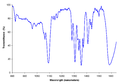 Dichloromethane NIR transmission
 -
 Ethanol NIR transmission
 -
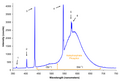 Old halophosphate fluorescent light
 -
 Blue flame
 -
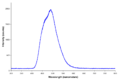 Electroluminescent panel
 -
 White LED
 -
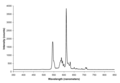 Yellow fluorescent light
 -
 HeNe laser
 -
 CRT phosphors
 -
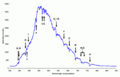 Blue sky
 -
 RGB LEDs
 -
 Rare earth phosphor fluorescent light
 -
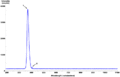 Blacklight fluorescent light
 -
 Chemoluminescent lightstick related spectra


.png)


![[1]](https://en.wikipedia.org/wiki/Image:Plutonium_button.jpg)
,_Parque_natural_de_la_Arr%C3%A1bida,_Portugal,_2020-07-23,_DD_43.jpg)
Bispira volutacornis, sometimes known as the twin fan worm or spiral fan worm, is a type of tube worm found in the shallow sublittoral zone of the eastern Atlantic Ocean. It grows in crevices and in stony areas and prefers areas rich in sediment but with low levels of illumination. It has a parchment-like tube with a mucoid outer layer that is often coated with mud or silt. The tube is usually concealed in a crevice and the worm can retract into the tube when disturbed. It feeds on plankton which it captures with its plumes. It also uses the plumes to gather sediment with which to expand the tube. This B. volutavornis worm was photographed in Arrábida Natural Park, Portugal.Photograph credit: Diego Delso
 |
Your Featured picture candidate has been promoted Your nomination for featured picture status, Image:Tumbler Snapper rope tricks.jpg, gained a consensus of support, and has been promoted. If you would like to nominate another image, please do so at Wikipedia:Featured picture candidates.
|