2008 TC3
 | |
| Discovery | |
|---|---|
| Discovered by | Catalina Sky Survey |
| Discovery date | October 6, 2008, 06:39 UTC |
| Designations | |
| 2008 TC3 | |
| Orbital characteristics[1] | |
| Epoch October 7, 2008 (JD 2454746.5) | |
| Uncertainty parameter 4 | |
| Observation arc | 1 day (575 observations) |
| Aphelion | 1.71644 AU (256.776 Gm) |
| Perihelion | 0.899957 AU (134.6317 Gm) |
| 1.308201 AU (195.7041 Gm) | |
| Eccentricity | 0.312065 |
| 1.50 yr (546.53 d) | |
| 330.7541° | |
| 0.6587071°/day | |
| Inclination | 2.54220° |
| 194.101138° | |
| 2008-Nov-20 | |
| 234.44897° | |
| Jupiter MOID | 3.57975 AU (535.523 Gm) |
| Physical characteristics | |
| Dimensions | 4.1 meters |
| Mass | 80 tonnes (80,000 kg) |
Mean density | ~1.5 g/cm3 |
| 0.0269409 h (1.61645 min)[1] | |
| 0.1±0.03 | |
| F/M | |
| 30.4[1] | |
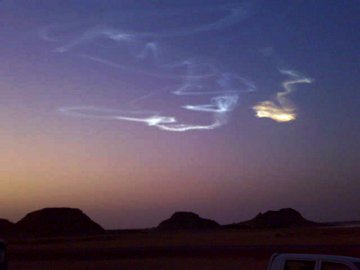
2008 TC3 (Catalina Sky Survey temporary designation 8TA9D69) was an 80-tonne (80-long-ton; 90-short-ton), 4.1-meter (13 ft) diameter asteroid[2] that entered Earth's atmosphere on October 7, 2008.[3] It exploded at an estimated 37 kilometers (23 mi) above the Nubian Desert in Sudan. Some 600 meteorites, weighing a total of 10.5 kilograms (23.1 lb), were recovered; many of these belonged to a rare type known as ureilites, which contain, among other minerals, nanodiamonds.[2][4][5]
It was the first time that an asteroid impact had been predicted before its entry into the atmosphere as a meteor.[6]
Discovery[edit]
.gif)
The asteroid was discovered by Richard A. Kowalski at the Catalina Sky Survey (CSS) 1.5-meter telescope at Mount Lemmon, north of Tucson, Arizona, US, on October 6, 06:39 UTC, 19 hours before the impact.[7][8][9]
It was notable as the first such body to be observed and tracked prior to reaching Earth.[6] The process of detecting and tracking a near-Earth object, an effort sometimes referred to as Spaceguard, was put to the test. In total, 586 astrometric and almost as many photometric observations were performed by 27 amateur and professional observers in less than 19 hours and reported to the Minor Planet Center, which in eleven hours issued 25 Minor Planet Electronic Circulars with new orbit solutions as observations poured in. On October 7, 01:49 UTC,[9] the asteroid entered the shadow of the Earth, which made further observations impossible.
Impact predictions were performed by University of Pisa's CLOMON 2 semi-automatic monitoring system[10][11] as well as Jet Propulsion Laboratory's Sentry system. Spectral observations that were performed by astronomers at the 4.2-meter William Herschel Telescope at La Palma, Canary Islands are consistent with either a C-type or M-type asteroid.
Entry[edit]


2008 TC3 · Sun · Earth
The meteor entered Earth's atmosphere above northern Sudan at 02:46 UTC (05:46 local time) on October 7, 2008, with a velocity of 12.8 kilometers per second (29,000 mph) at an azimuth of 281 degrees and an altitude angle of 19 degrees to the local horizon. It exploded tens of kilometers above the ground with the energy of 0.9 to 2.1 kilotons of TNT over a remote area of the Nubian Desert, causing a large fireball or bolide.[12]
The Times reported that the meteor's "light was so intense that it lit up the sky like a full moon, and an airliner 1,400 km (870 mi) away reported seeing the bright flash."[13] A webcam captured the flash lighting up El-Gouna beach 725 kilometres north of the explosion (see this webcam frame).[14] A low-resolution image of the explosion was captured by the weather satellite Meteosat 8.[15] The Meteosat images place the fireball at 21°00′N 32°09′E / 21.00°N 32.15°E.[16] Infrasound detector arrays in Kenya also detected a sound wave from the direction of the expected impact corresponding to energy of 1.1 to 2.1 kilotons of TNT.[17] Asteroids of this size hit Earth about two or three times a year.[18]
The trajectory showed intersection with Earth's surface at roughly 20°18′N 33°30′E / 20.3°N 33.5°E[19] though the object was expected to break up perhaps 100–200 kilometers (60–120 mi) west as it descended, somewhat east of the Nile River, and about 100 kilometers (60 mi) south of the Egypt–Sudan border.
According to U.S. government sources[20][21] U.S. satellites detected the impact at 02:45:40 UT, with the initial detection at 20°54′N 31°24′E / 20.9°N 31.4°E at 65.4 kilometers (40.6 mi; 35.3 nmi) altitude and final explosion at 20°48′N 32°12′E / 20.8°N 32.2°E at 37 kilometers (23 mi; 20 nmi) altitude. These images have not been publicly released.
Recovered fragments[edit]
 | This section needs to be updated. The reason given is: In 2022, Bischoff et al. concluded that the meteorite's classification as a ureilite may not be correct.[1] Their findings and the impact they may have on the 2009 Jenniskens study need to be incorporated. (November 2023) |

A search of the impact zone that began on December 6, 2008, turned up 10.5 kilograms (23 lb) of rock in some 600 fragments. These meteorites are collectively named Almahata Sitta[22] (Arabic: المحطة ستة), which means "Station Six"[23] and is a train station between Wadi Halfa and Khartoum, Sudan. This search was led by Peter Jenniskens from the SETI Institute, California and Muawia Shaddad of the University of Khartoum in Sudan and carried out with the collaboration of students and staff of the University of Khartoum. The initial 15 meteorites were found in the first three days of the search. Numerous witnesses were interviewed, and the hunt was guided with a search grid and specific target area produced by NASA's Jet Propulsion Laboratory in Pasadena, California.[24][25][26][27][28]
Samples of the Almahata Sitta meteorite were sent for analysis to a consortium of researchers led by Jenniskens, the Almahata Sitta consortium, including NASA Ames in California, the Johnson Space Center in Houston, the Carnegie Institution of Washington, and Fordham University in New York City. The first sample measured was an anomalous ultra-fine-grained porous polymict ureilite achondrite, with large carbonaceous grains. Reflectance spectra of the meteorite, combined with the astronomical observations, identified 2008 TC3 as an F-type asteroid. Fragile anomalous dark carbon-rich ureilites like in the Almahata Sitta meteorite are now firmly linked to the group of F-class asteroids.[2][clarification needed] Amino acids have been found on the meteorite.[29] The nanodiamonds found in the meteorite were shown to have grown slowly, implying that the source is another planet in the solar system.[30] More recently, in December 2020, further studies on the fragments have been reported. These studies revealed an extremely rare form of hydrated crystals, in a fragment called AhS 202, known as amphibole, suggesting to the researchers that 2008 TC3 early on likely belonged to a very large Ceres-class dwarf planet.[31]
Richard Kowalski, who discovered the object, received a tiny fragment of Almahatta Sitta, a gift from friends and well-wishers on the Minor Planet Mailing List, which Kowalski founded in order to help connect professional and amateur astronomers.[32]
Gallery[edit]
-
 Meteosat 8/EUMETSAT visual image of first light flare from 2008 TC3 with lat/long reference
 -
 Meteosat 8/EUMETSAT IR image of main fireball from 2008 TC3
 -
 Meteosat images combined, showing offset from first light flare to main IR flare


See also[edit]
References[edit]
- ^ a b c "JPL Small-Body Database Browser: (2008 TC3)" (last observation: October 7, 2008; arc: 1 day). Jet Propulsion Laboratory. Retrieved March 28, 2016.
- ^ a b c Jenniskens, P.; et al. (2009). "The impact and recovery of asteroid 2008 TC3". Nature. 458 (7237): 485–488. Bibcode:2009Natur.458..485J. doi:10.1038/nature07920. PMID 19325630. S2CID 7976525.
- ^ Plait, P. (October 6, 2008). "Incoming!!!". Bad Astronomy. Archived from the original on October 7, 2008. Retrieved October 8, 2008.
- ^ Chang, K. (March 25, 2009). "Recovered Pieces of Asteroid Hold Clues to Early History". The New York Times. Archived from the original on November 13, 2013. Retrieved March 26, 2009.
- ^ Borenstein, S. (March 26, 2009). "Astronomers catch a shooting star for 1st time". ABC news. The Associated Press. Archived from the original on March 29, 2009. Retrieved September 15, 2009.
- ^ a b Roylance, F. (October 7, 2008). "Predicted meteor may have been sighted". Maryland Weather. Archived from the original on October 10, 2008. Retrieved October 8, 2008.
- ^ Williams, G. V. (October 6, 2008). "MPEC 2008-T50". Minor Planet Center. Archived from the original on October 9, 2008. Retrieved October 8, 2008.
- ^ Huntington, J. (October 7, 2008). "Small Asteroid Enters Earth's Atmosphere". eFluxMedia. Archived from the original on October 10, 2008. Retrieved October 8, 2008.
- ^ a b Chesley, S.; Chodas, P.; Yeomans, D. (November 4, 2008). "Asteroid 2008 TC3 Strikes Earth: Predictions and Observations Agree". Near Earth Object Program. NASA. Archived from the original on June 18, 2009. Retrieved June 18, 2009.
- ^ "NEODys Main Risk Page". Retrieved October 8, 2008.
- ^ "NEODys 2008 TC3 page". Retrieved October 8, 2008.
- ^ "Astronomers predict shooting star over Sudan from space boulder". Agence France-Presse. October 6, 2008. Archived from the original on October 11, 2008. Retrieved October 8, 2008.
- ^ Simon, P. (October 8, 2008). "Weather Eye: NASA spots asteroid before annihilation". The Times. Retrieved October 8, 2008.
- ^
Javaux, G. "2008 TC3... Première détection d'un astéroïde avant son impact sur Terre... quelques heures plus tard" (in French). Retrieved September 15, 2009.
Une webcam de surveillance, située sur la plage de la Mer Rouge à El Gouna en Egypte, a enregistré indirectement le flash de l'explosion qui s'est produit à environ 725 km plus au sud.
- ^ "Asteroid Impact". SpaceWeather.com. October 8, 2008. Archived from the original on October 10, 2008. Retrieved October 8, 2008.
- ^ "m8 HRV 200810070245". October 8, 2008. Archived from the original on October 17, 2008. Retrieved October 8, 2008.
- ^ "Impact of Asteroid 2008 TC3 Confirmed". Near Earth Object Program. October 7, 2008. Archived from the original on October 10, 2008. Retrieved October 8, 2008.
- ^ Borenstein, S. (October 6, 2008). "Small Asteroid Headed for Light Show Over Africa". ABC News. The Associated Press. Retrieved September 15, 2009. [dead link]
- ^ Mike (October 6, 2008). "Very near NEO Meteoroid impact!". MKVH.de. Archived from the original on October 10, 2008.
- ^ "Asteroid Update". SpaceWeather.com. October 15, 2008. Retrieved October 18, 2008.
- ^ "Fireball detection". University of Western Ontario. October 15, 2008. Retrieved October 18, 2008.
- ^ "Almahata Sitta". Meteoritical Bulletin Database. August 12, 2013. Retrieved August 13, 2013.
- ^ Gebauer, S. (April 16, 2008). "Station Nr. 6. – Nubian Desert". Panoramio. Archived from the original on December 30, 2008. Retrieved June 15, 2009.
- ^ "NASA Team Finds Riches in Meteorite Treasure Hunt". NASA. March 27, 2009. Archived from the original on March 31, 2009. Retrieved April 5, 2009.
- ^ "Found: Pieces of meteorite spotted before impact". New Scientist (2697): 15. February 25, 2009.
- ^ Shiga, D. (February 19, 2009). "First tracked space rock recovered after impact". New Scientist.
- ^ Courtland, R. (March 25, 2009). "Meteorite hunters 'strike gold' in Sudan". New Scientist. Archived from the original on April 29, 2009. Retrieved April 4, 2009.
- ^ Kwok, R. (March 26, 2009). "Astronomy: The Rock That Fell to Earth". Nature. 458 (7237): 401–403. doi:10.1038/458401a. PMID 19325604.
- ^ "Life's Building Blocks Found on Surprising Meteorite". Space.com. December 16, 2010. Retrieved August 13, 2013.
- ^ Nabiei, Farhang; et al. (April 17, 2018). "A large planetary body inferred from diamond inclusions in a ureilite meteorite". Nature Communications. 9 (1). Springer Nature: 1327. Bibcode:2018NatCo...9.1327N. doi:10.1038/s41467-018-03808-6. ISSN 2041-1723. PMC 5904174. PMID 29666368.
- ^ Dockrill, Peter (December 22, 2020). "Meteorite Clues Point to a Huge, Unknown Object in The Early Solar System". SpaceAlert.com. Retrieved December 22, 2020.
- ^ Lakdawalla, E. (September 20, 2009). "A piece of an asteroid returns to the telescope that discovered it". The Planetary Society. Archived from the original on March 4, 2012. Retrieved October 7, 2009.
Further reading[edit]
- Atkinson, N. (October 13, 2008). "Where Are the Images from Asteroid 2008 TC3?". Universe Today. Archived from the original on February 15, 2009. Retrieved June 8, 2009.
- "80-ton asteroid's impact recorded". BBC News. March 25, 2009. Retrieved August 13, 2013.
- Dockweiler, T. (March 12, 2009). "Earth's First Pre-Known Asteroid Impact: The Sudan Event of October 7, 2008" (PDF). Science Newsletter. 4 (3). Triton Fun Company: 1–2. Archived from the original (PDF) on February 22, 2012. Retrieved August 13, 2013.
- Gayon-Markt, J.; Delbo, M.; Morbidelli, A.; Marchi, S. (April 30, 2012). "On the origin of the Almahata-Sitta meteorite and 2008 TC3 asteroid". Monthly Notices of the Royal Astronomical Society. 424 (1): 508–518. arXiv:1206.3042. Bibcode:2012MNRAS.424..508G. doi:10.1111/j.1365-2966.2012.21220.x. S2CID 119242802.
- Lakdawalla, E. (October 7, 2008). "The full story of Earth-impacting asteroid 2008 TC3". The Planetary Society. Retrieved August 13, 2013.
- Yeomans, D. (October 7, 2008). "Small Asteroid Predicted to Cause Brilliant Fireball over Northern Sudan". Near Earth Object Program. Archived from the original on April 6, 2013. Retrieved August 13, 2013.
External links[edit]

| External images | |
|---|---|
 An image of 2008 TC3 An image of 2008 TC3 | |
| Animation of 2008 TC3 | |
| Smoky trail (spaceweather.com November 8, 2008) |
- Remanzacco Observatory photographs of the incoming space rock
- Telescopio Nazionale Galileo photograph of 2008 TC3
- Announcement with animation
- "webcam record of flash effect from Red Sea beach at El Gouna, Egypt, 725 km away" (GIF). Archived from the original on March 14, 2011. Retrieved June 8, 2009.
- NASA Astronomy Picture of the Day: Almahata Sitta 15 (March 28, 2009)
- 2008 TC3 orbit and observations at IAU Minor Planet Center
- 2008 TC3 at NeoDyS-2, Near Earth Objects—Dynamic Site
- 2008 TC3 at ESA–space situational awareness
- 2008 TC3 at the JPL Small-Body Database