


Agave americana
| Agave americana | |
|---|---|

| |
| The flower stalk may reach up to 8 m (26 ft) in height | |
Scientific classification 
| |
| Kingdom: | Plantae |
| Clade: | Tracheophytes |
| Clade: | Angiosperms |
| Clade: | Monocots |
| Order: | Asparagales |
| Family: | Asparagaceae |
| Subfamily: | Agavoideae |
| Genus: | Agave |
| Species: | A. americana
|
| Binomial name | |
| Agave americana | |
| Synonyms[3][4] | |
|
Synonyms list
| |
Agave americana, commonly known as the century plant,[5] maguey, or American aloe,[6] is a flowering plant species belonging to the family Asparagaceae. It is native to Mexico and the United States, specifically Texas. This plant is widely cultivated worldwide for its ornamental value and has become naturalized in various regions, including Southern California, the West Indies, South America, the Mediterranean Basin, Africa, the Canary Islands, India, China, Thailand, and Australia.[7]
Despite being called "American aloe" in common parlance, Agave americana is not a member of the same family as Aloe, although it falls under the same order, Asparagales.
Description[edit]
The common name "century plant" stems from its semelparous nature of flowering only once at the end of its long life. After flowering, the plant dies but produces adventitious shoots from the base, allowing its growth to continue.[8] Although it is called the century plant, it typically lives only 10 to 30 years. It has a spread around 1.8–3.0 m (6–10 ft) with gray-green leaves measuring 0.9–1.5 m (3–5 ft) in length, each with a prickly margin and a heavy spike at the tip that can pierce deeply. Towards the end of its life, the plant produces a tall, branched stalk adorned with yellow blossoms, which can reach a height of 8–9 m (25–30 ft).[citation needed]
-
 On the Mediterranean island of Crete, Greece
 -
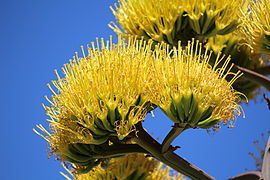 Blossoms
 -
 'Marginata', a variegated cultivar
 -
 Cultivar 'Medio-Picta'


Taxonomy and naming[edit]
Taxonomically, A. americana was described by Carl Linnaeus in the 1753 edition of Species Plantarum, and its binomial name is still in use today.[2]
Cultivation[edit]
A. americana is cultivated as an ornamental plant, particularly valued for its large, dramatic mature form. It is often found in modernist, xeriscapes (drought-tolerant), and desert-style cactus gardens. It is popularly used in hot climates and areas prone to drought.[9] The plant's presence can evoke the ambiance of 18th- to 19th-century Spanish colonial and Mexican provincial areas in the Southwestern United States, California, and xeric regions of Mexico. In dry beach gardens in Florida and coastal areas of the Southeastern United States, it is a favored choice for landscaping.[citation needed]
When grown as a houseplant, A. americana is tolerant of light levels ranging from direct sunlight to shade and requires minimal watering. It undergoes a winter resting period at temperatures around 10 to 12 °C (50 to 54 °F). It thrives in a highly porous, sandy potting soil, should be allowed to dry out between waterings, and should be repotted annually in the spring.[10]
Subspecies and varieties[edit]
The World Checklist of Selected Plant Families recognizes two subspecies and two varieties of A. americana. Additionally, there are several cultivars, including 'Marginata,' 'Mediopicta,' 'Mediopicta Alba,' 'Mediopicta Aurea,' 'Striata,' and 'Variegata.' Some of these cultivars, along with the parent species, have received the Royal Horticultural Society's Award of Garden Merit.
Two subspecies and two varieties of A. americana are:[11]
- A. americana subsp. americana
- A. americana subsp. protamericana Gentry
- A. americana var. expansa (Jacobi) Gentry
- A. americana var. oaxacensis Gentry
- A. americana var. marginata Trel. in L.H.Bailey, Stand. Cycl. Hort. 1: 235 (1914).
- A. americana var. picta (Salm-Dyck) A.Terracc., Prim. Contr. Monogr. Agave (1885).
- 'Marginata' agm[14] with yellow stripes along the margins of each leaf
- 'Mediopicta' agm[15] with a broad cream central stripe
- 'Mediopicta Alba' agm[16] with a central white band
- 'Mediopicta Aurea' with a central yellow band
- 'Striata' with multiple yellow to white stripes along the leaves
- 'Variegata' agm[17] with white edges on the leaves.
(those marked agm, as well as the parent species,[18] have gained the Royal Horticultural Society's Award of Garden Merit).
Uses[edit]

Cuisine[edit]
Agave americana has various uses starting in pre-Columbian Mexico. If the flower stem is cut before flowering, a sweet liquid known as aguamiel (“lit. 'honey water') can be collected from the plant's hollowed heart. This liquid can be fermented to produce the alcoholic drink called pulque or octli used in pre-Columbian Mexico.[19]
In the tequila-producing regions of Mexico, agaves are known as mezcales. Mezcal refers to the high-alcohol product obtained through fermented agave distillation, and A. americana is among the several Agave species used for this purpose. The specific mezcal known as tequila is produced from Agave tequilana, commonly referred to as "blue agave." Mezcal comes in various types, some of which may be flavored with the intensely pungent mezcal worm.[20]
It is important to note that mezcal and tequila, despite being produced from agave plants, differ from pulque in their sugar extraction techniques and classification as distilled spirits. In mezcal and tequila production, the sugars are obtained by heating the piñas (or hearts) of the plants in ovens, as opposed to collecting aguamiel from the cut stalk of the plant. Therefore, if pulque were to be distilled, it would not be classified as mezcal but rather as a distinct beverage.[21]
Agaves are also found throughout Latin America and are used in similar ways. In Ecuador, the equivalent of pulque is known as guarango, which has recently been distilled as miske.
Agave nectar is marketed as a natural sweeteners with a low glycemic index, primarily due to its high fructose content.[22]
Fibers[edit]
The leaves of A. americana yield fibers called pita, which are suitable for making ropes, nets, bags, sacks, matting, and coarse cloth. They are also used for leather embroidery in a technique known as piteado.[23] Both pulque and maguey fiber played significant roles in the pre-Columbian economy of Mexico.[19]
Medicine[edit]
Agave americana contains agavose, a sugar that is isomeric (similar) to sucrose (C12H22O11 )[24] but with reduced sweetening power, as well as agavasaponins and agavosides.[25] It is used in traditional medicine to treat various ailments,[26] and as a laxative, diuretic, and diaphoretic.[27] However, a comprehensive review of research literature using systematic methods (scientific review) did not find sufficient data to support its effectiveness or safety.[28] It is important to note that A. americana can cause severe allergic dermatitis.[29]
Heraldry[edit]
The plant holds heraldic significance and is featured in the coat of arms of Don Diego de Mendoza, a Native American governor of the village of Ajacuba, Hidalgo.[30]
Art[edit]
Additionally, the Aztecs used the pulped leaves of A. americana to create paper.[19] The fragments known as the Humboldt fragments were made using this technique.[31]
See also[edit]
References[edit]
- ^ García-Mendoza, A.J.; Sandoval-Gutiérrez, D.; Hernández Sandoval, L.; Zamudio, S. (2019). "Agave americana". IUCN Red List of Threatened Species. 2019: e.T13507070A13507074. doi:10.2305/IUCN.UK.2019-3.RLTS.T13507070A13507074.en. Retrieved 19 November 2021.
- ^ a b "Agave americana". Germplasm Resources Information Network. Agricultural Research Service, United States Department of Agriculture. Retrieved 2010-01-12.
- ^ "Tropicos - Name - Agave americana L." www.tropicos.org. Retrieved 4 July 2017.
- ^ "Agave americana L. — The Plant List". www.theplantlist.org. Retrieved 4 July 2017.
- ^ BSBI List 2007 (xls). Botanical Society of Britain and Ireland. Archived from the original (xls) on 2015-06-26. Retrieved 2014-10-17.
- ^ Bailey, L.H.; Bailey, E.Z.; the staff of the Liberty Hyde Bailey Hortorium. 1976. Hortus third: A concise dictionary of plants cultivated in the United States and Canada. Macmillan, New York.
- ^ Irish, Gary (2000). Agaves, Yuccas, and Related Plants: A Gardener's Guide. Timber Press. pp. 94–97. ISBN 978-0-88192-442-8.
- ^ RHS A-Z encyclopedia of garden plants. United Kingdom: Dorling Kindersley. 2008. p. 1136. ISBN 978-1405332965.
- ^ "Agave americana (American century plant)". Native Plant Database. Retrieved 2013-06-11.
- ^ Chiusoli, Alessandro; Boriani, Luisa Maria (1986). Simon & Schuster's guide to houseplants. New York: Simon and Schuster. ISBN 0671631314.
- ^ Search for "Agave americana", "World Checklist of Selected Plant Families". Royal Botanic Gardens, Kew. Retrieved 2012-12-12.
- ^ Vermeulen, Nico. 1998. The Complete Encyclopedia of Container Plants, pp. 36-37. Netherlands: Rebo International. ISBN 90-366-1584-4
- ^ Royal Horticultural Society Database : Agave americana Archived December 1, 2011, at the Wayback Machine, retrieved 2011-07-28
- ^ "RHS Plant Selector - Agave americana 'Marginata'". Retrieved 2015-06-17.
- ^ "RHS Plant Selector - Agave americana 'Mediopicta'". Retrieved 23 February 2020.
- ^ "RHS Plant Selector - Agave americana 'Mediopicta Alba'". Retrieved 23 February 2020.
- ^ "RHS Plant Selector - Agave americana 'Variegata'". Retrieved 23 February 2020.
- ^ "RHS Plant Selector - Agave americana". Retrieved 23 February 2020.
- ^ a b c Dr. Aguilar, Moreno (2006). Handbook to Life in the Aztec World. Los Angeles: California State University. pp. 371, 318. ISBN 0-8160-5673-0.
- ^ Hansen, Barbara (June 21, 2011). "Escamoles & Maguey Worms: John Sedlar on the Joy of Eating Bugs". L.A. Weekly.
- ^ Barbezat, Suzanne (2017-08-28). "Tequila, Mezcal and Pulque". TripSavvy. Retrieved 2018-07-25.
- ^ Oudhia, P. (2007). "Agave americana L." Plant Resources of Tropical Africa. Archived from the original on 2017-12-26. Retrieved 2017-07-04.
- ^ Hulle, Ashish; Kadole, Pradyumkumar; Katkar, Pooja (March 2015). "Agave Americana Leaf Fibers". Fibers. 3 (1): 64–75. doi:10.3390/fib3010064. ISSN 2079-6439.
- ^ "Agavose". Merriam-Webster Dictionary.
- ^ "List of All Chemicals - Agave americana (Agavaceae)" (PDF).
- ^ Thomas H. Frederiksen (1997–2005). Aztec Medicine - Aztec Student Research Guide.
- ^ "Agave americana". Arizona State University.
- ^ "Agave (Agave americana): an evidence-based systematic review by the Natural Standard Research Collaboration". 2006. doi:10.1080/J157v06n02_09.
- ^ de la Cueva, P.; González-Carrascosa, M.; Campos, M.; Leis, V.; Suárez, R.; Lázaro, P. (2005). "Contact dermatitis from Agave americana". Actas Dermo-Sifiliograficas. 96 (8): 534–536. doi:10.1016/s0001-7310(05)73128-8. PMID 16476291.
- ^ pacbell.net/nelsnfam/mexico Archived July 6, 2008, at the Wayback Machine
- ^ Mason, William A. (1920). A History of the Art of Writing. The Macmillan co. p. 114.
Further reading[edit]
- Brandes, Stanley. "Maguey". Encyclopedia of Mexico. Chicago: Fitzroy Dearborn 1997, pp. 767–769.
- Gonçalves de Lima, Oswaldo. El maguey y el pulque en los códices mexicanos. Mexico City: Fondo de Cultura Económica 1956.
- Payno, Manuel. Memoria sobre el maguey mexicano y sus diversos productos. Mexico City: Boix 1864.
External links[edit]

- Lady Bird Johnson Wildflower Center Native Plant Information Network (NPIN) — Agave americana
- Agave americana — UC Photos gallery
- Espelie, Karl E.; Wattendorff, Joachim; Kolattukudy, P. E. (1982). "Composition and ultrastructure of the suberized cell wall of isolated crystal idioblasts from Agave americana L. leaves". Planta. 155 (2): 166–75. Bibcode:1982Plant.155..166E. doi:10.1007/BF00392548. PMID 24271671. S2CID 2514355.
- IUCN Red List least concern species
- Agave
- Flora of Northeastern Mexico
- Flora of Northwestern Mexico
- Flora of Central Mexico
- Flora of the Chihuahuan Desert
- Flora of Arizona
- Flora of Texas
- Flora of Sonora
- Flora of Coahuila
- Flora of Tamaulipas
- Flora of Nuevo León
- Flora of San Luis Potosí
- Flora of Oaxaca
- Flora of Jalisco
- Flora of Querétaro
- Flora of Veracruz
- Plants described in 1753
- Taxa named by Carl Linnaeus
- Crops originating from Mexico
- Fiber plants
- Plants used in traditional Native American medicine
- Garden plants of North America
- Drought-tolerant plants