Alpha Phoenicis
  | |
| Observation data Epoch J2000 Equinox J2000 | |
|---|---|
| Constellation | Phoenix |
| Right ascension | 00h 26m 17.06309s[1] |
| Declination | −42° 18′ 21.7712″[1] |
| Apparent magnitude (V) | 2.377[2] |
| Characteristics | |
| Spectral type | K0.5 IIIb[3] |
| U−B color index | +0.903[2] |
| B−V color index | +1.092[2] |
| Astrometry | |
| Radial velocity (Rv) | +74.6[4] km/s |
| Proper motion (μ) | RA: +176.268[1] mas/yr Dec.: −398.872[1] mas/yr |
| Parallax (π) | 39.9183 ± 0.7283 mas[1] |
| Distance | 82 ± 1 ly (25.1 ± 0.5 pc) |
| Absolute magnitude (MV) | 0.52[5] |
| Orbit[6] | |
| Period (P) | 3848.8 days |
| Semi-major axis (a) | 103.5 m |
| Eccentricity (e) | 0.34 |
| Inclination (i) | 128.0±5.4° |
| Longitude of the node (Ω) | 242.8±3.9° |
| Periastron epoch (T) | 2416201.8 HJD |
| Argument of periastron (ω) (primary) | 19.8° |
| Details | |
| Mass | 1.57[7] M☉ |
| Radius | 15[8] R☉ |
| Luminosity | 83[7] L☉ |
| Surface gravity (log g) | 2.53[3] cgs |
| Temperature | 4,436[3] K |
| Metallicity [Fe/H] | −0.73[3] dex |
| Rotational velocity (v sin i) | 1.0[9] km/s |
| Other designations | |
| Database references | |
| SIMBAD | data |
Alpha Phoenicis (α Phoenicis, abbreviated Alpha Phe or α Phe), formally named Ankaa /ˈæŋkə/,[11] with the same pronunciation) is the brightest star in the constellation of Phoenix.
Nomenclature[edit]
Alpha Phoenicis is the star's Bayer designation. It also bore the traditional name Ankaa sometime after 1800, from the Arabic العنقاء al-ʽanqāʼ "the phoenix" for the name of the constellation.[11] The International Astronomical Union has formally adopted the Ankaa as the proper name for Alpha Phoenicis.[12]
Medieval Arab astronomers formed the constellation of the dhow (where Phoenix is), so another popular name for the star is Nair al Zaurak[13] from نائر الزورقnayyir az-zawraq "the bright (star) of the skiff". The Latin translation is Cymbae, from lūcida cumbae.[13]
In Chinese caused by adaptation of the European southern hemisphere constellations into the Chinese system, 火鳥 (Huǒ Niǎo), meaning Firebird, refers to an asterism consisting of α Phoenicis, ι Phoenicis, σ Phoenicis, ε Phoenicis, κ Phoenicis, μ Phoenicis, λ1 Phoenicis, β Phoenicis and γ Phoenicis . Consequently, α Phoenicis itself is known as 火鳥六 (Huǒ Niǎo liù, English: the Sixth Star of Firebird.)[14]
Description[edit]
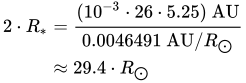
Alpha Phoenicis is a spectroscopic binary star system with components that orbit each other every 3,848.8 days (10.5 years).[6] The combined stellar classification of the system is K0.5 IIIb,[3] which matches the spectrum of a normal luminosity giant star. It has an apparent visual magnitude of 2.4,[2] so it is somewhat outshone by its first magnitude neighbors Achernar (α Eridani) and Fomalhaut (α Piscis Austrinus). Based upon parallax measurements, this system is at a distance of about 85 light-years (26 parsecs) from the Earth.[15] The interferometry-measured angular diameter of the primary component, after correcting for limb darkening, is 5.25±0.06 mas,[16] which, at its estimated distance, equates to a physical radius of about 15 times the radius of the Sun.[8]
References[edit]
- ^ a b c d e Vallenari, A.; et al. (Gaia collaboration) (2023). "Gaia Data Release 3. Summary of the content and survey properties". Astronomy and Astrophysics. 674: A1. arXiv:2208.00211. Bibcode:2023A&A...674A...1G. doi:10.1051/0004-6361/202243940. S2CID 244398875. Gaia DR3 record for this source at VizieR.
- ^ a b c d Gutierrez-Moreno, Adelina; et al. (1966), "A System of photometric standards", Publications of the Department of Astronomy University of Chile, 1, Publicaciones Universidad de Chile, Department de Astronomy: 1–17, Bibcode:1966PDAUC...1....1G
- ^ a b c d e Gray, R. O.; et al. (July 2006), "Contributions to the Nearby Stars (NStars) Project: Spectroscopy of Stars Earlier than M0 within 40 pc-The Southern Sample", The Astronomical Journal, 132 (1): 161–170, arXiv:astro-ph/0603770, Bibcode:2006AJ....132..161G, doi:10.1086/504637, S2CID 119476992
- ^ Evans, D. S. (June 20–24, 1966), Batten, Alan Henry; Heard, John Frederick (eds.), "The Revision of the General Catalogue of Radial Velocities", Determination of Radial Velocities and Their Applications, Proceedings from IAU Symposium No. 30, 30, University of Toronto: International Astronomical Union: 57, Bibcode:1967IAUS...30...57E
- ^ Cardini, D. (January 2005), "Mg II chromospheric radiative loss rates in cool active and quiet stars", Astronomy and Astrophysics, 430: 303–311, arXiv:astro-ph/0409683, Bibcode:2005A&A...430..303C, doi:10.1051/0004-6361:20041440, S2CID 12136256
- ^ a b Jancart, S.; et al. (October 2005), "Astrometric orbits of SB^9 stars", Astronomy and Astrophysics, 442 (1): 365–380, arXiv:astro-ph/0507695, Bibcode:2005A&A...442..365J, doi:10.1051/0004-6361:20053003, S2CID 15123997
- ^ a b Charbonnel, C.; Lagarde, N.; Jasniewicz, G.; North, P. L.; Shetrone, M.; Krugler Hollek, J.; Smith, V. V.; Smiljanic, R.; Palacios, A.; Ottoni, G. (2020), "Lithium in red giant stars: Constraining non-standard mixing with large surveys in the Gaia era", Astronomy and Astrophysics, 633: A34, arXiv:1910.12732, Bibcode:2020A&A...633A..34C, doi:10.1051/0004-6361/201936360, S2CID 204907220
- ^ a b Lang, Kenneth R. (2006), Astrophysical formulae, Astronomy and astrophysics library, vol. 1 (3rd ed.), Birkhäuser, ISBN 3-540-29692-1. The radius (R*) is given by:
- ^ Costa, J. M.; et al. (February 2002), "The tidal effects on the lithium abundance of binary systems with giant component", Astronomy and Astrophysics, 382 (3): 1016–1020, arXiv:astro-ph/0111539, Bibcode:2002A&A...382.1016C, doi:10.1051/0004-6361:20011676, S2CID 17024265
- ^ "alf Phe -- Spectroscopic binary", SIMBAD, Centre de Données astronomiques de Strasbourg, retrieved 2012-01-09
- ^ a b Kunitzsch, Paul; Smart, Tim (2006), A Dictionary of Modern star Names: A Short Guide to 254 Star Names and Their Derivations (2nd rev. ed.), Cambridge, Massachusetts: Sky Pub, ISBN 978-1-931559-44-7
- ^ "Star Names", International Astronomical Union, retrieved 2023-07-13
- ^ a b Allen, Richard Hinckley (1899), Star-names and their meanings, G. E. Stechert, p. 336
- ^ (in Chinese) AEEA (Activities of Exhibition and Education in Astronomy) 天文教育資訊網 2006 年 7 月 27 日
- ^ van Leeuwen, F. (November 2007), "Validation of the new Hipparcos reduction", Astronomy and Astrophysics, 474 (2): 653–664, arXiv:0708.1752, Bibcode:2007A&A...474..653V, doi:10.1051/0004-6361:20078357, S2CID 18759600
- ^ Richichi, A.; Percheron, I.; Khristoforova, M. (February 2005), "CHARM2: An updated Catalog of High Angular Resolution Measurements", Astronomy and Astrophysics, 431 (2): 773–777, Bibcode:2005A&A...431..773R, doi:10.1051/0004-6361:20042039