


Galaxy cluster

A galaxy cluster, or a cluster of galaxies, is a structure that consists of anywhere from hundreds to thousands of galaxies that are bound together by gravity,[1] with typical masses ranging from 1014 to 1015 solar masses. They are the second-largest known gravitationally bound structures in the universe after some superclusters (of which only one, the Shapley Supercluster, is known to be bound). They were believed to be the largest known structures in the universe until the 1980s, when superclusters were discovered.[2] One of the key features of clusters is the intracluster medium (ICM). The ICM consists of heated gas between the galaxies and has a peak temperature between 2–15 keV that is dependent on the total mass of the cluster. Galaxy clusters should not be confused with galactic clusters (also known as open clusters), which are star clusters within galaxies, or with globular clusters, which typically orbit galaxies. Small aggregates of galaxies are referred to as galaxy groups rather than clusters of galaxies. The galaxy groups and clusters can themselves cluster together to form superclusters.
Notable galaxy clusters in the relatively nearby Universe include the Virgo Cluster, Fornax Cluster, Hercules Cluster, and the Coma Cluster. A very large aggregation of galaxies known as the Great Attractor, dominated by the Norma Cluster, is massive enough to affect the local expansion of the Universe. Notable galaxy clusters in the distant, high-redshift universe include SPT-CL J0546-5345 and SPT-CL J2106-5844, the most massive galaxy clusters found in the early Universe. In the last few decades, they are also found to be relevant sites of particle acceleration, a feature that has been discovered by observing non-thermal diffuse radio emissions, such as radio halos and radio relics. Using the Chandra X-ray Observatory, structures such as cold fronts and shock waves have also been found in many galaxy clusters.
Basic properties
[edit]
Galaxy clusters typically have the following properties:
- They contain 100 to 1,000 galaxies, hot X-ray emitting gas and large amounts of dark matter.[4] Details are described in the "Composition" section.
- The distribution of the three components is approximately the same in the cluster.[citation needed]
- They have total masses of 1014 to 1015 solar masses.
- They typically have a diameter from 1 to 5 Mpc (see 1023 m for distance comparisons).
- The spread of velocities for the individual galaxies is about 800–1000 km/s.
Composition
[edit]There are three main components of a galaxy cluster. They are tabulated below:[2]
| Name of the components | Mass fraction | Description |
|---|---|---|
| Galaxies | 1% | In optical observations, only galaxies are visible |
| Intergalactic gas in intracluster medium | 9% | Plasma between the galaxies at high temperature and emit x-ray radiation by thermal bremsstrahlung |
| Dark matter | 90% | Most massive component but cannot be detected optically and is inferred through gravitational interactions |
Classification
[edit]Galaxy clusters are categorized as type I, II, or III based on morphology.[5][6]
Galaxy clusters as measuring instruments
[edit]Gravitational redshift
[edit]Galaxy clusters have been used by Radek Wojtak from the Niels Bohr Institute at the University of Copenhagen to test predictions of general relativity: energy loss from light escaping a gravitational field. Photons emitted from the center of a galaxy cluster should lose more energy than photons coming from the edge of the cluster because gravity is stronger in the center. Light emitted from the center of a cluster has a longer wavelength than light coming from the edge. This effect is known as gravitational redshift. Using the data collected from 8000 galaxy clusters, Wojtak was able to study the properties of gravitational redshift for the distribution of galaxies in clusters. He found that the light from the clusters was redshifted in proportion to the distance from the center of the cluster as predicted by general relativity. The result also strongly supports the Lambda-Cold Dark Matter model of the Universe, according to which most of the cosmos is made up of Dark Matter that does not interact with matter.[7]
Gravitational lensing
[edit]Galaxy clusters are also used for their strong gravitational potential as gravitational lenses to boost the reach of telescopes. The gravitational distortion of space-time occurs near massive galaxy clusters and bends the path of photons to create a cosmic magnifying glass. This can be done with photons of any wavelength from the optical to the X-ray band. The latter is more difficult, because galaxy clusters emit a lot of X-rays. However, X-ray emission may still be detected when combining X-ray data to optical data. One particular case is the use of the Phoenix galaxy cluster to observe a dwarf galaxy in its early high energy stages of star formation.[8]
List
[edit].png)
| Cluster | Notes | |||||||||||||||||||||||||||||||||||||||||||||||||||||||||||||||||||||||||||||||||||||||||||||||||
|---|---|---|---|---|---|---|---|---|---|---|---|---|---|---|---|---|---|---|---|---|---|---|---|---|---|---|---|---|---|---|---|---|---|---|---|---|---|---|---|---|---|---|---|---|---|---|---|---|---|---|---|---|---|---|---|---|---|---|---|---|---|---|---|---|---|---|---|---|---|---|---|---|---|---|---|---|---|---|---|---|---|---|---|---|---|---|---|---|---|---|---|---|---|---|---|---|---|---|
| Virgo Cluster | The nearest massive galaxy cluster | |||||||||||||||||||||||||||||||||||||||||||||||||||||||||||||||||||||||||||||||||||||||||||||||||
| Norma Cluster | The cluster at the heart of the Great Attractor | |||||||||||||||||||||||||||||||||||||||||||||||||||||||||||||||||||||||||||||||||||||||||||||||||
| Bullet Cluster | A cluster merger with the first observed separation between dark matter and normal matter | |||||||||||||||||||||||||||||||||||||||||||||||||||||||||||||||||||||||||||||||||||||||||||||||||
| This lists some of the most notable clusters; for more clusters, see the list article. | ||||||||||||||||||||||||||||||||||||||||||||||||||||||||||||||||||||||||||||||||||||||||||||||||||
Gallery
[edit]
.jpg)

Images
[edit]-
![Galaxy cluster SPT-CL J0615-5746.[18]](//upload.wikimedia.org/wikipedia/commons/thumb/b/bb/Distant_and_ancient_SPT0615-JD.jpg/120px-Distant_and_ancient_SPT0615-JD.jpg) Galaxy cluster SPT-CL J0615-5746.[18]
Galaxy cluster SPT-CL J0615-5746.[18] -
![Galaxy cluster RXC J0232.2-4420.[19]](//upload.wikimedia.org/wikipedia/commons/thumb/8/80/Strings_of_homeless_stars_RXC_J0232.2-4420.jpg/120px-Strings_of_homeless_stars_RXC_J0232.2-4420.jpg) Galaxy cluster RXC J0232.2-4420.[19]
Galaxy cluster RXC J0232.2-4420.[19] -
![Galaxy cluster RXC J0032.1+1808 as part of the RELICS program.[20]](//upload.wikimedia.org/wikipedia/commons/thumb/6/6e/From_toddlers_to_babies_RXC_J0032.1%2B1808.jpg/120px-From_toddlers_to_babies_RXC_J0032.1%2B1808.jpg)
-
![Massive galaxy cluster PSZ2 G138.61-10.84 is about six billion light-years away.[21]](//upload.wikimedia.org/wikipedia/commons/thumb/8/89/Approaching_the_Universe%27s_origins_PSZ2_G138.61-10.84.jpg/120px-Approaching_the_Universe%27s_origins_PSZ2_G138.61-10.84.jpg) Massive galaxy cluster PSZ2 G138.61-10.84 is about six billion light-years away.[21]
Massive galaxy cluster PSZ2 G138.61-10.84 is about six billion light-years away.[21] -
![HAWK-I and Hubble explore RCS2 J2327 cluster with the mass of two quadrillion Suns.[22]](//upload.wikimedia.org/wikipedia/commons/thumb/7/7e/HAWK-I_and_Hubble_Explore_a_Cluster_with_the_Mass_of_two_Quadrillion_Suns.jpg/120px-HAWK-I_and_Hubble_Explore_a_Cluster_with_the_Mass_of_two_Quadrillion_Suns.jpg)
-
![Abell 2537 is useful in probing cosmic phenomena like dark matter and dark energy.[23]](//upload.wikimedia.org/wikipedia/commons/thumb/3/37/Streaks_and_stripes_Abell_2537.jpg/120px-Streaks_and_stripes_Abell_2537.jpg) Abell 2537 is useful in probing cosmic phenomena like dark matter and dark energy.[23]
Abell 2537 is useful in probing cosmic phenomena like dark matter and dark energy.[23] -
![Abell 1300 acts like a lens, bending the very fabric of space around it.[24]](//upload.wikimedia.org/wikipedia/commons/thumb/d/dc/Cosmic_RELICS_Abell_1300.jpg/120px-Cosmic_RELICS_Abell_1300.jpg) Abell 1300 acts like a lens, bending the very fabric of space around it.[24]
Abell 1300 acts like a lens, bending the very fabric of space around it.[24] -
![Galaxy cluster WHL J24.3324-8.477.[25]](//upload.wikimedia.org/wikipedia/commons/thumb/4/4c/Cosmic_archaeology_WHL_J24.3324-8.477.jpg/120px-Cosmic_archaeology_WHL_J24.3324-8.477.jpg) Galaxy cluster WHL J24.3324-8.477.[25]
Galaxy cluster WHL J24.3324-8.477.[25] -
![Background galaxy has been gravitationally lensed by the intervening galaxy cluster.[26]](//upload.wikimedia.org/wikipedia/commons/thumb/c/c1/Hubble_pushed_beyond_limits_to_spot_clumps_of_new_stars_in_distant_galaxy.jpg/120px-Hubble_pushed_beyond_limits_to_spot_clumps_of_new_stars_in_distant_galaxy.jpg) Background galaxy has been gravitationally lensed by the intervening galaxy cluster.[26]
Background galaxy has been gravitationally lensed by the intervening galaxy cluster.[26] -
!["Smiley" image – galaxy cluster (SDSS J1038+4849) & gravitational lensing (an Einstein ring) (HST).[27]](//upload.wikimedia.org/wikipedia/commons/thumb/b/b9/HST-Smiling-GalaxyClusterSDSS-J1038%2B4849-20150210.jpg/120px-HST-Smiling-GalaxyClusterSDSS-J1038%2B4849-20150210.jpg) "Smiley" image – galaxy cluster (SDSS J1038+4849) & gravitational lensing (an Einstein ring) (HST).[27]
"Smiley" image – galaxy cluster (SDSS J1038+4849) & gravitational lensing (an Einstein ring) (HST).[27] -
![Galaxy cluster SpARCS1049 taken by Spitzer and the Hubble Space Telescope.[28]](//upload.wikimedia.org/wikipedia/commons/thumb/2/23/Image_of_the_galaxy_cluster_SpARCS1049.jpg/120px-Image_of_the_galaxy_cluster_SpARCS1049.jpg) Galaxy cluster SpARCS1049 taken by Spitzer and the Hubble Space Telescope.[28]
Galaxy cluster SpARCS1049 taken by Spitzer and the Hubble Space Telescope.[28] -
 Galaxy cluster MOO J1142+1527 discovered by the MaDCoWS survey
 -
![Abell 2744 galaxy cluster (HST).[16]](//upload.wikimedia.org/wikipedia/commons/thumb/4/4d/Heic1401a-Abell2744-20140107.jpg/108px-Heic1401a-Abell2744-20140107.jpg)
-
![Magnifying the distant universe through MACS J0454.1-0300.[29]](//upload.wikimedia.org/wikipedia/commons/thumb/b/b9/Magnifying_the_distant_Universe.jpg/120px-Magnifying_the_distant_Universe.jpg) Magnifying the distant universe through MACS J0454.1-0300.[29]
Magnifying the distant universe through MACS J0454.1-0300.[29] -
 Turbulence may prevent galaxy clusters from cooling; illustrated: Perseus Cluster and Virgo Cluster (Chandra X-ray).
 -
 MACS0416.1-2403 imaged by the HST
 -
 The galaxy cluster Abell 2813 (also known as ACO 2813) image from the NASA/ESA Hubble Space Telescope
 -
 A menagerie of galaxies — the galaxy cluster ACO S 295
 -
 Cosmic lens flare
 -
 Hubble spots three images of a distant supernova
 -
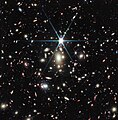 A massive galaxy cluster called WHL0137-08
 -
 Galaxy cluster known as "El Gordo"
 -
![Observation from the James Webb Space Telescope the massive galaxy cluster RX J2129.[30]](//upload.wikimedia.org/wikipedia/commons/thumb/e/e7/Seeing_Triple_%28potm2302a%29.jpeg/120px-Seeing_Triple_%28potm2302a%29.jpeg) Observation from the James Webb Space Telescope the massive galaxy cluster RX J2129.[30]
Observation from the James Webb Space Telescope the massive galaxy cluster RX J2129.[30]
![Galaxy cluster SPT-CL J0615-5746.[18]](/wiki/File:Distant_and_ancient_SPT0615-JD.jpg)
![Galaxy cluster RXC J0232.2-4420.[19]](/wiki/File:Strings_of_homeless_stars_RXC_J0232.2-4420.jpg)
![Galaxy cluster RXC J0032.1+1808 as part of the RELICS program.[20]](/wiki/File:From_toddlers_to_babies_RXC_J0032.1%2B1808.jpg)
![Massive galaxy cluster PSZ2 G138.61-10.84 is about six billion light-years away.[21]](/wiki/File:Approaching_the_Universe%27s_origins_PSZ2_G138.61-10.84.jpg)
![HAWK-I and Hubble explore RCS2 J2327 cluster with the mass of two quadrillion Suns.[22]](/wiki/File:HAWK-I_and_Hubble_Explore_a_Cluster_with_the_Mass_of_two_Quadrillion_Suns.jpg)
![Abell 2537 is useful in probing cosmic phenomena like dark matter and dark energy.[23]](/wiki/File:Streaks_and_stripes_Abell_2537.jpg)
![Abell 1300 acts like a lens, bending the very fabric of space around it.[24]](/wiki/File:Cosmic_RELICS_Abell_1300.jpg)
![Galaxy cluster WHL J24.3324-8.477.[25]](/wiki/File:Cosmic_archaeology_WHL_J24.3324-8.477.jpg)
![Background galaxy has been gravitationally lensed by the intervening galaxy cluster.[26]](/wiki/File:Hubble_pushed_beyond_limits_to_spot_clumps_of_new_stars_in_distant_galaxy.jpg)
!["Smiley" image – galaxy cluster (SDSS J1038+4849) & gravitational lensing (an Einstein ring) (HST).[27]](/wiki/File:HST-Smiling-GalaxyClusterSDSS-J1038%2B4849-20150210.jpg)
![Galaxy cluster SpARCS1049 taken by Spitzer and the Hubble Space Telescope.[28]](/wiki/File:Image_of_the_galaxy_cluster_SpARCS1049.jpg)

![Abell 2744 galaxy cluster (HST).[16]](/wiki/File:Heic1401a-Abell2744-20140107.jpg)
![Magnifying the distant universe through MACS J0454.1-0300.[29]](/wiki/File:Magnifying_the_distant_Universe.jpg)


.jpg)
_(2023-119).png)
![Observation from the James Webb Space Telescope the massive galaxy cluster RX J2129.[30]](/wiki/File:Seeing_Triple_(potm2302a).jpeg)
Videos
[edit]-
Video: Formation of galaxy cluster MRC 1138-262 (artist's concept).
See also
[edit]
References
[edit]- ^ a b "Hubble Pinpoints Furthest Protocluster of Galaxies Ever Seen". ESA/Hubble Press Release. Retrieved 13 January 2012.
- ^ a b Kravtsov, A. V.; Borgani, S. (2012). "Formation of Galaxy Clusters". Annual Review of Astronomy and Astrophysics. 50: 353–409. arXiv:1205.5556. Bibcode:2012ARA&A..50..353K. doi:10.1146/annurev-astro-081811-125502. S2CID 119115331.
- ^ "Galaxy cluster IDCS J1426". Retrieved 11 January 2016.
- ^ "Chandra :: Field Guide to X-ray Sources :: Groups & Clusters of Galaxies".
- ^ Bautz, L. P.; Morgan, W. W. (December 1970). "On the Classification of the Forms of Clusters of Galaxies" (PDF). Astrophysical Journal. 162: L149. Bibcode:1970ApJ...162L.149B. doi:10.1086/180643. A&AA ID. AAA004.160.015. Retrieved March 10, 2012.
- ^ Bautz, Laura P.; Morgan, W. W. (September 1970). "Preliminary Classification of Clusters of Galaxies" (PDF). Bulletin of the American Astronomical Society. 2: 294. Bibcode:1970BAAS....2R.294B. A&AA ID. AAA004.160.006. Retrieved March 10, 2012.
- ^ Yudhijit, Bhattacharjee. "Galaxy Clusters Back Up Einstein's Theory of Relativity". Wired. Retrieved 2022-04-04.
- ^ Chu, Jennifer (15 October 2019). "Astronomers use giant galaxy cluster as X-ray magnifying lens". MIT News. Retrieved 2022-04-04.
- ^ Chow, Denise; Wu, Jiachuan (12 July 2022). "Photos: How pictures from the Webb telescope compare to Hubble's - NASA's $10 billion telescope peers deeper into space than ever, revealing previously undetectable details in the cosmos". NBC News. Retrieved 16 July 2022.
- ^ Garner, Rob (11 July 2022). "NASA's Webb Delivers Deepest Infrared Image of Universe Yet". NASA. Archived from the original on 12 July 2022. Retrieved 12 July 2022.
- ^ Overbye, Dennis; Chang, Kenneth; Tankersley, Jim (11 July 2022). "Biden and NASA Share First Webb Space Telescope Image – From the White House on Monday, humanity got its first glimpse of what the observatory in space has been seeing: a cluster of early galaxies". The New York Times. Archived from the original on 12 July 2022. Retrieved 12 July 2022.
- ^ Pacucci, Fabio (15 July 2022). "How Taking Pictures of 'Nothing' Changed Astronomy - Deep-field images of "empty" regions of the sky from Webb and other space telescopes are revealing more of the universe than we ever thought possible". Scientific American. Retrieved 16 July 2022.
- ^ Deliso, Meredith; Longo, Meredith; Rothenberg, Nicolas (14 July 2022). "Hubble vs. James Webb telescope images: See the difference". ABC News. Retrieved 15 July 2022.
- ^ Kooser, Amanda (13 July 2012). "Hubble and James Webb Space Telescope Images Compared: See the Difference - The James Webb Space Telescope builds on Hubble's legacy with stunning new views of the cosmos". CNET. Retrieved 16 July 2022.
- ^ Atkinson, Nancy (2 May 2022). "Now, We can Finally Compare Webb to Other Infrared Observatories". Universe Today. Archived from the original on 10 May 2022. Retrieved 12 May 2022.
- ^ a b Clavin, Whitney; Jenkins, Ann; Villard, Ray (7 January 2014). "NASA's Hubble and Spitzer Team up to Probe Faraway Galaxies". NASA. Retrieved 8 January 2014.
- ^ Chou, Felecia; Weaver, Donna (16 October 2014). "RELEASE 14-283 – NASA's Hubble Finds Extremely Distant Galaxy through Cosmic Magnifying Glass". NASA. Retrieved 17 October 2014.
- ^ "Distant and ancient". www.spacetelescope.org. Retrieved 6 May 2019.
- ^ "Strings of homeless stars". www.spacetelescope.org. Retrieved 11 June 2018.
- ^ "From toddlers to babies". www.spacetelescope.org. Retrieved 7 May 2018.
- ^ "Approaching the Universe's origins". www.spacetelescope.org. Retrieved 16 April 2018.
- ^ "HAWK-I and Hubble Explore a Cluster with the Mass of two Quadrillion Suns". www.eso.org. Retrieved 25 December 2017.
- ^ "Streaks and stripes". www.spacetelescope.org. Retrieved 27 November 2017.
- ^ "Cosmic RELICS". www.spacetelescope.org. Retrieved 6 November 2017.
- ^ "Cosmic archaeology". www.spacetelescope.org. Retrieved 24 October 2017.
- ^ "Hubble pushed beyond limits to spot clumps of new stars in distant galaxy". www.spacetelescope.org. Retrieved 12 July 2017.
- ^ Loff, Sarah; Dunbar, Brian (10 February 2015). "Hubble Sees A Smiling Lens". NASA. Retrieved 10 February 2015.
- ^ "Image of the galaxy cluster SpARCS1049". Retrieved 11 September 2015.
- ^ "Magnifying the distant Universe". ESA/Hubble Picture of the Week. Retrieved 10 April 2014.
- ^ "Seeing Triple". October 18, 2023.


