


Encelia farinosa
| Brittlebush | |
|---|---|

| |
| Near Palm Springs, California | |
Scientific classification 
| |
| Kingdom: | Plantae |
| Clade: | Tracheophytes |
| Clade: | Angiosperms |
| Clade: | Eudicots |
| Clade: | Asterids |
| Order: | Asterales |
| Family: | Asteraceae |
| Genus: | Encelia |
| Species: | E. farinosa
|
| Binomial name | |
| Encelia farinosa | |
Encelia farinosa (commonly known as brittlebush, brittlebrush, or incienso), is a common desert shrub of the southwestern United States and northern Mexico. It has a variety of historical uses.
Description[edit]

Brittlebush grows up to 30 to 150 centimetres (12 to 59 inches) tall,[1] with fragrant leaves 3–10 cm (1+1⁄4–4 in) long, ovate to deltoid, and silvery tomentose.[2] Arranged in loose panicles above the leafy stems, the capitula are 3–3.5 cm (1+1⁄4–1+1⁄2 in) in diameter. Each has 8–18 orange-yellow ray florets, 6–15 millimetres (1⁄4–9⁄16 in) in length,[2] and yellow or purple-brown disc florets. The fruit measures 3–6 mm (1⁄8–1⁄4 in) and no pappus is visible.[3] During dry seasons the plant goes drought deciduous, shedding all of its foliage, relying on the water stored in its thick stems.[4]
Encelia californica is similar, but has only one flower head per stalk.[2]
Chemistry[edit]
The leaves contain 3-Acetyl-6-methoxybenzaldehyde.[5]
Taxonomy[edit]
Varieties[edit]

Two varieties of E. farinosa are recognized by Flora of North America.[3]
- Encelia farinosa var. farinosa – yellow disc florets
- Encelia farinosa var. phenicodonta (Blake) I.M.Johnston – purple-brown disc florets
Varieties formerly included E. f. var. radians, now regarded as a separate species E. radians Brandegee.[6]
Etymology[edit]
The common name "brittlebush" comes from the brittleness of its stems. Other names include hierba del vaso (Spanish) and cotx (Seri).[7] Another Spanish name for it is incienso because the dried sap was burned by early Spanish missions in the New World as incense.
Distribution and habitat[edit]

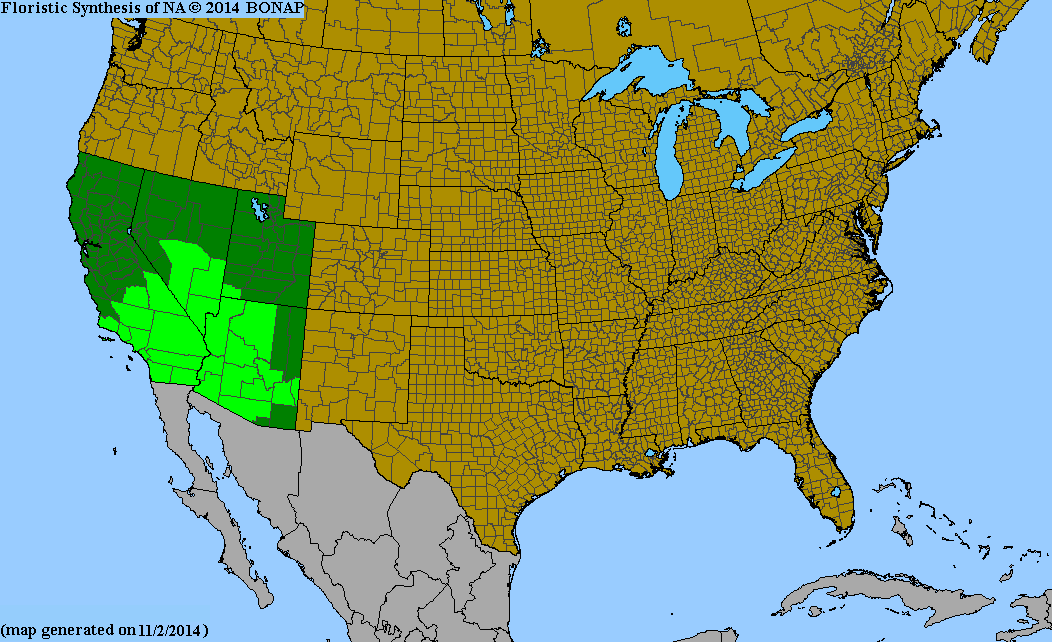
Encelia farinosa is common in the southwestern United States (California, Arizona, Utah, and Nevada) and northern Mexico (Baja California, Baja California Sur, Sonora, Sinaloa, and Hidalgo).[3][8][9]
It can be found in a variety of habitats from dry, gravelly slopes to open, sandy washes[2] up to 1,000 metres (3,300 feet) above sea level. It requires a very sunny position in a deep very well-drained soil, and minimal winter frost.[4]
It does well in cultivation often being used for border, erosion control, ground cover and massing.[10] Recently the plant has spread dramatically in areas not natural to its distribution in large part because Caltrans has begun to use it in hydroseeding.[citation needed]
Uses[edit]
Brittlebush has a long history of uses by indigenous and pioneer peoples, including:
- Glue: The resin collected from the base of the plant, yellowish to brown, can be heated and used as a glue. The O'odham and Seri use it for hafting, to hold points on arrows and harpoons.[7]
- Sealer: A different sort of resin collected from the upper stems is more gummy and generally a clear yellow. The Seri use this to seal pottery vessels.[7]
- Incense: Early Spanish friars learned that the resin made a highly fragrant incense, akin to frankincense in odor.[11]
- Gum: The Sells area Tohono O'odham children use upper stem resin as a passable chewing gum.[12]
- Toothbrush: Oldtime cowboys used brittlebush stem as a fine toothbrush.[12]
- Medicinal: Seri use brittlebush to treat toothache; the bark is removed, the branch heated in ashes, and then placed in the mouth to "harden" a loose tooth.[7] The Cahuilla used brittlebush to treat toothaches as well,[13] and used it as a chest pain reliever by heating the gum and applying it to the chest.[13][14]
- Waterproofing: It has been used to waterproof containers.[10]
- Varnish: It has been melted then used as a varnish.[10]
References[edit]
- ^ Hogan, C. Michael (ed.) "Brittlebush – Encelia farinosa" at the Encyclopedia of Life. Retrieved 1 April 2013.
- ^ a b c d Spellenberg, Richard (2001) [1979]. National Audubon Society Field Guide to North American Wildflowers: Western Region (rev ed.). Knopf. pp. 369–370. ISBN 978-0-375-40233-3.
- ^ a b c "Encelia farinosa in Flora of North America". Efloras.org. Retrieved 1 April 2022.
- ^ a b Gacsi/Morgan, April/Steve (January 1992). Deserts of the Southwest Self Guided Tour. Riverside, California: University of California, Riverside Botanic Gardens. p. 10.
- ^ Gray, Reed; Bonner, James (19 March 1948). "Structure Determination and Synthesis of a Plant Growth Inhibitor, 3-Acetyl-6-methoxybenzaldehyde, Found in the Leaves of Encelia Farinosa". Journal of the American Chemical Society. 70 (3): 1249–1253. doi:10.1021/ja01183a114. PMID 18909201.
- ^ Bohm, Bruce A. (2009). The Geography of Phytochemical Races. Dordrecht: Springer. p. 112. ISBN 9781402090523.
- ^ a b c d Felger, Richard Stephen; Moser, Mary Beck (1985). People of the Desert and Sea: Ethnobotany of the Seri Indians (2. print. ed.). Tucson, Ariz.: University of Arizona Press. ISBN 0816508186.
- ^ "Photographic image of distribution map" (PNG). Bonap.net. Retrieved 1 April 2022.
- ^ "Biota of North America Program 2014 county distribution map". Bonap.net. Retrieved 1 April 2022.
- ^ a b c "Encelia farinosa Brittle Bush, Brittlebush, Incienso PFAF Plant Database". www.pfaf.org. Retrieved 26 January 2019.
- ^ Dunmire, William W. (2004). Gardens of New Spain: How Mediterranean Plants and Foods Changed America. Austin: University of Texas Press. ISBN 978-0-292-70564-7.
- ^ a b Soule, Jacqueline A. (2012). Father Kinos's Herbs: Growing & Using Them Today. Tucson: Tierra del Sol Institute Press. ISBN 978-0-9758554-2-3.
- ^ a b "Plants of the Cahuilla Indians of the Colorado Desert and Surrounding Mountains". Enduring Knowledge Publications. Archived from the original on 4 March 2016. Retrieved 26 January 2019.
- ^ James, Harry (1985). Temalpakh: Cahuilla Indian Knowledge and Usage of Plants. Malki Museum Press. ISBN 978-0-9390-4606-5.
External links[edit]
 Media related to Encelia farinosa at Wikimedia Commons
- UC Jepson Manual treatment for Encelia farinosa
- Encelia farinosa – U.C. CalPhotos Gallery

- Encelia
- Flora of the Southwestern United States
- Flora of Northwestern Mexico
- Flora of the California desert regions
- Flora of the Sonoran Deserts
- Flora of the Coachella Valley
- Natural history of the California chaparral and woodlands
- Natural history of the Colorado Desert
- Natural history of the Mojave Desert
- Natural history of the Peninsular Ranges
- Natural history of the Santa Monica Mountains
- Plants used in traditional Native American medicine
- Drought-tolerant plants
- Garden plants of North America
- Plants described in 1848
- Taxa named by Asa Gray
- Taxa named by John Torrey