In mathematics, Green's identities are a set of three identities in vector calculus relating the bulk with the boundary of a region on which differential operators act. They are named after the mathematician George Green, who discovered Green's theorem.
This identity is derived from the divergence theorem applied to the vector field F = ψ ∇φ while using an extension of the product rule that ∇ ⋅ (ψX ) = ∇ψ ⋅X + ψ ∇⋅X: Let φ and ψ be scalar functions defined on some region U ⊂ Rd, and suppose that φ is twice continuously differentiable, and ψ is once continuously differentiable. Using the product rule above, but letting X = ∇φ, integrate ∇⋅(ψ∇φ) over U. Then[1]
where ∆ ≡ ∇2 is the Laplace operator, ∂U is the boundary of region U, n is the outward pointing unit normal to the surface element dS and dS = ndS is the oriented surface element.
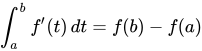
This theorem is a special case of the divergence theorem, and is essentially the higher dimensional equivalent of integration by parts with ψ and the gradient of φ replacing u and v.
Note that Green's first identity above is a special case of the more general identity derived from the divergence theorem by substituting F = ψΓ,
If φ and ψ are both twice continuously differentiable on U ⊂ R3, and ε is once continuously differentiable, one may choose F = ψε ∇φ − φε ∇ψ to obtain
For the special case of ε = 1 all across U ⊂ R3, then,
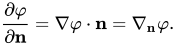
In the equation above, ∂φ/∂n is the directional derivative of φ in the direction of the outward pointing surface normal n of the surface element dS,
Explicitly incorporating this definition in the Green's second identity with ε = 1 results in
In particular, this demonstrates that the Laplacian is a self-adjoint operator in the L2 inner product for functions vanishing on the boundary so that the right hand side of the above identity is zero.
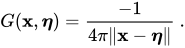
This form is used to construct solutions to Dirichlet boundary condition problems. Solutions for Neumann boundary condition problems may also be simplified, though the Divergence theorem applied to the differential equation defining Green's functions shows that the Green's function cannot integrate to zero on the boundary, and hence cannot vanish on the boundary. See Green's functions for the Laplacian or [2] for a detailed argument, with an alternative.
It can be further verified that the above identity also applies when ψ is a solution to the Helmholtz equation or wave equation and G is the appropriate Green's function. In such a context, this identity is the mathematical expression of the Huygens principle, and leads to Kirchhoff's diffraction formula and other approximations.
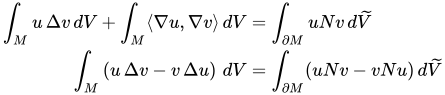
Green's identities hold on a Riemannian manifold. In this setting, the first two are
where u and v are smooth real-valued functions on M, dV is the volume form compatible with the metric, is the induced volume form on the boundary of M, N is the outward oriented unit vector field normal to the boundary, and Δu = div(grad u) is the Laplacian.
Green's second identity establishes a relationship between second and (the divergence of) first order derivatives of two scalar functions. In differential form
where pm and qm are two arbitrary twice continuously differentiable scalar fields. This identity is of great importance in physics because continuity equations can thus be established for scalar fields such as mass or energy.[3]
In vector diffraction theory, two versions of Green's second identity are introduced.
One variant invokes the divergence of a cross product [4][5][6] and states a relationship in terms of the curl-curl of the field
This equation can be written in terms of the Laplacians,
However, the terms
could not be readily written in terms of a divergence.
The other approach introduces bi-vectors, this formulation requires a dyadic Green function.[7][8] The derivation presented here avoids these problems.[9]
Consider that the scalar fields in Green's second identity are the Cartesian components of vector fields, i.e.,
Summing up the equation for each component, we obtain
The LHS according to the definition of the dot product may be written in vector form as
The RHS is a bit more awkward to express in terms of vector operators. Due to the distributivity of the divergence operator over addition, the sum of the divergence is equal to the divergence of the sum, i.e.,
Recall the vector identity for the gradient of a dot product,
which, written out in vector components is given by
This result is similar to what we wish to evince in vector terms 'except' for the minus sign. Since the differential operators in each term act either over one vector (say ’s) or the other (’s), the contribution to each term must be
These results can be rigorously proven to be correct through evaluation of the vector components. Therefore, the RHS can be written in vector form as
Putting together these two results, a result analogous to Green's theorem for scalar fields is obtained, Theorem for vector fields:





![{\displaystyle \int _{U}\left[\psi \,\nabla \cdot \left(\varepsilon \,\nabla \varphi \right)-\varphi \,\nabla \cdot \left(\varepsilon \,\nabla \psi \right)\right]\,dV=\oint _{\partial U}\varepsilon \left(\psi {\partial \varphi \over \partial \mathbf {n} }-\varphi {\partial \psi \over \partial \mathbf {n} }\right)\,dS.}](https://wikimedia.org/api/rest_v1/media/math/render/svg/ddf92c80ec8dca68ee19587e803b53dc67347966)



![{\displaystyle \int _{U}\left[G(\mathbf {y} ,{\boldsymbol {\eta }})\,\Delta \psi (\mathbf {y} )\right]\,dV_{\mathbf {y} }-\psi ({\boldsymbol {\eta }})=\oint _{\partial U}\left[G(\mathbf {y} ,{\boldsymbol {\eta }}){\partial \psi \over \partial \mathbf {n} }(\mathbf {y} )-\psi (\mathbf {y} ){\partial G(\mathbf {y} ,{\boldsymbol {\eta }}) \over \partial \mathbf {n} }\right]\,dS_{\mathbf {y} }.}](https://wikimedia.org/api/rest_v1/media/math/render/svg/8512737d8ecc9ecbeea84ea0422c24e50f57f746)
![{\displaystyle \psi ({\boldsymbol {\eta }})=\oint _{\partial U}\left[\psi (\mathbf {y} ){\frac {\partial G(\mathbf {y} ,{\boldsymbol {\eta }})}{\partial \mathbf {n} }}-G(\mathbf {y} ,{\boldsymbol {\eta }}){\frac {\partial \psi }{\partial \mathbf {n} }}(\mathbf {y} )\right]\,dS_{\mathbf {y} }.}](https://wikimedia.org/api/rest_v1/media/math/render/svg/b7893f565341c8a6c931eefd50c805d86a38ab8a)




![{\displaystyle \mathbf {P} \cdot \Delta \mathbf {Q} -\mathbf {Q} \cdot \Delta \mathbf {P} +\mathbf {Q} \cdot \left[\nabla \left(\nabla \cdot \mathbf {P} \right)\right]-\mathbf {P} \cdot \left[\nabla \left(\nabla \cdot \mathbf {Q} \right)\right]=\nabla \cdot \left(\mathbf {P} \times \left(\nabla \times \mathbf {Q} \right)-\mathbf {Q} \times \left(\nabla \times \mathbf {P} \right)\right).}](https://wikimedia.org/api/rest_v1/media/math/render/svg/8e97a5718e242d10afbd06fa6eb768872b69c44a)
![{\displaystyle \mathbf {Q} \cdot \left[\nabla \left(\nabla \cdot \mathbf {P} \right)\right]-\mathbf {P} \cdot \left[\nabla \left(\nabla \cdot \mathbf {Q} \right)\right],}](https://wikimedia.org/api/rest_v1/media/math/render/svg/a799dee9474cadd91b4ba3cf2bd105786800ea2d)

![{\displaystyle \sum _{m}\left[p_{m}\Delta q_{m}-q_{m}\Delta p_{m}\right]=\sum _{m}\nabla \cdot \left(p_{m}\nabla q_{m}-q_{m}\nabla p_{m}\right).}](https://wikimedia.org/api/rest_v1/media/math/render/svg/b0e237fa0360c20725dd3fd6f75a1f7ac37a8660)
![{\displaystyle \sum _{m}\left[p_{m}\,\Delta q_{m}-q_{m}\,\Delta p_{m}\right]=\mathbf {P} \cdot \Delta \mathbf {Q} -\mathbf {Q} \cdot \Delta \mathbf {P} .}](https://wikimedia.org/api/rest_v1/media/math/render/svg/98f703ad3193333c7aa474a3167350ebcf42da78)








![{\displaystyle \color {OliveGreen}\mathbf {P} \cdot \Delta \mathbf {Q} -\mathbf {Q} \cdot \Delta \mathbf {P} =\left[\left(\mathbf {P} \cdot \nabla \right)\mathbf {Q} +\mathbf {P} \times \left(\nabla \times \mathbf {Q} \right)-\left(\mathbf {Q} \cdot \nabla \right)\mathbf {P} -\mathbf {Q} \times \left(\nabla \times \mathbf {P} \right)\right].}](https://wikimedia.org/api/rest_v1/media/math/render/svg/927ec7570dbcc5d2e3060744ccfd2bf5238a2de5)

![{\displaystyle \mathbf {P} \cdot \Delta \mathbf {Q} -\mathbf {Q} \cdot \Delta \mathbf {P} =\nabla \cdot \left[\mathbf {P} \left(\nabla \cdot \mathbf {Q} \right)-\mathbf {Q} \left(\nabla \cdot \mathbf {P} \right)-\nabla \times \left(\mathbf {P} \times \mathbf {Q} \right)+\mathbf {P} \times \left(\nabla \times \mathbf {Q} \right)-\mathbf {Q} \times \left(\nabla \times \mathbf {P} \right)\right].}](https://wikimedia.org/api/rest_v1/media/math/render/svg/3b7c500e059748ad2415002b8c4f6eb0d2117e89)
![{\displaystyle \color {OliveGreen}\mathbf {P} \cdot \Delta \mathbf {Q} -\mathbf {Q} \cdot \Delta \mathbf {P} =\nabla \cdot \left[\mathbf {P} \left(\nabla \cdot \mathbf {Q} \right)-\mathbf {Q} \left(\nabla \cdot \mathbf {P} \right)+\mathbf {P} \times \left(\nabla \times \mathbf {Q} \right)-\mathbf {Q} \times \left(\nabla \times \mathbf {P} \right)\right].}](https://wikimedia.org/api/rest_v1/media/math/render/svg/d46a4caa8eeeb880fd9c0fadf49d3782678a819c)
![{\displaystyle \Delta \left(\mathbf {P} \cdot \mathbf {Q} \right)=\mathbf {P} \cdot \Delta \mathbf {Q} -\mathbf {Q} \cdot \Delta \mathbf {P} +2\nabla \cdot \left[\left(\mathbf {Q} \cdot \nabla \right)\mathbf {P} +\mathbf {Q} \times \nabla \times \mathbf {P} \right].}](https://wikimedia.org/api/rest_v1/media/math/render/svg/eaa6197976af013496fba2dbc9e144175a9f3a7a)
![{\displaystyle \mathbf {P} \cdot \left[\nabla \left(\nabla \cdot \mathbf {Q} \right)\right]-\mathbf {Q} \cdot \left[\nabla \left(\nabla \cdot \mathbf {P} \right)\right]=\nabla \cdot \left[\mathbf {P} \left(\nabla \cdot \mathbf {Q} \right)-\mathbf {Q} \left(\nabla \cdot \mathbf {P} \right)\right].}](https://wikimedia.org/api/rest_v1/media/math/render/svg/5dbbf8319f2aad7873fc278c528a6f133836f6d8)