Rules for computing derivatives of functions
This is a summary of differentiation rules , that is, rules for computing the derivative of a function in calculus .
Elementary rules of differentiation [ edit ] Unless otherwise stated, all functions are functions of real numbers (R ) that return real values; although more generally, the formulae below apply wherever they are well defined [1] [2] complex numbers (C ) .[3]
Constant term rule [ edit ] For any value of
c
{\displaystyle c}
c
∈
R
{\displaystyle c\in \mathbb {R} }
f
(
x
)
{\displaystyle f(x)}
f
(
x
)
=
c
{\displaystyle f(x)=c}
d
f
d
x
=
0
{\displaystyle {\frac {df}{dx}}=0}
[4]
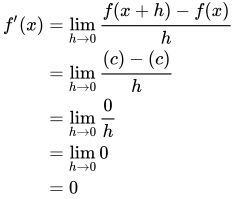
Let
c
∈
R
{\displaystyle c\in \mathbb {R} }
f
(
x
)
=
c
{\displaystyle f(x)=c}
f
′
(
x
)
=
lim
h
→
0
f
(
x
+
h
)
−
f
(
x
)
h
=
lim
h
→
0
(
c
)
−
(
c
)
h
=
lim
h
→
0
0
h
=
lim
h
→
0
0
=
0
{\displaystyle {\begin{aligned}f'(x)&=\lim _{h\to 0}{\frac {f(x+h)-f(x)}{h}}\\&=\lim _{h\to 0}{\frac {(c)-(c)}{h}}\\&=\lim _{h\to 0}{\frac {0}{h}}\\&=\lim _{h\to 0}0\\&=0\end{aligned}}}
This shows that the derivative of any constant function is 0.
Intuitive (geometric) explanation [ edit ] The derivative of the function at a point is the slope of the line tangent to the curve at the point. Slope of the constant function is zero, because the tangent line to the constant function is horizontal and it's angle is zero.
In other words, the value of the constant function, y, will not change as the value of x increases or decreases.
At each point, the derivative is the slope of a line that is tangent to the curve at that point. Note: the derivative at point A is positive where green and dash–dot, negative where red and dashed, and zero where black and solid. Differentiation is linear [ edit ] For any functions
f
{\displaystyle f}
g
{\displaystyle g}
a
{\displaystyle a}
b
{\displaystyle b}
h
(
x
)
=
a
f
(
x
)
+
b
g
(
x
)
{\displaystyle h(x)=af(x)+bg(x)}
x
{\displaystyle x}
h
′
(
x
)
=
a
f
′
(
x
)
+
b
g
′
(
x
)
.
{\displaystyle h'(x)=af'(x)+bg'(x).}
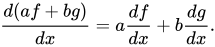
In Leibniz's notation this is written as:
d
(
a
f
+
b
g
)
d
x
=
a
d
f
d
x
+
b
d
g
d
x
.
{\displaystyle {\frac {d(af+bg)}{dx}}=a{\frac {df}{dx}}+b{\frac {dg}{dx}}.}
Special cases include:
The constant factor rule
(
a
f
)
′
=
a
f
′
{\displaystyle (af)'=af'}
The sum rule
(
f
+
g
)
′
=
f
′
+
g
′
{\displaystyle (f+g)'=f'+g'}
The difference rule
(
f
−
g
)
′
=
f
′
−
g
′
.
{\displaystyle (f-g)'=f'-g'.}
The product rule [ edit ] For the functions
f
{\displaystyle f}
g
{\displaystyle g}
h
(
x
)
=
f
(
x
)
g
(
x
)
{\displaystyle h(x)=f(x)g(x)}
x
{\displaystyle x}
h
′
(
x
)
=
(
f
g
)
′
(
x
)
=
f
′
(
x
)
g
(
x
)
+
f
(
x
)
g
′
(
x
)
.
{\displaystyle h'(x)=(fg)'(x)=f'(x)g(x)+f(x)g'(x).}
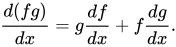
In Leibniz's notation this is written
d
(
f
g
)
d
x
=
g
d
f
d
x
+
f
d
g
d
x
.
{\displaystyle {\frac {d(fg)}{dx}}=g{\frac {df}{dx}}+f{\frac {dg}{dx}}.}
The chain rule [ edit ] The derivative of the function
h
(
x
)
=
f
(
g
(
x
)
)
{\displaystyle h(x)=f(g(x))}
h
′
(
x
)
=
f
′
(
g
(
x
)
)
⋅
g
′
(
x
)
.
{\displaystyle h'(x)=f'(g(x))\cdot g'(x).}
In Leibniz's notation, this is written as:
d
d
x
h
(
x
)
=
d
d
z
f
(
z
)
|
z
=
g
(
x
)
⋅
d
d
x
g
(
x
)
,
{\displaystyle {\frac {d}{dx}}h(x)=\left.{\frac {d}{dz}}f(z)\right|_{z=g(x)}\cdot {\frac {d}{dx}}g(x),}
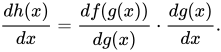
often abridged to
d
h
(
x
)
d
x
=
d
f
(
g
(
x
)
)
d
g
(
x
)
⋅
d
g
(
x
)
d
x
.
{\displaystyle {\frac {dh(x)}{dx}}={\frac {df(g(x))}{dg(x)}}\cdot {\frac {dg(x)}{dx}}.}
Focusing on the notion of maps, and the differential being a map
D
{\displaystyle {\text{D}}}
[
D
(
f
∘
g
)
]
x
=
[
D
f
]
g
(
x
)
⋅
[
D
g
]
x
.
{\displaystyle [{\text{D}}(f\circ g)]_{x}=[{\text{D}}f]_{g(x)}\cdot [{\text{D}}g]_{x}\,.}
The inverse function rule [ edit ] If the function f has an inverse function g , meaning that
g
(
f
(
x
)
)
=
x
{\displaystyle g(f(x))=x}
f
(
g
(
y
)
)
=
y
,
{\displaystyle f(g(y))=y,}
g
′
=
1
f
′
∘
g
.
{\displaystyle g'={\frac {1}{f'\circ g}}.}
In Leibniz notation, this is written as
d
x
d
y
=
1
d
y
d
x
.
{\displaystyle {\frac {dx}{dy}}={\frac {1}{\frac {dy}{dx}}}.}
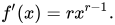
Power laws, polynomials, quotients, and reciprocals [ edit ] The polynomial or elementary power rule [ edit ] If
f
(
x
)
=
x
r
{\displaystyle f(x)=x^{r}}
r
≠
0
,
{\displaystyle r\neq 0,}
f
′
(
x
)
=
r
x
r
−
1
.
{\displaystyle f'(x)=rx^{r-1}.}
When
r
=
1
,
{\displaystyle r=1,}
f
(
x
)
=
x
,
{\displaystyle f(x)=x,}
f
′
(
x
)
=
1.
{\displaystyle f'(x)=1.}
Combining the power rule with the sum and constant multiple rules permits the computation of the derivative of any polynomial.
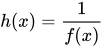
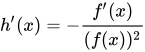
The reciprocal rule [ edit ] The derivative of
h
(
x
)
=
1
f
(
x
)
{\displaystyle h(x)={\frac {1}{f(x)}}}
f
h
′
(
x
)
=
−
f
′
(
x
)
(
f
(
x
)
)
2
{\displaystyle h'(x)=-{\frac {f'(x)}{(f(x))^{2}}}}
f In Leibniz's notation, this is written
d
(
1
/
f
)
d
x
=
−
1
f
2
d
f
d
x
.
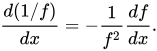
{\displaystyle {\frac {d(1/f)}{dx}}=-{\frac {1}{f^{2}}}{\frac {df}{dx}}.}
The reciprocal rule can be derived either from the quotient rule, or from the combination of power rule and chain rule.
The quotient rule [ edit ] If f g
(
f
g
)
′
=
f
′
g
−
g
′
f
g
2
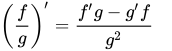
{\displaystyle \left({\frac {f}{g}}\right)'={\frac {f'g-g'f}{g^{2}}}\quad }
g This can be derived from the product rule and the reciprocal rule.
Generalized power rule [ edit ] The elementary power rule generalizes considerably. The most general power rule is the functional power rule : for any functions f g
(
f
g
)
′
=
(
e
g
ln
f
)
′
=
f
g
(
f
′
g
f
+
g
′
ln
f
)
,
{\displaystyle (f^{g})'=\left(e^{g\ln f}\right)'=f^{g}\left(f'{g \over f}+g'\ln f\right),\quad }
wherever both sides are well defined.
Special cases
If
f
(
x
)
=
x
a
{\textstyle f(x)=x^{a}\!}
f
′
(
x
)
=
a
x
a
−
1
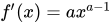
{\textstyle f'(x)=ax^{a-1}}
a x
The reciprocal rule may be derived as the special case where
g
(
x
)
=
−
1
{\textstyle g(x)=-1\!}
Derivatives of exponential and logarithmic functions [ edit ]
d
d
x
(
c
a
x
)
=
a
c
a
x
ln
c
,
c
>
0
{\displaystyle {\frac {d}{dx}}\left(c^{ax}\right)={ac^{ax}\ln c},\qquad c>0}
the equation above is true for all c , but the derivative for
c
<
0
{\textstyle c<0}
d
d
x
(
e
a
x
)
=
a
e
a
x
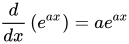
{\displaystyle {\frac {d}{dx}}\left(e^{ax}\right)=ae^{ax}}
d
d
x
(
log
c
x
)
=
1
x
ln
c
,
c
>
1
{\displaystyle {\frac {d}{dx}}\left(\log _{c}x\right)={1 \over x\ln c},\qquad c>1}
the equation above is also true for all c
c
<
0
{\textstyle c<0\!}
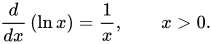
d
d
x
(
ln
x
)
=
1
x
,
x
>
0.
{\displaystyle {\frac {d}{dx}}\left(\ln x\right)={1 \over x},\qquad x>0.}
d
d
x
(
ln
|
x
|
)
=
1
x
,
x
≠
0.
{\displaystyle {\frac {d}{dx}}\left(\ln |x|\right)={1 \over x},\qquad x\neq 0.}
d
d
x
(
W
(
x
)
)
=
1
x
+
e
W
(
x
)
,
x
>
−
1
e
.
{\displaystyle {\frac {d}{dx}}\left(W(x)\right)={1 \over {x+e^{W(x)}}},\qquad x>-{1 \over e}.\qquad }
W
(
x
)
{\displaystyle W(x)}
Lambert W function
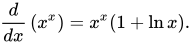
d
d
x
(
x
x
)
=
x
x
(
1
+
ln
x
)
.
{\displaystyle {\frac {d}{dx}}\left(x^{x}\right)=x^{x}(1+\ln x).}
d
d
x
(
f
(
x
)
g
(
x
)
)
=
g
(
x
)
f
(
x
)
g
(
x
)
−
1
d
f
d
x
+
f
(
x
)
g
(
x
)
ln
(
f
(
x
)
)
d
g
d
x
,
if
f
(
x
)
>
0
,
and if
d
f
d
x
and
d
g
d
x
exist.
{\displaystyle {\frac {d}{dx}}\left(f(x)^{g(x)}\right)=g(x)f(x)^{g(x)-1}{\frac {df}{dx}}+f(x)^{g(x)}\ln {(f(x))}{\frac {dg}{dx}},\qquad {\text{if }}f(x)>0,{\text{ and if }}{\frac {df}{dx}}{\text{ and }}{\frac {dg}{dx}}{\text{ exist.}}}
d
d
x
(
f
1
(
x
)
f
2
(
x
)
(
.
.
.
)
f
n
(
x
)
)
=
[
∑
k
=
1
n
∂
∂
x
k
(
f
1
(
x
1
)
f
2
(
x
2
)
(
.
.
.
)
f
n
(
x
n
)
)
]
|
x
1
=
x
2
=
.
.
.
=
x
n
=
x
,
if
f
i
<
n
(
x
)
>
0
and
{\displaystyle {\frac {d}{dx}}\left(f_{1}(x)^{f_{2}(x)^{\left(...\right)^{f_{n}(x)}}}\right)=\left[\sum \limits _{k=1}^{n}{\frac {\partial }{\partial x_{k}}}\left(f_{1}(x_{1})^{f_{2}(x_{2})^{\left(...\right)^{f_{n}(x_{n})}}}\right)\right]{\biggr \vert }_{x_{1}=x_{2}=...=x_{n}=x},{\text{ if }}f_{i<n}(x)>0{\text{ and }}}
d
f
i
d
x
exists.
{\displaystyle {\frac {df_{i}}{dx}}{\text{ exists. }}}
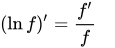
Logarithmic derivatives [ edit ] The logarithmic derivative is another way of stating the rule for differentiating the logarithm of a function (using the chain rule):
(
ln
f
)
′
=
f
′
f
{\displaystyle (\ln f)'={\frac {f'}{f}}\quad }
f Logarithmic differentiation is a technique which uses logarithms and its differentiation rules to simplify certain expressions before actually applying the derivative.[citation needed
Logarithms can be used to remove exponents, convert products into sums, and convert division into subtraction — each of which may lead to a simplified expression for taking derivatives.
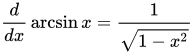
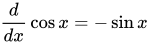
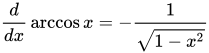
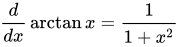
Derivatives of trigonometric functions [ edit ]
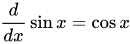
d
d
x
sin
x
=
cos
x
{\displaystyle {\frac {d}{dx}}\sin x=\cos x}
d
d
x
arcsin
x
=
1
1
−
x
2
{\displaystyle {\frac {d}{dx}}\arcsin x={\frac {1}{\sqrt {1-x^{2}}}}}
d
d
x
cos
x
=
−
sin
x
{\displaystyle {\frac {d}{dx}}\cos x=-\sin x}
d
d
x
arccos
x
=
−
1
1
−
x
2
{\displaystyle {\frac {d}{dx}}\arccos x=-{\frac {1}{\sqrt {1-x^{2}}}}}
d
d
x
tan
x
=
sec
2
x
=
1
cos
2
x
=
1
+
tan
2
x
{\displaystyle {\frac {d}{dx}}\tan x=\sec ^{2}x={\frac {1}{\cos ^{2}x}}=1+\tan ^{2}x}
d
d
x
arctan
x
=
1
1
+
x
2
{\displaystyle {\frac {d}{dx}}\arctan x={\frac {1}{1+x^{2}}}}
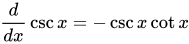
d
d
x
csc
x
=
−
csc
x
cot
x
{\displaystyle {\frac {d}{dx}}\csc x=-\csc {x}\cot {x}}
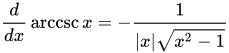
d
d
x
arccsc
x
=
−
1
|
x
|
x
2
−
1
{\displaystyle {\frac {d}{dx}}\operatorname {arccsc} x=-{\frac {1}{|x|{\sqrt {x^{2}-1}}}}}
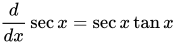
d
d
x
sec
x
=
sec
x
tan
x
{\displaystyle {\frac {d}{dx}}\sec x=\sec {x}\tan {x}}
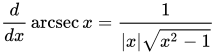
d
d
x
arcsec
x
=
1
|
x
|
x
2
−
1
{\displaystyle {\frac {d}{dx}}\operatorname {arcsec} x={\frac {1}{|x|{\sqrt {x^{2}-1}}}}}
d
d
x
cot
x
=
−
csc
2
x
=
−
1
sin
2
x
=
−
1
−
cot
2
x
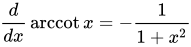
{\displaystyle {\frac {d}{dx}}\cot x=-\csc ^{2}x=-{\frac {1}{\sin ^{2}x}}=-1-\cot ^{2}x}
d
d
x
arccot
x
=
−
1
1
+
x
2
{\displaystyle {\frac {d}{dx}}\operatorname {arccot} x=-{1 \over 1+x^{2}}}
The derivatives in the table above are for when the range of the inverse secant is
[
0
,
π
]
{\displaystyle [0,\pi ]\!}
[
−
π
2
,
π
2
]
.
{\displaystyle \left[-{\frac {\pi }{2}},{\frac {\pi }{2}}\right].}
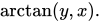
It is common to additionally define an inverse tangent function with two arguments ,
arctan
(
y
,
x
)
.
{\displaystyle \arctan(y,x).}
[
−
π
,
π
]
{\displaystyle [-\pi ,\pi ]}
(
x
,
y
)
.
{\displaystyle (x,y).}
x
>
0
{\displaystyle x>0}
arctan
(
y
,
x
>
0
)
=
arctan
(
y
/
x
)
.
{\displaystyle \arctan(y,x>0)=\arctan(y/x).}
∂
arctan
(
y
,
x
)
∂
y
=
x
x
2
+
y
2
and
∂
arctan
(
y
,
x
)
∂
x
=
−
y
x
2
+
y
2
.
{\displaystyle {\frac {\partial \arctan(y,x)}{\partial y}}={\frac {x}{x^{2}+y^{2}}}\qquad {\text{and}}\qquad {\frac {\partial \arctan(y,x)}{\partial x}}={\frac {-y}{x^{2}+y^{2}}}.}
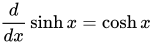
Derivatives of hyperbolic functions [ edit ]
d
d
x
sinh
x
=
cosh
x
{\displaystyle {\frac {d}{dx}}\sinh x=\cosh x}
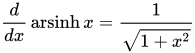
d
d
x
arsinh
x
=
1
1
+
x
2
{\displaystyle {\frac {d}{dx}}\operatorname {arsinh} x={\frac {1}{\sqrt {1+x^{2}}}}}
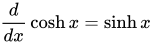
d
d
x
cosh
x
=
sinh
x
{\displaystyle {\frac {d}{dx}}\cosh x=\sinh x}
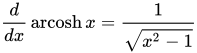
d
d
x
arcosh
x
=
1
x
2
−
1
{\displaystyle {\frac {d}{dx}}\operatorname {arcosh} x={\frac {1}{\sqrt {x^{2}-1}}}}
d
d
x
tanh
x
=
sech
2
x
=
1
−
tanh
2
x
{\displaystyle {\frac {d}{dx}}\tanh x={\operatorname {sech} ^{2}x}=1-\tanh ^{2}x}
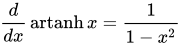
d
d
x
artanh
x
=
1
1
−
x
2
{\displaystyle {\frac {d}{dx}}\operatorname {artanh} x={\frac {1}{1-x^{2}}}}
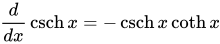
d
d
x
csch
x
=
−
csch
x
coth
x
{\displaystyle {\frac {d}{dx}}\operatorname {csch} x=-\operatorname {csch} {x}\coth {x}}
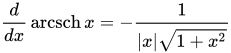
d
d
x
arcsch
x
=
−
1
|
x
|
1
+
x
2
{\displaystyle {\frac {d}{dx}}\operatorname {arcsch} x=-{\frac {1}{|x|{\sqrt {1+x^{2}}}}}}
d
d
x
sech
x
=
−
sech
x
tanh
x
{\displaystyle {\frac {d}{dx}}\operatorname {sech} x=-\operatorname {sech} {x}\tanh {x}}
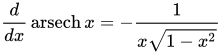
d
d
x
arsech
x
=
−
1
x
1
−
x
2
{\displaystyle {\frac {d}{dx}}\operatorname {arsech} x=-{\frac {1}{x{\sqrt {1-x^{2}}}}}}
d
d
x
coth
x
=
−
csch
2
x
=
1
−
coth
2
x
{\displaystyle {\frac {d}{dx}}\coth x=-\operatorname {csch} ^{2}x=1-\coth ^{2}x}
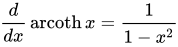
d
d
x
arcoth
x
=
1
1
−
x
2
{\displaystyle {\frac {d}{dx}}\operatorname {arcoth} x={\frac {1}{1-x^{2}}}}
See Hyperbolic functions for restrictions on these derivatives.
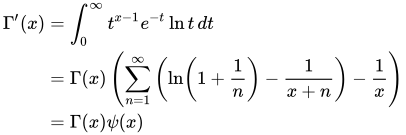
Derivatives of special functions [ edit ] Gamma function
Γ
(
x
)
=
∫
0
∞
t
x
−
1
e
−
t
d
t
{\displaystyle \Gamma (x)=\int _{0}^{\infty }t^{x-1}e^{-t}\,dt}
Γ
′
(
x
)
=
∫
0
∞
t
x
−
1
e
−
t
ln
t
d
t
=
Γ
(
x
)
(
∑
n
=
1
∞
(
ln
(
1
+
1
n
)
−
1
x
+
n
)
−
1
x
)
=
Γ
(
x
)
ψ
(
x
)
{\displaystyle {\begin{aligned}\Gamma '(x)&=\int _{0}^{\infty }t^{x-1}e^{-t}\ln t\,dt\\&=\Gamma (x)\left(\sum _{n=1}^{\infty }\left(\ln \left(1+{\dfrac {1}{n}}\right)-{\dfrac {1}{x+n}}\right)-{\dfrac {1}{x}}\right)\\&=\Gamma (x)\psi (x)\end{aligned}}}
with
ψ
(
x
)
{\displaystyle \psi (x)}
digamma function , expressed by the parenthesized expression to the right of
Γ
(
x
)
{\displaystyle \Gamma (x)}
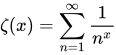
Riemann zeta function
ζ
(
x
)
=
∑
n
=
1
∞
1
n
x
{\displaystyle \zeta (x)=\sum _{n=1}^{\infty }{\frac {1}{n^{x}}}}
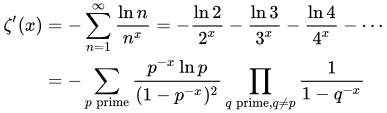
ζ
′
(
x
)
=
−
∑
n
=
1
∞
ln
n
n
x
=
−
ln
2
2
x
−
ln
3
3
x
−
ln
4
4
x
−
⋯
=
−
∑
p
prime
p
−
x
ln
p
(
1
−
p
−
x
)
2
∏
q
prime
,
q
≠
p
1
1
−
q
−
x
{\displaystyle {\begin{aligned}\zeta '(x)&=-\sum _{n=1}^{\infty }{\frac {\ln n}{n^{x}}}=-{\frac {\ln 2}{2^{x}}}-{\frac {\ln 3}{3^{x}}}-{\frac {\ln 4}{4^{x}}}-\cdots \\&=-\sum _{p{\text{ prime}}}{\frac {p^{-x}\ln p}{(1-p^{-x})^{2}}}\prod _{q{\text{ prime}},q\neq p}{\frac {1}{1-q^{-x}}}\end{aligned}}}
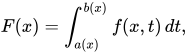
Derivatives of integrals [ edit ] Suppose that it is required to differentiate with respect to x the function
F
(
x
)
=
∫
a
(
x
)
b
(
x
)
f
(
x
,
t
)
d
t
,
{\displaystyle F(x)=\int _{a(x)}^{b(x)}f(x,t)\,dt,}
where the functions
f
(
x
,
t
)
{\displaystyle f(x,t)}
∂
∂
x
f
(
x
,
t
)
{\displaystyle {\frac {\partial }{\partial x}}\,f(x,t)}
t
{\displaystyle t}
x
{\displaystyle x}
(
t
,
x
)
{\displaystyle (t,x)}
a
(
x
)
≤
t
≤
b
(
x
)
,
{\displaystyle a(x)\leq t\leq b(x),}
x
0
≤
x
≤
x
1
{\displaystyle x_{0}\leq x\leq x_{1}}
a
(
x
)
{\displaystyle a(x)}
b
(
x
)
{\displaystyle b(x)}
x
0
≤
x
≤
x
1
{\displaystyle x_{0}\leq x\leq x_{1}}
x
0
≤
x
≤
x
1
{\displaystyle \,x_{0}\leq x\leq x_{1}}
F
′
(
x
)
=
f
(
x
,
b
(
x
)
)
b
′
(
x
)
−
f
(
x
,
a
(
x
)
)
a
′
(
x
)
+
∫
a
(
x
)
b
(
x
)
∂
∂
x
f
(
x
,
t
)
d
t
.
{\displaystyle F'(x)=f(x,b(x))\,b'(x)-f(x,a(x))\,a'(x)+\int _{a(x)}^{b(x)}{\frac {\partial }{\partial x}}\,f(x,t)\;dt\,.}
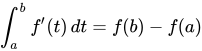
This formula is the general form of the Leibniz integral rule and can be derived using the
fundamental theorem of calculus .
Derivatives to n th order [ edit ] Some rules exist for computing the n -th derivative of functions, where n is a positive integer. These include:
Faà di Bruno's formula [ edit ] If f and g are n -times differentiable, then
d
n
d
x
n
[
f
(
g
(
x
)
)
]
=
n
!
∑
{
k
m
}
f
(
r
)
(
g
(
x
)
)
∏
m
=
1
n
1
k
m
!
(
g
(
m
)
(
x
)
)
k
m
{\displaystyle {\frac {d^{n}}{dx^{n}}}[f(g(x))]=n!\sum _{\{k_{m}\}}f^{(r)}(g(x))\prod _{m=1}^{n}{\frac {1}{k_{m}!}}\left(g^{(m)}(x)\right)^{k_{m}}}
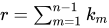
where
r
=
∑
m
=
1
n
−
1
k
m
{\textstyle r=\sum _{m=1}^{n-1}k_{m}}
and the set
{
k
m
}
{\displaystyle \{k_{m}\}}
consists of all non-negative integer solutions of the Diophantine equation
∑
m
=
1
n
m
k
m
=
n
{\textstyle \sum _{m=1}^{n}mk_{m}=n}
.
General Leibniz rule [ edit ] If f and g are n -times differentiable, then
d
n
d
x
n
[
f
(
x
)
g
(
x
)
]
=
∑
k
=
0
n
(
n
k
)
d
n
−
k
d
x
n
−
k
f
(
x
)
d
k
d
x
k
g
(
x
)
{\displaystyle {\frac {d^{n}}{dx^{n}}}[f(x)g(x)]=\sum _{k=0}^{n}{\binom {n}{k}}{\frac {d^{n-k}}{dx^{n-k}}}f(x){\frac {d^{k}}{dx^{k}}}g(x)}
See also [ edit ] References [ edit ]
^ Calculus (5th edition) , F. Ayres, E. Mendelson, Schaum's Outline Series, 2009, ISBN 978-0-07-150861-2 .^ Advanced Calculus (3rd edition) , R. Wrede, M.R. Spiegel, Schaum's Outline Series, 2010, ISBN 978-0-07-162366-7 .^ Complex Variables , M.R. Spiegel, S. Lipschutz, J.J. Schiller, D. Spellman, Schaum's Outlines Series, McGraw Hill (USA), 2009, ISBN 978-0-07-161569-3 ^ "Differentiation Rules" . University of Waterloo – CEMC Open Courseware . Retrieved 3 May 2022 .
Sources and further reading [ edit ] These rules are given in many books, both on elementary and advanced calculus, in pure and applied mathematics. Those in this article (in addition to the above references) can be found in:
Mathematical Handbook of Formulas and Tables (3rd edition) , S. Lipschutz, M.R. Spiegel, J. Liu, Schaum's Outline Series, 2009, ISBN 978-0-07-154855-7 .The Cambridge Handbook of Physics Formulas , G. Woan, Cambridge University Press, 2010, ISBN 978-0-521-57507-2 .Mathematical methods for physics and engineering , K.F. Riley, M.P. Hobson, S.J. Bence, Cambridge University Press, 2010, ISBN 978-0-521-86153-3 NIST Handbook of Mathematical Functions , F. W. J. Olver, D. W. Lozier, R. F. Boisvert, C. W. Clark, Cambridge University Press, 2010, ISBN 978-0-521-19225-5 .External links [ edit ]



















![{\displaystyle [{\text{D}}(f\circ g)]_{x}=[{\text{D}}f]_{g(x)}\cdot [{\text{D}}g]_{x}\,.}](https://wikimedia.org/api/rest_v1/media/math/render/svg/624f2d85795ec0b7c5d54e5dd6ed8fddcdcfca36)















![{\displaystyle {\frac {d}{dx}}\left(f_{1}(x)^{f_{2}(x)^{\left(...\right)^{f_{n}(x)}}}\right)=\left[\sum \limits _{k=1}^{n}{\frac {\partial }{\partial x_{k}}}\left(f_{1}(x_{1})^{f_{2}(x_{2})^{\left(...\right)^{f_{n}(x_{n})}}}\right)\right]{\biggr \vert }_{x_{1}=x_{2}=...=x_{n}=x},{\text{ if }}f_{i<n}(x)>0{\text{ and }}}](https://wikimedia.org/api/rest_v1/media/math/render/svg/0e52623821c09e999ec428d4b2264ed2123e6c5c)



![{\displaystyle [0,\pi ]\!}](https://wikimedia.org/api/rest_v1/media/math/render/svg/cb175ba2045ce5c320e0942973d0168dee16551a)
![{\displaystyle \left[-{\frac {\pi }{2}},{\frac {\pi }{2}}\right].}](https://wikimedia.org/api/rest_v1/media/math/render/svg/c631b663bb72b84a42765b6c31c1de35cc75dc2c)
![{\displaystyle [-\pi ,\pi ]}](https://wikimedia.org/api/rest_v1/media/math/render/svg/cb064fd6c55820cfa660eabeeda0f6e3c4935ae6)

















![{\displaystyle {\frac {d^{n}}{dx^{n}}}[f(g(x))]=n!\sum _{\{k_{m}\}}f^{(r)}(g(x))\prod _{m=1}^{n}{\frac {1}{k_{m}!}}\left(g^{(m)}(x)\right)^{k_{m}}}](https://wikimedia.org/api/rest_v1/media/math/render/svg/bfcc1b623a73361d1291918e4cb9b09b1e1be5f3)


![{\displaystyle {\frac {d^{n}}{dx^{n}}}[f(x)g(x)]=\sum _{k=0}^{n}{\binom {n}{k}}{\frac {d^{n-k}}{dx^{n-k}}}f(x){\frac {d^{k}}{dx^{k}}}g(x)}](https://wikimedia.org/api/rest_v1/media/math/render/svg/63405be1615e41e5620d8b0c45f48b7dd7e6f2ef)