


Hark! The Herald Angels Sing
| Hark! The Herald Angels Sing | |
|---|---|
 Worship of the Shepherds, 1539, by Bronzino | |
| Genre | Christmas carol |
| Written | 1739 |
| Text | Charles Wesley, adapted by George Whitefield and others |
| Based on | Luke 2:14 |
| Meter | 7.7.7.7 D with refrain |
| Melody | "Vaterland, in deinen Gauen" from Festgesang by Felix Mendelssohn, adapted by William H. Cummings |
"Hark! The Herald Angels Sing" is an English Christmas carol that first appeared in 1739 in the collection Hymns and Sacred Poems. The carol, based on Luke 2:14, tells of an angelic chorus singing praises to God. As it is known in the modern era, it features lyrical contributions from Charles Wesley and George Whitefield, two of the founding ministers of Methodism, with music adapted from "Vaterland, in deinen Gauen" of Felix Mendelssohn's cantata Festgesang (Gutenberg Cantata).
Wesley had written the original version as "Hymn for Christmas-Day" with the opening couplet "Hark! how all the Welkin (heaven) rings / Glory to the King of Kings".[1] Whitefield changed that to today's familiar lyric: "Hark! The Herald Angels sing, / 'Glory to the new-born King' ".[2] In 1840—a hundred years after the publication of Hymns and Sacred Poems—Mendelssohn composed a cantata to commemorate Johannes Gutenberg's invention of movable type, and it is music from this cantata, adapted by the English musician William H. Cummings to fit the lyrics of "Hark! The Herald Angels Sing", that is used for the carol today.[3][2]
Textual history[edit]
The original hymn text was written as a "Hymn for Christmas-Day" by Charles Wesley, included in the 1739 John Wesley collection Hymns and Sacred Poems.[4] The first stanza (verse) describes the announcement of Jesus's birth. Wesley's original hymn began with the opening line "Hark how all the Welkin rings". This was changed to the familiar "Hark! the Herald Angels sing" by George Whitefield in his 1754 Collection of Hymns for Social Worship.[5] A second change was made in the 1782 publication of the Tate and Brady New Version of the Psalms of David. In this work, Whitefield's adaptation of Wesley's hymn appears, with the repetition of the opening line "Hark! the Herald Angels sing/ Glory to the newborn king" at the end of each stanza, as it is commonly sung today.[6]
| "Hymn for Christmas-Day" (Charles Wesley, 1739)[7] |
Adaptation by George Whitefield (1758)[8] |
Carols for Choirs (1961)[9] |
|---|---|---|
HARK how all the Welkin rings |
HARK! the Herald Angels sing |
Hark! The herald-angels sing |
CHRIST, by highest Heav'n ador'd, |
Christ by highest Heav'n ador'd, |
Christ, by highest heaven adored |
Hail the Heav'nly Prince of Peace! |
Hail the Heav'n-born Prince of Peace |
Hail the Heaven-born Prince of Peace! |
Come, Desire of Nations, come, |
Come, Desire of Nations, come, | |
Adam's Likeness, LORD, efface, |
Adam's Likeness now efface, |
Melodies[edit]
Mendelssohn melody[edit]
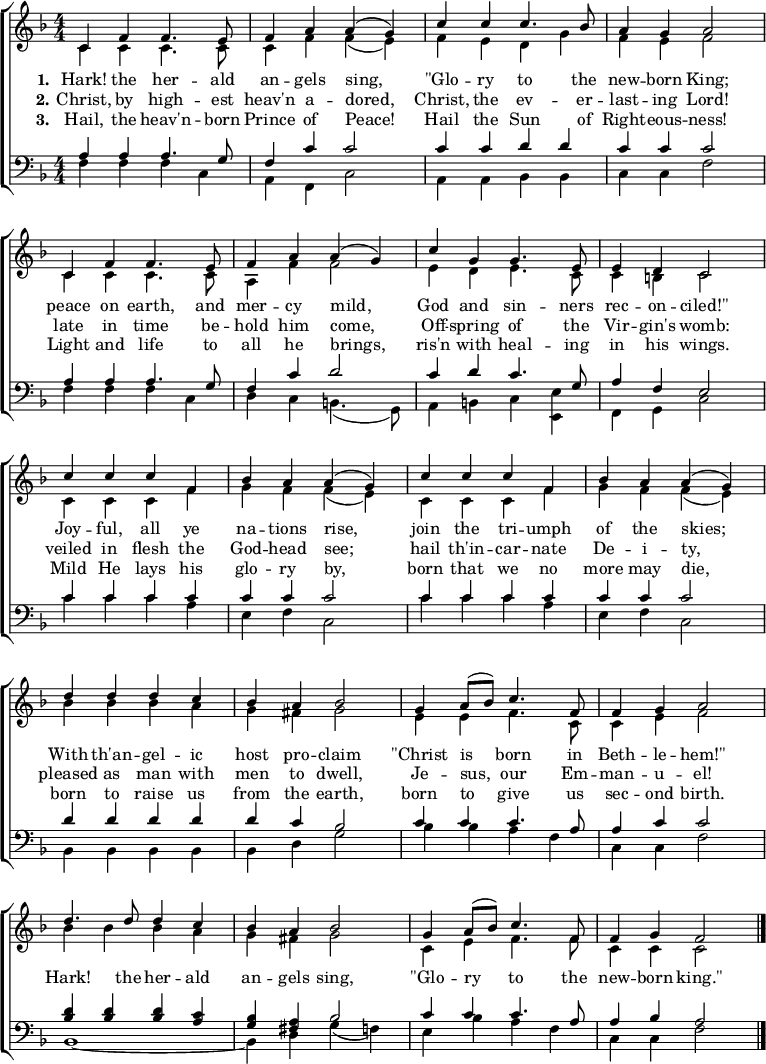
In 1855, British musician William Hayman Cummings, organist at Waltham Abbey Church,[11] adapted Felix Mendelssohn's secular music from Festgesang to fit the lyrics of "Hark! The Herald Angels Sing" written by Charles Wesley.[12] Wesley had originally envisioned the song being sung to the same tune as his Easter song "Christ the Lord Is Risen Today".[13]
"Hark! The Herald Angels Sing" was regarded as one of the Great Four Anglican Hymns and published as number 403 in The Church Hymn Book (New York and Chicago, 1872).[14]
In Britain, "Hark! The Herald Angels Sing" has popularly been performed in an arrangement that maintains the basic original William H. Cummings harmonisation of the Mendelssohn tune for the first two verses, but adds a soprano descant and a last verse harmonisation for the organ in verse three by Sir David Willcocks. This arrangement was first published in 1961 by Oxford University Press in the first book of the Carols for Choirs series. For many years it has served as the recessional hymn of the annual service of Nine Lessons and Carols at King's College Chapel, Cambridge.[15]
Advent adaptation[edit]
Mendelssohn's melody has been used for a 1990 Advent song in German, "In das Warten dieser Welt" (Into the waiting of this world) by Johannes Jourdan. It is part of regional sections of the common Catholic hymnal Gotteslob and songbooks.[16]
Handel melody[edit]
An uncommon arrangement of the hymn to the tune "See, the Conqu'ring hero comes" from Handel's Judas Maccabaeus, normally associated with the hymn "Thine Be the Glory", is traditionally[17] used as the recessional hymn of the Festival of Nine Lessons and Carols at St Patrick's Cathedral, Dublin. This is broadcast live each year on Christmas Eve on RTÉ Radio 1. The usual (first) three verses are divided into six verses, each with chorus. The arrangement features a brass fanfare with drums in addition to the cathedral organ, and takes about seven and a half minutes to sing. The Victorian organist W. H. Jude, in his day a popular composer, also composed a new setting of the work, published in his Music and the Higher Life.[18]
See also[edit]
- "Tochter Zion, freue dich", to the tune of Handel's "See, the Conqu'ring hero comes"
- List of Christmas carols
Footnotes[edit]
Notes
- ^ This line is a reference to Malachi 4:2 ("But for you who revere my name the sun of righteousness shall rise, with healing in its wings. You shall go out leaping like calves from the stall."), but is often mistakenly changed to "Son of righteousness".[10]
Citations
- ^ "Hymn Texts and Tunes: Hark! the herald angels sing (125)". Evangelical Lutheran Hymnary Handbook. Bethany Lutheran College. Retrieved 15 July 2023.
- ^ a b "Hark! the Herald Angels Sing" at Hymns and Carols of Christmas
- ^ John Wesley; Charles Wesley (1743). Hymns and Sacred Poems (4th ed.). Bristol: Felix Farley. pp. 142–143 – via Internet Archive.
- ^ Watson, J. R. (1997). "9. John and Charles Wesley". The English Hymn: A Critical and Historical Study. Oxford: Clarendon Press. pp. 205–229. ISBN 0198267622 – via Internet Archive.
- ^ Whitefield, George (1754). A Collection of Hymns for Social Worship. London: William Strahan.
- ^ Tate, Nahum; Nicholas Brady (1782). A New Version of the Psalms of David: Fitted to the Tunes Used in Churches. Cambridge: J. Archdeacon.
- ^ Wesley, John; Wesley, Charles (1739). "Hymn for Christmas-Day". Hymns and Sacred Poems. London: William Strahan. pp. 206–208.
- ^ Whitefield, George (1758). "XXXI. Hark! the Herald Angels sing". A Collection of Hymns for Social Worship, More Particularly Designed for the Use of the Tabernacle and Chapel Congregations in London. London: William Strahan. p. 24 – via Google Play.
- ^ Willcocks, David; Jacques, Reginald, eds. (1961). "Hark! The Herald Angels Sing". Carols for Choirs. Vol. 1. Oxford: Oxford University Press. p. 39 – via Internet Archive.
- ^ Fentress, Sara Beth (13 December 2018). "Hark! Thoughts on a Christmas Classic". cfc.sebts.edu. The Center for Faith and Culture. Retrieved 16 March 2022.
- ^ "Christmas Classics Person of the Day: William Hayman Cummings". Christmas Classics Ltd. 30 August 2013. Retrieved 19 December 2023 – via Waltham Abbey Archives.
- ^ Hark the Herald Angels Sing carols.org.uk
- ^ "Hark! The Herald Angels Sing". SongFacts.
- ^ Breed, David (1934). The History and Use Hymns and Hymn-Tunes. Old Tappan, New Jersey: Fleming H. Revell Company. Retrieved 25 December 2013.
- ^ "Nine Lessons and Carols". King's College, Cambridge. Archived from the original on 16 October 2007. Retrieved 25 October 2007.
- ^ "In das Warten dieser Welt". evangeliums.net (in German). 2023. Retrieved 18 December 2023.
- ^ C. George Bannister (March 1944). "Cornet v. Trumpet". The Musical Times. 85 (1213): 91. doi:10.2307/921578. JSTOR 921578.
- ^ Hark! The Herald Angels Sing, National Library of Australia.
External links[edit]

 Media related to Hark the Herald Angels Sing at Wikimedia Commons
- "Hark! The Herald Angels Sing" (Cummings): Scores at the International Music Score Library Project
- "Hark! The Herald Angels Sing", various versions at Hymns and Carols of Christmas
- "Hark! The Herald Angels Sing" on YouTube (to the arrangement by David Willcocks) sung by the Georgia Boy Choir
- Animated score and orchestral MIDI rendition on YouTube, Mendelssohn's "Vaterland, in deinen Gauen" from his Festgesang


| National | |
|---|---|
| Other | |
