


Loch Ness
| Loch Ness | |
|---|---|
 With Urquhart Castle in the foreground | |
  Loch Ness | |
| Location | Scottish Highlands |
| Coordinates | 57°18′N 4°27′W / 57.300°N 4.450°W |
| Type | freshwater loch, oligotrophic, dimictic[1] |
| Primary inflows | River Oich/Caledonian Canal, River Moriston, River Foyers, River Enrick, River Coiltie |
| Primary outflows | River Ness/Caledonian Canal |
| Catchment area | 1,770 km2 (685 sq mi) |
| Basin countries | Scotland, United Kingdom |
| Max. length | 36.2 km (22.5 mi) |
| Max. width | 2.7 km (1.7 mi) |
| Surface area | 56 km2 (21.8 sq mi) |
| Average depth | 132 m (433 ft) |
| Max. depth | 226.96 m (124.10 fathoms; 744.6 ft)[2] |
| Water volume | 7.5 km3 (1.8 cu mi) |
| Surface elevation | 15.8 m (52 ft) |
| Islands | 1 (Cherry Island) |
| Settlements | Fort Augustus, Invermoriston, Drumnadrochit, Abriachan, Lochend; Whitebridge, Foyers, Inverfarigaig, Dores. |
Loch Ness (/ˌlɒx ˈnɛs/; Scottish Gaelic: Loch Nis [l̪ˠɔx ˈniʃ]) is a large freshwater loch in the Scottish Highlands extending for approximately 37 kilometres (23 miles) along the length of the Great Glen southwest of Inverness. It takes its name from the River Ness, which flows from the northern end. Loch Ness is best known for claimed sightings of the cryptozoological Loch Ness Monster, also known affectionately as "Nessie" (Scottish Gaelic: Niseag). It is one of a series of interconnected, murky bodies of water in Scotland; its water visibility is exceptionally low due to the high peat content of the surrounding soil. The southern end connects to Loch Oich by the River Oich and a section of the Caledonian Canal. The northern end connects to Loch Dochfour via the River Ness, which then ultimately leads to the North Sea via the Moray Firth.
At 56 km2 (22 sq mi), Loch Ness is the second-largest Scottish loch by surface area after Loch Lomond[citation needed], but due to its great depth it is the largest by volume in Great Britain[citation needed]. Its deepest point is 230 metres (126 fathoms; 755 feet), making it the second deepest loch in Scotland after Loch Morar[citation needed]. It contains more water than all the lakes in England and Wales combined[citation needed], and is the largest body of water in the Great Glen, which runs from Inverness in the north to Fort William in the south. Its surface is 16 metres (52 feet) above sea level. It contains a single, artificial island named Cherry Island (Scottish Gaelic: Eilean Muireach) at the southwestern end. There are nine villages around the loch, as well as Urquhart Castle; the village of Drumnadrochit contains a "Loch Ness Centre and Exhibition".
Geography
[edit]
Loch Ness is an elongated freshwater loch in the Scottish Highlands southwest of Inverness, extending for approximately 37 kilometres (23 miles) and flowing from southwest to northeast. At 56 km2 (22 sq mi), it is the second-largest Scottish loch by surface area after Loch Lomond, but due to its great depth it is the largest by volume in the British Isles.[citation needed] Its deepest point is 230 metres (126 fathoms; 755 feet),[3][4] making it the second deepest loch in Scotland after Loch Morar. A 2016 survey claimed to have discovered a crevice extending to a depth of 271 m (889 ft), but further research determined this to be a sonar anomaly.[5] Its surface is 16 metres (52 feet) above sea level. It contains more water than all the lakes in England and Wales combined,[4] and is the largest body of water in the Great Glen, which runs from Inverness in the north to Fort William in the south. Loch Ness lies along the Great Glen Fault, which forms a line of weakness in the rocks which has been excavated by glacial erosion, forming the Great Glen and the basins of Loch Lochy, Loch Oich and Loch Ness.[6]
Loch Ness has one small island, Cherry Island (Scottish Gaelic: Eilean Muireach, meaning Murdoch's Island), at the southwestern end of the loch. It is an artificial island, known as a crannog, and was likely constructed during the Iron Age.[7] The island was originally 160 feet (49 m) by 168 feet (51 m) across, but is now smaller as the water level was raised during the construction of the Caledonian Canal in the early nineteenth century.[7] There was formerly a second, natural island nearby named Dog Island (Scottish Gaelic: Eilean Nan Con), but it was submerged when the water level rose.[7][8] A castle stood on Cherry Island during the 15th century; this was constructed of stone and oak wood and was likely used as a fortified refuge. Rev. Odo Blundell, writing in 1909, suggested that Eilean Muireach may have been a hunting lodge, with Eilean nan Con the home for the hunting dogs.[7]
The loch is one of a series of interconnected, murky bodies of water in Scotland; its water visibility is exceptionally low due to a high peat content in the surrounding soil. The southern end is fed by the River Oich, which runs from Loch Oich. The northern end flows out through the Bona Narrows into Loch Dochfour; the Bathymetrical survey of the Scottish fresh-water lochs considered Loch Dochfour to be distinct from Loch Ness proper, but capable of being regarded as forming part of Loch Ness.[9] Dochgarroch weir at the downstream end of Loch Dochfour delineates the start of the River Ness, which connects to the nearby and ultimately leads through Inverness to the North Sea via the Moray Firth. Loch Ness forms part of the Caledonian Canal, which comprises 60 miles (100 kilometres) of waterways connecting the east coast of Scotland at Inverness with the west coast at Corpachthe near Fort William. Only one-third of the entire length is man-made, the rest being formed by Loch Dochfour, Loch Ness, Loch Oich, and Loch Lochy, with the man-made canals running parallel with rivers such as the River Oich.[10]
Villages and places
[edit]| Shore | Places |
|---|---|
| Northern | |
| Western | |
| Eastern | |
| Southern |
At Drumnadrochit is the "Loch Ness Centre and Exhibition"[11] which examines the natural history and legend of Loch Ness. Boat cruises operate from various locations on the loch shore, giving visitors the chance to look for the "monster".
Urquhart Castle is located on the western shore, 2 kilometres (1+1⁄4 miles) east of Drumnadrochit.
Lighthouses are located at the northern and southern ends at Lochend (Bona Lighthouse) and Fort Augustus. There is an RNLI lifeboat station on the northern shore near Drumnadrochit, which has been operational since 2008 and was the first non-coastal RNLI station.[12] It is staffed by a volunteer crew and equipped with an inshore lifeboat (ILB).[13]
Etymology
[edit]Loch Ness takes its name from the River Ness which flows from the loch's northern end. The river's name probably derives from an old Celtic word meaning 'roaring one'.[14] William Mackay in his 1893 book Urquhart and Glenmoriston: Olden times in a highland parish recounts two Scottish legends that have been reported as the source of the name. In the first, a spring in a valley had been enchanted by Daly the Druid for purity, with the admonition that the well opening must be covered by a stone whenever not in use, or else "desolation will overtake the land". One day a woman left the well uncovered when rushing to save her baby from a fire, and it overflowed and filled the vale, forming the loch. The inhabitants cried out "Tha loch 'nis ann, tha loch 'nis ann!" ("There's a loch now, there's a loch now!"), and so it was named "Loch Nis". A second legend, named "The Tales of the Sons of Uisneach" by Mackay and now considered part of the Ulster Cycle of Irish mythology, recounts the Irish woman Deirdre or Dearduil, "the most beautiful woman of her age", who was courted by the king of Ulster, Conachar MacNessa; she fell in love instead with his cousin Noais, son of Uisneach. They fled to Scotland and were married on the banks of the loch, but Noais was slain by MacNessa, and the Loch Naois, River Naois, and Iverness were named after him. Mackay claims that while these legends are not the "true" origin of the name, that many places in the district have names associated with "The Tales of the Sons of Uisneach", and that the same tales have Conachar MacNessa's mother as the river goddess Ness. He argued instead that the etymology of the Celtic "Ness" derived from earlier words for "river".[15]
Monster
[edit]Loch Ness is known as the home of the mythical Loch Ness Monster (also known as "Nessie"), a cryptid, reputedly a large unknown animal. It is similar to other supposed lake monsters in Scotland and elsewhere, though its description varies from one account to the next. Popular interest and belief in the animal's existence have varied since it was first brought to the world's attention in 1933.[16]
Fish species
[edit]
The following fish species are native to Loch Ness. A number of others such as perch and roach have been introduced in the Loch or Caledonian Canal with various levels of success.[17]
| European eel | Anguilla anguilla |
| Northern pike | Esox lucius |
| European sea sturgeon | Acipenser sturio (unconfirmed in the Loch, but known from Beauly–Moray Firth, which is connected via the River Ness) |
| Three-spined stickleback | Gasterosteus aculeatus. |
| Brook lamprey | Lampetra planeri |
| Eurasian minnow | Phoxinus phoxinus |
| Atlantic salmon | Salmo salar |
| Sea trout | Salmo trutta |
| Brown trout (ferox trout) | Salmo trutta (Salmo ferox) |
| Arctic char | Salvelinus alpinus |
Hydroelectricity
[edit]Loch Ness serves as the lower storage reservoir for the 300MW Foyers pumped-storage hydroelectric scheme, which opened in 1975.[2] A smaller (5MW) power station nearby used to provide power for an aluminium smelting plant, but now electricity is generated and supplied to the National Grid. Another scheme, the 100-megawatt Glendoe Hydro Scheme near Fort Augustus, began generation in June 2009.[18] It was out of service between 2009 and 2012 for repair of the tunnels connecting the reservoir to the turbines.[19][20] The 450 MW / 2.8 GWh Red John project was approved in 2021. If funded at £550 million, it would store 5 million cubic metres of water near Dores.[21][22]
Gallery
[edit]-
 Locks on Caledonian Canal in Fort Augustus, Loch Ness in the background
 -
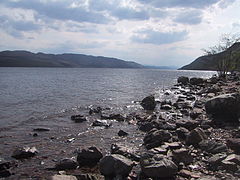 Loch Ness looking south, taken in May 2006.
 -
 Sunrise over Loch Ness, taken at Urquhart Castle
 -
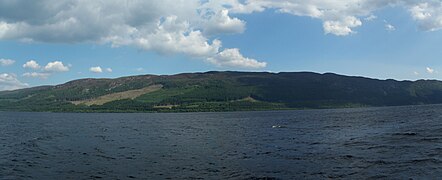 Loch Ness panorama from a ship in 2008
 -
 Cherry Island


Records
[edit]John Cobb died in an attempt at the water speed record in his boat Crusader in 1952.[23][better source needed] His accident was recorded by the BBC reporters on site at the time.[24] Nearby, there is a memorial to him erected by the people of Glenurquhart.
On 31 August 1974, David Scott Munro, of Ross-shire Caberfeidh Water Ski Club, became the first person in the world to water ski (mono ski) the length of Loch Ness. From Lochend to Fort Augustus and back, he covered the 77 km (48 miles) in 77 minutes at an average speed of 60 km/h (37 mph).[25]
In July 1966, Brenda Sherratt became the first person to swim the length of the loch. It took her 31 hours and 27 minutes to accomplish this feat.[26]
On 23 September 2022, swimmer Ross Edgley attempted the world's longest open water non-stop swim in Loch Ness. After 52 hours and 39 minutes he was forced to end his swim early due to the onset of cellulitis and hypothermia and was taken to hospital. The swim was done in support of Parley for the Oceans.[27]
References
[edit]- ^ Dill, W.A. (1993). Inland Fisheries of Europe, p. 227. EIFAC FAO Technical Report 52 suppl.
- ^ a b Cooper, Michael Colin (1999). "Site description" (PDF). Laminated Sediments of Loch Ness, Scotland: Indicators of Holocene Environmental Change (PhD). University of Plymouth. Retrieved 31 October 2021.
- ^ "Bathymetrical Survey of the Fresh-Water Lochs of Scotland, 1897–1909". National Library of Scotland. Archived from the original on 8 February 2007.
- ^ a b "Ness, Loch". The Gazetteer for Scotland. Archived from the original on 22 July 2011. Retrieved 9 February 2010.
- ^ "A new hideaway for the Loch Ness monster? Skipper claims to have uncovered deepest crevice yet". The Telegraph. Archived from the original on 21 March 2016. Retrieved 4 March 2016.
- ^ Piccardi, Luigi (2014). "Post-glacial activity and earthquakes of the Great Glen Fault (Scotland)" (PDF). Memorie Descrittive della Carta Geologica d'Italia. 96: 431–446. Archived (PDF) from the original on 20 April 2016. Retrieved 6 April 2016.
- ^ a b c d Blundell, O. (1909). Proceedings of the Society of Antiquaries of Scotland (PDF). Vol. 43. pp. 159–164. Archived (PDF) from the original on 31 October 2008. Retrieved 29 June 2008.
- ^ "EXAMINATION OF ARTIFICIAL ISLAND IN LOCH NESS" (PDF). Archived (PDF) from the original on 13 April 2022. Retrieved 21 August 2023.
- ^ "Lochs of the Ness Basin". Bathymetrical survey of the Scottish fresh-water lochs. 1910. p. 383.
- ^ "Caledonian Canal". Canals and rivers – Waterscape. British Waterways. Archived from the original on 5 March 2012.
- ^ "The Loch Ness Centre". Archived from the original on 20 June 2010. Retrieved 28 October 2021.
- ^ "RNLI is heading inland with Loch Ness Lifeboat". The Herald. Glasgow. 28 March 2008. Archived from the original on 28 October 2021. Retrieved 12 August 2020.
- ^ "Find my nearest > Lifeboat stations > Loch Ness Lifeboat Station". rnli.org. Royal National Lifeboat Institution. Archived from the original on 6 September 2020. Retrieved 12 August 2020.
- ^ "Online Etymology Dictionary". Archived from the original on 22 June 2020. Retrieved 20 June 2020.
- ^ Mackay, William (1893). Urquhart and Glenmoriston: Olden times in a highland parish. Northern Counties Newspaper and Printing and Publishing Company. pp. 5–7, 575.
- ^ Nessie, Legend of. "The Legend of Nessie the Ultimate Loch Ness Monster Site". www.nessie.co.uk. Archived from the original on 21 May 2013. Retrieved 28 February 2016.
- ^ Loch Ness Information site: The Fish and Invertebrates of Loch Ness. Archived 16 March 2015 at the Wayback Machine Retrieved 24 March 2015.
- ^ "Glendoe Hydro scheme". Scottish and Southern Energy. Archived from the original on 28 August 2007. Retrieved 28 August 2007.
- ^ "Hydro-electric scheme's dam close". BBC. 1 September 2008. Archived from the original on 5 January 2009. Retrieved 9 February 2010.
- ^ "SSE Glendoe".[permanent dead link]
- ^ Kajastie, Nia (17 June 2021). "Hydro scheme at Loch Ness gains planning consent". Ground Engineering (GE).
- ^ "Red John Pumped Storage Hydro Project". Power Technology. Archived from the original on 11 July 2021.
- ^ "Loch Ness could become testing ground for world water speed record 64 years after tragedy". Daily Express. 28 March 2016. Archived from the original on 20 January 2018. Retrieved 19 January 2018.
- ^ Gallacher, Terry (8 April 2011). "Loch Ness 1966". Archived from the original on 9 September 2011. Retrieved 24 May 2012.
- ^ Press & Journal newspaper. Inverness edition. 2 September 1974.
- ^ "Brenda Sherratt's Birthday Swim To Remember". Open Water Swimming. 8 June 2014. Archived from the original on 28 October 2021. Retrieved 17 August 2020.
- ^ "Grantham's Ross Edgley recalls challenge of 50-hour Loch Ness swim". BBC News. 5 October 2022.
External links
[edit]

 Media related to Loch Ness at Wikimedia Commons
- Media related to Cherry Island at Wikimedia Commons
 Loch Ness travel guide from Wikivoyage
- Cherry Island grid reference NH385102
- Cherry Island coordinates: 57°09′15″N 4°40′18″W / 57.15417°N 4.67153°W


| International | |
|---|---|
| National | |
