


Lodi Gardens
| Lodhi Gardens | |
|---|---|
  Location within New Delhi | |
| Type | Public park |
| Location | New Delhi, India |
| Area | 90 acres (360,000 m2) |
| Created | Lodhi Dynasty, Delhi Sultanate |
| Status | Open year round |
Lodi Gardens is a city park situated in New Delhi, India. Spread over 90 acres (360,000 m2),[1] it contains Mohammed Shah's Tomb, the Tomb of Sikandar Lodi, the Shisha Gumbad and the Bara Gumbad,[2] architectural works of the 15th century by Lodis - who ruled parts of northern India and Punjab and Khyber Pakhtunkhwa province of modern-day Pakistan, from 1451 to 1526 are present here. The site is now protected by the Archaeological Survey of India (ASI).[1]

The gardens are situated between Khan Market and Safdarjung's Tomb on Lodi Road and is a popular spot for morning walks for the Delhites.
Architecture
[edit]In the middle of the gardens is the Bara Gumbad ("Big Dome"), it consists of a large rubble-construct dome and is not a tomb[3] but was constructed as a gateway to either the attached three domed masjid (mosque) or a large walled enclosure. Both the Bara Gumbad and the mosque were built in 1494 during the reign of Sikander Lodi, there is also a residence surrounding a central courtyard, where the remains of a water tank can be seen. Opposite the Bara Gumbad is the Shisha Gumbad ("mirror dome") for the glazed tiles used in its construction, which contains graves, whose occupants are not clearly identifiable (either an unknown family of Sikandar Lodi's court or Bahlul Lodi).[4][5]

To the north of the garden are the remains of a stream which may once have run as far as the Yamuna River, and by its side is the Tomb of Sikandar Lodi. This structure still has the battlements enclosing it. Visible from Sikander's tomb is the Athpula ("Eight Piered") Bridge, one of the few monuments in Delhi that were built during the reign of Mughal Emperor Akbar,[6] it contains seven arches, amongst which the central one being the largest. The tomb of Mohammed Shah, the last of the Sayyid dynasty rulers, the earliest of the tombs in the garden, was built in 1444 by Ala-ud-din Alam Shah as a tribute to Mohammed Shah. The tomb is octagonal in shape, with numerous ornamental Hindu-style chhatris around the central dome, numerous arches, verandahs and sloping buttresses. There are turrets at each corner. The main tomb is supported by a 16-sided drum. It is of a flattened type and is surrounded by chhatris, which make it look diminutive compared to its substantially larger base. Several years later, the Tomb of Sikandar Lodi seems to have been copied from this Sayyid tomb.[7]
As there is little architecture dating to the Sayyid and the Lodi periods still standing, Lodi Gardens is an important archaeological site. The tomb of Mohammed Shah is visible from Lodi Road, and is the earliest structure in the gardens. It is a good example of a combination of the Hindu and Islamic styles of architecture. The Hindu features include eight chhatris, each of them capped by a lotus finial with a decorative band around the base; corner ornamental pinnacles (guldastas)and chhajja.[8]
Gallery
[edit]-
 Shisha Gumbad, Lodi Gardens
 -
 The three domed mosque, adjacent to Bada Gumbad, Lodi Gardens.
 -
 The eight piered bridge in Lodi gardens
 -
 A goose stands beside the lake at Lodi Gardens
 -
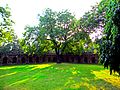 Walled enclosure of the Sikander Lodi's Tomb
 -
 Shisha Gumbad in front and Bara Gumbad with Mosque at back
 -
 The tomb of Mohammed Shah known as Mubarak Khan- Ka-Gumbaz
 -
 Tomb of Sikandar Lodi Built 1494 A.D.
 -
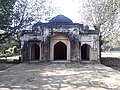 A Mosque including four walls of an enclosed garden

,_Lodhi_Gardens,_Delhi.jpg)
_Bridge_in_Lodi_gardens.JPG)


.jpg)

See also
[edit]- The Lodhi
- Delhi Sultanate
- Sunder Nursery
- List of Monuments of National Importance in Delhi
- Bara Gumbad
- Shisha Gumbad
- Sikandar Lodi
- Tomb of Bahlul Lodi
- Ibrahim Lodhi's Tomb
- Tomb of Sikandar Lodi
- Khwaja Khizr Tomb
References
[edit]- ^ a b "ASI have included the remaining unprotected monuments of Lodhi Garden under the Delhi Circle protection umbrella". The Hindu. 16 October 2002. Archived from the original on 2 August 2009. Retrieved 31 December 2008.
{{cite news}}: CS1 maint: unfit URL (link) - ^ "Heritage walk marks 75th anniversary of Lodi Garden". The Times of India. Archived from the original on 2 April 2013.
- ^ "Lodhi Garden | all the information you need about Lodhi Garden | Area around Lodhi Garden". schoolnearheart.blogspot.com. Retrieved 22 July 2022.
- ^ Simon Digby, The Tomb of Buhlul Lodi, The Bulletin of SOAS, Vol. 38, No. 3, 1975, pp. 550–61.
- ^ "Lodhi Garden in Delhi – Travel Guide". Indi Newz. 27 September 2019. Retrieved 22 October 2019.
- ^ SAIL to make Lodi Garden ‘stainless' The Times of India, Saurabh Sinha, TNN 14 August 2005.
- ^ Bhalla, A.S. Royal Tombs of India: 13th to 18th Century
- ^ "Muhammad Shah Sayyid Tomb". competentauthoritydelhi.co.in. Archived from the original on 30 June 2012.
Further reading
[edit]- Sunday at the Lodi Gardens, by Vinay Dharwadker. Published by Viking, 1994.
- Lalkot to Lodi Gardens: (Delhi of Sultans), by Ranjit Sinha. Published by South Asia Books, 1996. ISBN 81-7167-237-X
External links
[edit]
