


Luna (goddess)
| Luna | |
|---|---|
Goddess of the Moon | |
 Luna (AD 150–200, Musée d'Art et d'Histoire de Genève) | |
| Planet | Moon[1] |
| Symbol | Chariot, crescent moon |
| Day | Monday (dies Lunae) |
| Temples | Aventine Hill, Palatine Hill |
| Personal information | |
| Siblings | Sol, Aurora |
| Equivalents | |
| Greek equivalent | Selene |
| Indo-European equivalent | Meh₁not |
In Sabine and ancient Roman religion and myth, Luna is the divine embodiment of the Moon (Latin Lūna [ˈɫ̪uːnä]). She is often presented as the female complement of the Sun, Sol, conceived of as a god. Luna is also sometimes represented as an aspect of the Roman triple goddess (diva triformis), along with Diana and either Proserpina or Hecate. Luna is not always a distinct goddess, but sometimes rather an epithet that specializes a goddess, since both Diana and Juno are identified as moon goddesses.[2]
In Roman art, Luna attributes are the crescent moon plus the two-yoke chariot (biga). In the Carmen Saeculare, performed in 17 BC, Horace invokes her as the "two-horned queen of the stars" (siderum regina bicornis), bidding her to listen to the girls singing as Apollo listens to the boys.[3]
Varro categorized Luna and Sol among the visible gods, as distinguished from invisible gods such as Neptune, and deified mortals such as Hercules.[4] She was one of the deities Macrobius proposed as the secret tutelary of Rome.[5] In Imperial cult, Sol and Luna can represent the extent of Roman rule over the world, with the aim of guaranteeing peace.[6]
Luna's Greek counterpart was Selene. In Roman art and literature, myths of Selene are adapted under the name of Luna. The myth of Endymion, for instance, was a popular subject for Roman wall painting.[7]
Cult and temples[edit]

Varro lists Luna among twelve deities who are vital to agriculture,[8] as does Vergil in a different list of twelve, in which he refers to Luna and Sol as clarissima mundi lumina, the world's clearest sources of light.[9] Varro also lists Luna among twenty principal gods of Rome (di selecti).[10] In this list, Luna is distinguished from both Diana and Juno, who also appear on it.
The Romans dated the cultivation of Luna as a goddess at Rome to the semi-legendary days of the kings. Titus Tatius was supposed to have imported the cult of Luna to Rome from the Sabines,[11] but Servius Tullius was credited with the creation of the Temple of Luna on the Aventine Hill, just below a temple of Diana.[12] The anniversary of the temple founding (dies natalis) was celebrated annually on March 31.[13] It first appears in Roman literature in the story of how in 182 BC a windstorm of exceptional power blew off its doors, which crashed into the Temple of Ceres below it on the slope.[14] In 84 BC, it was struck by lightning, the same day the popularist leader Cinna was murdered by his troops.[15] The Aventine temple may have been destroyed by the Great Fire of Rome during the reign of Nero.[16]
As Noctiluna ("Night-Shiner") Luna had a temple on the Palatine Hill, which Varro described as shining or glowing by night. Nothing else is known about the temple, and it is unclear what Varro meant.[17]
Juno as Moon goddess[edit]
The Kalends of every month, when according to the lunar calendar the new moon occurred, was sacred to Juno, as all Ides were to Jupiter.[18] On the Nones, she was honored as Juno Covella, Juno of the crescent moon.[19] Both Juno and Diana were invoked as childbirth goddesses with the epithet Lucina.[20]
Chariot of the Moon[edit]
Luna is often depicted driving a two-yoke chariot called a biga, drawn by horses or oxen. In Roman art, the charioteer Luna is regularly paired with the Sun driving a four-horse chariot (quadriga).
Isidore of Seville explains that the quadriga represents the sun's course through the four seasons, while the biga represents the Moon, "because it travels on a twin course with the sun, or because it is visible both by day and by night—for they yoke together one black horse and one white."[21]
Luna in her biga was an element of Mithraic iconography, usually in the context of the tauroctony. In the mithraeum of S. Maria Capua Vetere, a wall painting that uniquely focuses on Luna alone shows one of the horses of the team as light in color, with the other a dark brown.[22]
A biga of oxen was also driven by Hecate, the chthonic aspect of the triple goddess in complement with the "horned" or crescent-crowned Diana and Luna.[23] The three-form Hecate (trimorphos) was identified by Servius with Luna, Diana, and Proserpina.[24] According to the Archaic Greek poet Hesiod, Hecate originally had power over the heavens, land, and sea, not as in the later tradition Heaven, Earth, and underworld.[25]
Gallery[edit]
-
 Bronze lamp of Luna and her ox-drawn chariot (1st century AD)
 -
 Statuette of Luna from the Mâcon treasure (AD 150–220)
 -
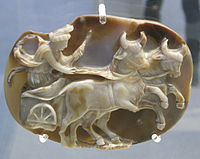
-
 Polychrome tauroctony relief, with Luna driving her ox-drawn biga (right), and the Sun his four-horse chariot (late 3rd century)
 -
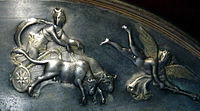 Ox-drawn biga of Luna on the Parabiago plate (2nd–5th century AD)
 -


.jpg)

.jpg)


See also[edit]
References[edit]
- ^ Evans, James (1998). The History and Practice of Ancient Astronomy. Oxford University Press. pp. 296–7. ISBN 978-0-19-509539-5. Retrieved 4 February 2008.
- ^ C.M.C. Green, Roman Religion and the Cult of Diana at Aricia (Cambridge University Press, 2007), p. 73.
- ^ Horace, Carmen Saeculare, lines 33–36.
- ^ Varro, frg. 23 (Cardauns) = Tertullian, Ad nationes 2.2.14–2-; Attilio Mastrocinque, "Creating One's Own Religion: Intellectual Choices," in A Companion to Roman Religion, p. 383.
- ^ Jörg Rüpke, Religion of the Romans, p. 133.
- ^ William Van Andringa, "Religion and the Integration of Cities in the Empire in the Second Century AD: The Creation of a Common Religious Language," in A Companion to Roman Religion (Blackwell, 2007), p. 94.
- ^ Annemarie Kaufmann-Heinimann, "Religion in the House", in A Companion to Roman Religion, p. 188.
- ^ Varro, De re rustica 1.1.4–6.
- ^ Vergil, Georgics 1.5–25.
- ^ Varro, as preserved by Augustine of Hippo, De Civitate Dei 7.2.
- ^ Varro, De lingua latina 5.74; Dionysius of Halicarnassus 2.50.3.
- ^ Orosius 5.12.3–10; De Vir. Ill. 65; Lawrence Richardson, A New Topographical Dictionary of Ancient Rome (Johns Hopkins University Press, 1992), p. 238.
- ^ Ovid, Fasti 3.883–84; Richardson, A New Topographical Dictionary, p. 238.
- ^ Livy 40.2.2; Richardson, A New Topographical Dictionary, p. 238.
- ^ Appian, Bellum Civile 1.78.
- ^ Tacitus, Annales 15.41; Richardson, A New Topographical Dictionary, p. 238.
- ^ Varro, De lingua latina 5.68; Richardson, A New Topographical Dictionary, p. 238.
- ^ Green, Roman Religion and the Cult of Diana, p. 73.
- ^ Varro, De lingua latina 6.27.
- ^ Green, Roman Religion and the Cult of Diana, p. 73.
- ^ Isidore, Etymologies 18.26, as translated by Stephen A. Barney et al., The Etymologies of Isidore of Seville (Cambridge University Press, 2006), p. 368 online.
- ^ M.J. Vermaseren, Mithraica I: The Mithraeum at S. Maria Capua Vetere (Brill, 1971), pp. 14–15; Plato, Phaedrus 246.
- ^ Prudentius, Contra Symmachum 733 (Migne); Friedrich Solmsen, "The Powers of Darkness in Prudentius' Contra Symmachum: A Study of His Poetic Imagination," Vigiliae Christianae 19.4 (1965), p. 248.
- ^ Servius, note to Aeneid 6.118.
- ^ Hesiod, Theogony 413f.
External links[edit]
 Media related to Luna (mythology) at Wikimedia Commons
| Deities (Dii Consentes) |  | |
|---|---|---|
| Legendary figures | ||
| Legendary beings | ||
| Texts | ||
| Concepts and practices | ||
| Philosophy | ||
| Events | ||
| Objects | ||
| Variations | ||
| See also | ||
| International | |
|---|---|
| National | |
