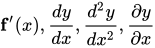
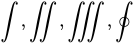
Modern Arabic mathematical notation is a mathematical notation based on the Arabic script, used especially at pre-university levels of education. Its form is mostly derived from Western notation, but has some notable features that set it apart from its Western counterpart. The most remarkable of those features is the fact that it is written from right to left following the normal direction of the Arabic script. Other differences include the replacement of the Greek and Latin alphabet letters for symbols with Arabic letters and the use of Arabic names for functions and relations.
It is written from right to left following the normal direction of the Arabic script. Other differences include the replacement of the Latin alphabet letters for symbols with Arabic letters and the use of Arabic names for functions and relations.
The notation exhibits one of the very few remaining vestiges of non-dotted Arabic scripts, as dots over and under letters (i'jam) are usually omitted.
Letter cursivity (connectedness) of Arabic is also taken advantage of, in a few cases, to define variables using more than one letter. The most widespread example of this kind of usage is the canonical symbol for the radius of a circle نق (Arabic pronunciation:[nɑq]), which is written using the two letters nūn and qāf. When variable names are juxtaposed (as when expressing multiplication) they are written non-cursively.
Notation differs slightly from region to another. In tertiary education, most regions use the Western notation. The notation mainly differs in numeral system used, and in mathematical symbols used.
Written numerals are arranged with their lowest-value digit to the right, with higher value positions added to the left. That is identical to the arrangement used by Western texts using Hindu-Arabic numerals even though Arabic script is read from right to left. The symbols "٫" and "٬" may be used as the decimal mark and the thousands separator respectively when writing with Eastern Arabic numerals, e.g. ٣٫١٤١٥٩٢٦٥٣٥٨3.14159265358, ١٬٠٠٠٬٠٠٠٬٠٠٠1,000,000,000. Negative signs are written to the left of magnitudes, e.g. ٣−−3. In-line fractions are written with the numerator and denominator on the left and right of the fraction slash respectively, e.g. ٢/٧2/7.
From the Arabic letterاʾalif; a and اʾalif are the first letters of the Latin alphabet and the Arabic alphabet's ʾabjadī sequence respectively, and the letters also share a common ancestor and the same sound
ٮ
A dotlessبbāʾ; b and بbāʾ are the second letters of the Latin alphabet and the ʾabjadī sequence respectively
حــــ
From the initial form of حḥāʾ, or that of a dotless جjīm; c and جjīm are the third letters of the Latin alphabet and the ʾabjadī sequence respectively, and the letters also share a common ancestor and the same sound
د
From the Arabic letter دdāl; d and دdāl are the fourth letters of the Latin alphabet and the ʾabjadī sequence respectively, and the letters also share a common ancestor and the same sound
س
From the Arabic letter سsīn. It is contested that the usage of Latin x in maths is derived from the first letter شšīn (without its dots) of the Arabic word شيءšayʾ(un)[ʃajʔ(un)], meaning thing.[1] (X was used in old Spanish for the sound /ʃ/). However, according to others there is no historical evidence for this.[2][3]
From كجمkāf-jīm-mīm. In some regions alternative symbols like (كغkāf-ġayn) or (كلغkāf-lām-ġayn) are used. All three abbreviations are derived from كيلوغرامkīlūġrām "kilogram" and its variant spellings.
From سsīn, which is in turn derived from the second word of درجة سيلسيوسdarajat sīlsīūs "degree Celsius"; also (°م) from مmīmʾ, which is in turn derived from the first letter of the third word of درجة حرارة مئوية "degree centigrade"
The letter (زzayn, from the first letter of the second word of دالة زائدية "hyperbolic function") is added to the end of trigonometric functions to express hyperbolic functions. This is similar to the way is added to the end of trigonometric functions in Latin-based notation.
^Cajori, Florian (1993). A History of Mathematical Notation. Courier Dover Publications. pp. 382–383. ISBN9780486677668. Retrieved 11 October 2012. Nor is there historical evidence to support the statement found in Noah Webster's Dictionary, under the letter x, to the effect that 'x was used as an abbreviation of Ar. shei (a thing), something, which, in the Middle Ages, was used to designate the unknown, and was then prevailingly transcribed as xei.'
^Oxford Dictionary, 2nd Edition. There is no evidence in support of the hypothesis that x is derived ultimately from the mediaeval transliteration xei of shei "thing", used by the Arabs to denote the unknown quantity, or from the compendium for L. res "thing" or radix "root" (resembling a loosely-written x), used by mediaeval mathematicians.





 hē.
hē.


 (كغ kāf-ġayn) or
  (كلغ kāf-lām-ġayn) are used. All three abbreviations are derived from كيلوغرام kīlūġrām "kilogram" and its variant spellings.


 (كلم kāf-lām-mīm) in some regions; both are derived from كيلومتر kīlūmitr "kilometer".


 (ٯ, i.e. dotless ق qāf) in some regions


 (°م) from م mīmʾ, which is in turn derived from the first letter of the third word of درجة حرارة مئوية "degree centigrade"


 (∑, a mirrored summation sign ∑) in some regions


 ( ں! ) in some regions

.PNG) ( ل(ں، ر) ) is used in some regions as
( ل(ں، ر) ) is used in some regions as

.PNG) ( ٯ(ں، ك) ) is used in some regions as and
( ٯ(ں، ك) ) is used in some regions as and .PNG) (ں
(ں
![{\displaystyle {\sqrt[{n}]{\,\,\,}}}](https://wikimedia.org/api/rest_v1/media/math/render/svg/120b39c33ede4f10eea426aff1d0840e1ade1ae3)


 (جب jīm-bāʾ) is used in some regions (e.g. Syria); Arabic for "sine" is جيب jayb

 (تجب tāʾ-jīm-bāʾ) is used in some regions (e.g. Syria); Arabic for "cosine" is جيب تمام

 (ظل ẓāʾ-lām) is used in some regions (e.g. Syria); Arabic for "tangent" is ظل ẓill

 (تظل tāʾ-ẓāʾ-lām) is used in some regions (e.g. Syria); Arabic for "cotangent" is ظل تمام


 (ز zayn, from the first letter of the second word of دالة زائدية "hyperbolic function") is added to the end of trigonometric functions to express hyperbolic functions. This is similar to the way is added to the end of trigonometric functions in Latin-based notation.


.PNG)