


Name of the Czech Republic


The Czech Republic's official long and short names at the United Nations are Česká republika and Česko in Czech, and the Czech Republic and Czechia in English.[1] All these names derive from the name of the Czechs, the West Slavic ethnolinguistic group native to the Czech Republic. Czechia (/ˈtʃɛkiə/), the official English short name specified by the Czech government, is used by many international organisations.
Attested as early as 1841,[2] then, for example in 1856[3] or 1866,[4] the word Czechia and the forms derived from it are always used by the authors synonymously with the territory of Bohemia (Kingdom of Bohemia at that time).[5]
The Czech name Čechy is from the same root but means Bohemia, the westernmost and largest historical region of modern Czechia. The name Bohemia is an exonym derived from the Boii, a Celtic tribe inhabiting the area before the early Slavs arrived. The Lands of the Bohemian Crown (1348–1918) were part of the Holy Roman Empire; often called "the Czech lands", they sometimes extended further, to all of Silesia, Lusatia, and various smaller territories. The Czech adjective český means both "Czech" and "Bohemian".
The Czech Republic's official formal and short names in Czech were decided at its creation after the dissolution of Czechoslovakia in 1992.[6][7][8][9][10][11]
Czech-language name[edit]
The country is named after the Czechs (Czech: Češi), a Slavic tribe residing in central Bohemia that subdued the surrounding tribes in the late 9th century and created the Czech/Bohemian state. The origin of the name of the tribe itself is unknown. According to legend, it comes from their leader Čech, who brought them to Bohemia. Research regards Čech as a derivative of the root čel- (member of the people, kinsman).[12]
Several variants of the name have been used over the centuries, due to the evolution of the Czech language. The digraph "cž" was used from the time of the 16th-century Bible of Kralice until the reform of 1842, being eventually replaced by "č" (changing Cžechy to Čechy). In the late 19th century the suffix for the names of countries changed from -y to -sko (e.g. Rakousy → Rakousko for Austria, Uhry → Uhersko for Hungary). While the notion of Česko appears for the first time in 1704, it only came into official use in 1918 as the first part of the name of the newly independent Czechoslovakia (Česko-Slovensko or Československo) . Within that state, the Czech Socialist Republic (Česká socialistická republika, ČSR)[9] was created on 1 January 1969.[13] On 6 March 1990 the Czech Socialist Republic was renamed the Czech Republic (Česká republika, ČR).[14] When Czechoslovakia broke up in 1993, the Czech part of the name was intended to serve as the name of the Czech state. The decision started a dispute as many perceived the "new" word Česko, which before had been only rarely used alone, as harsh sounding or as a remnant of Československo.[15] The older term Čechy was rejected by many because it was primarily associated with Bohemia proper and to use it for the whole country was seen as inappropriate. This feeling was especially prominent among the inhabitants of Moravia.[citation needed]
The use of the word "Česko" within the country itself has increased in recent years.[citation needed][note 1] During the 1990s, "Česko" was rarely used and viewed as controversial. Some Czech politicians and public figures (e.g. media magnate Vladimír Železný) expressed concern about the non-use of Česko and Czechia.[citation needed] Václav Havel claimed that "Slugs crawl on me a little whenever I read or hear the word [Česko]." In 1997, the Civic Initiative Czechia was formed by linguists and geographers in Brno to promote the use of Czechia.[16] The following year, a conference of professionals aimed at encouraging the use of the name was held at Charles University in Prague. The Czech Senate held a session on the issue in 2004.[17][18]
English-language name[edit]
The historical English name of the country is Bohemia, derived ultimately from Germanic Boi-haima, meaning "home of the Boii", a Celtic tribe who inhabited the area from the 4th century BC. The name survived all the later migrations affecting the area, including the arrival of the Slavs and the creation of the Czech state. In the 9th century, the country became officially known as the Duchy of Bohemia, changing to the Kingdom of Bohemia in the 11th century, and the Crown of Bohemia in the 14th century. The Bohemian state included the three historical lands: Bohemia proper (Čechy), Moravia (Morava) and Silesia (Slezsko). From the 14th century until 1635 it also included Upper and Lower Lusatia. The higher hierarchical status of the Bohemian region led to that name being used for the larger country (a linguistic device called pars pro toto), and the people and language of that country were referred to as Bohemian in English until the early 20th century. A number of other names for the country have been used, including Lands of the Bohemian Crown, Czech/Bohemian lands, Bohemian Crown, the lands of the Crown of Saint Wenceslas and others.[19][20]
The first known usage of the word Czechia in English comes from a book of 1841 by Henry and Thomas Rose, A New General Biographical Dictionary Projected and Partly Arranged.[21][19]
Shortly before the disintegration of the Austro-Hungarian empire, there were proposals to use the traditional name Bohemia for the newly formed state.[22] However, out of consideration for Slovak national aspirations, the name "Czecho-Slovakia" (later "Czechoslovakia") was adopted instead.
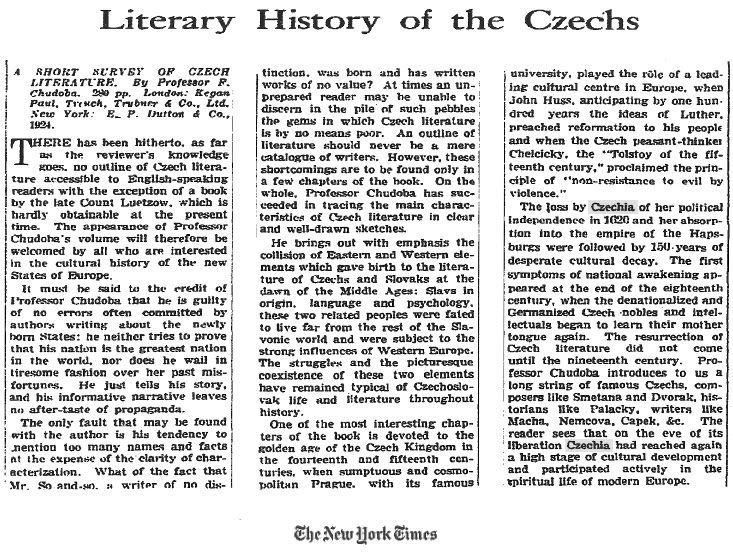
After the establishment of Czechoslovakia, the name Czechia appeared in English, alongside the official name, as a reference to all the Czech lands[23] and to differentiate between the Czech and Slovak parts of the state. It was used at least as early as 4 January 1925; appearing in the article "Literary History of the Czechs", published by The New York Times.[24] The name was used in the Anglophone press before the German occupation of the Czech lands in 1939.[25][26][27][28]
The current English ethnonym "Czech" comes from the Czech ethnonym associated with the area spelled historically as "Cžech" until the reform of 1842, possibly influenced by Latin "Czechus", or the Polish spelling "Czech".[29][30][31] The words "Czechian", "Czechish", "Czechic" and later "Czech" (using antiquated Czech spelling)[19] have appeared in English-language texts since the 17th century. During the 19th-century national revival, the word "Czech" was also used to distinguish between the Czech- and German-speaking peoples living in the country. The term "Czechia" is attested as early as 1569 in Latin[19] and 1841 in English (Poselkynie starych Przjbiehuw Czeskych – Messenger of the old Fates of Czechia).[21][19] There were other early mentions in 1856[32] and in an 1866 report on the Austro-Prussian War.[33]
Latin-language name[edit]

Although in Latin the Bohemian lands (three historical regions of Bohemia (Čechy), Moravia (Morava), and Silesia (Slezsko) were referred to by the collective name Bohemia, based on the fact that they were part of the whole "Corona regni Bohemiae" (Bohemian Crown), in the first half of the 16th century Bohemia (proper) was referred to as Czechia, the first historically documented record of which can be found in the Chronicle of Bohemia (Kronyka Czeska) of Václav Hájek z Libočan in 1541. (Václav Hájek did not use the term in the Latin text, but in the Czech text; he replaced the present letter Č with the then-existing digraph Cž, i.e. Cžechya.[34]
In the second half of the 16th century the name Czechia began to be commonly used in Latin and in 1598 Czechia was listed in the Bohemian(Czech)-Latin-Greek-German dictionary published by Daniel Adam z Veleslavína.[35]
Furthermore, the designation Czechia is mentioned, for example, by Pavel Stránský ze Záp in his work Respublica Bojema from 1634, who mentions it already in his first chapter De situ qualitatibusque Bojemiae: "Europaei orbis ea regio, quam (quemadmodum Chorographis placet) inter longitudinis gradum trigesimum quartum et quintum aliquanto ultra trigesimum octavum, et inter latitudinis gradum quadragesimum octavum et nonum ad quinquagesimum primum, gens mea colit, usitato jam nomine Bojemia, seu Bohemia, et Boemia, itemque Czechia vocatur.". In Emanuel Tonner's translation, 1893: On the location and nature of the country of Bohemia: "That country in Europe, that part of the world, in which (as geographers teach) according to the longitude between the thirty-fourth and fifth degrees to the thirty-eighth, and according to the latitude between the forty-eighth and ninth degrees to the fifty-first, the Bohemians (Čechové, Czechs, i.e. Czech people) inhabit, my nation, by its usual name, is called Bohemia (Čechy, i.e. Czechia"). The description includes County of Kladsko, which belonged to Bohemia until 1742 (historical territory of Bohemia). Further east from Bohemia is Moravia.[36]
The Latin name was later adopted into English (as well as the common "Bohemia" in the past).
Adoption of Czechia[edit]
In accordance with Resolution No. 4 I. of the UN conference on the standardization of geographic names (Geneva 1967) and Resolution No. 2 III. of the UN conference on the standardization of geographic names (Athens 1977), the Terminological Committee of the Czech Office for Surveying, Mapping, and Cadaster in cooperation with the Czech Ministry of Foreign Affairs nationally standardized Czechia as the English translation of Česko in early 1993.[37] Other names suggested in the 1990s included Czechomoravia or Czechlands.[38]
In 2013, Czech president Miloš Zeman recommended the wider official use of Czechia in English sources,[39] and on 14 April 2016 Czech political leaders endorsed the short name Czechia in English.[40] The short name Czechia was approved by the Czech cabinet on 2 May 2016 and was internationally standardized by being published in the United Nations UNTERM and UNGEGN country name databases on 5 July 2016.[1][7][41][42][43]
In September 2016, the British Permanent Committee on Geographical Names (PCGN) recommended the use of Czechia and added it as the sole form of the country name to their list of country names.[44] On 26 September 2016, the International Organization for Standardization included the short name Czechia in the official ISO 3166 country codes list.[45][46] In November 2016 the Czech Ministry of Foreign Affairs presented recommendations on how to use the short name Czechia in international contexts.[47] On 1 June 2017, the geography department of the Faculty of Sciences of Charles University in Prague organized a special conference to assess the progress of the name's proliferation.[48]
In 2018, the European Union updated its official guidelines and replaced "Czech Republic" with "Czechia" as the short name of the country. The same was done by the Council of Europe.[49]
Multinational technology companies that have adopted the name Czechia include Google,[50] Apple,[51] and Microsoft.[52][53] The business network LinkedIn updated its locations to Czechia in October 2020.[54]
In 2021, the government of the United States started using the form Czechia instead of Czech Republic as the short name for the country.[55]
The International Ice Hockey Federation updated to Czechia in December 2021.[56] On 28 April 2022, a conference of all sports associations was held under the patronage of the Foreign Ministry at the Czernin Palace. Following basketball, ice hockey, baseball, rugby, and association football, which started to use the short name, all remaining sports agreed to transition to the short name Czechia shortly.[57] The Czech Football Association announced the adoption of the names Česko and Czechia on 24 May 2022.[58]
AP Stylebook updated on 1 July 2022 online entry with the following statement: "Czechia, the Czech Republic. Both are acceptable. The shorter name Czechia is preferred by the Czech government. If using Czechia, clarify in the story that the country is more widely known in English as the Czech Republic."[59]
In August 2022, the exception of keeping the long form of the name on the country plates at the United Nations was dropped and Czechia is since then used on name plates at the United Nations.[60]
In September 2022, the UEFA website was updated to Czechia.[61] NATO, the World Bank, FIFA, ISU and the Universal Postal Union switched to Czechia in October 2022.[62][63][64][65][66]
On 1 November 2022, the Czech Olympic Committee requested the International Olympic Committee and European Olympic Committees to enter the name Czechia into their databases of countries for sports competitions. These were both adjusted.[67][68][69]
In January 2023, The Czech Ministry of Tourism updated the website VisitCzechRepublic.com to VisitCzechia.com.[70]
On 10 February 2023, the European Broadcasting Union (EBU), the organisers of the Eurovision Song Contest, began to refer to the country as Czechia with the name being changed on the Eurovision website. This was announced with the release of the Czech entry at the Eurovision Song Contest 2023, upon which the EBU confirmed that the country would be referred to as Czechia at the contest going forward.[71]
The government of Canada adopted the short name Czechia in 2023.[72][73][74] Lonely Planet tour guides began using the name in June 2023.[75] OECD and OSCE adopted Czechia in October 2023.[76][77]
See also[edit]


Notes[edit]
References[edit]
- ^ a b "The Czech Republic". The United Nations Terminology Database. Retrieved 16 June 2023.
- ^ Rose, Hugh James (1841). "A New General Biographical Dictionary, Vol. III, BAH-BEE".
- ^ "Notes and Queries: Medium of Inter-Communication for Literary Men, Artists, Antiquaries, Genealogists, etc. Second Series, Volume Second, July-December, 1856". 1856.
- ^ "Latest from Prussia. The Mercury, page 4, Saturday, 21 July 1866". Mercury. 21 July 1866.
- ^ Beckovský, Jan František (1700). "Poselkyně starých přjběhůw cžeských, aneb, Kronyka cžeska od prwnjho do nyněgssý Země cžeské přjchozu dwauch knjžat charwátských Cžecha y Lecha wlastnjch bratřj až do sstiastného panowánj cýsaře ržjmského, krále cžeského [et] c. Ferdynanda prwnjho wždyckny wjtěze slawného. K rozmnoženj obecného dobrého, k zwelebenj gazyka cžeského, a k prospěchu bližnjho. Djl prwnj w němž se někteřj cyzý přjběhowé nacházegj, kteřj k domácým přináležegjce od nich se odcyzyti nemohli" (in Czech). Praha (Staré Město pražské): Jan Karel Jeřábek. Retrieved 6 January 2023.
- ^ a b Boháč, Pavel; Kolář, Jaroslav (1993). Jména států a jejich územních částí [Names of states and their territorial parts] (in Czech). Praha: Český úřad zeměměřický a katastrální. ISBN 978-8-08691-857-0.
- ^ a b "World Geographical Names database". UNGEGN. 25 April 2019. Retrieved 31 December 2019.
- ^ "Ústava České republiky ze dne 16. prosince 1992" [Constitution of the Czech Republic of 16 December 1992]. Parliament of the Czech Republic (in Czech). Retrieved 10 May 2017.
- ^ a b Knappová, Miloslava (1983). "Česko = Česká socialistická republika". Naše řeč (in Czech). 66 (4): 205–206. Retrieved 10 May 2017.
- ^ "FAQ: Česko". Ústav pro jazyk český (in Czech). Archived from the original on 9 March 2013. Retrieved 31 December 2019.
- ^ "Česko". Internetová jazyková příručka (IJP) [Online language guide] (in Czech). 8 January 2012. Retrieved 31 December 2019.
- ^ Spal, Jaromír (1953). "Původ jména Čech" [Origin of the name Čech]. Naše řeč (Our Speech) (in Czech). 36 (9–10). The Academy of Sciences of the Czech Republic: 263–267. Retrieved 11 October 2012.
- ^ "Ústavní zákon ze dne 27. října 1968 o československé federaci" [Constitutional Act of 27 October 1968 on the Czechoslovak Federation]. Parliament of the Czech Republic (in Czech). Retrieved 10 May 2017.
- ^ "53/1990 Sb. Ústavní zákon České národní rady o změně názvu České socialistické republiky" [53/1990 Sb. Constitutional Act of the Czech National Council on the Change of the Name of the Czech Socialist Republic]. Zákony pro lidi (in Czech). Retrieved 10 May 2017.
- ^ Lazarová, Daniela (13 May 2004). "Looking for a name". Radio Prague. Retrieved 27 January 2011.
- ^ "Česko/Czechia". The Civic Initiative Czechia. Retrieved 10 May 2017.
- ^ "Funkční rozlišování spisovných názvů Česká republika a Česko a jejich cizojazyčných ekvivalentů" [Functional differentiation of literary names Czech Republic and Czechia and their equivalents in foreign languages]. Senate of the Czech Republic (in Czech). 11 May 2004. Retrieved 10 May 2017.
- ^ "Těsnopisecký záznam ze 7. veřejného slyšení Senátu Parlamentu České republiky" [Stenographic record of the 7th public hearing of the Senate of the Parliament of the Czech Republic]. Senate of the Czech Republic (in Czech). 11 May 2004. Retrieved 10 May 2017.
- ^ a b c d e Šitler, Jiří (1 July 2017). "Czechia si to bude muset protrpět" [Czechia will have to endure it]. Lidové noviny (in Czech). Retrieved 6 July 2017 – via PressReader.
- ^ Moryson, Fynes (1908) [1626]. The Itinerary of Fynes Moryson Containing His Ten Yeeres Travell through the Twelve Dominions of Germany, Bohmerland, Sweitzerland, Netherland, Denmarke, Poland, Italy, Turky, France, England, Scotland & Ireland (Volume IV). Glasgow: James MacLehose and Sons. Retrieved 31 December 2019.
- ^ a b Rose, Hugh James; Rose, Henry John; Wright, Thomas (1 January 1841). A New General Biographical Dictionary Projected and Partly Arranged. Fellowes. Retrieved 10 May 2017 – via Google Books.
- ^ Beneš, Edvard (1917). Bohemia's case for independence. London: Allen & Unwin. ISBN 0-405-02734-6.
- ^ Munzar, Jan; Drápela, Milan Václav (1999). "Czechia = Bohemia + Moravia + Silesia". Moravian Geographical Report (in Czech). 7 (2). Brno: Ústav Geoniky: 58–61. Retrieved 31 December 2019 – via Masaryk University.
- ^ "Literary History of the Czechs". The New York Times. 4 January 1925. Retrieved 10 May 2017.
- ^ "Soviet Note to Germany". The New York Times. 20 March 1939. Retrieved 10 May 2017.
- ^ "Saving The Children". The Palestine Post. 28 December 1939. Retrieved 10 May 2017.
- ^ "Dr. Benes Broadcasts To His Countrymen". The Barrier Miner. Broken Hill, New South Wales. 16 March 1940. p. 6. Retrieved 10 May 2017 – via Trove.
- ^ "Search results containing "Czechia"". Chronicling America. Library of Congress. Retrieved 31 December 2019.
- ^ "Czech definition and meaning". Collins English Dictionary. HarperCollins. Retrieved 19 November 2012.
- ^ "Czech". American Heritage Dictionary. Houghton Mifflin Harcourt. Retrieved 24 January 2018.
- ^ "Czech - Definition in English". Oxford English Dictionary. Oxford University. Archived from the original on 12 April 2018. Retrieved 11 April 2018.
Origin Polish spelling of Czech Čech.
- ^ "Replies to Minor Queries". Notes and Queries. II (27). Oxford University Press: 20. July 1856. Retrieved 31 December 2019.
- ^ "Latest From Prussia". The Mercury. Hobart, Tasmania. 21 July 1866. p. 4. Retrieved 10 May 2017 – via Trove.
- ^ Hájek z Libočan, Václav (1819). Kronyka Czeská (reprint). Brno: Rytijrž Jan Ferdynand z Ssenfeldu.
- ^ Šitler, Jiří (2 July 2017). "Czechia si to bude muset protrpět". Lidové noviny - Orientace (in Czech). pp. 1, 20.
- ^ Mistra Pavla Stránského ze Zapské Stránky poopravené i rozmnožené vypsání vší obce království českého. Z latiny přeložil, životopisem Stránského a mnohými poznámkami opatřil Emanuel Tonner. Praha: V Praze Tiskem J. Otty. 1893. p. 1.
- ^ Čižmárová, Libuše (1993). "K peripetiím vývoje názvů našeho státu a postojů k nim od roku 1918 (Příspěvek k 80. výročí vzniku Československé republiky)". Naše řeč (in Czech). 82 (1): 1–15.
- ^ Rocks, David (10 May 1998). "After 5 Years, Czech Republic Still Searching for a Short Name". Chicago Tribune. Archived from the original on 7 January 2017. Retrieved 31 December 2019.
- ^ McDonald-Gibson, Charlotte (11 October 2013). "What's in a name? Czech Republic mulls shock rebranding as Czechia". The Independent. Retrieved 10 May 2017.
- ^ "Czechia: Czech Republic leaders approve plan to change country's name". The Independent. 14 April 2016. Archived from the original on 18 June 2022. Retrieved 4 June 2022.
- ^ "Short country name "Česko"/"Czechia" to be entered in UN databases". Ministry of Foreign Affairs. 21 April 2016. Retrieved 31 December 2019.
- ^ "Vláda schválila doplnení jednoslovného názvu Cesko v cizích jazycích do databází OSN" [The government has approved the addition of one-word Czech name in foreign languages to UN databases]. Ministerstvo zahraničních věcí České republiky (in Czech). 2 May 2016. Retrieved 28 August 2018.
- ^ Tapon, Francis (22 May 2017). "Czechia Has Won The Czech Republic Name Debate". Forbes. Retrieved 31 December 2019.
- ^ "Czechia: New English-language country name for the Czech Republic" (PDF). Permanent Committee on Geographical Names. September 2016. Retrieved 31 December 2019.
- ^ "CZ: ISO 3166 codes for the representation of names of countries and their subdivisions". International Organization for Standardization. Retrieved 31 December 2019.
- ^ Laughland, Oliver (14 April 2016). "Czech Republic officials say country would like to be called 'Czechia' instead". The Guardian. Retrieved 31 December 2019.
- ^ "How to Use the Short Country name "Czechia"". Ministry of Foreign Affairs. 11 November 2016. Retrieved 31 December 2019.
- ^ Fraňková, Ruth (8 June 2017). "Czechia: mapping progress one year on". Radio Prague. Retrieved 24 January 2018.
- ^ "Publications Office – Interinstitutional Style Guide – Annex A5 – List of countries, territories and currencies". publications.europa.eu. Retrieved 31 July 2020.
- ^ "A je to "oficiální". Mapy Google začaly Česku říkat Czechia" [And it's "official". Google Maps calls Česko Czechia]. iDNES (in Czech). 20 January 2017. Retrieved 16 September 2019.
- ^ Chan, Sewell (19 April 2018). "Swaziland's King Wants His Country to Be Called eSwatini". The New York Times. Retrieved 31 December 2019.
- ^ "Maps". www.bing.com.
- ^ "Country/region availability and supported languages - Business Central". docs.microsoft.com. 25 January 2024.
- ^ "LinkedIn: Log In or Sign Up". LinkedIn.
- ^ "Czechia - The World Factbook". 26 January 2022. Archived from the original on 26 January 2022. Retrieved 1 January 2024.
- ^ "IIHF Member National Association Czechia". Archived from the original on 7 May 2022. Retrieved 7 May 2022.
- ^ "Czechia vs. Czech republic! Co budeme nosit na dresech?". www.olympijskytym.cz (in Czech). Retrieved 30 April 2022.
- ^ "Komuniké ze zasedání VV FAČR ze dne 24. 5. 2022 | FAČR". Fotbal.cz. 24 May 2022. Retrieved 3 June 2022.
- ^ @APStylebook (1 July 2022). "We have a new Stylebook Online entry: Czechia, the Czech Republic.Both are acceptable. The shorter name Czechia is…" (Tweet) – via Twitter.
- ^ "Member States".
- ^ "Czechia". Uefa.com. Retrieved 26 September 2022.
- ^ NATO. "Member countries". NATO. Retrieved 3 October 2022.
- ^ "Czechia | Data".
- ^ "FIFA".
- ^ "Czechia - ISU".
- ^ "Member Countries".
- ^ "Český olympijský výbor požádá o zápis názvu Czechia do mezinárodní sportovní databáze".
- ^ "Czechia - International Olympic Committee".
- ^ "Czechia - European Olympic Committee". 11 October 2016.
- ^ "VisitCzechia". 6 February 2024.
- ^ "Czechia - Eurovision.tv".
- ^ "Canada and Czechia". 22 July 2021.
- ^ "Travel advice and advisories for Czechia". 16 November 2012.
- ^ "Canada-Czechia relations". 20 May 2020.
- ^ "Prague & Czechia".
- ^ https://www.oecd.org/czech/
- ^ "Participating States".
External links[edit]

- "Otevřený dopis českému olympijskému výboru, českým sportovním svazům, politikům, podnikatelům, médiím apod" [Open letter to the Czech Olympic Foundation, Czech Sports Union, politicians, business people, media, etc."]. National Geographic (in Czech). 7 May 2001. Archived from the original on 27 September 2007.
- Daniela Lazarova (13 May 2004). "Looking for a name". Radio Prague. Retrieved 8 October 2021.
- Leoš Jeleček (1999). "Česko versus Czechy? On the geographic name of the Czech Republic". Archived from the original on 7 August 2011.
- Jiří Šitler (12 July 2016). "From Bohemia to Czechia". Radio Prague. Retrieved 8 October 2021.
- Which form of the country's name, “Czechia” or “the Czech Republic”, is preferred for international use, and in what contexts should each be applied?, 2024 recommendations from the Ministry of Foreign Affairs of the Czech Republic