


Niavaran Complex
| Niavaran Complex | |
|---|---|
 The Niavaran mansion. | |
| Type | Historic house, memorial |
| Location | Shemiran (northern Tehran), Iran |
| Coordinates | 35°48′43″N 51°28′21″E / 35.8120°N 51.4725°E |
| Built | 1772 |
| Restored by | Mohammad Reza Nikbakht |
| Governing body | Cultural Heritage Organization of Iran |
The Niavaran Palace Complex (Persian: مجموعه کاخ نیاوران – Majmue-ye Kākh-e Niāvarān) is a historical palace complex situated in Shemiran (northern Tehran), Iran. It consists of several palace buildings and monuments dating back to the Qajar and Pahlavi eras.[1]
History
[edit]During the reign of the Pahlavi Dynasty, a new palace named Niavaran was built for the imperial family of Mohammad Reza Shah (1919–1980). The palace was designed in 1958 and completed in 1967. It served a variety of purposes for the imperial court including as a home for the Shah and Empress as well a place to entertain visiting foreign heads of state. On New Year's Eve 1977, the reception and state banquet for US President Jimmy Carter took place here.[2]
The Shah and Empress left basically everything behind when they left Iran in January 1979. All of the peripheral buildings of the Saheb Qaranie, with the exception of the Ahmad Shahi Pavilion, were demolished, and the present-day structures were built to the north of the Saheb Qaranie. The Ahmad Shahi Pavilion was then used as an exhibition centre for presents from world leaders to the Iranian imperial monarchs.[1]
Private library
[edit]The library was publicly inaugurated in 1994, on the occasion of International Museum Day.[3]
Construction
[edit]The interior designing of the library was designed by architect Aziz Farmanfarmayan.
Features
[edit]The building is allocated to libraries in three separate levels; the reading room, the main library, and the audio visual room. Other sections of the library include sets of artwork, which number over 350. The works reflect parts of modern art history, particularly the modern tendencies of Iranian art in the 1950s and 1960s.
Gallery
[edit]-
 Books
Books -
 The first floor
 -
 Book shelves and glassy cylindrical ceiling
 -
 The first floor
 -
 Another view of inside the library
 -
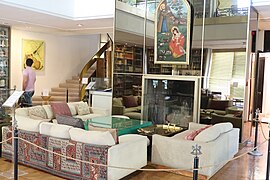 Another view of inside the library
.jpg)
.jpg)
.jpg)
.jpg)


Gallery
[edit]
-
-

-
 The Imperial office of the Shah within the Saheb Qaranie.
 -
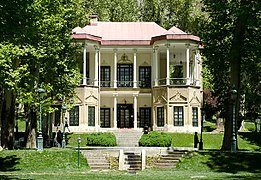
 Area in front of the Niavaran Mansion.
 -
 The gate of the Niavaran Mansion.
 -
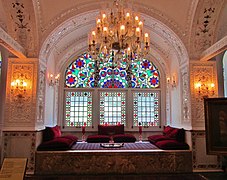 Inside the Niavaran Mansion.
 -
 Inside the Niavaran Mansion.
 -
 Inside the Niavaran Mansion.
 -
 Inside the Niavaran Mansion.
 -
 Inside the Niavaran Mansion.
 -
 Inside the Niavaran Mansion
 -

-
 Inside the Ahmad Shahi Pavilion.
 -
 Area in front of the Pavilion.
 -

-
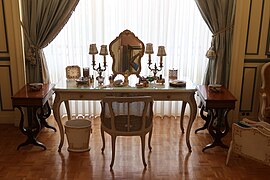 Farah Pahlavi's dressing table
 -
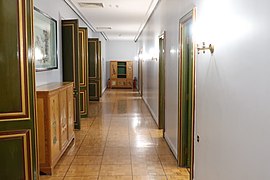 Corridor to private rooms in Niavaran Palace
 -
 Interior of Alireza Pahlavi's room
 -
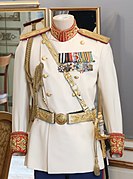 Mohammad Reza Pahlavi's dress in Niavaran Palace
 -
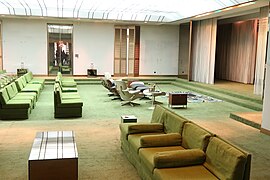 Cinema inside the Niavaran Mansion


See also
[edit]References
[edit]- ^ a b Niavaran Cultural Historic Complex: History Archived 31 January 2016 at the Wayback Machine (in Persian)
- ^ "8 Handshakes That Changed History: Jimmy Carter - Shah of Iran". RealClearPolitics. 21 April 2009.
- ^ http://oldregion1.tehran.ir/Default.aspx?PageContentMode=1&tabid=21548 [permanent dead link] Niavaran Cultural – Historical Complex/Private Library, 25 April 2011
External links
[edit]
