


Ossip Zadkine
Ossip Zadkine | |
|---|---|
 Zadkine in 1914 | |
| Born | Yossel Aronovich Tsadkin 28 January 1888 |
| Died | 25 November 1967 (aged 79) Paris, France |
| Resting place | Cimetière Montparnasse |
| Known for | Sculpture, painting, lithography |
| Movement | Cubism, Art Deco, School of Paris |
Ossip Zadkine (Russian: Осип Цадкин; 28 January 1888 – 25 November 1967) was a Russian-French artist of the School of Paris.[1] He is best known as a sculptor, but also produced paintings and lithographs.[2]
Early years and education[edit]
Zadkine was born on 28 January 1888 as Yossel Aronovich Tsadkin (Russian: Иосель Аронович Цадкин) in the city of Vitsebsk, Russian Empire (now Belarus).[3][4] He was born to a baptized Jewish father and a mother named Zippa-Dvoyra, who he claimed to be of Scottish origin.[5] Archival materials state that Iosel-Shmuila Aronovich Tsadkin was of Jewish faith and studied in the Vitebsk City Technical School between 1900 and 1904, including two years in one class with would-be artists Marc Chagall (then Movsha Shagal) and Victor Mekler (then Avigdor Mekler). Archival materials contradict Zadkine himself and states that his father did not convert to the Russian Orthodox religion and his mother was not of a Scottish extraction.[6] He had 5 siblings: sisters Mira, Roza and Fania and brothers Mark and Moses.
At the age of fifteen, Zadkine was sent by his father to Sunderland to learn English and "good manners". He then moved to London and attended lessons at the Regent Street Polytechnic where he considered the teachers to be too conservative.[7]
Zadkine settled in Paris in 1910. He studied at the École des Beaux-Arts for six months. In 1911 he lived and worked in La Ruche. While in Paris he joined the Cubist movement, working in a Cubist idiom from 1914 to 1925. He later developed his own style, one that was strongly influenced by African and Greek art.[8]
Career[edit]
In 1921 he obtained French citizenship.[5] Zadkine served as a stretcher-bearer in the French Army during World War I, and was wounded in action. He spent World War II in the US. His best-known work is probably the sculpture The Destroyed City (1951–1953), representing a man without a heart, a memorial to the destruction of the center of the Dutch city of Rotterdam in 1940 by the Nazi-German Luftwaffe.[9]
He taught sculpture classes at Académie de la Grande Chaumière until 1958, students of his included artists Geula Dagan (1925–2008), Gunnar Aagaard Andersen and Genevieve Pezet.[10]
Death and legacy[edit]
Zadkine died in Paris in 1967 at the age of 79 after undergoing abdominal surgery[9] and was interred in the Cimetière du Montparnasse.
Museums[edit]
His former home and studio in Montparnasse is now the Musée Zadkine.[11] When his former wife Prax died, she donated the house and art studio to the City of Paris for the formation of Musée Zadkine.[11]
There is also a Musée Zadkine in the village of Les Arques in the Midi-Pyrénées region of France. Zadkine lived in Les Arques for a number of years, and while there, carved an enormous Christ on the Cross and Pieta that are featured in the 12th-century church which stands opposite the museum.
Personal life[edit]
In August 1920, Zadkine married Valentine Prax (1897–1981), an Algerian-born painter of Sicilian and French-Catalan descent.[12][13] Prax and Zadkine had no children.[14]
Zadkine was a neighbor in Montparnasse and a friend of Henry Miller and was represented by the character "Borowski" in Miller's novel, Tropic of Cancer (1934).[11][15][16] His other neighbors there included Chaïm Soutine, and Tsuguharu Foujita.[11]
While living in Manhattan during wartime from 1942 to 1945, Zadkine had a relationship with American artist Carol Janeway[17] and created several portraits of her.[18]
The artist's only child, Nicolas Hasle (born 1960), was born after an affair with a Danish woman, Annelise Hasle.[19] Since 2009, Hasle, a psychiatrist, who had been acknowledged by the artist and had his parentage legally established in France in the 1980s, has been party to a lawsuit with the City of Paris to establish his claim to his father's estate.[20][19][21]
Awards[edit]
- 1950 Venice Biennale sculpture prize[22]
- 1961 Grand Prix National des Arts[22]
Legacy[edit]
Gallery[edit]
-
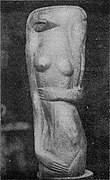 Maternité, 1913, painted elmwood, 81 cm, exhibited at the 1914 Salon des Indépendants, Paris, Published in Montjoie, 1914
 -
 Femme au violon (Woman with a Violin), 1918 photograph by Pierre Choumoff
 -
 Venus, 1920, published in Action: Cahiers individualistes de philosophie et d'art, Volume 1, Number 4, July 1920
 -
 Prometheus, c. 1930–1940, wooden sculpture
 -
 The prisoners (Die Gefangenen), 1943, bronze sculpture
 -
![The Destroyed City (De Verwoeste Stad), 1951–53, bronze sculpture in Rotterdam, which is now a registered monument.[24]](//upload.wikimedia.org/wikipedia/commons/thumb/3/3f/Rotterdam_zadkine_monument.jpg/129px-Rotterdam_zadkine_monument.jpg) The Destroyed City (De Verwoeste Stad), 1951–53, bronze sculpture in Rotterdam, which is now a registered monument.[24]
The Destroyed City (De Verwoeste Stad), 1951–53, bronze sculpture in Rotterdam, which is now a registered monument.[24] -
 Orpheus, 1956, bronze sculpture
 -
 Lotophage, 1961–62, bronze sculpture, Tel Aviv Museum of Art, Tel Aviv
 -
 Vincent and Theo van Gogh, 1963–64, bronze sculpture, in Zundert, The Netherlands
 -
 Bas-relief of the Blomme House in Brussels representing the architect's instruments

.jpg)


.jpg)
![The Destroyed City (De Verwoeste Stad), 1951–53, bronze sculpture in Rotterdam, which is now a registered monument.[24]](/wiki/File:Rotterdam_zadkine_monument.jpg)


Public collections[edit]
Among the public collections holding works by Ossip Zadkine are:
- Los Angeles County Museum of Art, Los Angeles
- Musée Zadkine, Paris
- Museum de Fundatie, Zwolle, Netherlands
- Museum of Modern Art, New York City
- National Gallery of Art, Washington, D.C.
- Tate Gallery, London
- Tel Aviv Museum of Art, Israel
- Van Abbemuseum, Eindhoven, Netherlands
See also[edit]
References[edit]
- ^ "Ossip ZADKINE". Bureau d’art Ecole de Paris. 5 January 2019. Retrieved 26 November 2023.
- ^ Zadkine Research Center
- ^ "Une enfance en Russie". paris.fr. 19 March 2013.
- ^ "Людмила Хмельницкая. Витебское окружение Марка Шагала". chagal-vitebsk.com.
- ^ a b Ossip Joselyn Zadkine Facts, YourDictionary
- ^ "Александр Лисов. Цадкин и Витебск". chagal-vitebsk.com.
- ^ "Ossip Zadkine, 1888–1967". Sculpture International Rotterdam.
- ^ "La source grecque, l'enracinement d'une "terre"". paris.fr. 14 May 2012.
- ^ a b "Sculptor Dies". The Age. 27 November 1967. Archived from the original on 15 January 2013. Retrieved 20 April 2010.
- ^ Hauer, Caroline (20 March 2019). "Paris: Le Messager, une oeuvre monumentale d'Ossip Zadkine – Quai d'Orsay – VIIème". Paris la Douce (in French). Retrieved 12 June 2020.
- ^ a b c d "Musée Zadkine". Artist's Studio Museum Network. Retrieved 12 June 2020.
- ^ Birnbaum, Paula J. (2017). Women Artists in Interwar France: Framing Femininities. Routledge. p. 130. ISBN 9781351536714.
- ^ Wolpert, Martin; Winter, Jeffrey (2004). Modern Figurative Paintings: The Paris Connection. Schiffer Publishing. ISBN 9780764319624.
- ^ Prax, Valentine Henriette. 2011. doi:10.1093/benz/9780199773787.article.b00145672.
{{cite book}}:|work=ignored (help) - ^ "Musée Zadkine". Walking Paris with Henry Miller. Archived from the original on 4 March 2016.
- ^ Frederick Turner: Renegade: Henry Miller and the Making of "Tropic of Cancer", Yale University Press, 2012.
- ^ Jenssen, Victoria (2022). The Art of Carol Janeway: A Tile & Ceramics Career with Georg Jensen Inc. and Ossip Zadkine in 1940s Manhattan. Friesen Press. ISBN 9781039130869.
- ^ Art, Philadelphia Museum of. "Philadelphia Museum of Art - Collections Object : Carol Janeway with Zadkine Sculpture". philamuseum.org. Retrieved 13 April 2017.
- ^ a b "Paris Must Justify Right To Sculptor Ossip Zadkine's Estate". Artforum.com. 31 March 2011. Retrieved 12 June 2020.
- ^ "The Art Newspaper". theartnewspaper.com.
- ^ "Ossip Zadkine: Who Owns the Sculptor's Estate?". Center for Art Law. 3 April 2011. Retrieved 12 June 2020.
- ^ a b "Ossip Zadkine – Obituary". The Montreal Gazette. 27 November 1967. Retrieved 20 April 2010.
- ^ Zadkine college
- ^ Rijksmonumenten
- Czwiklitzer, Christophe, Ossip Zadkine, le sculpteur-graveure de 1919 à 1967, Paris, Chez l'auteur, 1967.
- Yamanashi Kenritsu Bijutsukan, Ossip Zadkine, Tokyo, Yomiuri Shinbunsha, 1989.
- Andreas Weiland, "(Re-)Discovering Zadkine", in: Art in Society, issue # 10
External links[edit]


- Zadkine Research Center
- Works by or about Ossip Zadkine at Internet Archive
- Zadkine Museum in Paris
- Zadkine Museum in Les Arques
- Ossip Zadkine in American public collections, on the French Sculpture Census website

| International | |
|---|---|
| National | |
| Artists | |
| People | |
| Other | |
- 1888 births
- 1967 deaths
- 20th-century Russian sculptors
- 20th-century Russian male artists
- Russian male sculptors
- Modern sculptors
- Jewish sculptors
- Russian Jews
- French people of Belarusian-Jewish descent
- People from the Russian Empire of Scottish descent
- French people of Scottish descent
- Alumni of Chelsea College of Arts
- Burials at Montparnasse Cemetery
- School of Paris
- Emigrants from the Russian Empire to France
- 20th-century French sculptors
- French male sculptors