


Owl Nebula

| Emission nebula | |
|---|---|
| Planetary nebula | |
 Owl Nebula Messier 97 | |
| Observation data: J2000.0 epoch | |
| Right ascension | 11h 14m 47.734s[1] |
| Declination | +55° 01′ 08.50″[1] |
| Distance | 2,030 ly (621 pc)[2] 2,800 ly (870 pc)[3] ly |
| Apparent magnitude (V) | 9.9[4] |
| Apparent dimensions (V) | 3′.4 × 3′.3 |
| Constellation | Ursa Major |
| Physical characteristics | |
| Radius | 0.91 ly (0.28 pc)[5] ly |
| Notable features | Owl-like "eyes" visible through larger telescopes |
| Designations | M97, NGC 3587, PN G148.4+57.0 |
The Owl Nebula (also known as Messier 97, M97 or NGC 3587) is a planetary nebula approximately 2,030 light years away in the constellation Ursa Major.[2] Estimated to be about 8,000 years old,[6] it is approximately circular in cross-section with a faint internal structure. It was formed from the outflow of material from the stellar wind of the central star as it evolved along the asymptotic giant branch.[5] The nebula is arranged in three concentric shells, with the outermost shell being about 20–30% larger than the inner shell.[7] The owl-like appearance of the nebula is the result of an inner shell that is not circularly symmetric, but instead forms a barrel-like structure aligned at an angle of 45° to the line of sight.[5]
The nebula holds about 0.13 solar masses (M☉) of matter, including hydrogen, helium, nitrogen, oxygen, and sulfur;[5] all with a density of less than 100 particles per cubic centimeter.[7] Its outer radius is around 0.91 ly (0.28 pc) and it is expanding with velocities in the range of 27–39 km/s into the surrounding interstellar medium.[5]
The 14th magnitude central star has passed the turning point in its evolution and is condensing to form a white dwarf.[7][8] It has 55–60% of solar mass, is 41 to 148 times solar luminosity (L☉),[5] and has an effective temperature of 123,000 K.[9] The star has been successfully resolved by the Spitzer Space Telescope as a point source that does not show the infrared excess characteristic of a circumstellar disk.[10]
History
[edit]The Owl Nebula was discovered by French astronomer Pierre Méchain on February 16, 1781.[8] Pierre Méchain was Charles Messier's observing colleague, and the nebula was observed by Messier himself a few weeks following the initial sighting.[11] Thus, the object was named Messier 97, and included in his catalog on March 24, 1781.[12] Of the object, he noted:[13][14][15][16]
Nebula in the great Bear, near Beta: It is difficult to see, reports M. Méchain, especially when one illuminates the micrometer wires: its light is faint, without a star. M. Méchain saw it the first time on Feb 16, 1781, & the position is that given by him. Near this nebula he has seen another one, [the position of] which has not yet been determined [Messier 108], and also a third which is near Gamma of the Great Bear [Messier 109]. (diam. 2′).
In 1844, Admiral William H. Smyth classified the object as a planetary nebula.[12][17] When William Parsons, 3rd Earl of Rosse, observed the nebula in Ireland in 1848, his hand-drawn illustration resembled an owl's head. In his notes, the object was described as "Two stars considerably apart in the central region, dark penumbra round each spiral arrangement, with stars as apparent centres of attraction. Stars sparkling in it; resolvable."[18][19] It has been known as the Owl Nebula ever since.[20] More recent developments in the late 1900s include the discovery of a giant red halo of wind extended around its inner shells,[21] and the mapping of the nebula's structure.[17][22][23]
Observing
[edit]Although the Owl Nebula can not be seen with the naked eye, a faint image of it can be observed under remarkably good conditions with a small telescope or 20×80 binoculars. To make out the nebula's more distinctive owl like eye features, a telescope with an aperture 10" or better is required. To locate the nebula in the night sky, look to the southwest corner of the Big Dipper's bowl, marked by the star Beta Ursae Majoris. From there, M97 lies just over 2.5 degrees in the southeast direction towards the star positioned opposite Beta Ursae Majoris in the other bottom corner of the Big Dippers Bowl, Gamma Ursae Majoris; which marks the constellations southwest corner. M97, together with Alpha Ursae Majoris, point the way to Polaris.[24]
Gallery
[edit]-
 HaRGB image of the Owl Nebula M97 from the Liverpool Telescope
 -
 Drawing of the Owl Nebula (M97) by Lord Rosse, who gave the name to the planetary nebula. Source: seds.org
 -
 Location of M97 in Ursa Major
 -
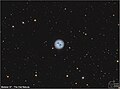 The Owl Nebula (also known as Messier 97, M97 or NGC 3587) - 239 x 60 second exposure.
 -
 Outer O-III shell of M97 in a HOO composition


See also
[edit]References
[edit]- ^ a b Kerber, F.; et al. (September 2003), "Galactic Planetary Nebulae and their central stars. I. An accurate and homogeneous set of coordinates", Astronomy and Astrophysics, 408 (3): 1029–1035, Bibcode:2003A&A...408.1029K, doi:10.1051/0004-6361:20031046.
- ^ a b Stanghellini, Letizia; et al. (December 2008), "The Magellanic Cloud Calibration of the Galactic Planetary Nebula Distance Scale", The Astrophysical Journal, 689 (1): 194–202, arXiv:0807.1129, Bibcode:2008ApJ...689..194S, doi:10.1086/592395, S2CID 119257242.
- ^ Frew, David; et al. (2016), "The Hα surface brightness-radius relation: a robust statistical distance indicator for planetary nebulae", Monthly Notices of the Royal Astronomical Society, 455 (2): 1459–1488, arXiv:1504.01534, Bibcode:2016MNRAS.455.1459F, doi:10.1093/mnras/stv1516, hdl:10722/222005.
- ^ "Messier 97". SEDS Messier Catalog. Retrieved 30 April 2022.
- ^ a b c d e f Cuesta, L.; Phillips, J. P. (November 2000), "Excitation and Density Mapping of NGC 3587", The Astrophysical Journal, 120 (5): 2661–2669, Bibcode:2000AJ....120.2661C, doi:10.1086/316800.
- ^ Per Guerrero et al. (2003), the age is 12,900 × d years, where d is the distance in kpc. According to Stanghellini et al. (2008), d is 0.621 kpc. Hence, the age is 12,900 × 0.621 ≈ 8,000 years.
- ^ a b c Guerrero, Martín A.; et al. (June 2003), "Physical Structure of Planetary Nebulae. I. The Owl Nebula", The Astrophysical Journal, 125 (6): 3213–3221, arXiv:astro-ph/0303056, Bibcode:2003AJ....125.3213G, doi:10.1086/375206, S2CID 16782468.
- ^ a b Jones, Kenneth Glyn (1991), Messierś Nebulae and Star Clusters (2nd ed.), Cambridge University Press, pp. 277–279, ISBN 978-0521370790.
- ^ Capriotti, Eugene R.; Kovach, William S. (March 1968), "Effective Temperatures of the Central Stars of Planetary Nebulae", Astrophysical Journal, 151 (5): 991–995, Bibcode:1968ApJ...151..991C, doi:10.1086/149498.
- ^ Bilíková, Jana; et al. (May 2012), "Spitzer Search for Dust Disks around Central Stars of Planetary Nebulae", The Astrophysical Journal Supplement, 200 (1): 3, Bibcode:2012ApJS..200....3B, doi:10.1088/0067-0049/200/1/3.
- ^ Moore, S. L. (April 2011). "The Owl Nebula - M97". JBAA. 121: 114–115. Bibcode:2011JBAA..121..114M. ISSN 0007-0297.
- ^ a b "Owl Nebula - Messier 97 – Constellation Guide". Retrieved 2020-04-20.
- ^ "Charles Messier's Original Catalog". www.messier.seds.org. Retrieved 2020-04-20.
- ^ Guerrero, Martn A.; Chu, You-Hua; Manchado, Arturo; Kwitter, Karen B. (June 2003). "Physical Structure of Planetary Nebulae. I. The Owl Nebula". The Astronomical Journal. 125 (6): 3213–3221. arXiv:astro-ph/0303056. Bibcode:2003AJ....125.3213G. doi:10.1086/375206. ISSN 0004-6256. S2CID 16782468.
- ^ Kwitter, K. B.; Chu, Y.-H.; Downes, R. A. (1993), "CCD Imaging of Planetary Nebula Halos", Planetary Nebulae, vol. 155, Springer Netherlands, p. 209, Bibcode:1993IAUS..155..209K, doi:10.1007/978-94-011-2088-3_81, ISBN 978-0-7923-2440-9
- ^ Manchado, A.; Guerrero, M.; Kwitter, K. B.; Chu, Y.-H. (December 1992). "A Halo of Red Giant Wind around the Owl Nebula". AAS. 181: 67.04. Bibcode:1992AAS...181.6704M.
- ^ a b "Owl Nebula (M97, NGC 3587)", The Encyclopedia of Astronomy and Astrophysics, IOP Publishing Ltd, 2001, doi:10.1888/0333750888/5320, ISBN 0-333-75088-8
- ^ O'Meara, Stephen James, 1956- (2007). Steve O'Meara's Herschel 400 observing guide : how to find and explore 400 star clusters, nebulae, and galaxies discovered by William and Caroline Herschel. Cambridge: Cambridge University Press. ISBN 978-0-521-85893-9. OCLC 85829276.
{{cite book}}: CS1 maint: multiple names: authors list (link) CS1 maint: numeric names: authors list (link) - ^ Nasim, Omar W., 1976- (6 January 2014). Observing by hand : sketching the nebulae in the nineteenth century. Chicago: University of Chicago Press. ISBN 978-0-226-08440-4. OCLC 868276095.
{{cite book}}: CS1 maint: multiple names: authors list (link) CS1 maint: numeric names: authors list (link) - ^ Clark, Roger Nelson (1990), Visual Astronomy of the Deep Sky, CUP Archive, ISBN 978-0521361552.
- ^ Bond, H. E. (August 1981). "A giant halo around the planetary nebula NGC 3242". Publications of the Astronomical Society of the Pacific. 93: 429. Bibcode:1981PASP...93..429B. doi:10.1086/130849. ISSN 0004-6280.
- ^ García-Díaz, Ma. T. Steffen, W. Henney, W. J. López, J. A. García-López, F. González-Buitrago, D. Aviles, A. (2018-06-12). The Owl and other strigiform nebulae: multipolar cavities within a filled shell. OCLC 1098137978.
{{cite book}}: CS1 maint: multiple names: authors list (link) - ^ Sabbadin, F.; Bianchini, A.; Ortolani, S.; Strafella, F. (1985-12-01). "The structure of NGC 3587, the Owl nebula". Monthly Notices of the Royal Astronomical Society. 217 (3): 539–549. Bibcode:1985MNRAS.217..539S. doi:10.1093/mnras/217.3.539. ISSN 0035-8711.
- ^ "Messier 97: Owl Nebula – Messier Objects". 25 August 2015. Retrieved 2020-04-20.
External links
[edit]
- The Owl Nebula @ SEDS Messier pages
- The Owl Nebula at Calar Alto Observatory
- NightSkyInfo.com – M97, the Owl Nebula
- The Owl Nebula on WikiSky: DSS2, SDSS, GALEX, IRAS, Hydrogen α, X-Ray, Astrophoto, Sky Map, Articles and images
- Norton, Andy; Crowther, Paul; Hardy, Liam. "M97 – Owl Nebula". Deep Sky Videos. Brady Haran.
- The Owl Nebula (M97) at Constellation Guide
- Messier 97: Owl Nebula at Messier Objects


| List |
|  |
|---|---|---|
| See also | ||


